Sustonit
Poland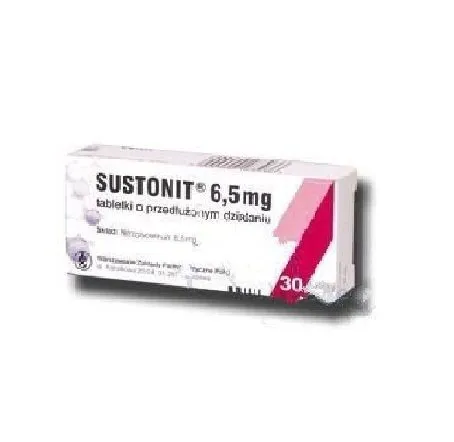
Table of Contents
Package leaflet: Information for the patient
SUSTONIT, 6.5 mg, prolonged-release tablets
Glyceroli trinitras
Please read all of this leaflet carefully before taking this medicine, because it contains
important information for you.
- Keep this leaflet as you may need to read it again.
- If you have any further questions, ask your doctor or pharmacist.
- This medicine has been prescribed for a specific individual. Do not pass it on to others. It may harm them even if their symptoms are the same.
- If you experience any adverse effects, including any not listed in this leaflet, inform your doctor or pharmacist. See section 4.
Leaflet contents
- What Sustonit is and what it is used for
- Important information before taking Sustonit
- How to take Sustonit
- Possible side effects
- How to store Sustonit
- Contents of the pack and other information
1. What Sustonit is and what it is used for
Sustonit contains glycerol trinitrate (nitroglycerin) and is a vasodilator and antianginal agent. It primarily dilates venous vessels and, to a lesser extent, arterial vessels. It reduces the heart's oxygen demand and cardiac workload, thereby improving exercise tolerance and reducing the frequency of angina attacks.
Sustonit is indicated for the prevention of angina attacks in stable angina pectoris.
2. Important information before using Sustonit
When not to use Sustonit:
- if the patient is taking medicines containing sildenafil, vardenafil, or tadalafil; during treatment with glyceryl trinitrate (nitroglycerin), these drugs must not be taken simultaneously;
- if the patient has been diagnosed with angina pectoris caused by hypertrophic cardiomyopathy (a heart disease characterized by thickening of the left ventricle of the heart);
- if the patient is allergic to glyceryl trinitrate, other nitrates, or any of the other ingredients of this medicine (listed in section 6);
- if the patient has severe anemia;
- in patients with head trauma;
- in patients who have suffered hemorrhagic stroke;
- in patients with glaucoma (an eye disease involving progressive damage to the optic nerve, at least partially related to increased intraocular pressure).
Warnings and precautions
Before starting treatment with Sustonit, discuss this with your doctor.
The doctor will consider using the medicine in patients:
- in the early post-infarction period;
- with hyperthyroidism;
- with severe liver impairment;
- with excessive gastric motility or malabsorption syndrome.
The medicine should be used with caution in patients:
- with certain cardiovascular diseases, e.g., acute circulatory shock including hypovolemic shock or cardiogenic shock with low diastolic pressure, severe aortic stenosis, cardiac tamponade, constrictive pericarditis, or orthostatic disorders, as administration of vasodilating drugs in these patients may worsen their clinical condition;
- with left ventricular hypertrophy associated with aortic stenosis, because the drug may impair blood supply to the heart muscle;
- with myocardial infarction, as arterial hypotension with bradycardia may occur;
- with angina pectoris and moderate or severe aortic valve stenosis;
- with severe hypotension (systolic blood pressure below 90 mm Hg) and in patients with cardiogenic shock;
- with cerebrovascular diseases, because hypotension may exacerbate symptoms;
- with lung diseases or pulmonary heart disease (cor pulmonale), because the drug may increase oxygen deficiency in the blood;
- in elderly patients, because orthostatic hypotension (sudden drop in arterial pressure when changing position from lying to standing) may occur.
If discontinuation of the medicine is necessary, strictly follow the doctor's instructions, as the drug should be withdrawn gradually and carefully to avoid worsening of symptoms of ischemic heart disease.
The occurrence of hypotension may be a sign of drug overdose. In such a case, consult a doctor who will adjust the dosage regimen.
Sustonit and other medicines
Inform your doctor or pharmacist about all medicines currently or recently taken, as well as any medicines you plan to take.
- During treatment with Sustonit, do not take sildenafil, vardenafil, or tadalafil (see "When not to use Sustonit" in section 2 of this leaflet).
- Concomitant use of Sustonit with antihypertensive drugs, β-adrenergic receptor blockers, vasodilators, calcium channel antagonists, neuroleptics, tricyclic antidepressants, or sapropterin (a medicine used in the treatment of an inherited disease called phenylketonuria) may lead to decreased arterial pressure.
- Acetylcysteine (a drug that reduces sputum viscosity, used, among others, in bronchitis) enhances the effect of Sustonit.
- The drug may enhance the anticoagulant effect of heparin. If these drugs are used concomitantly, the doctor will recommend appropriate blood tests.
When using long-acting medicines containing organic nitrates, tolerance (gradual reduction in drug effect) to glyceryl trinitrate may develop.
In such cases, the doctor will decide whether to increase the dose of Sustonit or discontinue treatment.
Sustonit and alcohol
Do not consume alcohol while taking this medicine, as it increases the risk of lowering blood pressure and may lead to fainting.
Pregnancy and breastfeeding
If the patient is pregnant or breastfeeding, suspects she might be pregnant, or is planning to have a child, she should consult a doctor or pharmacist before using this medicine.
The doctor will decide whether it is safe to use the medicine during pregnancy and breastfeeding.
Driving and operating machinery
Sustonit does not affect the ability to drive or operate machinery, unless adverse effects such as dizziness, headache, or fainting occur.
Sustonit contains monohydrate lactose and cochineal red (E 124)
If the patient has previously been diagnosed with intolerance to certain sugars, the patient should consult a doctor before taking this medicine.
Due to the presence of cochineal red, the medicine may cause allergic reactions.
3. How to use Sustonit
This medicine should always be used exactly as directed by the physician. In case of doubts, consult
your doctor.
The usual dose is 1 to 2 tablets (corresponding to 6.5 mg to 13 mg of glyceryl trinitrate) twice daily.
An asymmetric dosing schedule is recommended, i.e. twice daily with an 8-hour interval (e.g. at 8:00 a.m. and 4:00 p.m.). The longer break after the second dose should coincide with a period of low physical activity and a time when symptoms are usually mild.
Do not chew or crush the tablets. Swallow whole.
Warning: This medicine must not be used to terminate an acute angina attack.
Use of a higher than recommended dose of Sustonit
If a higher than recommended dose of Sustonit is used, overdose may occur, manifesting as a drop in blood pressure. After significant overdose, severe circulatory disturbances, increased heart rate, loss of consciousness, and cyanosis may occur. After administration of large doses, increased intracranial pressure may occur, accompanied by neurological symptoms (headache, nausea, vomiting, seizures, paresis, disturbances of consciousness, coma). Colicky abdominal pain and diarrhea have also been reported.
Management: contact a physician. If an excessive dose has been taken, removal of the drug from the gastrointestinal tract by inducing vomiting or gastric lavage may be effective. If necessary, the physician will provide symptomatic treatment.
Missed dose of Sustonit
Do not take a double dose to make up for a missed tablet.
Stopping Sustonit
Do not stop taking this medicine without consulting your doctor – see "Warnings and precautions" in section 2.
If you have any further questions about the use of this medicine, consult your doctor or pharmacist.
4. Possible adverse reactions
Like all medicines, this medicine can cause adverse reactions, although not everyone experiences them.
The adverse reactions listed below are categorized according to their frequency of occurrence.
Very common (affects more than 1 in 10 people):
- headache (due to lowering of blood pressure).
Common (affects less than 1 in 10 people):
- dizziness (due to lowering of blood pressure);
- somnolence;
- increased heart rate, orthostatic hypotension (sudden drop in blood pressure upon changing from lying to standing position);
- asthenia (fatigue, weakness);
- lowering of blood pressure (especially during initiation of treatment and after dose increase).
Uncommon (affects less than 1 in 100 people):
- fainting;
- worsening of angina symptoms;
- slowing of heart rate;
- cyanosis;
- facial flushing;
- circulatory collapse (symptoms: severe weakness, weak and usually very rapid pulse, pale skin with a grayish-blue hue, covered with cold, clammy sweat, rapid shallow breathing, significantly lowered blood pressure);
- nausea, vomiting.
Very rare (affects less than 1 in 10,000 people):
- methemoglobinemia (reduced ability of blood to bind and transport oxygen, symptoms include: cyanosis, shortness of breath, headache, dizziness, somnolence, coma; may be fatal);
- anxiety;
- cerebral ischemia;
- respiratory depression;
- heartburn, unpleasant taste and bad breath;
- exfoliative dermatitis, drug rash.
Reporting of adverse reactions
If any adverse reactions occur, including those not listed in this leaflet, inform your doctor, pharmacist, or nurse.
Adverse reactions can be reported directly to the Department of Monitoring Adverse Drug Reactions at the Office for Registration of Medicinal Products, Medical Devices and Biocidal Products
Al. Jerozolimskie 181C
02-222 Warsaw
Phone: +48 22 49 21 301
Fax: +48 22 49 21 309
Website: https://smz.ezdrowie.gov.pl
Adverse reactions may also be reported to the marketing authorization holder.
Reporting adverse reactions helps to provide more information on the safety of this medicine.
5. How to store Sustonit
Keep this medicine out of sight and reach of children.
Store below 25°C. Protect from light.
Do not use this medicine after the expiry date stated on the carton and blister. The expiry date refers to the last day of the month indicated.
The marking on the packaging following "EXP" indicates the expiry date, and that following "LOT" or "LOT" indicates the batch number.
Medicines should not be disposed of via wastewater or household waste. Ask your pharmacist how to dispose of medicines no longer required. Proper disposal helps protect the environment.
6. Contents of the packaging and other information
What Sustonit contains
- The active substance is glyceryl trinitrate (nitroglycerin). Each prolonged-release tablet contains 6.5 mg of glyceryl trinitrate.
- Other ingredients: hypromellose, monohydrate lactose, colloidal hydrated silica, stearic acid, carmine red lake (E 124).
What Sustonit looks like and contents of the pack
Sustonit is a prolonged-release tablet. The tablets are pink, marbled, round, flat, with a bevelled edge.
Pack contains 30 prolonged-release tablets.
Marketing Authorisation Holder
POLPHARMA Pharmaceutical Works S.A.
Pelplińska 19, 83-200 Starogard Gdański
Poland
Tel. +48 22 364 61 01
Manufacturer
POLPHARMA Pharmaceutical Works S.A.
Production Plant in Nowa Dęba
Metalowca 2, 39-460 Nowa Dęba
Poland