Sumamigren
Poland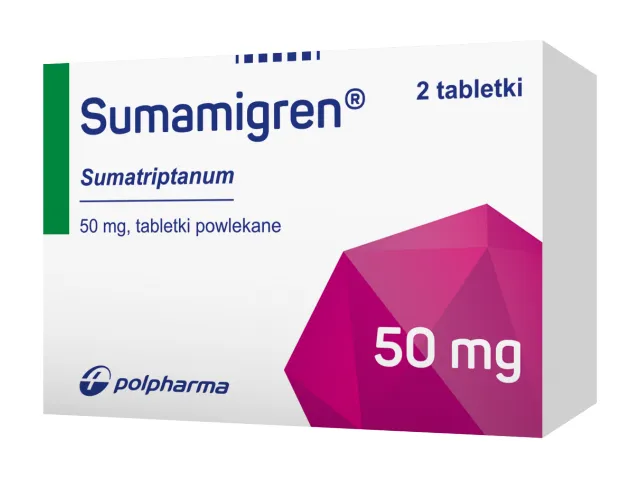
Table of Contents
Package leaflet: Information for the patient
Sumamigren, 50 mg, coated tablets
Sumamigren, 100 mg, coated tablets
Sumatriptan
Please read all of this leaflet carefully before taking this medicine, because it contains
important information for you.
- Keep this leaflet. You may need to read it again.
- If you have any further questions, ask your doctor or pharmacist.
- This medicine has been prescribed for a specific individual. Do not pass it on to others. It may harm them, even if their symptoms are the same.
- If you experience any adverse reactions, including any not listed in this leaflet, inform your doctor or pharmacist. See section 4.
Contents of the leaflet
- What Sumamigren is and what it is used for
- Important information before taking Sumamigren
- How to take Sumamigren
- Possible side effects
- How to store Sumamigren
- Contents of the pack and other information
1. What Sumamigren is and what it is used for
Sumamigren is indicated for the acute treatment of migraine attacks.
Sumamigren contains sumatriptan as the active substance, which belongs to a group of medicines called
triptans. Sumatriptan has an anti-migraine effect by constricting blood vessels in the carotid artery
circulation area. Dilation of these vessels is believed to be one of the causes of migraine. Sumatriptan relieves headache and other symptoms associated with migraine, including nausea, photophobia, and phonophobia.
The effect of the medicine begins approximately 30 minutes after administration.
2. Important Information Before Using Sumamigren
When not to use Sumamigren:
if the patient is allergic to sumatriptan or any of the other ingredients of this medicine
(listed in section 6)
do not use prophylactically – Sumamigren should only be taken after migraine symptoms
have started
in patients under 18 years of age or over 65 years of age
if the patient has heart diseases, including heart failure, previous myocardial
infarction, ischemic heart disease or symptoms related to it, angina pectoris (chest
pain), coronary artery spasm (so-called Prinzmetal's angina)
if the patient has ever had a stroke or transient ischemic attacks
if the patient has mild hypertension or is being treated for moderate or
severe hypertension
if the patient has severe liver function disorders
if the patient has circulatory disorders, leg cramps while walking, or if the
doctor has diagnosed peripheral vascular disease
when taking medicines called monoamine oxidase inhibitors used, among others,
in the treatment of depression (e.g. phenelzine, isocarboxazid, tranylcypromine). Sumamigren may
be used no sooner than 14 days after stopping treatment with monoamine oxidase
inhibitors.
when taking other anti-migraine medicines, including other triptans (medicines
containing sumatriptan or zolmitriptan, rizatriptan or naratriptan), medicines containing
ergotamine or its derivatives, such as methysergide.
Warnings and precautions
Before starting to take Sumamigren, discuss this with your doctor or pharmacist.
You should tell your doctor if:
- the patient has had seizures or factors lowering the seizure threshold (e.g. taking antidepressants or antipsychotics)
- the patient has risk factors for cardiovascular diseases, such as:
- in men over 40 years of age
- in postmenopausal women
- smoking or using nicotine substitutes
- obesity
- the patient has migraine-type headache, but migraine has not been previously diagnosed, or if a patient with migraine has an atypical headache, as it may be caused by a neurological disorder
- the patient has previously been diagnosed with hemiplegic, basilar or ophthalmoplegic migraine
- the patient has had liver or kidney disease
- the patient is allergic (has an allergy) to sulfonamides. In patients allergic to sulfonamides, administration of Sumamigren may cause allergic symptoms of varying severity, from skin rashes to anaphylactic shock (its symptoms include: shortness of breath, swelling of the larynx and throat, skin itching and redness, headache, feeling of "pressure", dizziness, significant weakness, up to loss of consciousness; in severe cases it may be life-threatening).
- the patient is taking antidepressant medicines containing selective serotonin reuptake inhibitors or serotonin-norepinephrine reuptake inhibitors (SSRIs and SNRIs) (see "Sumamigren with other medicines" below)
- the patient has mild controlled hypertension, as transient increase in blood pressure and increased peripheral vascular resistance may occur
- the patient has intolerance to certain sugars (see "Sumamigren contains lactose" below)
- the patient has acute or chronic pain or other conditions treated with buprenorphine. Concurrent use of this medicine with Sumamigren may lead to serotonin syndrome, a potentially life-threatening condition (see section "Sumamigren with other medicines").
You should stop using the medicine and seek medical advice if the patient experiences:
- an atypical headache, as it may be a symptom of stroke, transient ischemic attack or intracranial hemorrhage. Patients with migraine have an increased risk of developing these conditions.
- transient pain and sensation of pressure in the chest and throat after taking Sumamigren. These symptoms usually appear within 30 minutes of taking the medicine and last up to 2 hours. These symptoms may indicate ischemic heart disease, therefore you should contact your doctor immediately.
- frequent or daily headaches occur despite (or because of) regular use of Sumamigren.
Do not take Sumamigren together with products containing St. John's wort
(Hypericum perforatum), as adverse reactions may occur more frequently.
Sumamigren with other medicines
Tell your doctor or pharmacist about all medicines you are currently taking or have recently taken, as well as any medicines you plan to take. The medicines listed below may be marketed under several different brand names. These will not be included in this section; only active substances or their groups are listed. Therefore, carefully check the packaging and the leaflet of the medicine you are taking for the name of its active ingredient.
Sumamigren should not be used with:
- medicines containing ergotamine and its derivatives (e.g. methysergide), used in the treatment of migraine. At least 24 hours must elapse after taking any medicine containing ergotamine or other triptans (zolmitriptan, rizatriptan or naratriptan) before taking Sumamigren (see When not to use Sumamigren). Conversely, medicines containing ergotamine may be used no sooner than 6 hours after taking Sumamigren. Other triptans may be used no sooner than 24 hours after taking Sumamigren.
- medicines containing monoamine oxidase inhibitors (used, among others, in the treatment of depression). Sumamigren may be used no sooner than 14 days after stopping treatment with monoamine oxidase inhibitors.
- medicines containing selective serotonin reuptake inhibitors (used in the treatment of certain psychiatric disorders, including depression), e.g. citalopram, fluoxetine, fluvoxamine, paroxetine, sertraline, medicines containing serotonin-norepinephrine reuptake inhibitors, e.g. venlafaxine, as well as buprenorphine. Cases of serotonin syndrome have been reported when sumatriptan and these medicines are used together. Serotonin syndrome is characterized by the following symptoms: muscle rigidity, involuntary rhythmic muscle contractions, including muscles controlling eye movements, dilated pupils, seizures, tremor, increased reflexes, hallucinations, restlessness, agitation, drowsiness, excessive sweating, elevated body temperature (above 38°C), elevated blood pressure, vomiting, diarrhea. If the patient experiences any of these symptoms, contact a doctor immediately. If concurrent use of these medicines is necessary, the patient should remain under close medical supervision.
- products containing St. John's wort (Hypericum perforatum), as adverse reactions may occur more frequently.
Sumamigren with food and drink
Oral administration. Sumamigren may be taken regardless of meals.
Tablets should be swallowed whole with water.
Pregnancy and breastfeeding
If the patient is pregnant or breastfeeding, suspects she may be pregnant, or is planning to become
pregnant, she should consult her doctor or pharmacist before using this medicine.
Sumamigren should not be used during pregnancy or while breastfeeding (unless the doctor
advises otherwise).
Breastfeeding should be avoided for 12 hours after taking Sumamigren. Breast milk expressed during this time should be discarded and not used for feeding the infant.
Some breastfeeding women have reported breast and/or nipple pain after using sumatriptan. The pain is usually transient and resolves within 3 to 12 hours.
Driving and operating machinery
Drowsiness may occur during treatment with Sumamigren. If drowsiness occurs, do not drive or operate machinery.
Sumamigren 50 mg tablets contain 123.5 mg monohydrate lactose, carmine red lake, and sodium
Sumamigren 100 mg tablets contain 247 mg monohydrate lactose and sodium
Lactose
If the patient has previously been diagnosed with intolerance to certain sugars, the patient should
consult a doctor before taking this medicine.
Carmine red lake (E124)
Carmine red lake may cause allergic reactions.
Sodium
The medicine contains less than 1 mmol (23 mg) of sodium per tablet, meaning the medicine is considered "sodium-free".
3. How to use Sumamigren
This medicine should always be used exactly as directed by your doctor. If in doubt, consult your doctor or pharmacist.
The dosage is individually determined by the doctor according to the patient's condition.
Sumamigren must not be used prophylactically.
Sumamigren is indicated for the acute treatment of migraine attacks and must not be used simultaneously with other medicines containing sumatriptan or other triptans (zolmitriptan, rizatriptan, or naratriptan), or with medicines containing ergotamine or ergotamine derivatives (including methysergide).
Do not take a higher dose than recommended.
Adults aged above 18 to 65 years
The recommended single dose is 50 mg, taken as soon as possible after the onset of a migraine attack (the medicine is also effective during the attack). Some patients may require a dose of 100 mg.
Tablets should be swallowed whole with water.
If a single dose (1 tablet) does not relieve symptoms, do not take a second Sumamigren tablet during the same migraine attack. In such a case, paracetamol, acetylsalicylic acid, or non-steroidal anti-inflammatory drugs may be used during the attack. The next tablet may be taken during a subsequent attack.
If a single dose relieves symptoms, but the migraine attack returns, another dose (1 tablet) may be taken within the following 24 hours, provided that at least 2 hours have elapsed between the two doses. The maximum daily dose must not exceed 300 mg. In patients with mild to moderate hepatic impairment, the maximum daily dose is 50 mg.
Children and adolescents (under 18 years of age)
The use of this medicine in children and adolescents is contraindicated (see: When not to use Sumamigren).
Elderly patients (over 65 years of age)
The use of this medicine in this patient group is contraindicated (see: When not to use Sumamigren).
Use of a higher than recommended dose of Sumamigren
If you have taken more than the recommended dose, contact your doctor immediately. Your doctor will initiate appropriate treatment.
If you have any further doubts regarding the use of this medicine, consult your doctor or pharmacist.
4. Possible adverse reactions
Like any medicine, this medicine can cause adverse reactions, although not everyone experiences them.
The frequency of adverse reactions has been defined according to the following convention:
Common: in less than 1 in 10 patients
Rare: in less than 1 in 1000 patients
Very rare: in less than 1 in 10,000 patients
Not known: frequency cannot be estimated from available data.
You should seek immediate medical attention if the following adverse reactions occur (unless otherwise indicated, they occur with not known frequency):
- Wheezing, difficulty breathing, sensation of "tightness", swelling of the face, eyelids, lips, tongue, throat and larynx, itchy skin rash (urticaria), dizziness, disorientation and fainting, which may be symptoms of severe allergic reactions, including anaphylactic shock;
- Seizures;
- Raynaud's syndrome, which may manifest as paleness or bluish discoloration of the skin and (or) pain in the fingers of hands or feet, ears, nose or jaw due to cold or stress;
- Ischaemic colitis (inflammation of part of the intestine), which may present as pain in the left lower abdomen and (or) bloody diarrhoea;
- Increasing or prolonged sensation of heaviness, increased blood pressure, pain and tightness in the chest, throat or other parts of the body, prickling, tingling, burning sensations (common adverse reactions). These symptoms may occur within 30 minutes of taking the medicine and are usually not persistent. However, if they last longer than 2 hours or worsen (especially chest pain), you should seek immediate medical attention, as in very rare cases they may indicate myocardial infarction (see warnings in section 2).
Other adverse reactions that may occur after administration of Sumamigren
Common:
- Sudden, short-lived facial flushing, dizziness, weakness, fatigue and drowsiness (important when driving or operating machinery).
- Nausea or vomiting – if not part of the migraine attack.
- Muscle pain.
- Sensory disturbances, including hypoesthesia (loss of sensation).
- Pain, sensation of heat or cold, tightness.
- Dyspnoea (shortness of breath).
Rare:
Other rare adverse reactions include:
- Chest pain.
Very rare:
- Changes in laboratory test results assessing liver function.
Frequency not known:
- Visual disturbances, including flickering lights, double vision, changes in visual field, nystagmus. Cases of vision loss, including permanent vision defects, have also been observed.
- Low blood pressure, which may lead to fainting, especially upon standing.
- Slowed or accelerated heartbeat, palpitations, cardiac arrhythmias, chest pain.
- Tremor or uncontrolled movements.
- Diarrhoea.
- Excessive sweating.
- Joint pain.
- Neck stiffness.
- Anxiety.
- In patients who have recently experienced trauma or who have an inflammatory condition (such as rheumatism or inflammatory bowel disease), pain or worsening of pain at the site of injury or inflammation may occur.
- Difficulty swallowing.
Other adverse reactions may occur in some patients during treatment with this medicine.
Reporting of adverse reactions
If any adverse symptoms occur, including any adverse reactions not listed in this leaflet, inform your doctor or pharmacist. Adverse reactions can be reported directly to the Department of Monitoring Adverse Drug Reactions of the Office for Registration of Medicinal Products, Medical Devices and Biocidal Products
Al. Jerozolimskie 181C
02-222 Warszawa
Tel.: + 48 22 49 21 301
Fax: + 48 22 49 21 309
Website: https://smz.ezdrowie.gov.pl
Adverse reactions can also be reported to the marketing authorization holder.
Reporting adverse reactions helps to provide more information on the safety of the medicine.
5. How to store Sumamigren
Keep this medicine out of the sight and reach of children.
No special storage conditions are required for this medicine.
Do not use this medicine after the expiry date stated on the carton and blister after: EXP.
The expiry date refers to the last day of the stated month.
The marking on the packaging following EXP indicates the expiry date, and following Lot/LOT indicates the batch number.
Medicines must not be disposed of via wastewater or household waste. Ask your pharmacist how to dispose of medicines no longer required. These measures help protect the environment.
6. Contents of the pack and other information
What Sumamigren contains
- The active substance is sumatriptan as succinate. Each tablet contains 50 mg or 100 mg of sumatriptan.
- The other ingredients are: tablet core: monohydrate lactose, microcrystalline cellulose, sodium croscarmellose, magnesium stearate, talc, colloidal anhydrous silica. tablet coating: hypromellose, macrogol 6000, talc, titanium dioxide (E171), triethyl citrate, and (only in 50 mg tablets) carmine red lake (E124).
What Sumamigren looks like and contents of the pack
The 50 mg coated tablets are elongated, biconvex, light pink in colour, with a line. The line on the tablet is not intended for breaking the tablet.
The 100 mg coated tablets are elongated, biconvex, white in colour.
Pack contents:
2, 6, 9, 12 or 18 coated tablets in aluminium/aluminium foil blisters, packed in a cardboard box.
Not all pack sizes may be marketed.
Marketing Authorisation Holder and Manufacturer
Zakłady Farmaceutyczne POLPHARMA S.A.
ul. Pelplińska 19, 83-200 Starogard Gdański
tel. +48 22 364 61 01