Starazolin
Poland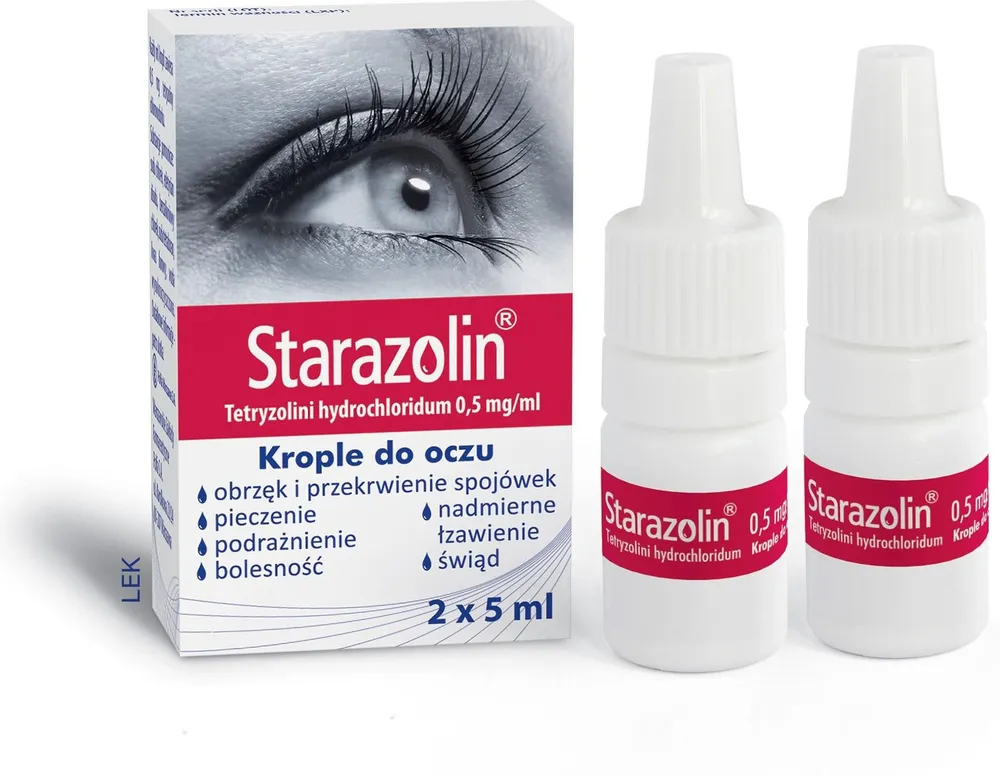
Table of Contents
Patient Information Leaflet
Starazolin, 0.5 mg/ml, eye drops
Tetryzolini hydrochloridum
Please read this leaflet carefully before using the medicine, as it contains
important information for the patient.
This medicine should always be used exactly as described in this patient leaflet or as directed by
a doctor or pharmacist.
- Keep this leaflet, as you may need to read it again.
- If you need advice or further information, consult your pharmacist.
- If you experience any adverse reactions, including any not listed in this leaflet, inform your doctor, pharmacist, or nurse. See section 4.
- If there is no improvement after 2 days, or if your condition worsens, consult your doctor.
Table of Contents
- What Starazolin is and what it is used for
- Important information before using Starazolin
- How to use Starazolin
- Possible side effects
- How to store Starazolin
- Contents of the pack and other information
1. What Starazolin is and what it is used for
Starazolin contains the active substance tetryzoline, which is a sympathomimetic amine,
an imidazoline derivative.
When applied locally to the eye, it causes constriction of small blood vessels, thereby reducing
conjunctival congestion and swelling.
Indications
For symptomatic treatment of conditions associated with conjunctival swelling and congestion caused by irritants such as dust, smoke, contact lenses, wind, bright sunlight, chlorinated water, cosmetics, as well as in allergic inflammatory conditions such as hay fever and grass pollen allergy.
Starazolin relieves accompanying symptoms such as burning, itching, pain, excessive tearing, and irritation.
The medicine is not effective in treating late-type allergic reactions, such as contact conjunctivitis or contact dermatitis of the eyelid skin.
2. Important information before using Starazolin
When not to use Starazolin
- if the patient is allergic to tetryzoline hydrochloride or any of the other ingredients of this medicine (listed in section 6);
- in children under 2 years of age;
- if the patient has glaucoma, especially with narrow drainage angle, or other serious eye diseases;
- if the patient is pregnant or breastfeeding.
Warnings and precautions
Before starting to use Starazolin, discuss this with your doctor or pharmacist.
- Treatment should be discontinued if inflammatory symptoms worsen during use. The medicine is intended for the treatment of only moderately severe conjunctival irritation.
- Use of the medicine is not recommended during infections, corneal injury, or severe pain.
- The patient should discontinue the medicine and contact a doctor if there is no clear improvement after two days of use.
- Prolonged use of the medicine may cause secondary irritation and hyperemia, burning and stinging sensations, as well as atrophic changes due to chronic hypoxia of the eye's mucous membrane.
- Caution is advised in patients with severe cardiovascular diseases (e.g. coronary artery disease) and hypertension, pheochromocytoma, patients with diabetes and hyperthyroidism, and those treated with monoamine oxidase inhibitors and other drugs that may increase blood pressure.
- Soft contact lenses should not be worn during treatment (see section "Starazolin contains benzalkonium chloride").
- At the recommended dose, the medicine does not cause pupil dilation; however, with excessive use, there is a risk of pupil dilation, especially in patients with light (blue) irises.
- If severe eye pain, headache, vision loss, sudden appearance of moving spots in the visual field, sudden eye redness, light-induced pain, or double vision occur, contact a doctor immediately.
- The medicine is not effective in treating late-type allergic reactions, such as contact conjunctivitis and eyelid skin inflammation.
Children
Prolonged use of the medicine should be avoided, especially in children.
Use in children under 2 years of age is contraindicated.
Starazolin and other medicines
Inform your doctor or pharmacist about all medicines currently used, recently used, or planned to be used.
- Concomitant use of Starazolin with MAO inhibitors or tricyclic antidepressants, guanethidine, or reserpine may increase blood pressure. In such cases, Starazolin should be used only after consultation with a doctor.
- When used concomitantly with anesthetics, insulin, atropine sulfate, or propranolol, tetryzoline may enhance the effects of these drugs on the circulatory system.
- When using other eye drops simultaneously, a 15-minute interval should be maintained between administrations.
Pregnancy and breastfeeding
If the patient is pregnant or breastfeeding, suspects she may be pregnant, or is planning to become pregnant, she should consult a doctor or pharmacist before using this medicine.
Pregnancy
The safety of using tetryzoline during pregnancy has not been established.
Starazolin may be used during pregnancy only if, in the opinion of the doctor, it is absolutely necessary.
Breastfeeding
There is no data available on the passage of tetryzoline into breast milk. Breastfeeding women should use the medicine with great caution and only after the doctor has evaluated the risks and benefits of treatment.
Driving and operating machinery
There is no data on the effect of Starazolin on the ability to drive or operate machinery; however, the inflammatory condition of the conjunctiva, pupil dilation, and blurred vision should be taken into account, as these may impair psychophysical performance. In such cases, driving and operating machinery should be avoided.
Starazolin contains benzalkonium chloride
The medicine contains 0.1 mg of benzalkonium chloride per ml of solution. Benzalkonium chloride may be absorbed by soft contact lenses and may alter their color. Contact lenses should be removed before instillation and at least 15 minutes should be waited before reinsertion. Benzalkonium chloride may also cause eye irritation, especially in individuals with dry eye syndrome or corneal disorders (transparent front layer of the eye). If abnormal sensations, stinging, or eye pain occur after using the medicine, contact a doctor.
3. How to use Starazolin
This medicine should always be used exactly as described in the patient information leaflet or as directed by a doctor or pharmacist. If in doubt, consult a doctor or pharmacist.
Adults and children over 2 years of age
Usually, 1 to 2 drops should be administered 2 to 3 times daily.
Prolonged use of the medicine should be avoided, especially in children.
Use of the medicine in children under 2 years of age is contraindicated.
Method of administration
For ocular use.
Note
Starazolin is a sterile solution.
Do not touch the dropper tip, and after instillation, close the bottle immediately with the cap tightly.
Contact lenses should be removed before using the medicine and reinserted approximately 15 minutes after instillation.
Use of a higher than recommended dose of Starazolin
If a higher than recommended dose has been used, consult a doctor or pharmacist immediately.
Overdose may cause:
- depression of the central nervous system,
- drowsiness, decreased body temperature,
- bradycardia (slow heart rate), hypotension (low blood pressure),
- apnea, coma.
After accidental ingestion, symptoms of overdose usually include:
- dilated pupils, nausea, cyanosis;
- increased body temperature, muscle spasms, tachycardia (rapid heart rate);
- cardiac arrhythmias, cardiac arrest, elevated blood pressure;
- pulmonary edema, respiratory disturbances, psychiatric disorders.
Missed dose of Starazolin
If a dose is missed, it should be taken as soon as possible. Do not use a double dose to make up for a missed dose.
If there are any further doubts concerning the use of this medicine, consult a doctor or pharmacist.
4. Possible adverse reactions
Like any medicine, this medicine can cause adverse reactions, although not everyone will experience them.
Excessive use of the medicine (for too long or too frequently) may lead to eye pain or burning, reactive hyperaemia, blurred vision, irritation of the conjunctiva, or - rarely - pupil dilation. In isolated cases, the medicine may produce systemic sympathomimetic effects (elevated blood pressure, increased heart rate, accelerated respiration).
Adverse reactions occurring frequently (in less than 1 in 10 patients):
- reactive hyperaemia, mucosal burning, dryness of mucous membranes, systemic effects (e.g. palpitations, headache, tremor, weakness, excessive sweating, elevated arterial pressure).
Adverse reactions occurring very rarely (in less than 1 in 10,000 patients):
- excessive keratinization of the conjunctiva with closure of the lacrimal points and excessive tearing.
Blurred vision, conjunctival irritation, and rarely pupil dilation may occur.
There is a risk, especially in newborns and children up to 2 years of age, of symptoms related to absorption of the medicine, including after accidental ingestion. The most important adverse symptoms are: disorders of the central nervous system, such as elevated arterial pressure, cardiac rhythm disturbances, tachycardia (increased heart rate), tachyarrhythmia (irregular heartbeat), and reactive bradycardia (slowed heart rate).
Reporting of adverse reactions
If any adverse symptoms occur, including any adverse symptoms not listed in this leaflet, inform your doctor or pharmacist. Adverse reactions can be reported directly to the Department of Monitoring Adverse Drug Reactions of the Office for Registration of Medicinal Products, Medical Devices and Biocidal Products
Al. Jerozolimskie 181C
02-222 Warsaw
Tel.: + 48 22 49 21 301
Fax: + 48 22 49 21 309
Website: https://smz.ezdrowie.gov.pl
Adverse reactions can also be reported to the marketing authorization holder.
By reporting adverse reactions, additional information on the safety of the medicine can be collected.
5. How to store Starazolin
Do not store above 25°C.
Keep the medicine in a place invisible and inaccessible to children.
Do not use this medicine after the expiry date stated on the packaging. The expiry date refers to the last day of the stated month.
The medicine is suitable for use within 28 days after first opening the bottle.
Medicines must not be disposed of via wastewater or household waste. Ask your pharmacist how to dispose of medicines no longer in use. This will help protect the environment.
6. Contents of the package and other information
What Starazolin contains
- The active substance is tetryzoline. Each ml of drops contains 0.5 mg of tetryzoline hydrochloride.
- Other ingredients are: sodium chloride, disodium edetate, benzalkonium chloride, sodium tetraborate, boric acid, purified water.
What Starazolin looks like and contents of the pack
Polyethylene bottle containing 5 ml of eye drops, packed in cardboard boxes of 2 pieces.
Marketing Authorisation Holder and Manufacturer
Marketing Authorisation Holder
POLPHARMA Pharmaceutical Works S.A.
Pelplinska Street 19, 83-200 Starogard Gdanski
tel. +48 22 364 61 01
Manufacturer
JADRAN-GALENSKI LABORATORIJ d.d.
Svilno 20, 51000 Rijeka
Croatia