Sorbifer durules
Poland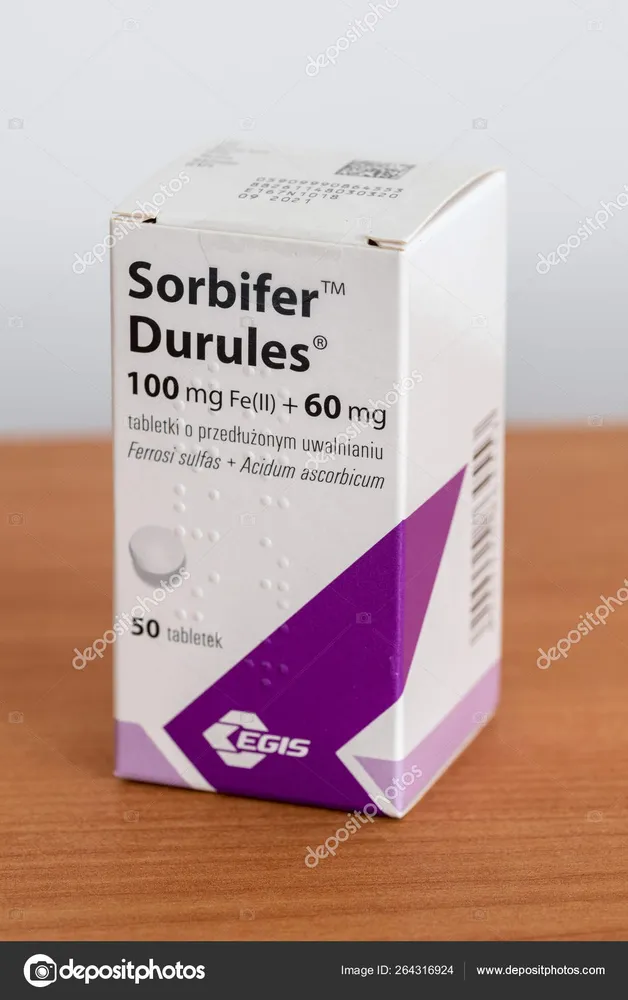
Table of Contents
Patient Information Leaflet
Warning! Keep this leaflet! Information on the immediate packaging is in a foreign language.
Sorbifer Durules, 100 mg Fe(II) + 60 mg, prolonged-release tablets
Ferrosi sulfas + Acidum ascorbicum
Please read the entire leaflet carefully before using this medicine, as it contains important information for the patient.
- Keep this leaflet, as you may need to read it again.
- If you have any questions, consult your doctor, pharmacist, or nurse.
- This medicine has been prescribed for a specific individual. Do not pass it on to others. It may harm someone else, even if their symptoms are the same.
- If you experience any adverse reactions, including any not listed in this leaflet, inform your doctor, pharmacist, or nurse. See section 4.
Table of contents:
- What Sorbifer Durules is and what it is used for
- What you need to know before taking Sorbifer Durules
- How to take Sorbifer Durules
- Possible side effects
- How to store Sorbifer Durules
- Contents of the pack and other information
1. What Sorbifer Durules is and what it is used for
Sorbifer Durules contains ferrous sulfate and ascorbic acid, which enhances iron absorption.
Sorbifer Durules is used:
- for the treatment of iron deficiency anemia;
- for the treatment of latent iron deficiency;
- for prophylaxis during pregnancy.
Sorbifer Durules is intended for use in adults and children above 12 years of age.
2. Important information before taking Sorbifer Durules
When not to take Sorbifer Durules
- If the patient is allergic to ferrous sulfate, ascorbic acid, or any of the other ingredients of this medicine (listed in section 6);
- If the patient has esophageal stricture or other disorders impairing food passage through the gastrointestinal tract;
- If the patient has excessive iron stores in the body (hemochromatosis, hemosiderosis);
- If the patient has anemia not caused by iron deficiency;
- If the patient has received multiple blood transfusions.
Warnings and precautions
Before starting treatment with Sorbifer Durules, discuss this with your doctor or pharmacist.
- Due to the risk of oral ulceration and tooth discoloration, tablets must not be sucked, chewed, or held in the mouth. They should be swallowed whole with water. If following this instruction is not possible or if you have difficulty swallowing, contact your doctor.
Difficulty swallowing
If a tablet is accidentally aspirated, contact your doctor as soon as possible. This is because of the risk of developing ulcers and bronchial strictures if the tablet enters the respiratory tract. This may result in persistent cough, coughing up blood, and/or a feeling of breathlessness, even if aspiration occurred several days to several months earlier. Therefore, it is important to promptly assess whether the tablet has damaged the respiratory tract.
The medicine may cause dark discoloration of the stool.
Children and adolescents
Sorbifer Durules must not be given to infants or children under 12 years of age.
This medicine may cause poisoning in children.
Sorbifer Durules with other medicines
Tell your doctor or pharmacist about all medicines the patient is currently taking or has recently taken, as well as any medicines the patient plans to take.
Concomitant use with the following medicines should be avoided:
- Antibiotics (antibacterial agents) of the fluoroquinolone group (e.g. ciprofloxacin, levofloxacin, moxifloxacin, norfloxacin, ofloxacin);
- Mycophenolate mofetil, an immunosuppressive medicine;
- Antibiotics (antibacterial agents) of the tetracycline group (e.g. tetracycline, oxytetracycline, doxycycline, minocycline).
When Sorbifer Durules is taken concomitantly with the following medicines, a dosage adjustment may be necessary. An interval of at least 2 hours should be maintained between the administration of Sorbifer Durules and the following medicines:
- Antacids containing aluminium hydroxide, magnesium carbonate;
- Captopril (a medicine that lowers blood pressure);
- Bone disorder treatments of the bisphosphonate group, such as alendronate, clodronate, risedronate;
- Thyroid hormones (thyroxine);
- Penicillamine (a metal-chelating agent);
- Medicines used in Parkinson's disease, such as levodopa;
- Antihypertensive medicines containing methyldopa.
Taking Sorbifer Durules with food and drink
Iron absorption may be reduced when consuming tea, coffee, eggs, dairy products, wholemeal bread, cereal products, and foods rich in dietary fiber (plant fiber) at the same time. An interval as long as possible should be maintained between taking Sorbifer Durules and consuming these products.
Pregnancy and breastfeeding
If the patient is pregnant or breastfeeding, suspects she may be pregnant, or is planning to become pregnant, she should consult her doctor or pharmacist before using this medicine.
During pregnancy and breastfeeding, only the doses recommended by the doctor should be taken (see section 3).
Driving and using machines
This medicine has no influence on the ability to drive or operate machinery.
3. How to take Sorbifer Durules
This medicine should always be taken exactly as directed by the doctor. In case of doubt, consult
your doctor or pharmacist.
Strictly follow the prescribed dosage and duration of treatment.
The tablet should be swallowed whole with water. Do not suck, chew, or hold the tablet in the mouth.
Tablets should be taken before meals or during meals, depending on gastrointestinal tolerance.
Tablets should never be taken while lying down.
Adults and adolescents over 12 years of age
The recommended dose for adults and adolescents above 12 years of age is 1 tablet twice daily (morning
and evening). If necessary, due to adverse effects, the dose may be reduced by half (1 tablet per day).
In iron deficiency anemia, the dose may be increased, if needed, to 3 or 4 tablets per day, administered
in two divided doses (morning and evening).
Use in children
This medicine must not be given to infants or children under 12 years of age.
Pregnant women
The recommended dose during pregnancy is 1 tablet per day for the prevention of iron deficiency
(prophylactic use).
In case of iron deficiency, 1 tablet twice daily (morning and evening) is usually prescribed.
The treating physician will individually determine the duration of treatment based on laboratory
assessments of iron metabolism in the patient.
Use in children (under 12 years of age)
This medicine must not be given to infants or children under 12 years of age.
Accidental overdose of Sorbifer Durules
If the patient accidentally takes more tablets than recommended, contact a doctor immediately or go
to the nearest hospital.
Overdose is particularly dangerous for young children.
Missed dose of Sorbifer Durules
Do not take a double dose to make up for a missed dose.
Stopping treatment with Sorbifer Durules
Do not discontinue treatment immediately after correcting iron deficiency without consulting your
doctor. Continue treatment as advised by the doctor to replenish body iron stores (approximately
2 months). In cases of symptomatic iron deficiency, treatment usually lasts 3 to 6 months.
If you have any further questions about the use of this medicine, consult your doctor or pharmacist.
4. Possible adverse reactions
Like all medicines, this medicine can cause adverse reactions, although not everyone experiences them.
Frequent adverse reactions (may occur in up to 1 in 10 patients):
- nausea,
- abdominal pain,
- diarrhoea,
- constipation.
Rare adverse reactions (may occur in up to 1 in 1000 patients):
- esophageal mucosal ulceration (esophageal ulcers),
- narrowing (stenosis) of the esophagus.
Adverse reactions with unknown frequency (frequency cannot be determined from available data):
- severe allergic reaction causing difficulty in breathing or dizziness (anaphylactic reaction). Immediate medical attention is required;
- severe allergic reaction causing swelling of the face or throat (angioedema). Immediate medical attention is required;
- skin rash,
- vomiting,
- oral ulceration (in case of improper use, when tablets are sucked, chewed, or held in the mouth),
- all patients, but especially elderly patients and patients with swallowing disorders, may be at risk of throat or esophageal ulceration (the tube connecting the mouth to the stomach). If a tablet enters the airways, there is a risk of bronchial ulceration (main lung airways), which may lead to bronchial stenosis.
Reporting of adverse reactions
If any adverse reactions occur, including any not listed in this leaflet, inform your doctor, pharmacist, or nurse. Adverse reactions can also be reported directly to the Department of Monitoring of Adverse Drug Reactions at the Office for Registration of Medicinal Products, Medical Devices and Biocidal Products, Al. Jerozolimskie 181C, 02-222 Warsaw, phone: +48 22 49 21 301, fax: +48 22 49 21 309, website: https://smz.ezdrowie.gov.pl.
Reporting adverse reactions helps provide more information on the safety of this medicine.
5. How to store Sorbifer Durules
Keep this medicine out of sight and reach of children.
Store below 25°C in the original packaging.
Do not use this medicine after the expiry date stated on the packaging. The expiry date refers to the last day of the stated month.
Medicines must not be disposed of via wastewater or household waste. Ask your pharmacist how to dispose of medicines no longer required. This will help protect the environment.
6. Contents of the packaging and other information
What Sorbifer Durules contains
The active substances are: 100 mg of iron(II) as 320 mg of dried ferrous sulfate (anhydrous ferrous sulfate) and 60 mg of ascorbic acid in one tablet.
Other components: povidone K 25, polyethylene powder, carbomer 934 P, magnesium stearate.
Coating composition: hypromellose, macrogol 6000, titanium dioxide (E 171), yellow iron oxide (E 172), solid paraffin.
What Sorbifer Durules looks like and contents of the pack
Prolonged-release tablets, ochre in colour, slightly convex on both sides, marked with the letter "Z" on one side.
The pack consists of a brown glass bottle closed with a PE cap with an immobilizing safety feature, containing 120 prolonged-release tablets, packed in a cardboard box.
For further detailed information, please contact the responsible party or the parallel importer.
Marketing Authorisation Holder in Romania, country of export:
Egis Pharmaceuticals PLC
Keresztúri út 30-38
1106 Budapest, Hungary
Manufacturer:
Egis Pharmaceuticals PLC
Mátyás király út 65
9900 Körmend, Hungary
Parallel Importer:
InPharm Sp. z o.o.
ul. Strumykowa 28/11
03-138 Warsaw, Poland
Repackaged in:
InPharm Sp. z o.o. Services sp. k.
ul. Chełmżyńska 249
04-458 Warsaw, Poland
Marketing Authorisation Number in Romania, country of export: 6512/2014/10
Parallel Import Licence Number: 343/22