Solpadeine max
Poland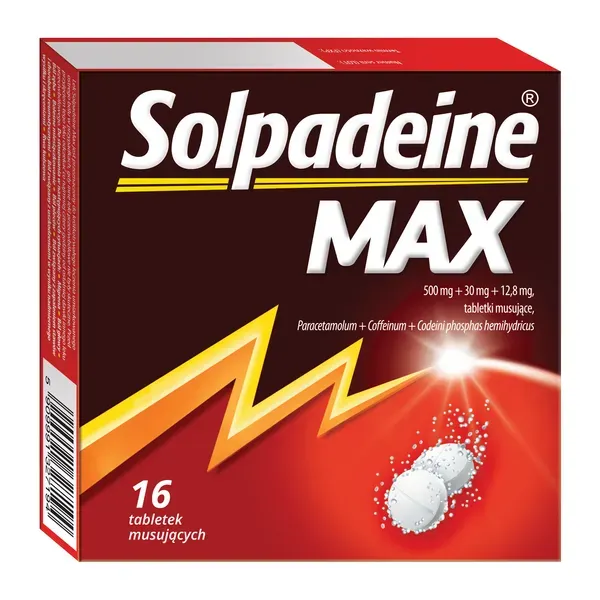
Table of Contents
Package leaflet: Information for the user
Solpadeine Max, 500 mg + 30 mg + 12.8 mg, effervescent tablets
Paracetamolum + Coffeinum + Codeini phosphas hemihydricus
- This medicine is intended for short-term treatment of moderate acute pain when other painkillers have not been effective.
- This medicine should be taken for no more than 3 consecutive days. If it is necessary to use this medicine for longer than 3 days, consult a doctor or pharmacist.
- This medicine contains codeine, which may cause dependence if used continuously for more than 3 days. Withdrawal symptoms may occur after stopping the medicine.
- Taking this medicine for headache for longer than 3 days may worsen the headaches.
Please read all of this leaflet carefully before taking this medicine, as it contains
important information for the patient.
This medicine should always be taken exactly as described in this patient leaflet or as advised by
the doctor or pharmacist.
- Keep this leaflet, as you may need to read it again.
- If you need advice or further information, consult your pharmacist.
- If you experience any side effects, including any not listed in this leaflet, tell your doctor or pharmacist. See section 4.
- If there is no improvement or if you feel worse, contact your doctor.
Contents of the leaflet
- What Solpadeine Max is and what it is used for
- Important information before taking Solpadeine Max
- How to take Solpadeine Max
- Possible side effects
- How to store Solpadeine Max
- Contents of the pack and other information
1. What Solpadeine Max is and what it is used for
Solpadeine Max may be used in patients over 12 years of age for short-term relief of moderate pain requiring stronger pain relief than that observed after taking other painkillers such as those containing paracetamol, ibuprofen or acetylsalicylic acid alone.
It may be used in the treatment of headache, migraine with or without aura, toothache (including pain after extraction), painful menstruation, neuralgia, pain due to injuries and sprains, back pain, bone and joint pain associated with arthritis and rheumatism, and sciatica.
The tablets contain three active substances: paracetamol, codeine and caffeine. Codeine and paracetamol are painkillers. Codeine belongs to a group of medicines called opioid painkillers that relieve pain. It can be used alone or in combination with other painkillers. Caffeine enhances the effectiveness of paracetamol. Thanks to the triple mechanism of action of its components, rapid relief of moderate pain is possible.
2. Important information before taking Solpadeine Max
- This medicine contains codeine, which may cause dependence if used continuously for more than 3 days. Withdrawal symptoms may then occur after stopping the medicine.
- Taking this medicine for headache for longer than 3 days may worsen the headaches.
When not to use Solpadeine Max:
- if you have ever had an allergic reaction to paracetamol, codeine, caffeine or any of the other ingredients of this medicine (listed in section 6)
- if you are taking other medicines containing paracetamol and codeine
- in children under 12 years of age
- if you are breastfeeding
- if you have breathing difficulties
- if you suffer from chronic constipation
- for pain relief in children and adolescents (aged 0–18 years) after tonsillectomy or adenoidectomy due to obstructive sleep apnoea
- if it is known that you metabolise codeine to morphine very rapidly.
Before starting to take this medicine, consult your doctor or pharmacist if:
- you have liver or kidney disease, including alcoholic liver disease, or if you have Gilbert’s syndrome (hereditary non-haemolytic jaundice), the dose should be reduced or the interval between doses increased
- you are taking medicines that affect the liver
- you have intestinal problems, including intestinal obstruction
- you have had surgery to remove your gallbladder
- you have asthma and are allergic to aspirin
- you have hypotension, hypothyroidism, head injury or increased intracranial pressure
- you are monitoring your sodium intake. Each tablet contains 427 mg of sodium
- you have intolerance to certain sugars, glucose-6-phosphate dehydrogenase deficiency or glutathione deficiency
- you suffer from chronic alcoholism, are undernourished or dehydrated
- you are elderly, an adult or adolescent with body weight below 50 kg
- in elderly people, a lower dose may be required. In such cases, consult your doctor or pharmacist
Warnings and precautions
Codeine is converted to morphine by a liver enzyme. Morphine is the substance that relieves
pain. Some people have a modified version of this enzyme, which may affect them differently.
In some individuals, morphine is not produced or is produced in very small amounts, resulting in inadequate pain relief. Others are at higher risk of severe side effects due to the production of very large amounts of morphine. If you experience any of the following side effects, stop taking the medicine and contact your doctor immediately: slow or shallow breathing, confusion, drowsiness, pinpoint pupils, nausea or vomiting, constipation, loss of appetite.
Consult your doctor before use if you have liver or kidney problems, are underweight (<50 kg), are undernourished or regularly consume alcohol, as this may increase the risk of liver damage. It may be necessary to reduce the amount of paracetamol taken or avoid using this product altogether.
Before starting Solpadeine Max, discuss with your doctor or pharmacist:
- if you are or have ever been dependent on opioids, alcohol, prescription medicines or illegal substances. Regular and long-term use of codeine (an active ingredient in this medicine) may lead to dependence and misuse, which in turn may result in overdose and/or death. Do not use this medicine longer than necessary. Do not pass this medicine on to others. During treatment with Solpadeine Max, inform your doctor immediately if you develop serious conditions, including severe kidney dysfunction or sepsis (when bacteria and their toxins circulate in the blood, leading to organ damage), malnutrition, chronic alcoholism, or if you are also taking flucloxacillin (an antibiotic). In these situations, patients have been reported to develop a serious condition called metabolic acidosis (an abnormality in blood and body fluid chemistry) when taking paracetamol regularly over a long period or when taking paracetamol with flucloxacillin. Symptoms of metabolic acidosis may include: severe breathing difficulties, including rapid deep breathing, drowsiness, nausea and vomiting.
Children and adolescents
Do not give this medicine to children under 12 years of age.
Use in children and adolescents after surgery: Codeine should not be used for pain relief in children and adolescents after tonsillectomy or adenoidectomy due to obstructive sleep apnoea.
Use in children with breathing disorders: Codeine is not recommended in children with breathing disorders, as symptoms of morphine toxicity may be intensified in these children.
Solpadeine Max and other medicines
Tell your doctor or pharmacist if you are taking, have recently taken or might take any other medicines, especially the following: metoclopramide or domperidone (used to treat nausea and vomiting); cholestyramine (used to lower blood cholesterol levels); monoamine oxidase inhibitors (MAOIs) prescribed for depression taken within the last 2 weeks, or substances causing drowsiness (e.g. sedatives, antidepressants or alcohol).
If you are taking anticoagulant medicines (blood thinners such as warfarin or coumarin derivatives) and need to take a painkiller daily, discuss the risk of bleeding with your doctor, but you may still take occasional doses of Solpadeine Max together with anticoagulants.
If you are taking probenecid, discuss with your doctor, as it may be necessary to reduce the dose of Solpadeine Max.
You should inform your doctor if you are taking sedatives and vasoconstrictors, as Solpadeine Max contains caffeine, which may interfere with or intensify their effects.
Paracetamol and other medicines
Tell your doctor or pharmacist if you are taking:
- Flucloxacillin (an antibiotic), due to the serious risk of blood and body fluid disorders (called metabolic acidosis), which require urgent treatment (see section 2).
Concomitant use of Solpadeine Max and sedative medicines, e.g. benzodiazepines or related drugs, increases the risk of drowsiness, breathing difficulties (respiratory depression) or coma, which may be life-threatening. Therefore, combination therapy should only be considered when no other treatment options are available.
If Solpadeine Max is used together with other sedative medicines, the doctor should limit the dose and duration of concomitant use.
You should inform your doctor about all sedative medicines you are taking and strictly follow the prescribed dose. It may be helpful to inform a relative or close friend about the possibility of the above-mentioned symptoms occurring. If such symptoms occur, consult your doctor.
Pregnancy and breastfeeding
If you are pregnant, consult your doctor before taking Solpadeine Max.
Do not take Solpadeine Max while breastfeeding. Codeine and morphine pass into breast milk.
Driving and operating machinery
Do not drive or operate machinery while taking Solpadeine Max, as it may cause dizziness or excessive drowsiness.
Solpadeine Max contains sodium
The maximum recommended daily dose of this medicinal product (8 tablets) contains 3416 mg of sodium (present in table salt). This corresponds to 171% of the recommended maximum daily sodium intake for an adult. Consult your doctor or pharmacist if you need to take Solpadeine Max daily for a prolonged period, especially if you are on a low-salt diet.
Solpadeine Max contains sorbitol (E420)
This medicine contains 50 mg of sorbitol per tablet.
Sorbitol is a source of fructose. If you (or your child) have previously been diagnosed with intolerance to certain sugars or hereditary fructose intolerance, a rare genetic disorder in which the body cannot break down fructose, you should consult your doctor before taking this medicine or giving it to your child.
3. How to take Solpadeine Max
This medicine should always be taken exactly as described in this patient information leaflet, or as directed by your doctor or pharmacist. If in doubt, consult your doctor or pharmacist.
Adults:
Dissolve 1 to 2 tablets in at least half a glass of water (200 ml). Take the medicine every 4 to 6 hours, if needed.
- Do not take more often than every 4 hours.
- Do not take more than 8 tablets in any 24-hour period (equivalent to 4 g of paracetamol, 102.4 mg of dihydrocodeine phosphate hemihydrate, and 240 mg of caffeine).
Elderly patients
Dosage reduction may be necessary in elderly, debilitated, or immobile patients.
Renal function impairment:
For patients with renal impairment, when administering paracetamol, it is recommended to reduce the dose and increase the minimum interval between doses to at least 6 hours.
Adults:
| Glomerular filtration rate (GFR) | Dose |
| 10-50 ml/min | 500 mg every 6 hours |
| <10 ml/min | 500 mg every 8 hours |
Liver function disorders:
In patients with impaired liver function or Gilbert's syndrome, the dose should be reduced or the dosing interval prolonged.
Adolescents aged 16 to 18 years:
Dissolve 1 or 2 tablets in at least half a glass of water (200 ml). Take the medicine every 6 hours, if needed.
- Do not take more frequently than every 6 hours.
- Do not take more than 8 tablets within 24 hours (equivalent to 4 g of paracetamol, 102.4 mg of codeine phosphate hemihydrate, and 240 mg of caffeine).
Adolescents aged 12 to 15 years:
Dissolve 1 tablet in at least half a glass of water (200 ml). Take the medicine every 6 hours, if needed.
- Do not take more frequently than every 6 hours.
- Do not take more than 4 tablets within 24 hours (equivalent to 2 g of paracetamol, 51.2 mg of codeine phosphate hemihydrate, and 120 mg of caffeine).
- Do not use a higher dose than recommended.
In the following cases, the maximum dose of paracetamol should not exceed 2 g within 24 hours, unless otherwise directed by a physician:
- if the patient is elderly or an adult or adolescent with body weight below 50 kg
- if the patient has mild or moderate liver or kidney impairment
- if the patient has Gilbert's syndrome (hereditary non-hemolytic jaundice)
- if the patient suffers from chronic alcoholism, malnutrition, or dehydration
Avoid consuming excessive amounts of caffeine in beverages such as coffee and tea. High caffeine intake may cause sleep disturbances, tremors, and chest discomfort.
This medicine should not be used for longer than 3 days. If pain persists after 3 days, consult a doctor.
Use in children and adolescents under 12 years of age
Solpadeine Max should not be used in patients under 12 years of age due to the risk of severe breathing problems.
Possible withdrawal effects
This medicine contains codeine and may lead to dependence if used continuously for more than 3 days. Withdrawal symptoms may occur upon discontinuation of the medicine.
If symptoms persist or headache does not resolve, consult a doctor.
Accidental overdose of Solpadeine Max
Seek immediate medical advice from a doctor if an overdose of this medicine is taken, even if the patient feels well. This is because an excessive dose of paracetamol may cause delayed, severe liver damage.
Missed dose of Solpadeine Max
Do not take a double dose to make up for a missed dose.
If you have any further questions about the use of this medicine, consult your doctor or pharmacist.
4. Possible adverse effects
Like all medicines, this medicine may cause adverse effects, although not everyone will experience them.
You should stop taking the medicine and immediately inform your doctor if any of the following symptoms occur:
- dry mouth, nausea and vomiting, especially if the patient has recently undergone gallbladder removal
- acute pancreatitis (inflammation of the pancreas), which may result in severe stomach pain
- allergic reactions, which may be severe and may manifest as skin rash or oral ulcers, sometimes with flu-like symptoms or itching, sometimes with swelling of the lips or face, or shortness of breath, or skin peeling
- breathing difficulties. These symptoms are more likely if they have occurred previously in the patient during use of other painkillers, such as ibuprofen and acetylsalicylic acid
- unexplained bruising or bleeding
- nausea, sudden weight loss, loss of appetite, and yellowing of the eyes and skin
- difficulty urinating
- cloudy urine
Other adverse effects
- nervousness and dizziness
- constipation
Very rare cases of severe skin reactions have been reported.
Frequency of occurrence: "frequency unknown" (cannot be estimated based on available data).
A serious condition that may cause acidification of the blood (so-called metabolic acidosis) in patients with severe liver disease taking paracetamol (see section 2).
How can a patient know if they are dependent?
If the medicine is taken according to the dosage instructions, the likelihood of dependence on the medicine is very low. Nevertheless, it is important to consult a doctor in the following situations:
- If the patient needs to take the medicine for a prolonged period
- If the patient needs to take a dose higher than recommended
- If, after stopping the medicine, the patient feels unwell, but their well-being improves upon resuming the medicine
Reporting adverse effects
If any adverse effects occur, including any adverse effects not listed in this leaflet, inform your doctor or pharmacist.
Adverse effects can be reported directly to the Department of Monitoring Adverse Drug Reactions at the Office for Registration of Medicinal Products, Medical Devices and Biocidal Products, Al. Jerozolimskie 181C, 02-222 Warsaw, tel. +48 22 4921301, fax: +48 22 4921309,
Website: https://smz.ezdrowie.gov.pl
Adverse effects can also be reported to the marketing authorization holder.
Reporting adverse effects helps to collect more information on the safety of the medicine.
5. How to store Solpadeine Max
Keep the medicine out of the sight and reach of children.
Do not store above 25°C.
Store in the original packaging to protect from moisture.
Do not use this medicine after the expiry date stated on the blister and cardboard pack following EXP. The expiry date refers to the last day of the stated month.
Medicines should not be disposed of via wastewater or household waste. Ask your pharmacist how to dispose of medicines no longer in use. This will help protect the environment.
6. Contents of the pack and other information
What Solpadeine Max contains
- The active substances are paracetamol, caffeine, and codeine phosphate hemihydrate. Each tablet contains 500 mg of paracetamol, 30 mg of caffeine, and 12.8 mg of codeine phosphate hemihydrate.
- Other components: sorbitol (E420), sodium saccharin, sodium hydrogen carbonate, sodium lauryl sulfate, anhydrous citric acid, anhydrous sodium carbonate, povidone K-25, and dimethicone 350.
What Solpadeine Max looks like and contents of the pack
Solpadeine Max is available as white, bevel-edged tablets.
The line on the tablet is not intended for dividing the tablet into equal doses.
Pack sizes: 8, 10, 12, or 16 tablets.
Not all pack sizes may be marketed.
Marketing Authorisation Holder:
Perrigo Poland Sp. z o.o.
ul. Domaniewska 48
02-672 Warsaw
tel.: +48 (22) 852 55 51
Manufacturer:
GlaxoSmithKline Dungarvan Limited, Knockbrack, Dungarvan, Co. Waterford, Ireland
Swiss Caps GmbH, Grassingerstrasse 9, 83043 Bad Aibling, Germany
This medicinal product is authorised in the European Economic Area countries under the following names:
| Romania | Solpadeine Forte 500 mg/12.8 mg/30 mg effervescent tablets |
| Poland | Solpadeine Max |
| Ireland | Solpa-Plus with Caffeine Soluble Tablets Paracetamol 500 mg, Codeine Phosphate Hemihydrate 12.8 mg, Caffeine 30 mg |