Soledum junior
Poland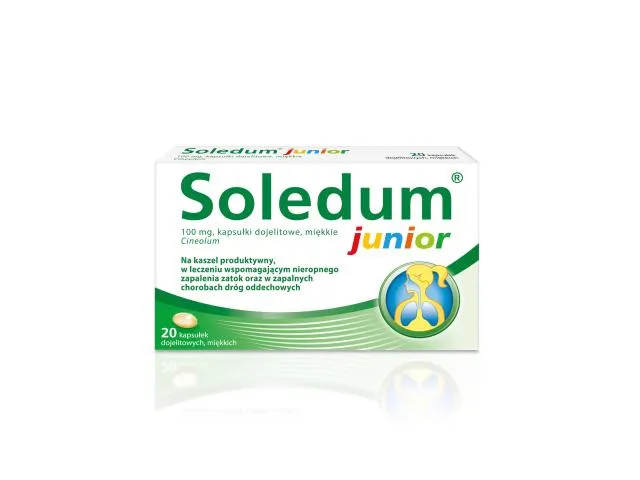
Table of Contents
Patient Information Leaflet
Soledum junior, 100 mg, enteric soft capsules
Cineolum
Please read all of this leaflet carefully before taking this medicine, because it contains
important information for the patient.
This medicine should always be taken exactly as described in this patient leaflet or as directed by
the doctor or pharmacist.
- Keep this leaflet so that you can read it again if necessary.
- If you need advice or further information, please consult your pharmacist.
- If you experience any adverse reactions, including any possible side effects not listed in this leaflet, inform your doctor or pharmacist. See section 4.
- If there is no improvement after 7 days, or if you feel worse, consult your doctor.
Contents of the leaflet
- What Soledum junior is and what it is used for
- Important information before taking Soledum junior
- How to take Soledum junior
- Possible side effects
- How to store Soledum junior
- Contents of the pack and other information
1. What Soledum junior is and what it is used for
The active substance in this medicine is 1,8-cineole, which helps reduce inflammation in the respiratory tract and supports the removal of excess mucus from the sinuses and bronchi, thus facilitating expectoration and relieving cough.
Soledum junior is used as an expectorant in productive cough (also known as wet cough), as supportive treatment in acute non-purulent sinusitis, and as supportive treatment in inflammatory diseases of the respiratory tract.
If there is no improvement after 7 days, or if you feel worse, you should consult your doctor.
2. Information before taking Soledum junior
When not to take Soledum junior
- if the patient is allergic to 1,8-cineole or any of the other ingredients of this medicine (listed in section 6);
- in cases of whooping cough or pseudo-whooping cough;
- in infants and children under 2 years of age.
Warnings and precautions
Before starting treatment with Soledum junior, discuss this with your doctor or pharmacist.
- If the patient suffers from a disease associated with significant hypersensitivity of the respiratory tract.
- If the patient has bronchial asthma, treatment with Soledum junior should be administered only under medical supervision.
- If symptoms persist for more than one week, or if shortness of breath (respiratory disturbances), fever, or purulent or bloody sputum occur, consult a doctor.
- Use in children under 6 years of age is not recommended.
Soledum junior and other medicines
Inform your doctor or pharmacist about any medicines you are currently taking, have recently taken, or plan to take.
Animal studies have shown that 1,8-cineole induces the metabolism of liver enzymes. Therefore, it cannot be ruled out that high doses of 1,8-cineole may reduce or shorten the effect of other medicines.
To date, such an interaction has not been observed in humans.
Pregnancy and breastfeeding
If the patient is pregnant or breastfeeding, suspects she might be pregnant, or is planning to become pregnant, she should consult her doctor or pharmacist before using this medicine.
Pregnancy
There are no available data on the use of Soledum junior during pregnancy.
Soledum junior should only be used during pregnancy after consultation with a doctor.
Animal studies have shown that 1,8-cineole – the active substance in Soledum junior – crosses the placental barrier into the fetal circulation in rats. However, the available results from animal studies do not indicate any fetal abnormalities.
Breastfeeding
1,8-cineole passes into breast milk after oral administration, but no noticeable problems have been reported in infants breastfed by women taking 1,8-cineole. Soledum junior may be used during breastfeeding.
Driving and operating machinery
No special precautions are required.
Children
Soledum junior is recommended for children aged 6 years and older. Use in children under 8 years of age should be supervised by a doctor. Use in children under 6 years of age is not recommended, and in children under 2 years of age is contraindicated.
Warnings regarding excipients
Soledum junior contains sorbitol and sodium.
Sorbitol
Each capsule contains 11 mg of sorbitol (liquid, non-crystallizing sorbitol) (E 420).
Sodium
Each capsule contains less than 1 mmol (23 mg) of sodium, meaning the medicine is considered "sodium-free".
One capsule of Soledum junior corresponds to 0.0013 carbohydrate exchange units. This should be taken into account in patients with diabetes.
3. How to take Soledum junior
This medicine should always be taken according to the doctor's or pharmacist's instructions.
If in doubt, consult your doctor or pharmacist.
Recommended dose:
| Age | Single dose | Daily total dose |
| Children aged 6 to 12 years | 1 capsule (corresponding to 100 mg 1,8-cineole) | 3 capsules (corresponding to 300 mg 1,8-cineole) |
| Adults and adolescents over 12 years of age | 2 capsules (corresponding to 200 mg 1,8-cineole) | 4 – 6 capsules (corresponding to 400 – 600 mg 1,8-cineole) |
Children aged 6 to 12 years: 1 capsule three times a day.
Adults and adolescents over 12 years of age: 2 capsules three times a day.
For continuation of therapy or long-term treatment, a dose of 2 capsules twice a day is usually sufficient.
The duration of treatment should be adjusted according to the nature, severity, and progression of the disease. Patients should consult a doctor if symptoms persist for more than one week, or if dyspnea, fever, or bloody or purulent sputum occur.
Method of administration:
Soledum junior capsules should be swallowed whole (do not chew), with an adequate amount of room-temperature water (preferably a glass of water, 200 ml), approximately half an hour before meals.
In case of a sensitive gastrointestinal system, the capsules should be taken during meals.
Consult a doctor or pharmacist if there is a feeling that the effect of Soledum junior is too strong or too weak.
Overdose of Soledum junior
There is a lack of detailed data regarding symptoms of overdose with Soledum junior.
Contact a doctor if the patient suspects having taken an excessive amount of Soledum junior capsules. The doctor will decide on the appropriate management based on the severity of poisoning symptoms.
Possible symptoms of Soledum junior poisoning include central nervous system disturbances such as impaired consciousness, fatigue, limb weakness, miosis, and in severe cases, coma and respiratory disturbances.
Missed dose of Soledum junior
Do not take a double dose to make up for a missed dose.
If you have any further questions about the use of this medicine, please consult your doctor or pharmacist.
4. Possible adverse reactions
Like all medicines, this medicine can cause adverse reactions, although not everybody gets them.
Treatment with Soledum junior must be discontinued immediately if signs of hypersensitivity reactions occur.
Uncommon (not more frequent than in 1 out of 100 patients)
Gastrointestinal disturbances: nausea, diarrhoea.
Rare (not more frequent than in 1 out of 1000 patients)
Hypersensitivity reactions (e.g. facial swelling, itching, breathing difficulties, cough) and difficulty in swallowing.
Reporting of adverse reactions
If any adverse reactions occur, including any adverse reactions not listed in this leaflet, inform your doctor or pharmacist. Adverse reactions can be reported directly to the Department of Monitoring Adverse Drug Reactions of the Office for Registration of Medicinal Products, Medical Devices and Biocidal Products, Al. Jerozolimskie 181C, 02-222 Warsaw, tel.: + 48 22 49 21 301, fax: + 48 22 49 21 309, website: https://smz.ezdrowie.gov.pl
Adverse reactions can also be reported to the marketing authorization holder.
By reporting adverse reactions, more information on the safety of this medicine can be collected.
5. How to store Soledum junior
Store below 30 °C.
Keep the medicine in a place out of sight and reach of children.
Do not use this medicine after the expiry date (EXP) stated on the carton and blister.
The expiry date refers to the last day of the month indicated.
Medicines should not be disposed of via wastewater or household waste. Ask your pharmacist
what to do with medicines no longer required. This will help protect the environment.
6. Contents of the package and other information
What Soledum junior contains
The active substance is 1,8-cineole (Cineolum).
One enteric soft capsule contains 100 mg of 1,8-cineole (Cineolum).
The other ingredients are: medium-chain triglycerides;
Gelatin capsule: gelatin, liquid sorbitol, non-crystallizing (E 420), 85% glycerol, purified water;
Enteric coating: Surelease - Nutrateric suspension (ethylcellulose, medium-chain triglycerides, oleic acid, concentrated ammonium hydroxide, purified water), NS Enteric - Nutrateric (sodium alginate, stearic acid), Candelilla wax.
What Soledum junior looks like and contents of the pack
Enteric soft capsules.
The capsules are oval and colourless.
Aluminium/PVC/PVDC blister in a cardboard box.
The pack contains 20, 50 or 100 enteric soft capsules.
Marketing Authorisation Holder and Manufacturer
Marketing Authorisation Holder:
M.C.M. Klosterfrau Healthcare Sp. z o.o.
ul. Hrubieszowska 2
01-209 Warszawa
Poland
tel. +48 22 231 8287
Manufacturer:
Klosterfrau Berlin GmbH
Motzener Strasse 41
12277 Berlin
Germany
Artesan Pharma GmbH & Co. KG
Wendlandstr. 1
29439 Lüchow
Germany