Smecta
Poland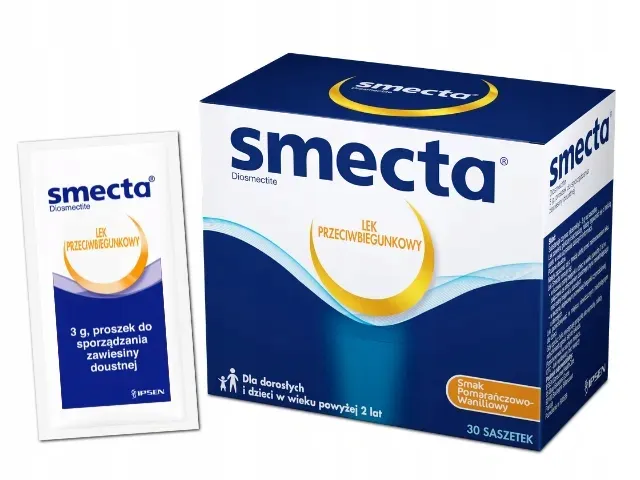
Table of Contents
Package leaflet: Information for the user
Warning! Keep this leaflet! Information on the immediate packaging in a foreign language.
Smecta (Smecta orange-vanille)
3 g, powder for oral suspension
Diosmectite
Smecta and Smecta orange-vanille are different brand names of the same medicine.
Please read this leaflet carefully before taking the medicine, as it contains
important information for the patient.
This medicine should always be used exactly as described in this patient leaflet or as directed by
a doctor or pharmacist.
- Keep this leaflet, so that you can read it again if necessary.
- If you need advice or further information, please consult your pharmacist.
- If you experience any adverse reactions, including any possible adverse reactions not listed in this leaflet, inform your doctor, pharmacist, or nurse. See section 4.
- If there is no improvement after 2 to 3 days, or if your condition worsens, contact your doctor.
Table of contents of the leaflet:
- What Smecta is and what it is used for
- Important information before taking Smecta
- How to take Smecta
- Possible side effects
- How to store Smecta
- Contents of the pack and other information
1. What Smecta is and what it is used for
Due to its structure and high viscosity, Smecta exhibits strong coating properties on the mucous membrane of the gastrointestinal tract, thereby reinforcing the protective barrier against irritants and pathogens.
Smecta is indicated:
- for the treatment of acute diarrhoea in children over 2 years of age, in combination with oral rehydration solutions, and in adults with acute diarrhoea
- for the symptomatic treatment of chronic functional diarrhoea in adults
If there is no improvement after 2 to 3 days, or if your condition worsens, contact your doctor.
Prolonged or frequent use of Smecta without medical advice is not recommended.
2. Important information before using Smecta
When not to use Smecta
- If the patient is allergic to diosmectite or any of the other ingredients of this medicine (listed in section 6).
- Smecta must not be used in infants and children under 2 years of age.
Warnings and precautions
Before starting treatment with Smecta, consult a doctor or pharmacist:
- if the patient has been informed by a doctor of having an intolerance to certain sugars (see also section "Smecta contains glucose and sucrose"),
- if the patient has previously experienced severe constipation.
During treatment of diarrhoea, it is necessary to replenish fluids and electrolytes. The volume and route of administration of rehydration solutions should be adjusted according to the patient's age, health status, and severity of diarrhoea.
Additional dietary recommendations:
- Ensure hydration with large amounts of salty or sweet drinks to compensate for fluid loss due to diarrhoea (average daily fluid requirement in adults is 2 litres).
- Continue feeding until diarrhoea resolves, but exclude certain foods, particularly raw vegetables and fruits, green vegetables, spicy dishes, as well as frozen foods or drinks.
- Grilled meat and rice are preferred.
Consult a doctor:
- if symptoms do not improve within 3 days.
Children and adolescents
Smecta must not be used in infants and children under 2 years of age. In children over 2 years of age, acute diarrhoea must be treated in combination with early administration of oral rehydration solution to prevent dehydration. Prolonged use of Smecta is not recommended.
Smecta and other medicines
Inform the doctor or pharmacist about all medicines currently or recently taken, as well as any medicines the patient intends to take.
Due to its adsorptive properties, this medicine may affect the rate and/or extent of absorption of other substances. Therefore, no other medicine should be administered at the same time as diosmectite.
A 2-hour interval between administration of Smecta and other medicines is recommended.
Pregnancy, breastfeeding and fertility
There are no data or only limited data on the use of Smecta in pregnant or breastfeeding women.
Smecta is not recommended during pregnancy.
Smecta should not be used during breastfeeding. The effect of the medicine on human fertility has not been evaluated.
Driving and operating machinery
No studies on the effect of the medicine on the ability to drive vehicles or operate machinery have been conducted; however, no such effect is expected.
Smecta contains glucose and sucrose
If the patient has previously been diagnosed with intolerance to certain sugars, the patient should consult a doctor before taking this medicine.
Smecta contains 0.679 g of glucose and 0.27 g of sucrose per sachet. This should be taken into account in patients with diabetes.
3. How to use Smecta
This medicine should always be taken exactly as described in the patient information leaflet or according to the instructions of a doctor or pharmacist. If in doubt, consult your doctor or pharmacist.
Treatment of acute diarrhoea:
In children over 2 years of age
- 2 sachets per day. At the beginning of an episode of acute diarrhoea, the dose may be doubled (i.e. up to 4 sachets per day).
In adults:
The usual dose is 3 sachets per day.
At the beginning of an episode of acute diarrhoea, the dose may be doubled (i.e. up to 6 sachets per day).
Symptomatic treatment of chronic functional diarrhoea:
In adults:
The usual dose is 3 sachets per day.
Duration of treatment
If there is no improvement after 2 to 3 days, or if the patient feels worse, medical advice should be sought. Long-term or frequent use of Smecta without medical supervision is not recommended.
Method and route of administration
For oral use.
Immediately before administration, the contents of the sachet should be dissolved in liquid to form a suspension.
In children over 2 years of age: The contents of one sachet may be dissolved in a bottle containing 50 ml of water and administered in small portions throughout the day. It may also be mixed with semi-liquid foods such as broth, cooked fruits, purees, or ready-made baby meals.
In adults: The contents of one sachet may be dissolved in half a glass of water.
Use of a higher than recommended dose of Smecta
Taking more than the recommended dose of Smecta may cause severe constipation or formation of a bezoar, i.e. accumulation of undigested material in the gastrointestinal tract.
If more than the recommended dose of Smecta has been taken, consult your doctor.
Missed dose
Do not take a double dose to make up for a missed dose.
If you have any further doubts concerning the use of this medicine, consult your doctor or pharmacist.
4. Possible adverse reactions
Like all medicines, this medicine can cause adverse reactions, although not everybody gets them.
If you notice any of the following symptoms, stop taking Smecta and contact your doctor immediately:
- allergic reaction (hypersensitivity) – symptoms may include skin redness, itching, swelling,
- severe allergic reaction causing swelling of the face and throat, difficulty breathing, fainting or collapse (angioedema). The frequency of the above adverse reactions is unknown (cannot be estimated from the available data). Other adverse reactions are:
Common (may occur in up to 1 in 10 people):
- Constipation
Uncommon (may occur in up to 1 in 100 people):
- Rash
Rare (may occur in up to 1 in 1000 people):
- Urticaria (itchy rash)
Reporting of adverse reactions
If any adverse reactions occur, including any possible adverse reactions not listed in this leaflet, consult your doctor, pharmacist or nurse. Adverse reactions can be reported directly to the Department for Monitoring Adverse Reactions to Medicinal Products at the Office for Registration of Medicinal Products, Medical Devices and Biocidal Products: Al. Jerozolimskie 181C, 02-222 Warsaw, tel.: + 48 22 49 21 301, fax: + 48 22 49 21 309, website: https://smz.ezdrowie.gov.pl .
Reporting adverse reactions helps provide more information on the safety of the medicine.
Adverse reactions may also be reported to the marketing authorisation holder or the parallel importer.
5. How to store Smecta
Keep this medicine out of sight and reach of children.
Store in a dry place.
Do not use this medicine after the expiry date stated on the packaging. The expiry date refers to the last day of the stated month.
Medicines must not be disposed of via the sewage system or household waste. Ask your pharmacist how to dispose of medicines no longer required. Such measures help protect the environment.
6. Contents of the packaging and other information
What Smecta contains
- The active substance is: diosmectite (aluminosilicate). One sachet contains 3 g of diosmectite in the form of aluminosilicate.
- Other ingredients are: glucose monohydrate, sodium saccharin, orange flavour*, vanilla flavour **
* Orange flavour: maltodextrin, sucrose, acacia gum (E 414), mono- and diglycerides of fatty acids esterified with mono- and diacetyltartaric acid (E 472e), silicon dioxide (E 551), orange flavour.
** Vanilla flavour: maltodextrin, sucrose, glyceryl triacetate (E 1518), silicon dioxide (E 551), ethyl alcohol, soybean lecithin (E 322), vanilla flavour.
What Smecta looks like and contents of the pack
Smecta is a powder for oral suspension contained in sachets.
Smecta is available in packs containing 10 or 30 sachets, packed in a cardboard box.
For further information, please contact the marketing authorisation holder or the parallel importer.
Marketing authorisation holder in France, the country of export:
IPSEN Consumer HealthCare
65, quai Georges Gorse
92100 Boulogne Billancourt
France
Manufacturer:
Beaufour Ipsen Industrie
rue Ethé Virton
28100 Dreux
France
Parallel importer:
Allpharm Sp. z o.o. sp.k.
ul. M. Zdziechowskiego 11/4
02-659 Warsaw
Poland
Repackaged in:
CEFEA Sp. z o.o. Sp. komandytowa Synoptis Industrial Sp. z o.o.
ul. Działkowa 56 ul. Forteczna 35-37
02-234 Warsaw 87-100 Toruń
Marketing authorisation numbers in France, the country of export: 34009 319 230 7 7
34009 319 231 3 8
34009 319 233 6 7
34009 279 158 9 5
Parallel import authorisation number: 122/23