Sinora
Poland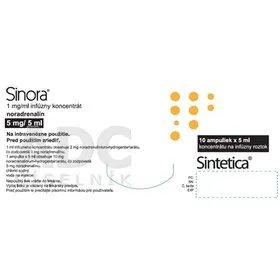
Table of Contents
- PACKAGE LEAFLET: INFORMATION FOR THE USER
- 1. What Sinora is and what it is used for
- 2. Important information before receiving Sinora
- 3. How to use Sinora
- 4. Possible adverse reactions
- 5. How to store Sinora
- 6. Contents of the packaging and other information
- Information intended exclusively for medical professionals:
PACKAGE LEAFLET: INFORMATION FOR THE USER
Sinora
1 mg/ml, concentrate for solution for infusion
Noradrenalinum (as noradrenaline tartrate)
Please read this leaflet carefully before receiving this medicine, as it contains important information for the patient.
- Keep this leaflet, so that you can read it again if necessary.
- If you have any further questions, please consult your doctor or pharmacist.
- This medicine has been prescribed for a specific individual. Do not pass it on to others. The medicine may harm other people, even if their symptoms are the same.
- If the patient experiences any adverse reactions, including any not listed in this leaflet, inform the doctor or pharmacist immediately. See section 4.
Leaflet contents:
- What Sinora is and what it is used for
- What you need to know before receiving Sinora
- How to use Sinora
- Possible side effects
- How to store Sinora
- Contents of the pack and other information
1. What Sinora is and what it is used for
Sinora is a medicine belonging to the group of drugs affecting adrenergic and dopaminergic receptors.
Sinora is indicated for use in acute hypotensive states (acute low blood pressure) to restore normal blood pressure.
2. Important information before receiving Sinora
When not to use Sinora:
- If the patient is allergic to medicines containing norepinephrine or to any of the other ingredients of this medicine (listed in section 6).
- If the patient has hypotension (low blood pressure) caused by hypovolemia (reduced blood volume).
Warnings and precautions
Before starting treatment with Sinora, discuss with your doctor or pharmacist:
- if the patient has diabetes,
- if the patient has high blood pressure,
- if the patient has hyperthyroidism,
- if the patient has low oxygen levels in the blood,
- if the patient has high carbon dioxide levels in the blood,
- if the patient has blood clots or blocked blood vessels supplying blood to the heart, intestines, or other parts of the body,
- if the patient has low blood pressure after a heart muscle infarction,
- if the patient suffers from a type of angina (chest pain) called Prinzmetal's angina,
- if the patient is elderly,
- if the patient is at risk of extravasation (a risk that blood or lymph may leak from the vessels into surrounding tissues),
- if the patient has severe left ventricular failure,
- if the patient has recently had a myocardial infarction (heart attack),
- if the patient has heart rhythm disorders (heartbeat that is too fast, too slow, or irregular), a dose reduction may be necessary.
During norepinephrine infusion, the doctor will continuously monitor blood pressure and heart rate.
Children and adolescents
The safety and efficacy of Sinora have not been established in children and adolescents.
Sinora with other medicines
Tell your doctor or nurse about all medicines the patient is currently taking or has recently taken, as well as any medicines the patient plans to take.
It has been confirmed that certain medicines increase the toxic effects of norepinephrine, including:
- monoamine oxidase inhibitors (antidepressants),
- tricyclic antidepressants,
- linezolid (an antibiotic),
- anaesthetic agents (especially inhalational anaesthetics),
- antidepressants affecting adrenergic and serotonergic receptors, e.g. those used in the treatment of asthma or heart diseases.
Pregnancy, breastfeeding, and fertility
If the patient is pregnant or breastfeeding, suspects she may be pregnant, or is planning to have a baby,
she should consult her doctor or nurse before receiving this medicine.
Norepinephrine may have harmful effects on the unborn child. The doctor will decide whether the patient
should receive Sinora 1 mg/ml, concentrate for solution for infusion.
Driving and using machines
Not applicable.
Sinora contains sodium
One ampoule containing 1 ml of concentrate contains less than 1 mmol of sodium (23 mg). This medicine contains less than 1 mmol of sodium (23 mg) per ampoule and is essentially considered "sodium-free".
One ampoule containing 4 ml of concentrate contains less than 1 mmol of sodium (23 mg). This medicine contains less than 1 mmol of sodium (23 mg) per ampoule and is essentially considered "sodium-free".
One ampoule containing 5 ml of concentrate contains less than 1 mmol of sodium (23 mg). This medicine contains less than 1 mmol of sodium (23 mg) per ampoule and is essentially considered "sodium-free".
One ampoule containing 10 ml of concentrate contains 1.44 mmol of sodium (33 mg). This medicine contains 33 mg of sodium (the main component of table salt) in each ampoule. This corresponds to 1.65% of the recommended maximum daily intake of sodium for an adult.
Patients who are controlling sodium intake in their diet should take this into account.
3. How to use Sinora
Your doctor or nurse will administer Sinora to you in the hospital. The medicine is given as an intravenous infusion after prior dilution.
The initial dose of Sinora will depend on the patient's condition. The usual dose is 0.4 to 0.8 mg per hour of noradrenaline (0.8 mg to 1.6 mg per hour of noradrenaline bitartrate). Your doctor will determine the appropriate dose for you. After the initial dose is given, your doctor will assess your response and adjust the dose accordingly.
Overdose of Sinora
Receiving a higher than recommended dose is unlikely, as the medicine is administered in a hospital setting. If you have any concerns, discuss them with your doctor or nurse.
Symptoms of overdose include: very high blood pressure, slow heartbeat, severe headache, sensitivity to light, chest pain, pallor, excessive sweating, and vomiting.
If you have any further questions about the use of this medicine, consult your doctor or pharmacist.
4. Possible adverse reactions
Like all medicines, Sinora may cause adverse reactions, although not everyone experiences them.
The frequency of occurrence of adverse reactions cannot be determined based on available data.
- Seek immediate medical advice if any of the following conditions occur:
- slow heart rate, rapid heartbeat, palpitations, increased myocardial contractility, acute heart failure,
- irregular heartbeat,
- breathing difficulties,
- restlessness, insomnia, confusion, weakness, psychotic state,
- headache, tremor,
- high blood pressure (hypertension), reduced oxygen supply to certain organs (hypoxia),
- acute glaucoma,
- cold extremities,
- limb pain,
- nausea, vomiting,
- urinary retention,
- local reactions: possible irritation or necrosis (cell damage leading to tissue cell death) at the site of administration.
In cases of hypersensitivity or overdose, the following adverse reactions may occur more frequently:
arterial hypertension (elevated blood pressure), photophobia (intolerance to visual perception of light),
retrosternal pain (chest pain), oropharyngeal pain (sore throat), pallor, excessive sweating, and vomiting.
The doctor will monitor blood pressure and blood volume.
Reporting of adverse reactions
If any adverse symptoms occur, including any adverse effects not listed in this leaflet, inform your doctor, pharmacist, or nurse.
Adverse reactions can be reported directly to the Department of Monitoring Adverse Drug Reactions of the Office for Registration of Medicinal Products, Medical Devices and Biocidal Products, Al. Jerozolimskie 181C, PL-02 222 Warsaw, Tel.: + 48 22 49 21 301, Fax: + 48 22 49 21 309, website: https://smz.ezdrowie.gov.pl . Reporting adverse reactions helps to gather additional information on the safety of using the medicine. Adverse reactions can also be reported to the responsible entity.
5. How to store Sinora
Keep the medicine out of sight and reach of children.
Do not use this medicine after the expiry date {month/year} stated on the outer packaging and on the ampoule. The expiry date refers to the last day of the specified month.
Do not store above 25°C. Do not freeze. Store in the original packaging to protect from light.
From a microbiological point of view, the product should be used immediately after dilution.
Medicines must not be disposed of via the sewage system. Ask your pharmacist how to dispose of medicines no longer required. Such measures will help protect the environment.
6. Contents of the packaging and other information
What Sinora contains
The active substance in Sinora is noradrenaline ( Noradrenalinum ) in the form of noradrenaline bitartrate.
1 ml of concentrate for solution for infusion contains 2 mg of noradrenaline bitartrate, corresponding to 1 mg
of noradrenaline.
Sinora, 1 mg/1 ml
2 ml vial containing 1 ml of concentrate for solution for infusion contains 2 mg of noradrenaline bitartrate, corresponding to 1 mg
of noradrenaline.
Sinora, 4 mg/4 ml
5 ml vial containing 4 ml of concentrate for solution for infusion contains 8 mg of noradrenaline bitartrate, corresponding to
4 mg of noradrenaline.
Sinora, 5 mg/5 ml
5 ml vial containing 5 ml of concentrate for solution for infusion contains 10 mg of noradrenaline bitartrate, corresponding to
5 mg of noradrenaline.
Sinora, 10 mg/10 ml
10 ml vial containing 10 ml of concentrate for solution for infusion contains 20 mg of noradrenaline bitartrate,
corresponding to 10 mg of noradrenaline.
The other ingredients are: sodium chloride and water for injections.
What Sinora looks like and contents of the pack
This medicinal product is a concentrate for solution for infusion. The solution is clear and colourless.
The medicinal product is available in packs containing 10 vials x 1 ml, 10 vials x 4 ml, 10 vials x 5 ml, 10 vials x 10 ml of concentrate for solution for infusion.
Not all pack sizes may be marketed.
Marketing Authorisation Holder and Manufacturer
Marketing Authorisation Holder:
Sintetica GmbH
Albersloher Weg 11
48155 Münster
Germany
Manufacturer / Importer:
Sirton Pharmaceuticals Spa
Piazza XX Settembre, 2
22079 Villa Guardia (CO)
Italy
Sintetica GmbH
Albersloher Weg 11
48155 Münster
Germany
For further information, contact the local representative of the Marketing Authorisation Holder:
IMED Poland Sp. z o.o.
ul. Puławska 314, 02-819 Warszawa
This medicinal product is authorised in the European Economic Area countries under the following names:
Austria, Germany: Sinora 1 mg/ml Konzentrat zur Herstellung einer Infusionslösung
Czech Republic, Poland: Sinora
Hungary: Sinora 1 mg/ml koncentrátum oldatos infúzióhoz
Slovakia: Sinora 1 mg/ml infúzny koncentrát
Information intended exclusively for medical professionals:
Intravenous administration.
Dilute before use.
Sinora, concentrate for preparation of infusion solution for intravenous administration. To avoid ischemic necrosis (skin, limbs), an infusion catheter should be placed in a suitably large vein or in a central venous access.
The infusion rate must be controlled using a syringe pump, infusion pump, or drip counter.
Pharmaceutical incompatibilities
Pharmaceutical incompatibilities have been reported for infusion solutions containing bitartrate of noradrenaline with the following substances: alkaline agents or oxidizing agents, barbiturates, chlorpheniramine, chlorothiazide, nitrofurantoin, novobiocin, phenytoin, sodium bicarbonate, sodium iodide, and streptomycin.
Dilution instructions
Before administration, dilute the product in 5% glucose solution or 9 mg/ml (0.9%) sodium chloride solution, or in a mixture of 9 mg/ml sodium chloride and 5% glucose solution.
When administering via syringe pump: add 2 ml of concentrate to 48 ml of 5% glucose solution (or 9 mg/ml sodium chloride solution, or 9 mg/ml sodium chloride with 5% glucose solution).
When administering via drip infusion: add 20 ml of concentrate to 480 ml of 5% glucose solution (or 9 mg/ml sodium chloride solution, or 9 mg/ml sodium chloride with 5% glucose solution).
In both cases, the final concentration of the infusion solution is 40 mg/liter noradrenaline (equivalent to 80 mg/liter noradrenaline bitartrate).
The medicinal product may also be diluted to concentrations other than 40 mg/liter noradrenaline. If diluted to a concentration other than 40 mg/liter noradrenaline, the infusion rate must be accurately recalculated before starting treatment.
The medicinal product can be used with PVC infusion bags.
Any unused medicinal product or waste material should be disposed of in accordance with local regulations.
Stability after dilution
Chemical and physical stability of the solution after preparation is 24 hours at 25°C when diluted to 4 mg/liter and 40 mg/liter noradrenaline in 9 mg/ml (0.9%) sodium chloride solution or 5% glucose solution, or in a mixture of 9 mg/ml sodium chloride and 5% glucose solution. However, from a microbiological standpoint, the product should be used immediately. If not administered immediately, the responsibility for determining storage conditions and duration after preparation lies with the user; this generally should not exceed 24 hours at 2–8°C.