Setronon
Poland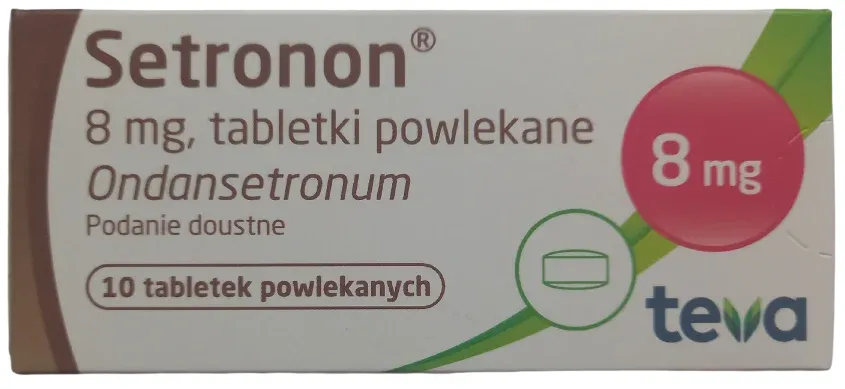
Table of Contents
Patient Information Leaflet
Setronon, 8 mg, film-coated tablets
Ondansetronum
Please read all of this leaflet carefully before taking this medicine, because it contains
important information for you.
- Keep this leaflet, as you may need to read it again.
- If you have any further questions, please ask your doctor, pharmacist or nurse.
- This medicine has been prescribed for a specific individual. Do not pass it on to others. It may harm someone else even if their symptoms are the same.
- If you experience any adverse effects, including any not listed in this leaflet, tell your doctor, pharmacist or nurse. See section 4.
Contents of the leaflet
- What Setronon is and what it is used for
- Important information before taking Setronon
- How to take Setronon
- Possible side effects
- How to store Setronon
- Contents of the pack and other information
1. What Setronon is and what it is used for
Setronon contains the active substance ondansetron, which belongs to a group of medicines called antiemetics.
Ondansetron is a 5HT3 receptor antagonist. It acts by blocking 5HT3 receptors located in the peripheral and central nervous system.
Setronon is used:
- to prevent and control nausea and vomiting caused by cancer chemotherapy and radiotherapy (in adults);
- to prevent nausea and vomiting after surgery (in adults);
- to prevent and control nausea and vomiting caused by chemotherapy (in children).
Please consult your doctor, nurse or pharmacist if you require further information regarding the use of this medicine.
2. Important information before using Setronon
When not to use Setronon
- if the patient is allergic to ondansetron or any of the other ingredients of this medicine (see section 6);
- if the patient is taking apomorphine (used in the treatment of Parkinson's disease).
If in doubt about the use of Setronon, consult a doctor,
pharmacist or nurse.
Warnings and precautions
Before using Setronon, discuss with your doctor, pharmacist or nurse if:
- the patient is allergic to medicines similar to ondansetron, such as granisetron or palonosetron;
- the patient has liver disease;
- the patient has intestinal obstruction;
- the patient has or may develop QT interval prolongation (a measurement on the ECG). Setronon causes dose-dependent QT interval prolongation (manifested by heart rhythm disturbances). Cases of life-threatening ventricular tachycardia of the type torsade de pointes have been rarely observed in patients receiving this medicine. This mainly concerns patients with electrolyte imbalance (abnormal levels of potassium, sodium and magnesium in the body), congenital long QT syndrome (a heart condition causing irregular heartbeat), congestive heart failure, bradyarrhythmia (abnormally slow and irregular heart rate), or those taking medicines causing QT interval prolongation;
- the patient is taking medicines belonging to the group of selective serotonin reuptake inhibitors (SSRIs) or serotonin-norepinephrine reuptake inhibitors (SNRIs) used in the treatment of depression and (or) anxiety disorders, because concomitant use with Setronon may lead to serotonin syndrome. If concomitant use of Setronon and these medicines is necessary, the patient will be under appropriate medical supervision. Symptoms of serotonin syndrome include headache, hallucinations, racing thoughts, confusion, restlessness, insomnia, difficulty concentrating, elevated body temperature, muscle stiffness, tremors, excessive sweating, high blood pressure, rapid heartbeat, nausea, vomiting, diarrhoea, skin flushing and dilated pupils. If any of these symptoms occur, inform your doctor immediately.
Hypokalaemia (low potassium levels in the blood) and hypomagnesaemia (low magnesium levels in the blood) must be corrected before administration of Setronon.
If the patient is unsure whether any of the above conditions apply, they should consult a doctor or pharmacist before using Setronon.
Immediately inform the doctor or pharmacist if any of the following symptoms occur during or after treatment with Setronon:
- sudden chest pain or chest tightness (myocardial ischaemia).
Setronon and other medicines
Tell your doctor, nurse or pharmacist about all medicines the patient is currently taking or has recently taken, as well as any medicines the patient plans to take. This includes over-the-counter medicines and herbal supplements. This is important because Setronon may affect the action of certain medicines. Likewise, certain other medicines may affect the action of Setronon.
In particular, inform your doctor, nurse or pharmacist if the patient is taking any of the following medicines:
- carbamazepine or phenytoin, used in the treatment of epilepsy;
- rifampicin, used to treat infections such as tuberculosis;
- tramadol, a painkiller;
- medicines affecting the heart, including those affecting the QT interval;
- medicines causing electrolyte imbalance;
- anticancer medicines (especially anthracyclines);
- antibiotics such as erythromycin or ketoconazole;
- selective serotonin reuptake inhibitors (SSRIs) used in the treatment of depression and (or) anxiety disorders, including fluoxetine, paroxetine, sertraline, fluvoxamine, citalopram, escitalopram;
- serotonin-norepinephrine reuptake inhibitors (SNRIs) used in the treatment of depression and (or) anxiety disorders, including venlafaxine and duloxetine.
If the patient is unsure whether any of the above situations apply, consult a doctor, nurse or pharmacist before using Setronon.
Pregnancy and breastfeeding
Do not use Setronon during the first trimester of pregnancy. Setronon may have harmful effects on fetal development. This is because Setronon may slightly increase the risk of cleft lip and/or cleft palate [an opening or fissure in the upper lip and/or palate].
If the patient is pregnant, suspects she may be pregnant, or is planning to become pregnant, she should consult a doctor or pharmacist before using Setronon. If the patient is a woman of childbearing age, effective contraception may be recommended.
Before starting Setronon, the doctor will check whether a woman of childbearing age is pregnant and, if necessary, perform a pregnancy test. Sexually active women should use an effective method of contraception during treatment with Setronon.
Before taking this medicine, ask your doctor about effective methods of contraception.
Do not breastfeed while taking Setronon, as small amounts of the medicine pass into breast milk. Consult your doctor or midwife.
Driving and operating machinery
Setronon has not been shown to impair the ability to perform tasks or cause sedation.
Setronon contains lactose monohydrate
One Setronon tablet contains 95.6 mg of lactose monohydrate. If the patient has previously been diagnosed with intolerance to certain sugars, they should consult their doctor before taking this medicine.
Setronon contains sodium
The medicine contains less than 1 mmol (23 mg) of sodium per tablet, meaning the medicine is considered "sodium-free".
3. How to use Setronon
This medicine should always be used exactly as directed by your doctor. If in doubt, consult your doctor, nurse, or pharmacist. The prescribed dose depends on the type of treatment the patient is receiving.
Adults
Prevention and control of nausea and vomiting induced by chemotherapy with moderate emetogenic potential and radiotherapy for tumours
On the day chemotherapy or radiotherapy is administered:
- the usual dose is 2 tablets of 4 mg or 1 tablet of 8 mg (total 8 mg of ondansetron) taken one or two hours before treatment, followed by another 2 tablets of 4 mg or 1 tablet of 8 mg (total 8 mg of ondansetron) twelve hours later.
On subsequent days:
- the usual dose is 2 tablets of 4 mg or 1 tablet of 8 mg (total 8 mg of ondansetron) twice daily;
- this dose may be continued for up to 5 days.
If the prescribed chemotherapy causes severe nausea and vomiting, the patient may receive ondansetron intravenously, intramuscularly, or rectally during the first 24 hours. The dose will be determined by the doctor. In the following days, treatment continues as for chemotherapy with moderate emetogenic potential.
Prevention and treatment of postoperative nausea and vomiting
To prevent postoperative nausea and vomiting, the usual dose in adults is 4 tablets of 4 mg or 2 tablets of 8 mg (total 16 mg of ondansetron), taken one hour before surgery.
For treatment of nausea and vomiting in the postoperative period, ondansetron should be administered intravenously or intramuscularly.
Children aged 6 months and above, and adolescents
Prevention and control of nausea and vomiting induced by cancer chemotherapy
The doctor will decide the appropriate dose.
On the day chemotherapy is administered:
- immediately before starting chemotherapy, the doctor or nurse will administer the first dose of ondansetron intravenously as an injection solution;
- 12 hours after chemotherapy, the medicine is usually given orally as follows:
- children with body weight up to 10 kg should not be given tablets; treatment should be with syrup.
- children with body weight above 10 kg: 1 tablet of 4 mg (total 4 mg of ondansetron).
On subsequent days:
- oral doses as above, twice daily for up to 5 days.
The maximum daily dose is 32 mg of ondansetron, given in divided doses.
Prevention and treatment of postoperative nausea and vomiting
In children aged 1 month and above and in adolescents, ondansetron is recommended in the form of injection solution.
Patients with moderate or severe liver disease
The daily dose should not exceed 8 mg.
Setronon should start working within one to two hours after taking a dose.
If vomiting occurs within one hour of taking a dose:
- take the same dose again;
- in all other cases, do not take more than the dose prescribed by your doctor.
If nausea persists, inform your doctor or nurse.
Accidental overdose of Setronon
If an adult or child takes more than the recommended dose of Setronon, contact a doctor immediately or go to hospital. Bring the medicine pack with you.
In most cases, symptoms observed in overdose are similar to adverse reactions (see section 4).
Missed dose of Setronon
If a dose of Setronon is missed and nausea or vomiting occurs:
- take the missed dose as soon as possible;
- then take the next dose at the usual time (as directed by your doctor);
- do not take a double dose to make up for the missed dose.
If a dose of Setronon is missed and no nausea or vomiting occurs:
- take the next dose at the usual time (as directed by your doctor);
- do not take a double dose to make up for the missed dose.
4. Possible adverse reactions
Like all medicines, this medicine can cause adverse reactions, although not everyone experiences them.
Some adverse reactions may be serious
You should STOP taking Setronon and seek immediate medical help if
the patient experiences any of the following symptoms:
Severe allergic reactions
Occur rarely in patients taking Setronon. If the patient experiences an allergic reaction,
the medicine should be discontinued immediately and medical advice should be sought. Symptoms may include:
- sudden wheezing, difficulty breathing, chest pain or tightness in the chest;
- swelling of the eyelids, face, lips, mouth or tongue;
- rash – red spots or patches under the skin anywhere on the body (urticaria);
- fainting.
Myocardial ischaemia
Symptoms include:
- sudden chest pain or
- chest tightness
Other adverse reactions include:
Other possible adverse reactions include the following effects listed below. If these effects become severe, inform your doctor, pharmacist or healthcare provider.
Very common (occur in more than 1 in 10 patients)
- headache.
Common (occur in no more than 1 in 10 patients)
- feeling of warmth or skin flushing;
- constipation.
Uncommon (occur in no more than 1 in 100 patients)
- hiccups;
- low blood pressure, which may cause fainting or dizziness;
- abnormally slow or irregular heartbeat (arrhythmias);
- chest pain;
- seizures;
- unusual body movements or tremor;
- changes in liver function test results.
Rare (occur in no more than 1 in 1000 patients)
- dizziness;
- blurred vision;
- heart rhythm disorders (sometimes leading to sudden loss of consciousness), including life-threatening ventricular tachycardia of the type torsade de pointes.
Very rare (occur in no more than 1 in 10,000 patients)
- widespread rash with blisters and peeling of the skin, affecting a large part of the body (toxic epidermal necrolysis);
- impaired vision or transient vision loss, which usually resolves within 20 minutes.
Reporting of adverse reactions
If any adverse reactions occur, including any adverse reactions not listed
in this leaflet, inform your doctor, pharmacist or nurse. Adverse reactions
can be reported directly to the Department of Monitoring Adverse Drug Reactions of the Office for Registration of Medicinal Products, Medical Devices and Biocidal Products, Al. Jerozolimskie 181C, 02-222 Warsaw
Tel.: + 48 22 49 21 301
Fax: + 48 22 49 21 309 Website: https://smz.ezdrowie.gov.pl
Adverse reactions can also be reported to the marketing authorisation holder.
Reporting adverse reactions helps provide more information on the safety of this medicine.
5. How to store Setronon
Keep the medicine out of the sight and reach of children.
Store below 30°C.
Store in the original packaging.
Do not use this medicine after the expiry date stated on the cardboard box after:
EXP. The expiry date refers to the last day of the stated month.
Medicines should not be disposed of via the sewage system or household waste. Ask your
pharmacist how to dispose of medicines no longer required. Such action helps
protect the environment.
6. Contents of the pack and other information
What Setronon contains
The active substance is ondansetron. Each coated tablet contains 8 mg of ondansetron in the form of ondansetron hydrochloride dihydrate.
The other ingredients are: microcrystalline cellulose, monohydrate lactose, maize starch, magnesium stearate.
Coating composition: Opadry II white: hypromellose 15 cP, monohydrate lactose, titanium dioxide (E 171), macrogol 4000, sodium citrate (E 331).
What Setronon looks like and contents of the pack
- White or almost white, round, biconvex, film-coated tablets, embossed with the code PA on one side and 934 on the other side.
The medicine is available in packs containing 10 film-coated tablets.
Marketing Authorisation Holder and Manufacturer
Marketing Authorisation Holder
Teva Pharmaceuticals Polska Sp. z o.o.
ul. Emilii Plater 53,
00-113 Warsaw
tel.: (22) 345 93 00
Manufacturer
Teva Operations Poland Sp. z o.o.
ul. Mogilska 80,
31-546 Kraków