Senzop
Poland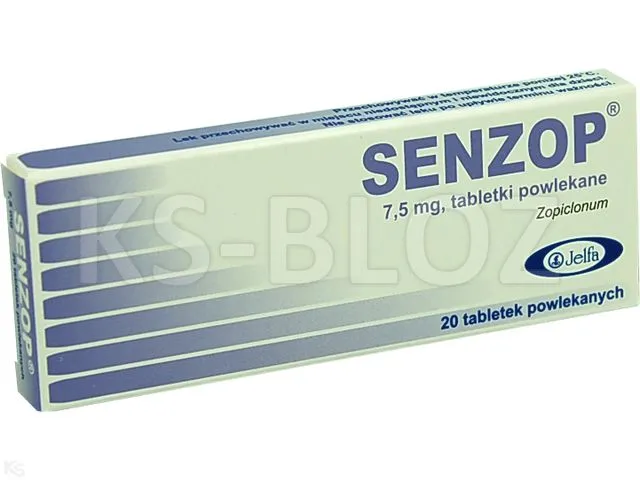
Table of Contents
SENZOP, 7.5 mg, coated tablets
(Zopiclone)
Please read this leaflet carefully before using the medicine, as it contains
important information for the patient.
- Keep this leaflet for future reference.
- If you have any questions, consult your doctor, pharmacist, or nurse.
- This medicine has been prescribed for a specific individual. Do not pass it on to others. The medicine may harm someone else, even if their symptoms are similar.
- If you experience any adverse reactions, including those not listed in this leaflet, inform your doctor, pharmacist, or nurse. See section 4.
Table of contents
- What Senzop is and what it is used for
- Important information before taking Senzop
- How to take Senzop
- Possible side effects
- How to store Senzop
- Contents of the pack and other information
1. What Senzop is and what it is used for
Senzop is a hypnotic agent belonging to the cyclopyrrolone class, acting similarly to benzodiazepines.
Senzop facilitates falling asleep, reduces the number of nocturnal awakenings, prolongs sleep duration, and improves both sleep quality and the sense of well-being upon waking. Like other hypnotics, zopiclone shortens stage I sleep (drowsiness) and prolongs stage II (light sleep); however, unlike other hypnotics, it also prolongs stages III and IV (deep sleep).
Indications
Short-term treatment of insomnia in adults – transient, short-term, or chronic (including difficulty falling asleep, fragmented sleep, and early morning awakening).
2. Important information before using Senzop
When not to use Senzop:
- if the patient is allergic to the active substance (zopiclone) or to any of the other ingredients of this medicine (listed in section 6);
- if the patient has muscle weakness ( myasthenia gravis) ;
- if the patient has severe sleep apnoea syndrome;
- if the patient has respiratory insufficiency;
- if the patient has severe hepatic insufficiency.
Warnings and precautions
Before starting treatment with Senzop, discuss this with your doctor, pharmacist or nurse.
Exercise caution when administering Senzop to patients:
- of advanced age;
- with psychiatric disorders;
- who are currently or have previously abused drugs;
- with hepatic or renal insufficiency;
- with acute respiratory insufficiency. In each of these cases, the doctor will recommend an appropriate dosage – see section 3 (How to use Senzop).
Since the hypnotic effect of Senzop occurs quickly (within 15 to 20 minutes), the dose should be taken shortly before going to bed. Senzop should not be used as the sole treatment for patients with psychosis or severe depression. In such patients, as well as in all patients with insomnia, the underlying disease and contributing factors should first be treated.
Psychiatric and paradoxical reactions have been observed in patients taking Senzop – see section 4 (Possible side effects).
Tolerance
The effectiveness of benzodiazepines and benzodiazepine-like drugs may decrease during continuous treatment lasting several weeks. However, use of Senzop for periods not exceeding 4 weeks has not been associated with the development of tolerance.
Dependence
The risk of dependence cannot be excluded. This risk increases with higher doses and longer duration of therapy. The risk of dependence should be considered in patients with a history of alcohol and/or drug abuse. If dependence develops, the doctor will recommend gradually discontinuing Senzop to avoid withdrawal symptoms.
Withdrawal symptoms include: headache, muscle pain, severe anxiety, tension, restlessness, confusion (disorientation), and irritability. In severe cases, the following symptoms may occur: derealization (feeling of environmental strangeness), depersonalization (loss of self-identity), hyperacusis (increased sensitivity to sound), numbness and tingling in the extremities, hypersensitivity to light, noise and physical contact, hallucinations, or epileptic seizures.
If treatment lasted no more than 4 weeks, the occurrence of withdrawal symptoms upon discontinuation is unlikely, although patients may still benefit from a gradual tapering off of therapy.
During regular use of benzodiazepines and similar short-acting drugs, withdrawal symptoms may occur between doses, especially if the doses were high.
Rebound insomnia
This is a transient event characterized by the recurrence of symptoms that led to the initiation of treatment with benzodiazepines or benzodiazepine-like drugs. These symptoms may return in an intensified form after stopping treatment.
Other symptoms may also occur: mood changes, anxiety, and agitation. Since the risk of withdrawal symptoms and rebound insomnia is greater after prolonged treatment or abrupt discontinuation of the drug, gradual dose reduction is recommended.
Amnesia
Anterograde amnesia (memory loss) may occur. To reduce the risk of amnesia, patients should take the tablets only immediately before going to bed and ensure uninterrupted sleep for 7–8 hours.
Sleepwalking and similar behaviours
In patients taking zopiclone who do not fully awaken, the following disorders may occur: sleepwalking and associated behavioural disturbances such as driving while asleep, preparing and eating food, making phone calls during sleep, with no memory of these activities.
Consumption of alcohol or concomitant use of drugs that depress the central nervous system increases the risk of such behaviours, as does using zopiclone at doses exceeding the maximum recommended dose. Patients reporting such behaviours should discontinue zopiclone.
Children and adolescents
The safety and efficacy of Senzop in children and adolescents under 18 years of age have not been established.
Senzop and other medicines
Inform your doctor or pharmacist about all medicines currently or recently used, as well as any medicines you plan to use.
The following medicines may enhance the central nervous system (CNS) depressant effect of Senzop:
- other hypnotics;
- antipsychotics;
- anxiolytics;
- antidepressants;
- antiepileptics;
- antihistamines (used for allergies) that have sedative effects;
- narcotic analgesics, including opioids and morphine derivatives (used as painkillers, antitussives, and in substitution therapy for withdrawal symptoms).
Medicines that accelerate gastric emptying may affect the absorption of Senzop.
Medicines such as ketoconazole, erythromycin, clarithromycin, itraconazole, ritonavir and nefazodone, which inhibit the metabolism of zopiclone in the body, may intensify its effects.
Erythromycin accelerates the absorption of zopiclone and may enhance its hypnotic effect.
The blood concentration of zopiclone may be reduced when used concomitantly with the following medicines:
- rifampicin;
- carbamazepine, phenobarbital, phenytoin (antiepileptic drugs);
- St John's wort ( Hypericum perforatum) . In such cases, the doctor may increase the dose of Senzop.
Concomitant use of Senzop and opioids (strong analgesics, medicines used in substitution therapy, and some antitussives) increases the risk of excessive drowsiness, breathing difficulties (respiratory depression), coma, and potentially life-threatening effects. Therefore, concomitant use of these medicines should only be considered when other treatment options are not feasible.
If the doctor prescribes Senzop together with opioids, the dose and duration of concurrent treatment should be limited.
Inform the doctor about all opioids being taken and strictly follow medical advice. It may be helpful to inform family members or close friends about the above symptoms. If such symptoms occur, contact the doctor immediately.
Senzop, food, drink and alcohol
Avoid consuming alcohol while taking Senzop. Alcohol enhances the sedative effect of zopiclone.
Pregnancy, breastfeeding and fertility
If the patient is pregnant or breastfeeding, suspects she may be pregnant, or is planning to have a child, she should consult her doctor or pharmacist before using this medicine.
Senzop should not be used during pregnancy or breastfeeding.
If the patient suspects she is pregnant or plans to become pregnant, she should contact her doctor to discontinue Senzop.
Driving and operating machinery
Due to its sedative effect, Senzop affects the ability to drive and operate machinery. Driving and performing tasks requiring special concentration should be avoided for at least 8 hours after taking the medicine.
Senzop contains monohydrate lactose. If the patient has been previously diagnosed with intolerance to certain sugars, the patient should consult a doctor before taking Senzop.
3. How to use Senzop
This medicine should always be used according to the instructions given by the doctor or pharmacist. In case of doubts,
consult a doctor or pharmacist.
The medicine should be taken just before bedtime.
The recommended dose is 7.5 mg, administered orally before bedtime. This dose should not be exceeded.
In elderly patients, and in patients with hepatic impairment or chronic respiratory insufficiency, treatment should be initiated at a dose of 3.75 mg (½ tablet). The dose may be increased to 7.5 mg (1 tablet) only if necessary and if the patient tolerates the medicine well.
Although there is no accumulation of zopiclone in the body in renal impairment, it is nevertheless recommended to initiate treatment at a dose of 3.75 mg (½ tablet) per day in such cases.
The score line on the tablet facilitates dividing it into equal doses.
Use in children and adolescents
The safe and effective dose of the medicine has not been established in children and adolescents under 18 years of age.
Method of administration: swallow the tablets whole without chewing, with a small amount of liquid. Take in the evening,
immediately before sleep.
Duration of treatment :
- transient insomnia: 2 to 5 days;
- short-term insomnia: 2 to 3 weeks.
Use of a higher than recommended dose of Senzop
Overdose manifests as central nervous system depression: drowsiness, dizziness, confusion, lethargy,
decreased arterial blood pressure, respiratory disturbances, coma, ataxia (lack of coordination), and loss of consciousness, depending on the dose. Overdose is usually not life-threatening unless it occurs in combination with other agents that depress the CNS (including alcohol).
Other risk factors, such as concomitant illness or poor general condition of the patient, may contribute to worsening of symptoms. Very rarely, these may lead to death.
Treatment of overdose consists of administering activated charcoal as soon as possible. Particular attention should be paid to respiratory and cardiovascular function. Flumazenil may be administered as an antidote. Hemodialysis is not effective in treating zopiclone overdose. Gastric lavage may be useful only if performed immediately after ingestion of zopiclone.
Missed dose of Senzop
Do not take a double dose to make up for a missed dose.
Discontinuation of Senzop
Withdrawal symptoms and rebound insomnia may occur, particularly after long-term use or abrupt discontinuation of zopiclone. For this reason, gradual dose reduction is recommended.
If you have any further doubts regarding the use of this medicine, consult your doctor, pharmacist, or nurse.
4. Possible adverse reactions
Like all medicines, this medicine can cause adverse reactions, although not everyone experiences them.
The most common adverse reactions associated with zopiclone use are bitter taste, dryness of the oral mucosa, and morning drowsiness after the administered dose.
Adverse reactions may occur with the following frequencies:
- very common: (occur in more than 1 in 10 people);
- common: (occur in 1 to 10 in 100 people);
- uncommon: (occur in 1 to 10 in 1,000 people);
- rare: (occur in 1 to 10 in 10,000 people);
- very rare: (occur in less than 1 in 10,000 people);
- unknown: (frequency cannot be estimated from available data).
Gastrointestinal disorders:
common: bitter or metallic taste in the mouth, dryness of the oral mucosa;
uncommon: nausea, vomiting, dyspepsia.
General disorders and administration site conditions:
common: next-day morning fatigue;
uncommon: headache, dizziness;
rare: generalized allergic reactions;
very rare: angioedema.
Psychiatric disorders:
rare: withdrawal symptoms, rebound insomnia or worsening of insomnia, worsening of depression;
very rare: anterograde amnesia, nightmares, hallucinations and behavioural disturbances such as irritability, aggression, confusion or depression, disturbances of sexual drive, psychic and paradoxical reactions, psychotic symptoms and irrational behaviour possibly related to amnesia.
Skin and subcutaneous tissue disorders:
rare: rash, pruritus;
very rare: anaphylactic reactions.
Investigations:
very rare: slight or moderate increase in aminotransferase and (or) alkaline phosphatase activity.
Reporting of adverse reactions
If any adverse reactions occur, including any adverse reactions not listed in this leaflet, inform your doctor or pharmacist. Adverse reactions can be reported directly to the Department of Monitoring Adverse Drug Reactions of the Office for Registration of Medicinal Products, Medical Devices and Biocidal Products.
Al. Jerozolimskie 181C
02-222 Warsaw
Phone: +48 22 49 21 301
Fax: +48 22 49 21 309
Website: https://smz.ezdrowie.gov.pl
Adverse reactions can also be reported to the marketing authorization holder.
Reporting adverse reactions helps to provide more information on the safety of the medicine.
5. How to store Senzop medicine
Store below 25 °C.
Keep the medicine out of sight and reach of children.
Do not use this medicine after the expiry date stated on the packaging after the words: Expiry
date. The expiry date refers to the last day of the stated month.
Medicines must not be disposed of via wastewater or household waste. Ask your pharmacist how to dispose of medicines no longer in use. Proper disposal helps protect the environment.
6. Contents of the pack and other information
What Senzop contains
- The active substance is zopiclone. One coated tablet contains 7.5 mg of zopiclone.
- The other ingredients are: calcium hydrogen phosphate dihydrate, lactose monohydrate, maize starch, sodium carboxymethyl starch (type A), magnesium stearate.
Coating ingredients: hypromellose, propylene glycol, talc, titanium dioxide (E 171).
What Senzop looks like and contents of the pack
Senzop is a white, round, biconvex coated tablet.
On one side of the coated tablet there is a score line allowing the tablet to be divided.
The pack contains 20 coated tablets.
Marketing Authorisation Holder and Manufacturer
Marketing Authorisation Holder
Bausch Health Ireland Limited
3013 Lake Drive
Citywest Business Campus
Dublin 24, D24PPT3
Ireland
Manufacturer
Przedsiębiorstwo Farmaceutyczne Jelfa SA
ul. Wincentego Pola 21
58-500 Jelenia Góra
Poland