Salbutamol wzf
Poland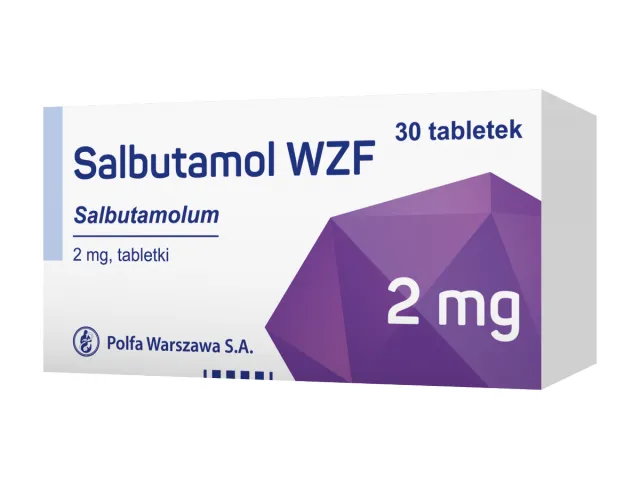
Table of Contents
Patient Information Leaflet
SALBUTAMOL WZF 2 mg tablets
SALBUTAMOL WZF 4 mg tablets
Salbutamolum
Please read all of this leaflet carefully before taking this medicine, because it contains
important information for you.
- Keep this leaflet. You may need to read it again.
- If you have any further questions, please ask your doctor, pharmacist, or nurse.
- This medicine has been prescribed for a specific individual. Do not pass it on to others. It may harm other people, even if their symptoms are the same.
- If you experience any side effects, including any not listed in this leaflet, tell your doctor, pharmacist, or nurse. See section 4.
Leaflet Contents
- What Salbutamol WZF is and what it is used for
- What you need to know before taking Salbutamol WZF
- How to take Salbutamol WZF
- Possible side effects
- How to store Salbutamol WZF
- Contents of the pack and other information
1. What Salbutamol WZF is and what it is used for
Salbutamol WZF belongs to a group of medicines called beta-adrenergic agonists. It causes relaxation of the muscles in the bronchi and airways.
Salbutamol WZF is used:
- in asthma;
- in bronchospasm and (or) reversible obstructive airway conditions.
Salbutamol WZF is indicated for use in adults and children aged 6 years and older.
2. Important information before using Salbutamol WZF
When not to use Salbutamol WZF
- If the patient is allergic to salbutamol sulfate or any of the other ingredients of this medicine (listed in section 6).
- Although salbutamol in the form of injection solution is used in uncomplicated preterm labour, it should not be used in threatened abortion.
Warnings and precautions
Before starting treatment with Salbutamol WZF, discuss this with your doctor or pharmacist.
When to exercise special caution when using Salbutamol WZF
- If the patient has any of the health problems listed below, they should inform their doctor before taking the medicine:
- heart diseases and circulatory disorders (symptoms such as chest pain, cardiac hypoxia, rapid or irregular heartbeat, shortness of breath, high blood pressure, tachycardia),
- hyperthyroidism,
- epilepsy,
- diabetes (elevated blood glucose levels).
- In elderly patients.
- If Salbutamol WZF is used as the sole or primary medication in patients with severe or unstable asthma, there is a risk of severe asthma attack.
- If the patient develops signs of allergy during treatment with Salbutamol WZF, such as bronchospasm, throat swelling, or skin rash, hives—especially in children—contact a doctor immediately—see section 4. "Possible side effects".
- The dose and frequency of administration must not be increased without prior consultation with a doctor.
Children
Caution should be exercised when administering high doses of salbutamol. If adverse reactions occur, discontinue the medication and contact a doctor.
Salbutamol WZF and other medicines
Inform your doctor or pharmacist about all medicines currently used, recently used, or planned for use.
- Salbutamol WZF must not be used concurrently with other bronchodilators administered orally or intravenously, as this may cause severe cardiovascular adverse effects, such as rapid or irregular heartbeat.
- Salbutamol WZF should be used only after consultation with a doctor:
- with drugs used for arrhythmia or excessively rapid heart rate (such as digoxin);
- with beta-adrenergic receptor blocking agents (such as atenolol or propranolol), including ophthalmic formulations (e.g. timolol), as this may cause bronchospasm in asthmatic patients;
- with xanthine derivatives (e.g. theophylline or aminophylline);
- with diuretics, especially those causing potassium loss (e.g. furosemide);
- with corticosteroids (e.g. prednisolone);
- with antidiabetic drugs used to lower blood glucose (e.g. insulin, metformin or glibenclamide);
- with antidepressants, including monoamine oxidase inhibitors (MAOIs) and tricyclic antidepressants;
- with other inhaled bronchodilators.
- When Salbutamol WZF and digoxin (a cardiac medication) are used concurrently, the doctor may recommend monitoring digoxin blood levels.
If a surgical procedure under general anaesthesia is planned, the treating physician will discontinue Salbutamol WZF 6 hours before the procedure, if possible, to prevent adverse effects (e.g. cardiac arrhythmia).
Pregnancy and breastfeeding
If the patient is pregnant or breastfeeding, suspects she may be pregnant, or is planning to become pregnant, she should consult a doctor before using this medicine.
The drug inhibits uterine contractions and may interfere with labour.
The doctor may recommend using Salbutamol WZF during pregnancy only if, in their opinion, the benefit to the mother outweighs the potential risk to the fetus.
Salbutamol is likely to pass into breast milk. If treatment is necessary, the patient should discontinue breastfeeding.
Driving and operating machinery
There are no data on the effect of salbutamol on driving or operating machinery.
Salbutamol WZF contains lactose
If the patient has previously been diagnosed with intolerance to certain sugars, they should consult a doctor before taking this medicine.
3. How to use Salbutamol WZF
This medicine should always be used exactly as directed by the physician. In case of doubt, consult
your doctor or pharmacist.
The usual doses are as follows:
Adults and children over 12 years of age
Initial dose: 2 mg to 4 mg, up to three to four times daily.
If necessary, the initial dose may be repeated, but at least a 6-hour interval must be maintained
between doses. If the effect of these doses is inadequate, they may be gradually increased, but
doses higher than 8 mg four times daily should not be used.
If symptoms listed in section 4. "Possible side effects" occur during dose escalation,
administration of the medicine should be discontinued.
Single doses higher than 4 mg may be used only if there is no response to lower doses.
Elderly patients and patients with increased sensitivity to this medicine or to other medicines
with similar effects:
Initial dose: 2 mg, up to four times daily.
If the effect is inadequate, the physician may increase the dose to 8 mg three to four times daily.
The maximum daily dose of Salbutamol WZF is 32 mg.
Children aged 6 to 12 years
Initial dose: 2 mg, up to three to four times daily. If necessary, the initial dose may be repeated,
but at least a 6-hour interval must be maintained between doses.
If the effect is inadequate, the dose may be gradually increased, but doses higher than 6 mg
four times daily (24 mg) should not be used. If symptoms listed in section 4. "Possible side effects"
occur during dose escalation, administration of the medicine should be discontinued.
Use of a higher than recommended dose of Salbutamol WZF
After using a dose higher than recommended, the following may occur: chest pain, convulsions,
increased or decreased blood pressure, rapid heartbeat, irregular heartbeat, nervousness, headache,
dizziness, tremor, dryness of the oral mucosa, nausea, and insomnia. Use of the medicine should
be discontinued and medical advice should be sought immediately.
If no more than one hour has passed since taking the medicine, the physician may perform
gastric lavage. If necessary, the physician will administer appropriate treatment.
Missed dose of Salbutamol WZF
Do not use a double dose to make up for a missed dose.
Stopping Salbutamol WZF
If you have any further doubts regarding the use of this medicine, consult your doctor or pharmacist.
4. Possible adverse reactions
Like all medicines, this medicine can cause adverse reactions, although not everyone will experience them.
If the patient experiences the first symptoms of hypersensitivity (e.g. swelling of the face, lips, tongue,
throat, causing difficulty in breathing or swallowing, bronchospasm, acute
cardiovascular failure), medical advice must be sought immediately. Such symptoms
are very rare.
Very common (occurs in more than 1 in 10 people):
- tremor.
Common (occurs in less than 1 in 10 people):
- headache;
- increased heart rate (tachycardia), palpitations;
- muscle cramps.
Uncommon (occurs in less than 1 in 1,000 people):
- decreased blood potassium levels (hypokalaemia);
- peripheral vasodilation.
Rare (occurs in less than 1 in 10,000 people):
- heart rhythm disorders (including irregular heartbeat, rapid heartbeat, and extra heartbeats);
- hyperactivity;
- muscle stiffness;
- urticaria.
Rarely, chest pain (associated with heart conditions such as angina) may occur in some individuals. If such symptoms occur, the patient should not abruptly discontinue the medicine, but should contact their doctor as soon as possible.
Frequency not known (frequency cannot be estimated from available data):
- increased levels of sugar (glucose) and/or lactic acid in the blood;
- low blood pressure, which may cause a feeling of "emptiness in the head" or dizziness;
- fluid accumulation in the lungs (pulmonary oedema), which may cause breathing difficulties;
- sudden flushing of the face;
- hypotension.
Reporting of adverse reactions
If any adverse reactions occur, including any adverse reactions not listed in this leaflet, inform your doctor, pharmacist, or nurse. Adverse reactions can be reported directly to the Department for Monitoring Adverse Drug Reactions of the Office for Registration of Medicinal Products, Medical Devices and Biocidal Products
Al. Jerozolimskie 181C
02-222 Warsaw
Tel.: + 48 22 49 21 301
Fax: + 48 22 49 21 309
Website: https://smz.ezdrowie.gov.pl
Adverse reactions can also be reported to the marketing authorisation holder.
Reporting adverse reactions helps provide more information on the safety of the medicine.
5. How to store Salbutamol WZF
Store below 25°C.
Keep blisters in the outer packaging to protect from light.
Keep out of the sight and reach of children.
Do not use this medicinal product after the expiry date stated on the carton and blister after: EXP.
The expiry date refers to the last day of the stated month.
The marking on the packaging following EXP indicates the expiry date, and following Lot/LOT indicates the batch number.
Medicines should not be disposed of via wastewater or household waste. Ask your pharmacist how to dispose of medicines no longer required. This will help protect the environment.
6. Contents of the pack and other information
What Salbutamol WZF contains
- The active substance is salbutamol in the form of salbutamol sulfate. Each tablet contains either 2 mg or 4 mg of salbutamol.
- The other ingredients are: maize starch, monohydrate lactose, microcrystalline cellulose, magnesium stearate.
What Salbutamol WZF looks like and contents of the pack
Salbutamol WZF 2 mg are white, round, flat tablets, with a score line on one side and the letter "S" below it.
The pack contains 30 tablets in 2 aluminum/PVC blisters of 15 tablets each, placed in a cardboard box.
Salbutamol WZF 4 mg are white, round, flat tablets, with a score line on one side, the number "4" above it and the letter "S" below it.
The pack contains 25 tablets in 1 aluminum/PVC blister, placed in a cardboard box.
Marketing Authorisation Holder
Zakłady Farmaceutyczne POLPHARMA S.A.
ul. Pelplińska 19, 83-200 Starogard Gdański
tel. + 48 22 364 61 01
Manufacturer
Zakłady Farmaceutyczne POLPHARMA S.A.
Production Site in Nowa Dęba
ul. Metalowca 2, 39-460 Nowa Dęba