Rivastigmine orion
Poland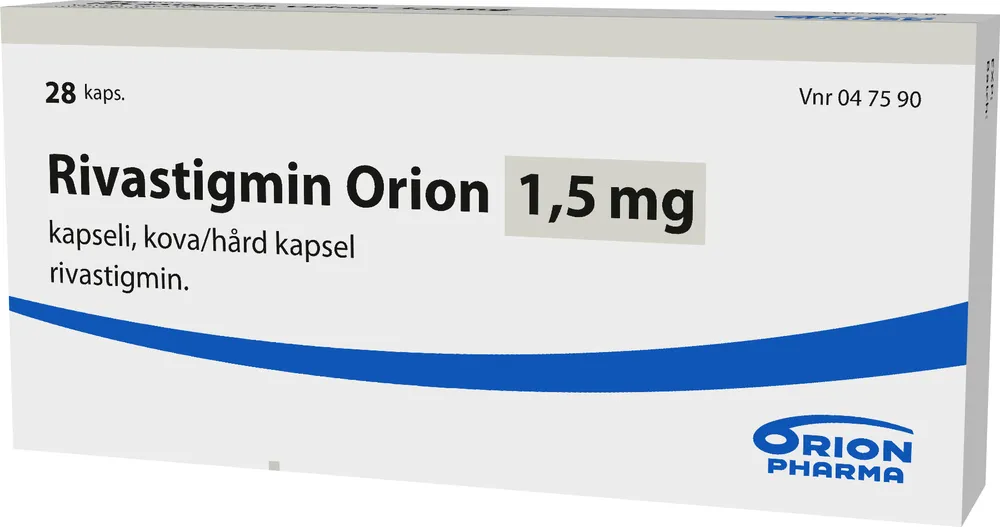
Table of Contents
Package leaflet: Information for the user
Rivastigmin Orion, 1.5 mg, hard capsules
Rivastigmin Orion, 3 mg, hard capsules
Rivastigmin Orion, 4.5 mg, hard capsules
Rivastigmin Orion, 6 mg, hard capsules
Rivastigminum
Please read all of this leaflet carefully before taking this medicine, because it contains
important information for the patient.
- Keep this leaflet, as you may need to read it again.
- If you have any further questions, ask your doctor, pharmacist, or nurse.
- This medicine has been prescribed for a specific individual. Do not pass it on to others. It may harm other people, even if their symptoms are the same.
- If the patient experiences any adverse reactions, including any not listed in this leaflet, inform the doctor, pharmacist, or nurse. See section 4.
Contents of the leaflet:
- What Rivastigmin Orion is and what it is used for
- Important information before taking Rivastigmin Orion
- How to take Rivastigmin Orion
- Possible side effects
- How to store Rivastigmin Orion
- Contents of the pack and other information
1. What Rivastigmin Orion is and what it is used for
The active substance in Rivastigmin Orion is rivastigmine.
Rivastigmin Orion belongs to a group of medicines called cholinesterase inhibitors. In patients
with Alzheimer's type dementia or dementia associated with Parkinson's disease, certain brain
cells degenerate, leading to reduced levels of the neurotransmitter acetylcholine (a substance
that enables nerve cells to communicate with each other). Rivastigmine works by inhibiting
the enzymes that break down acetylcholine: acetylcholinesterase and butyrylcholinesterase.
By inhibiting these enzymes, Rivastigmin Orion increases the concentration of acetylcholine
in the brain, which helps to alleviate symptoms of Alzheimer's disease and dementia associated
with Parkinson's disease.
Rivastigmin Orion is used in the treatment of adult patients with mild to moderate Alzheimer's
type dementia, a progressive brain disorder causing gradual impairments in memory, intellectual
abilities, and behaviour. The capsules may also be used in the treatment of dementia in adult
patients with Parkinson's disease.
2. Information before using Rivastigmin Orion
When not to use Rivastigmin Orion
- if the patient is allergic to rivastigmine (the active substance in Rivastigmin Orion) or to any of the other ingredients of this medicine (listed in section 6)
- if the patient has previously experienced a skin reaction indicating allergic contact dermatitis related to the use of rivastigmine.
If this applies to the patient, tell the doctor and do not use Rivastigmin Orion.
Warnings and precautions
Before starting treatment with Rivastigmin Orion, discuss the following with the doctor:
- if the patient has or has ever had heart conditions, such as irregular or slow heartbeat, QT prolongation, familial QT prolongation, torsade de pointes, or low levels of potassium or magnesium in the blood;
- if the patient has or has ever had active peptic ulcer
- if the patient has or has ever had difficulty passing urine
- if the patient has or has ever had seizures (convulsions or fits)
- if the patient has or has ever had bronchial asthma or severe respiratory disease
- if the patient has or has ever had kidney function disorders
- if the patient has or has ever had liver function disorders
- if the patient has muscle tremors
- if the patient has low body weight
- if the patient experiences gastrointestinal reactions such as nausea, vomiting, and diarrhoea. The patient may become dehydrated (losing too much fluid) if vomiting or diarrhoea persists for a prolonged period.
If any of the above apply, the doctor may need to monitor the patient more closely during treatment.
If the patient has stopped taking Rivastigmin Orion for more than three days, the patient should not take another dose until discussing it with the doctor.
Children and adolescents
Rivastigmin Orion is not appropriate for use in children and adolescents for the treatment of Alzheimer's type dementia.
Rivastigmin Orion and other medicines
Tell the doctor about all medicines the patient is currently taking or has recently taken, as well as any medicines the patient plans to take.
Rivastigmin Orion should not be administered concurrently with other medicines having similar actions.
Rivastigmin Orion may interact with anticholinergic medicines (medicines used to relieve stomach cramps or spasms, in Parkinson's disease, or to prevent motion sickness).
Rivastigmin Orion should not be used at the same time as metoclopramide (a medicine used to relieve or prevent nausea and vomiting). Concomitant use of these two medicines may cause adverse effects such as limb rigidity and hand tremors.
If the patient needs to undergo surgery while taking Rivastigmin Orion, inform the doctor about the use of rivastigmine before receiving any anaesthetics, because Rivastigmin Orion may enhance the effect of certain muscle relaxants used during anaesthesia.
Caution is advised when Rivastigmin Orion is used together with beta-blockers (medicines such as atenolol used in the treatment of hypertension, angina pectoris, and other heart conditions). Concomitant use of these two medicines may lead to adverse effects such as slowing of the heart rate (bradycardia), which may result in fainting or loss of consciousness.
Caution is advised when Rivastigmin Orion is used together with other medicines that may affect heart rhythm or the cardiac conduction system (QT prolongation).
Pregnancy, breastfeeding and fertility
If the patient is pregnant or breastfeeding, suspects she may be pregnant, or is planning to have a baby, she should consult her doctor or pharmacist before using this medicine.
If the patient is pregnant, the benefits of using Rivastigmin Orion should be weighed against the possible risks to the unborn child. Rivastigmin Orion should not be used during pregnancy unless clearly necessary.
Breastfeeding is not recommended while taking Rivastigmin Orion.
Driving and using machines
The doctor will advise the patient whether their condition allows safe driving and operating machinery. Rivastigmin Orion may cause dizziness and drowsiness, particularly during the initial period of treatment or during dose escalation. If the patient experiences dizziness or drowsiness, the patient should not drive, operate machinery, or perform any other tasks requiring concentration.
3. How to use Rivastigmin Orion
This medicine should always be used exactly as your doctor has told you. If in doubt, consult your
doctor, pharmacist, or nurse.
How to start treatment
- Your doctor will determine the dose of Rivastigmin Orion you should take.
- Treatment usually starts with a low dose.
- Your doctor will gradually increase the dose, depending on your response to treatment.
- The maximum dose that can be taken is 6 mg twice daily.
Your doctor will regularly check whether the medicine is working for you. While taking this medicine,
your doctor will also monitor your body weight.
If you have stopped taking Rivastigmin Orion for more than three days, consult your doctor before
taking the next dose.
Patients using this medicine
- Should inform their caregiver that they are taking Rivastigmin Orion.
- Should take the medicine every day to achieve the desired therapeutic effect.
- Rivastigmin Orion should be taken twice daily (in the morning and evening) with food.
- Capsules should be swallowed whole with liquid.
- Do not open or crush the capsules.
Taking more Rivastigmin Orion than prescribed
If you accidentally take more Rivastigmin Orion than prescribed, inform your doctor immediately,
as medical assistance may be needed.
In some people who have accidentally taken too much Rivastigmin Orion, nausea, vomiting, diarrhoea,
high blood pressure, and hallucinations have been observed. Slow heartbeat and fainting may also occur.
If you miss a dose of Rivastigmin Orion
If you accidentally miss a dose of Rivastigmin Orion, wait and take the next dose at your usual
scheduled time. Do not take a double dose to make up for a missed dose.
If you have any further questions about the use of this medicine, consult your doctor or pharmacist.
4. Possible adverse effects
Like all medicines, this medicine can cause adverse effects, although not everyone will experience them.
Adverse effects may occur more frequently during the initial period of treatment or during dose escalation.
Adverse effects usually gradually diminish as the body adapts to the treatment.
Very common (may affect more than 1 in 10 people)
- dizziness
- loss of appetite
- stomach problems such as nausea or vomiting, diarrhoea
Common (may affect up to 1 in 10 people)
- anxiety
- sweating
- headache
- heartburn
- weight loss
- abdominal pain
- restlessness
- feeling tired or weak
- general malaise
- tremor or confusion
- reduced appetite
- nightmares
Uncommon (may affect up to 1 in 100 people)
- depression
- difficulty sleeping
- fainting or accidental falls
- changes in liver function
Rare (may affect up to 1 in 1,000 people)
- chest pain
- rash, itching
- seizures (convulsions)
- peptic ulcer of the stomach or intestines
Very rare (may affect up to 1 in 10,000 people)
- high blood pressure
- urinary tract infections
- seeing things that are not there (hallucinations)
- heart rhythm disorders such as fast or slow heartbeat
- gastrointestinal bleeding – blood in stool or vomit
- pancreatitis – symptoms include severe pain in the upper abdomen, often with nausea or vomiting
- worsening of Parkinson's disease symptoms or development of similar symptoms – such as muscle rigidity, difficulty performing voluntary movements
Frequency not known (cannot be estimated from available data)
- severe vomiting, which may lead to rupture of the oesophagus (the part of the digestive tract connecting the mouth to the stomach)
- dehydration (loss of too much fluid)
- liver function disorders (yellowing of the skin, yellowing of the whites of the eyes, abnormally dark urine, or unexplained nausea, vomiting, fatigue and loss of appetite)
- aggression, restlessness
- irregular heartbeat
- Pisa syndrome (a condition involving involuntary muscle contractions with abnormal tilting of the body and head to one side)
Patients with dementia and Parkinson's disease
In these patients, certain adverse effects occur more frequently. Other additional symptoms may also occur:
Very common (may affect more than 1 in 10 people)
- tremor
- fainting
- accidental falls
Common (may affect up to 1 in 10 people)
- anxiety
- restlessness
- slow and fast heartbeat
- difficulty sleeping
- excessive salivation and dehydration
- abnormal slowing of movements or poor control of movements
- worsening of Parkinson's disease symptoms or development of similar symptoms – such as muscle rigidity, difficulty performing voluntary movements, and muscle weakness
Uncommon (may affect up to 1 in 100 people)
- irregular heartbeat and poor control of movements
Not known (frequency cannot be estimated from available data)
- Pisa syndrome (a condition involving involuntary muscle contractions with abnormal tilting of the body and head to one side)
Other adverse effects observed with rivastigmine administered as a transdermal patch, which may also occur with the use of hard capsules:
Common (may affect up to 1 in 10 people)
- fever
- severe confusion
- urinary incontinence (inability to properly control urine)
Uncommon (may affect up to 1 in 100 people)
- hyperactivity (high level of activity, restlessness)
Frequency not known (cannot be estimated from available data)
- allergic skin reaction at the application site, such as blisters or skin inflammation
If any of the above symptoms occur, contact a doctor, as medical help may be needed.
Reporting of adverse effects
If any adverse effects occur, including any not listed in this leaflet, inform your doctor or pharmacist. Adverse effects can be reported directly to the Department of Monitoring Adverse Drug Reactions, Office for Registration of Medicinal Products, Medical Devices and Biocidal Products,
Al. Jerozolimskie 181 C, 02-222 Warsaw, Tel.: +48 22 49 21 301,
Fax: +48 22 49 21 309. Website: https://smz.ezdrowie.gov.pl
Adverse effects can also be reported to the marketing authorisation holder.
Reporting adverse effects helps to provide more information on the safety of the medicine.
5. How to store Rivastigmin Orion
- Keep this medicine out of sight and reach of children.
- Do not use this medicine after the expiry date stated on the blister and carton after "EXP". The expiry date refers to the last day of that month.
- This medicine does not require any special storage conditions.
- Medicines must not be disposed of via wastewater or household waste. Ask your pharmacist how to dispose of medicines no longer required. These measures will help protect the environment.
6. Contents of the pack and other information
What Rivastigmin Orion contains
- The active substance is rivastigmine. Each hard capsule of Rivastigmin Orion contains 1.5 mg of rivastigmine in the form of rivastigmine hydrogen tartrate. Each hard capsule of Rivastigmin Orion contains 3.0 mg of rivastigmine in the form of rivastigmine hydrogen tartrate. Each hard capsule of Rivastigmin Orion contains 4.5 mg of rivastigmine in the form of rivastigmine hydrogen tartrate. Each hard capsule of Rivastigmin Orion contains 6.0 mg of rivastigmine in the form of rivastigmine hydrogen tartrate.
- The other ingredients of the capsule are: magnesium stearate, hypromellose, microcrystalline cellulose, colloidal anhydrous silica. The ingredients of the capsule shell (body and cap) are: gelatin, sodium lauryl sulfate, yellow iron oxide (E 172), titanium dioxide (E 171), and red iron oxide (E 172) (in 3.0 mg, 4.5 mg, and 6.0 mg capsules).
What Rivastigmin Orion looks like and contents of the pack
Hard capsule.
Rivastigmin Orion 1.5 mg hard capsule is yellow, 3 mg hard capsule is orange,
4.5 mg hard capsule is red, 6 mg hard capsule is half red and half orange.
The hard opaque capsules contain a powder ranging from almost white to light yellow.
They are packed in PVC/PVdC/Aluminium blisters. Packs containing 28, 56 hard capsules.
Additionally, only for Rivastigmin Orion 3 mg, 4.5 mg, 6 mg hard capsules: pack of 112 hard capsules.
Not all pack sizes may be marketed.
Marketing Authorisation Holder
Orion Corporation
Orionintie 1
FI-02200 Espoo
Finland
Manufacturer
Orion Corporation Orion Pharma
Orionintie 1
FI-02200 Espoo
Finland
Orion Corporation Orion Pharma
Joensuunkatu 7
FI-24100 Salo
Finland
For further information about this medicinal product, please contact the local representative of the Marketing Authorisation Holder:
Orion Pharma Poland Sp. z o.o.
[email protected]
This medicinal product is authorised in the Member States of the European Economic Area under the following names:
Denmark, Finland, Norway, Poland, Sweden: Rivastigmin Orion