Rhesonativ
Poland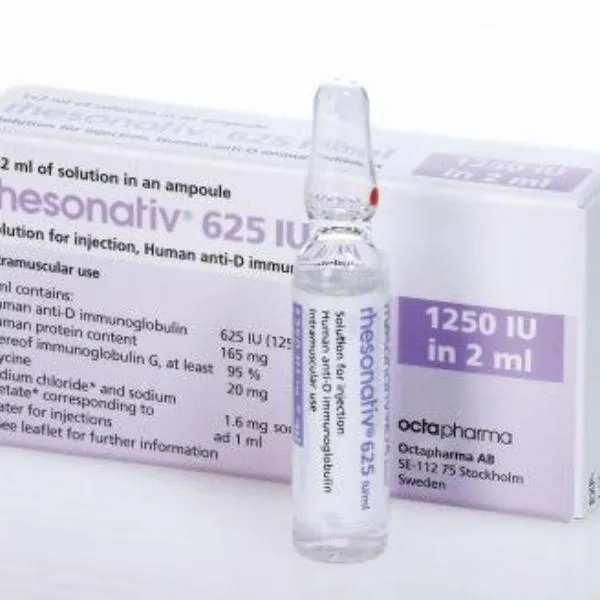
Table of Contents
- Package leaflet: Information for the user
- 1. What Rhesonativ is and what it is used for
- 2. Important information before using Rhesonativ
- 3. How to use Rhesonativ
- 4. Possible adverse reactions
- 5. How to store Rhesonativ
- 6. Contents of the pack and other information
- Information intended exclusively for medical professionals:
Package leaflet: Information for the user
Rhesonativ, 750 IU/ml, solution for injection
Human anti-D immunoglobulin
Please read all of this leaflet carefully before using this medicine, because it contains
important information for you.
Keep this leaflet as you may need to read it again.
If you have any further questions, ask your doctor, pharmacist, or nurse.
This medicine has been prescribed for a specific individual. Do not pass it on to others. It may
harm someone else, even if their symptoms are the same as yours.
If you experience any side effects, including any not listed in this leaflet, tell your doctor,
pharmacist, or nurse. See section 4.
Contents of the leaflet
- What Rhesonativ is and what it is used for
- What you need to know before using Rhesonativ
- How to use Rhesonativ
- Possible side effects
- How to store Rhesonativ
- Contents of the pack and other information
1. What Rhesonativ is and what it is used for
Rhesonativ is an immunoglobulin and contains antibodies against the Rhesus factor. If a woman
who does not have the Rhesus factor on her red blood cells (Rh-negative) is pregnant and her
unborn child has the Rhesus factor (Rh-positive), her immune system may be stimulated to
produce antibodies against the Rhesus factor. These antibodies can harm the unborn child,
especially in subsequent pregnancies.
Rhesonativ is used to prevent Rh-negative women from becoming immunized during
pregnancy and childbirth, thereby preventing harm to the unborn child. Rhesonativ is used in
Rh-negative women in the following situations:
Prophylactic treatment of Rh-negative pregnant women to prevent Rh immunization;
Delivery of an Rh-positive baby;
Miscarriage or threatened miscarriage;
Ectopic pregnancy, certain uterine pathologies (e.g. hydatidiform mole), or in cases of bleeding
with fetal-maternal hemorrhage under normal maternal circulation conditions, or fetal death in
a later stage of pregnancy;
Invasive procedures during pregnancy, such as amniocentesis (withdrawing amniotic fluid
using a syringe), fetal blood sampling from the umbilical vein, biopsies or manipulative
obstetric procedures (e.g. external cephalic version to improve fetal position), following
abdominal trauma, or intrauterine fetal surgery.
Rhesonativ may also be used in Rh-negative patients who have accidentally received Rh-positive blood transfusions.
2. Important information before using Rhesonativ
When not to use Rhesonativ:
if the patient is allergic to normal human immunoglobulin or to any of the other
components of this medicine (listed in section 6).
Warnings and precautions
Before starting treatment with Rhesonativ, discuss this with your doctor, pharmacist, or
nurse.
Inform your doctor about any other medical conditions.
Rhesonativ is not indicated for administration to Rh (D)-positive individuals or to individuals who have previously been immunized against Rh (D) antigen.
True hypersensitivity reactions (allergic reactions) are rare, but may occur.
If an allergic reaction or severe allergic reaction (anaphylactic reaction) is suspected, inform your doctor or nurse immediately. Symptoms of such reactions may include dizziness, rapid heartbeat, low blood pressure, difficulty breathing or swallowing, chest tightness, itching, generalized urticaria, swelling of the face, tongue, or throat, collapse, and rash. If any of the above symptoms occur, seek immediate medical attention.
If a patient experiences symptoms such as shortness of breath, pain and swelling in a limb, or chest pain, contact a doctor or nurse immediately, as these may be signs of blood clot formation.
Children
There is no available data on the use of this medicine in children.
Patients who are overweight
In patients who are overweight or obese, consider using an intravenous anti-D product.
Viral safety
For medicines derived from human blood or plasma, measures are taken to prevent transmission of infection to patients. These include:
careful selection of blood and plasma donors to exclude individuals who may be carriers of infection,
testing of individual donations and plasma pools for the presence of viruses/infections,
application of virus inactivation or removal methods during the processing of blood or plasma.
Despite these measures, when using medicines derived from human blood or plasma, it cannot be completely excluded that infection may be transmitted. This also applies to unknown or newly emerging viruses or other types of infections.
The methods used appear to be effective against enveloped viruses such as human immunodeficiency virus (HIV), hepatitis B virus, hepatitis C virus, and the non-enveloped hepatitis A virus.
These methods may have limited effectiveness against non-enveloped viruses such as parvovirus B19.
The use of immunoglobulin products has not been associated with hepatitis A or parvovirus B19 infection, possibly due to the presence of protective antibodies against these infections in these products.
In every case of Rhesonativ administration, it is recommended to record the product name and batch number for identification of the batches used.
Rhesonativ and other medicines
Tell your doctor or pharmacist about all medicines the patient is currently taking or has recently taken, as well as any medicines the patient plans to take.
Rhesonativ may reduce the effectiveness of vaccines such as measles, mumps, rubella, and varicella vaccines. This applies to vaccines administered approximately 2–4 weeks before the injection of any anti-D antibody, as well as to vaccinations given afterwards. After administration of Rhesonativ, vaccination with these vaccines should be performed after 3 months. Therefore, inform any doctor who intends to administer a vaccination about the use of Rhesonativ.
When blood is drawn for laboratory tests, inform the doctor about the use of immunoglobulins, as this treatment may affect laboratory test results.
Pregnancy and breastfeeding
Rhesonativ is intended for use during pregnancy and may be used during breastfeeding.
Driving and operating machinery
No influence on the ability to drive or operate machinery has been observed.
Rhesonativ contains sodium
This medicine contains less than 1 mmol (23 mg) of sodium per 1 ml (750 IU), meaning the medicine is considered "sodium-free".
3. How to use Rhesonativ
The need for administration of Rhesonativ and its dosage will be determined by a physician. Rhesonativ is administered via intramuscular injections (into the muscle) by medical personnel.
4. Possible adverse reactions
Like all medicines, this medicine can cause adverse reactions, although not everybody will get them.
The frequency of the following adverse reactions is unknown (frequency cannot be
estimated from the available data): headache, palpitations, hypotension,
wheezing, vomiting, nausea, skin reactions, joint pain, lower back pain,
dizziness, fever, feeling of discomfort, including chest discomfort, chills,
reactions at the injection site such as swelling and pain, decreased number of red blood cells, and
acute allergic reactions, including anaphylactic shock.
If any symptoms of anaphylactic shock occur, such as dizziness, nausea, vomiting, abdominal cramps, cough, difficulty breathing or swallowing, cyanosis, itching, urticaria, rash, rapid heartbeat, low blood pressure, swelling of the face, tongue or throat, collapse or chest pain, seek immediate medical assistance by contacting a doctor without delay.
Reporting of adverse reactions
If any adverse reactions occur, including any adverse reactions not listed in this leaflet, inform a doctor, pharmacist or nurse.
Adverse reactions can be reported directly to the Department of Monitoring Adverse Drug Reactions at the Office for Registration of Medicinal Products, Medical Devices and Biocidal Products
Al. Jerozolimskie 181C
02-222 Warsaw
Tel.: +48 22 49 21 301
Fax: +48 22 49 21 309
e-mail:
Adverse reactions can also be reported to the marketing authorization holder.
Reporting adverse reactions enables better assessment of the safety profile of the medicine.
5. How to store Rhesonativ
Keep this medicine out of sight and reach of children.
Store in a refrigerator (2°C – 8°C). Do not freeze. Keep the ampoule in the outer packaging to protect from light.
During its shelf life, the product may be stored at temperatures below 25°C for up to one month without the need to return it to the refrigerator; however, it must be discarded if not used within this period.
Do not use this medicine after the expiry date stated on the label and outer packaging after: EXP (abbreviation used to indicate expiry date). The expiry date refers to the last day of the stated month.
Medicines must not be disposed of via wastewater or household waste. Ask your pharmacist how to dispose of medicines no longer required. Such measures help protect the environment.
6. Contents of the pack and other information
What Rhesonativ contains
- The active substance is human anti-D immunoglobulin. 1 ml contains 750 IU (150 micrograms) of human anti-D immunoglobulin.
- One 1 ml vial contains 750 IU (150 micrograms) of human anti-D immunoglobulin. One 2 ml vial contains 1500 IU (300 micrograms) of human anti-D immunoglobulin.
- The total protein content is 165 mg, of which immunoglobulin G accounts for at least 95%.
- Other ingredients are: glycine, sodium chloride, sodium acetate, polysorbate 80, and water for injections.
What Rhesonativ looks like and contents of the pack
Rhesonativ is a solution for injection (750 IU/ml or 1500 IU/ml in a vial). Pack sizes: 1 vial of 1 ml and 1 vial of 2 ml. The solution may vary in colour from colourless to pale yellow or light brown. Not all pack sizes may be marketed.
Marketing Authorisation Holder and Manufacturer
Octapharma (IP) SPRL
Allée de la Recherche 65
1070 Anderlecht
Belgium
Manufacturer
Octapharma AB
Lars Forssells gata 23
112 75 Stockholm
Sweden
This medicinal product is authorised in the Member States of the European Economic Area under the following names:
| Member State | Medicinal product name |
| Bulgaria | Rhesonativ 750 IU/ml, solution for injection |
| Poland | Rhesonativ, 750 IU/ml, solution for injection |
| Portugal | Rhesonativ 750 UI/ml, solução injetável |
| Romania | Rhesonativ 750 UI/ml, solutie injectabila |
| Slovakia | Rhesonativ 750 IU/ml injekčný roztok |
| Slovenia | Rhesonativ 750 i.e./ml, raztopina za injiciranje |
| Sweden | Rhesonativ, 750 IE/ml injektionsvätska, lösning |
| Hungary | Rhesonativ 750 NE/ml oldatos injekció |
Information intended exclusively for medical professionals:
The product should be brought to room temperature or body temperature before use.
Do not use the solution if it is not homogeneous or contains particulate matter.
The contents of the vial should be used immediately after opening. Any unused medicinal product or
waste material must be disposed of in accordance with local regulations.
Rhesonativ must be administered intramuscularly. Before injection, the plunger of the syringe should be withdrawn to ensure that the needle is not located within a blood vessel.
If intramuscular administration is contraindicated (e.g. coagulation disorders), subcutaneous injection may be performed if an intravenous product is not available. In such case, gentle pressure should be applied with a swab at the injection site.
If larger volumes are required (more than 2 ml in children and more than 5 ml in adults), it is recommended to administer them as divided doses at different sites.
This medicinal product must not be mixed with other medicinal products.
In overweight or obese women, an intravenous anti-D product is recommended due to the potential lack of efficacy of intramuscular administration.