Rennie antacidum
Poland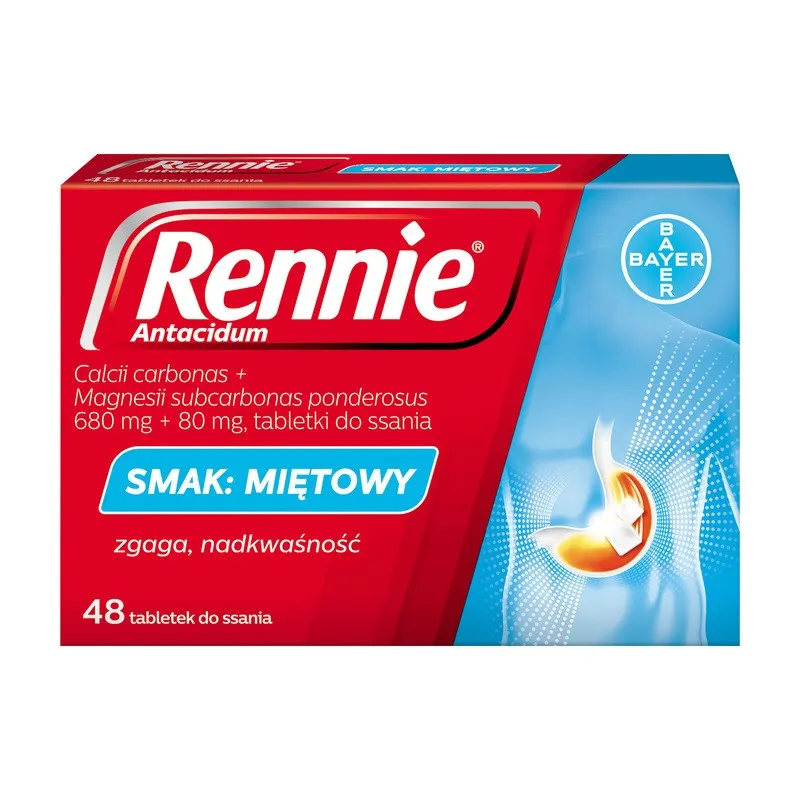
Table of Contents
Package leaflet: Information for the patient
Warning! Keep the leaflet, information on the immediate packaging in a foreign language!
Rennie Antacidum (Rennie)
680 mg + 80 mg, chewable tablets
Calcii carbonas + Magnesii subcarbonas ponderosus
Rennie Antacidum and Rennie are different trade names of the same medicine.
Please read the leaflet carefully before taking this medicine, as it contains
important information for the patient.
This medicine should always be taken exactly as described in this patient leaflet or as directed by
your doctor or pharmacist.
- Keep this leaflet, so that you can read it again if necessary.
- If you need advice or further information, please consult your pharmacist.
- If you experience any side effects, including any possible side effects not listed in this leaflet, tell your doctor, pharmacist or nurse. See section 4.
- If there is no improvement or if you feel worse after 7 days, you should contact your doctor.
Table of contents
- What Rennie Antacidum is and what it is used for
- Important information before taking Rennie Antacidum
- How to take Rennie Antacidum
- Possible side effects
- How to store Rennie Antacidum
- Contents of the pack and other information
1. What Rennie Antacidum is and what it is used for
Rennie Antacidum is a medicine that neutralizes excess hydrochloric acid in the stomach.
It contains two active substances: calcium carbonate and heavy magnesium carbonate.
Rennie Antacidum is used for symptomatic treatment of discomfort associated with gastric hyperacidity, such as:
- heartburn,
- indigestion,
- bloating,
- nausea,
- feeling of fullness or heaviness in the upper abdomen,
- belching.
2. Important information before using Rennie Antacidum
When not to use Rennie Antacidum:
- If the patient is allergic to the active substances or any of the other ingredients of the medicine (listed in section 6).
- If the patient has elevated calcium levels in the blood (hypercalcaemia).
- If the patient has calcium kidney stones (nephrolithiasis).
- If the patient has severe renal insufficiency.
- If the patient has low levels of inorganic phosphate in the blood (hypophosphataemia).
Warnings and precautions
Before starting to use Rennie Antacidum, discuss it with your doctor or pharmacist.
Exercise particular caution when using Rennie Antacidum if:
- the patient has renal insufficiency; in such cases, calcium, phosphate, and magnesium levels in the blood should be monitored regularly,
- the patient has excessive excretion of calcium in the urine (hypercalciuria),
- the patient is using the medicine long-term and in high doses; this may lead to (especially in patients with renal insufficiency) increased levels of magnesium and calcium in the blood, and to milk-alkali syndrome (a condition caused by excessive oral intake of calcium compounds). This may in turn cause nausea, vomiting, excessive urination, increased thirst, dehydration, fatigue, and disturbances in orientation and thinking (so-called confusion); increased risk of kidney stone formation; muscle weakness.
Rennie Antacidum with other medicines
Inform your doctor or pharmacist about all medicines the patient is currently taking, has recently taken, or plans to take.
Rennie Antacidum may affect the rate and extent of absorption of other medicines. Therefore, all medicines, especially those listed below, should be taken 1 or 2 hours before or after taking Rennie Antacidum:
- tetracycline antibiotics and other antibacterial agents – quinolones,
- cardiac glycosides, such as digoxin,
- bisphosphonates (used in the treatment of osteoporosis),
- dolutegravir (an antiretroviral medicine used in the treatment of HIV infection),
- levothyroxine (used, among others, in hypothyroidism),
- eltrombopag (used in the treatment of thrombocytopenia),
- phosphates,
- fluorides,
- iron preparations,
- thiazide diuretics. Due to the increased risk of hypercalcaemia when thiazide diuretics are used concomitantly, serum calcium levels should be monitored regularly.
Rennie Antacidum with food and drink
The medicine should be taken after meals. The medicine should not be taken with large amounts of milk or dairy products.
Pregnancy and breastfeeding
If the patient is pregnant or breastfeeding, suspects she may be pregnant, or is planning to have a child, she should consult a doctor or pharmacist before using this medicine. Rennie Antacidum may be used during pregnancy and breastfeeding. In such cases, recommended doses should be strictly followed and the medicine should be used according to indications. The medicine should not be used for longer than 2 weeks.
Driving and operating machinery
No effect.
Rennie Antacidum contains sucrose.
One tablet contains 475 mg of sucrose. This should be taken into account in patients with diabetes.
If the patient has previously been diagnosed with intolerance to certain sugars, the patient should consult a doctor before taking the medicine.
3. How to use Rennie Antacidum
This medicine should always be taken exactly as described in the patient leaflet or as directed by a doctor or pharmacist. If in doubt, consult a doctor or pharmacist.
Recommended dose
Adults and children over 12 years of age:
Take 1 to 2 tablets at a time, one hour after meals and before bedtime. Do not take more than 11 tablets per day.
Method of administration
- Administer orally; tablets may be sucked or chewed.
- In case of heartburn or pain associated with hyperacidity, an additional one or two tablets may be taken between regular dosing times.
- Prolonged use of the medicine should be avoided. Long-term use and high doses may lead to adverse effects (see section 4).
If symptoms do not improve within 7 days or improve only partially, consult a doctor, as further investigations are recommended to exclude a more serious condition.
Use in children
Rennie Antacidum should not be used in children under 12 years of age.
Accidental overdose of Rennie Antacidum
If more than the recommended dose is taken, discontinue the medicine and drink plenty of fluids.
The following overdose symptoms may occur:
- nausea, vomiting, muscle weakness, drowsiness. If symptoms are severe, seek medical advice, as additional rehydration methods (e.g. infusions) may be necessary.
4. Possible adverse reactions
Like all medicines, this medicine can cause adverse reactions, although not everybody will experience them.
Rennie Antacidum may cause the following adverse reactions:
- hypersensitivity reactions (very rarely reported); clinical symptoms may include: rash, urticaria, itching, angioedema, dyspnoea and anaphylactic shock;
- nausea, vomiting, gastric discomfort, constipation and diarrhoea;
- muscle weakness.
Prolonged use of high doses, particularly in patients with impaired renal function,
may lead to hypermagnesaemia (increased magnesium blood levels) or hypercalcaemia
(increased calcium blood levels) and alkalosis (increased alkaline levels in the blood).
Symptoms of the milk-alkali syndrome:
- taste disturbances;
- calcifications;
- weakness;
- headaches;
- increased nitrogen in the blood (azotaemia).
Reporting of adverse reactions
If any adverse reactions occur, including any not listed in this leaflet, inform your doctor, pharmacist or nurse. Adverse reactions can be reported directly to the Department for Monitoring Adverse Drug Reactions at the Office for Registration of Medicinal Products, Medical Devices and Biocidal Products: Al. Jerozolimskie 181C, 02-222 Warsaw, tel.: 22 49-21-301, fax: 22 49-21-309, website: https://smz.ezdrowie.gov.pl.
Reporting adverse reactions enables better assessment of the safety of the medicine.
5. How to store Rennie Antacidum
Keep this medicine out of the sight and reach of children.
Do not store above 25°C. Store in the original packaging to protect from moisture.
Do not use this medicine after the expiry date stated on the packaging. The expiry date refers to the last day of the stated month.
Medicines must not be disposed of via wastewater or household waste. Ask your pharmacist how to dispose of medicines no longer required. Such measures help protect the environment.
6. Contents of the pack and other information
What Rennie Antacidum contains
The active substances in this medicine are: calcium carbonate and heavy magnesium carbonate. Each tablet contains 680 mg of calcium carbonate and 80 mg of heavy magnesium carbonate.
The other components (excipients) are: sucrose, pregelatinized corn starch, potato starch, magnesium stearate, talc, light liquid paraffin, peppermint flavour (peppermint oil, maltodextrin, gum arabic, colloidal anhydrous silica), lemon flavour (flavouring agents – lemon oil, maltodextrin, α-tocopherol).
What Rennie Antacidum looks like and contents of the pack
The medicine is in the form of cream-white, square tablets with rounded edges, marked with the word "RENNIE" on both sides. The tablets are packed in blisters. The pack contains 12, 24, 36, 48, 60 or 96 chewable and suckable tablets.
For more detailed information, please contact the marketing authorisation holder or the parallel importer.
Marketing Authorisation Holder in the Netherlands, the country of export:
Bayer B.V.
Siriusdreef 36
2132 WT Hoofddorp
The Netherlands
Manufacturer:
Delpharm Gaillard
33, rue de l'Industrie
74240 Gaillard
France
Bayer Bitterfeld GmbH
Salegaster Chaussee 1
06803 Bitterfeld-Wolfen
Germany
Parallel Importer:
Medezin Sp. z o.o.
Zbąszyńska 3
91-342 Łódź
Poland
Repackaged by:
Medezin Sp. z o.o.
Zbąszyńska 3
91-342 Łódź
Poland
Marketing Authorisation Number in the Netherlands, the country of export: RVG 08892
Parallel Import Licence Number: 313/24