Relpax
Poland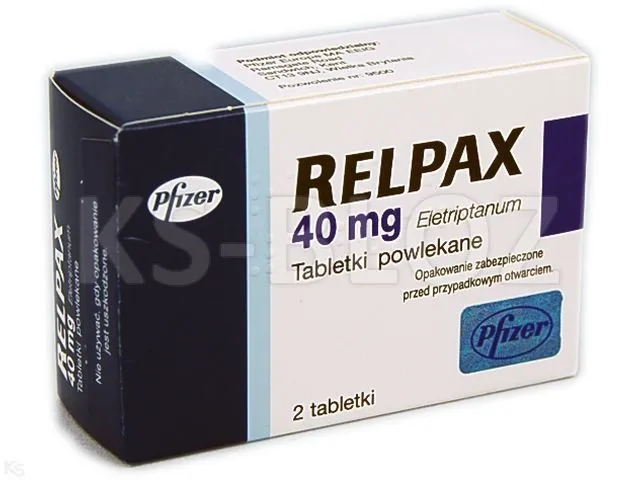
Table of Contents
Package leaflet: Information for the patient
Warning! Please keep the leaflet. Information on the immediate packaging is in a foreign language.
Relpax
40 mg, film-coated tablets
Eletriptanum
Please read carefully all the information in this leaflet before taking the medicine, as it contains
important information for the patient.
- Keep this leaflet, as you may need to read it again.
- If you have any questions, please consult your doctor or pharmacist.
- This medicine has been prescribed for a specific individual. Do not pass it on to others. The medicine may harm another person, even if their symptoms are the same.
- If you experience any adverse reactions, including any not listed in this leaflet, inform your doctor, pharmacist, or nurse. See section 4.
Table of contents of the leaflet
- What Relpax is and what it is used for
- Important information before taking Relpax
- How to take Relpax
- Possible side effects
- How to store Relpax
- Contents of the pack and other information
1. What Relpax is and what it is used for
Relpax contains the active substance eletriptan, which reduces the severity of migraine pain.
Relpax is indicated for the acute treatment of migraine attacks with or without aura.
Relpax is also effective in treating:
- symptoms associated with migraine attacks, such as vomiting, nausea, photophobia, and phonophobia,
- menstrually-related migraine,
- recurrent migraine headaches.
It has not been shown that Relpax administered during the migraine aura phase prevents the onset of headache.
Therefore, Relpax should be taken only during the migraine headache phase.
2. Important information before using Relpax
When not to use Relpax
- if the patient is allergic to the active substance or to any of the other ingredients of this medicine (listed in section 6);
- if the patient has severe hepatic or renal insufficiency;
- in cases of moderate to severe or uncontrolled mild arterial hypertension;
- if the patient has been diagnosed with coronary artery disease, including ischemic heart disease (angina pectoris, history of myocardial infarction, or confirmed asymptomatic ischemia);
- if the patient has coronary artery vasospasm, objective or subjective symptoms of ischemic heart disease, or Prinzmetal's angina;
- in the presence of clinically significant cardiac arrhythmias or heart failure;
- if peripheral vascular disease has been diagnosed;
- in case of history of stroke or transient ischemic attack (TIA);
- when concomitantly taking ergotamine or ergotamine derivatives (including methysergide) within 24 hours before or 24 hours after administration of eletriptan;
- when concomitantly taking other 5-HT receptor agonists.
Warnings and precautions
- in patients with probable, undiagnosed heart disease. Relpax should not be used without prior diagnostic evaluation;
- in patients with risk factors for coronary artery disease, such as: hypertension, diabetes, cigarette smoking or nicotine replacement therapy, male sex, age over 40 years, postmenopausal women, and patients with a family history of ischemic heart disease;
- in patients taking medications for depression and other psychiatric disorders, known as selective serotonin reuptake inhibitors (SSRIs) or serotonin-norepinephrine reuptake inhibitors (SNRIs). These medications may increase the risk of serotonin syndrome, which may manifest as agitation, disorientation, diarrhea, high body temperature and blood pressure, excessive sweating, tachycardia, and increased response to stimuli;
- when concomitantly taking triptans and herbal medicines containing St. John's wort (Hypericum perforatum);
- when using medications containing ergotamine (used, among others, in peripheral vascular disorders and migraine) or its derivatives (e.g. dihydroergotamine). An interval of 24 hours should be maintained between the last dose of these medications and administration of Relpax.
Relpax should only be used when migraine has been clearly diagnosed. Relpax
is not indicated for the treatment of hemiplegic migraine (during aura, transient hemiparesis occurs),
ophthalmoplegic migraine (after a migraine attack, ophthalmoplegia develops), or basilar migraine
(during aura, symptoms occur in the territory supplied by the basilar artery of the brain, such as:
diplopia, transient visual disturbances, speech disturbances, ataxia, sensation of numbness/tingling,
accompanied by transient loss of consciousness, followed by severe occipital pain with vomiting).
"Atypical" headaches should not be treated with Relpax, as they may be caused by serious conditions (e.g. stroke, aneurysm rupture), in which cerebral vasoconstriction could be harmful.
Transient, mild increases in blood pressure have been observed after therapeutic doses of Relpax (60 mg eletriptan or higher).
Prolonged use of any analgesic medication may lead to worsening of headache. In patients experiencing frequent or daily headaches despite regular use of pain medications, medication-overuse headache should be considered. If such a cause of headache is present or suspected, the medication should be discontinued.
Relpax and other medicines
Inform your doctor or pharmacist about all medicines currently used, recently used, or planned to be used, especially:
- ketoconazole, itraconazole (used in the treatment of fungal infections);
- ritonavir, indinavir, or nelfinavir (antiviral drugs used in the treatment of HIV infections);
- erythromycin, clarithromycin, josamycin (antibiotics used in the treatment of bacterial infections);
as these medicines should not be taken simultaneously with Relpax.
Inform your doctor if you are taking:
- medications for depression and other psychiatric disorders;
- triptans or herbal medicines containing St. John's wort;
- medications containing ergotamine or its derivatives (e.g. dihydroergotamine);
as special caution is required when these medicines are used concomitantly with Relpax.
Pregnancy and breastfeeding
If the patient is pregnant, breastfeeding, suspects she may be pregnant, or is planning to become pregnant, she should consult a doctor or pharmacist before using this medicine.
The safety of Relpax in pregnant women has not been established. Relpax may be used during pregnancy only if clearly necessary (when the expected benefit to the mother outweighs the potential risk to the fetus).
Eletriptan passes into breast milk. Relpax should be used with caution in breastfeeding women. The effect on the infant can be minimized by avoiding breastfeeding for 24 hours after taking the medicine.
Driving and operating machinery
Migraine or use of Relpax may cause drowsiness or dizziness in some patients. Caution is advised, and individual ability to drive or operate machinery should be assessed during a migraine attack and while taking Relpax.
Relpax contains monohydrate lactose, Orange Yellow S FCF, aluminium lake (E 110), and sodium
Monohydrate lactose is a type of sugar. If the patient has previously been diagnosed with intolerance to certain sugars, the patient should consult a doctor before taking this medicine.
Orange Yellow S FCF, aluminium lake (E 110) may cause allergic reactions.
Relpax contains less than 1 mmol (23 mg) of sodium per tablet, meaning the medicine is considered "sodium-free".
3. How to use Relpax
This medicine should always be used as directed by your doctor. If in doubt, consult your doctor or pharmacist.
Relpax should be taken as soon as possible after the onset of a migraine attack, although it remains effective even if taken later.
Relpax taken during the migraine aura phase does not prevent the subsequent occurrence of migraine headache; therefore, Relpax should be taken only during the migraine headache phase.
Relpax must not be used prophylactically.
Tablets should be swallowed whole with water.
Use in adults
The recommended initial dose is 40 mg.
If headache recurs within 24 hours: If migraine headache recurs within 24 hours despite an initially effective response, clinical studies have shown that an additional dose of Relpax (the same as the first) may be effective in treating this recurrence. If a second dose is indicated, it must not be taken earlier than 2 hours after the first dose.
If headache does not improve: If the patient does not experience improvement within 2 hours after taking the first dose of Relpax, a second dose should not be taken for treatment of the same attack, as clinical studies have not confirmed the efficacy of a second dose in such cases.
Clinical studies have shown that in patients in whom treatment of one migraine attack was ineffective, treatment may be effective during a subsequent migraine attack.
In patients in whom the 40 mg dose proved ineffective (in cases of good tolerance and lack of response in 2 out of 3 attacks), an 80 mg dose (2 x 40 mg) may be effective during subsequent migraine attacks. The next 80 mg dose must not be taken earlier than 24 hours after the first dose.
The maximum daily dose of Relpax must not exceed 80 mg.
Use in children and adolescents
The use of Relpax is not recommended in children and adolescents.
Use in patients with renal impairment
An initial dose of 20 mg is recommended in patients with mild to moderate renal impairment. The maximum daily dose must not exceed 40 mg. Relpax is contraindicated in patients with severe renal impairment.
Use in patients with hepatic impairment
Dose adjustment is not necessary in cases of mild or moderate hepatic impairment. The use of Relpax is contraindicated in patients with severe hepatic impairment.
Use in elderly patients
Relpax is not recommended for use in elderly patients over 65 years of age.
Use of a higher than recommended dose of Relpax
If a higher than recommended dose of Relpax is taken, contact your doctor immediately or go to the nearest hospital.
Symptoms of overdose may include arterial hypertension and serious cardiovascular disorders.
4. Possible adverse reactions
Like all medicines, this medicine can cause adverse reactions, although not everyone experiences them.
Relpax has been used in clinical trials involving over 5000 patients. The most common adverse reactions are weakness, drowsiness, nausea, and dizziness. The severity of adverse reactions was generally dose-dependent. In patients receiving therapeutic doses in clinical trials, the following adverse reactions were observed:
Common (may occur in up to 1 in 10 people):
Pharyngitis and nasopharyngitis, drowsiness, headache, dizziness, tingling or sensory disturbances, increased muscle tension, hypoesthesia, myasthenia, dizziness of labyrinthine origin, palpitations, tachycardia, sudden facial flushing, pharyngitis, throat tightness, abdominal pain, nausea, dry mouth, dyspepsia, excessive sweating, back pain, muscle pain, feeling of warmth, asthenia, chest symptoms (pain, tightness, pressure), chills, and pain.
Uncommon (may occur in up to 1 in 100 people):
Anorexia, thinking disturbances, restlessness, confusion, depersonalization, euphoria, depression and insomnia, tremor, hyperesthesia, ataxia (lack of voluntary coordination of muscle movements), hypokinesia (prolonged motor activity characterized, among others, by slowness and reduction of movements), speech disorders, stupor, taste disturbances, visual disturbances, eye pain, photophobia, disturbances of lacrimal secretion, ear pain, tinnitus, peripheral vascular disease, dyspnea, breathing disorders, yawning, diarrhea, glossitis, rash, pruritus, joint pain, degenerative joint changes, bone pain, pollakiuria, urinary disorders, polyuria, malaise, facial swelling, increased thirst, edema, and peripheral edema.
Rare (may occur in up to 1 in 1,000 people):
Respiratory tract infection, lymphadenopathy, emotional lability, conjunctivitis, bradycardia, shock, asthma, voice changes, constipation, esophagitis, tongue swelling, belching with regurgitation of food, hyperbilirubinemia (increased bilirubin concentration in plasma), elevated AspAT activity, skin disorders, urticaria, arthritis, myopathy, and fasciculations (irregular muscle twitches), breast pain, menorrhagia.
Frequency not known (frequency cannot be estimated from the available data) – adverse reactions observed after marketing authorization:
allergic reactions (some of which may be severe, such as angioedema), serotonin syndrome, rare cases of fainting, stroke, hypertension, ischemia or myocardial infarction, coronary artery spasm, rare reports of ischemic colitis, vomiting, pruritus, rash, urticaria.
Reporting of adverse reactions
If any adverse reactions occur, including any adverse reactions not listed in this leaflet, inform your doctor, pharmacist, or nurse. Adverse reactions can be reported directly to the Department of Monitoring of Adverse Drug Reactions at the Office for Registration of Medicinal Products, Medical Devices and Biocidal Products: Al. Jerozolimskie 181C, 02-222 Warsaw, tel.: +48 22 49 21 301, fax: +48 22 49 21 309, website: https://smz.ezdrowie.gov.pl
Reporting adverse reactions helps to provide more information on the safety of the medicine.
5. How to store the medicine Relpax
Keep the medicine out of the sight and reach of children.
Do not use this medicine after the expiry date stated on the packaging. The expiry date refers to the last day of the stated month.
Store below 30°C. Protect from moisture.
Medicines must not be disposed of via wastewater or household waste. Ask your pharmacist how to dispose of medicines no longer in use. This will help protect the environment.
6. Contents of the packaging and other information
What Relpax contains
- The active substance is eletriptan in the form of eletriptan hydrobromide. One Relpax coated tablet contains 40 mg of eletriptan.
- Other components of the medicine are: Microcrystalline cellulose, lactose monohydrate, sodium croscarmellose, magnesium stearate.
Coating: lactose monohydrate, hypromellose, titanium dioxide (E 171), triacetin, orange-yellow S FCF, aluminium lake (E 110) (see section 2 Relpax contains lactose monohydrate, orange-yellow S FCF, aluminium lake (E 110) and sodium).
What Relpax looks like and contents of the pack
Relpax is a round, convex, orange coated tablet with the imprint "REP 40" on one side and "VLE" on the other side.
The pack contains 2, 4 or 6 tablets in PVC/Aclar/Aluminium blisters, packed in a cardboard carton.
For further detailed information, please contact the responsible party or the parallel importer.
Responsible party in Austria, country of export:
Upjohn EESV
Rivium Westlaan 142
2909 LD Capelle aan den IJssel
The Netherlands
Manufacturer:
Pfizer Italia S.r.l.
Località Marino del Tronto
63100 Ascoli Piceno, Italy
Parallel importer:
Delfarma Sp. z o.o.
ul. Św. Teresy od Dzieciątka Jezus 111, 91-222 Łódź
Repackaged in:
Delfarma Sp. z o.o.
ul. Św. Teresy od Dzieciątka Jezus 111, 91-222 Łódź
Austrian licence number, country of export: 1-24155
Parallel import licence number: 392/25