Rectodelt
Poland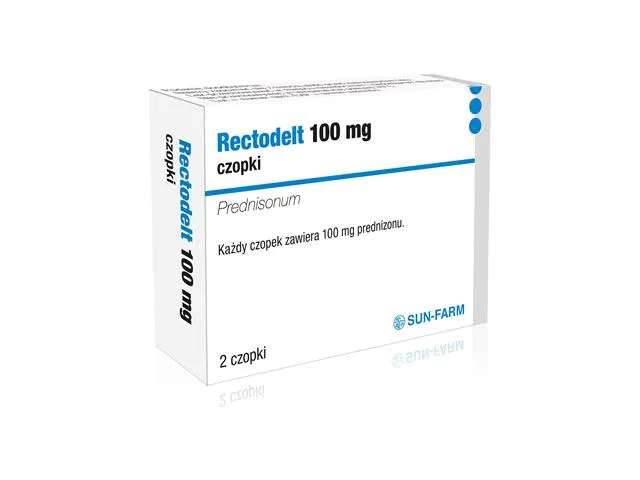
Table of Contents
Package leaflet: Information for the patient
Warning! Keep this leaflet! Information on the immediate packaging in a foreign language.
Rectodelt, 100 mg, suppositories
Prednisone
Please read this leaflet carefully before using the medicine, as it contains
important information for the patient.
- Keep this leaflet so that you can read it again if necessary.
- If you have any doubts, consult your doctor or pharmacist.
- This medicine has been prescribed for a specific individual. Do not pass it on to others. The medicine may harm another person, even if their symptoms are the same.
- If the patient experiences any adverse reactions, including any adverse reactions not listed in this leaflet, inform the doctor or pharmacist. See section 4.
Table of contents of the leaflet
- What is Rectodelt and what is it used for
- Important information before using Rectodelt
- How to use Rectodelt
- Possible adverse effects
- How to store Rectodelt
- Contents of the pack and other information
1. What is Rectodelt and what is it used for
Rectodelt contains the active substance prednisone, which is a glucocorticosteroid
(corticosteroid) affecting metabolism, electrolyte balance, and tissue function.
Rectodelt is used in infants, young children, and children for the treatment of acute
croup (acute laryngotracheitis with airway narrowing), croup, and acute exacerbations of asthma or acute episodes of wheezing.
2. Important information before using Rectodelt
When not to use Rectodelt:
if the patient is allergic to prednisone or any of the other ingredients of this medicine
(listed in section 6).
There are no other known contraindications for short-term use of Rectodelt in the treatment of
acute conditions.
Warnings and precautions
Use of this medicine may cause a pheochromocytoma crisis, which can be fatal. A pheochromocytoma is
a rare tumour of the adrenal glands. A pheochromocytoma crisis may present with headache,
excessive sweating, palpitations, and increased blood pressure. If any of these symptoms occur, the
patient should contact a doctor immediately.
Before starting treatment with Rectodelt, discuss the following with your doctor or pharmacist:
-
if the patient or their parent has scleroderma (an autoimmune disorder also known as systemic sclerosis), because doses of at least 15 mg per day may increase the risk of a serious complication called scleroderma renal crisis. Symptoms of scleroderma renal crisis include elevated
blood pressure and reduced urine output. The treating physician may recommend regular monitoring
of blood pressure and urine. -
if the patient or their parent experiences blurred vision or other visual disturbances.
-
if the patient or their parent has been diagnosed with or is suspected of having a pheochromocytoma (adrenal gland tumour).
Systemic effects of corticosteroids administered as suppositories may occur, particularly with high doses and prolonged use. Possible systemic effects include Cushing's syndrome, Cushingoid features, adrenal suppression, growth retardation in children and adolescents, decreased bone mineral density, cataracts, increased intraocular pressure (glaucoma), and, less commonly, various psychological or behavioural effects such as psychomotor hyperactivity, sleep disturbances, anxiety, depression, or aggression (especially in children).
Improper use of Rectodelt as a doping agent
Use of Rectodelt may lead to positive results in anti-doping tests. Using Rectodelt as a doping agent may pose a health risk.
Rectodelt and other medicines
Tell your doctor or pharmacist about all medicines the patient is currently taking or has recently taken, as well as any medicines the patient plans to take, including those available without a prescription.
Which other medicines affect the action of Rectodelt?
- Medicines that increase the breakdown of other drugs in the liver (barbiturates, phenytoin, primidone [medicines used to treat seizures], rifampicin [a medicine used to treat tuberculosis]): the effect of corticosteroids may be reduced.
- Certain female sex hormones (oestrogens): the effect of corticosteroids may be increased.
- Some medicines may enhance the effect of Rectodelt, and the treating physician may wish to monitor the patient closely if these medicines are taken (including certain medicines used in HIV infection: ritonavir, cobicistat). How does Rectodelt affect the action of other medicines? If Rectodelt is used concomitantly with:
- medicines used to treat inflammatory and rheumatic conditions (salicylates, indomethacin, and other non-steroidal anti-inflammatory drugs): the risk of gastric ulcers and gastrointestinal bleeding may be increased.
- blood sugar-lowering medicines (antidiabetic agents): their blood sugar-lowering effect may be reduced.
- medicines that prevent blood clotting (oral anticoagulants, coumarin derivatives): their blood-thinning effect may be weakened.
- certain medicines used to treat eye conditions (atropine) and substances with similar effects (other anticholinergic medicines): additional increase in intraocular pressure may occur.
- certain medicines causing muscle relaxation (non-depolarising muscle relaxants): muscle relaxation may be prolonged.
- medicines used to treat parasitic infections (praziquantel): their effect may be weakened.
- medicines used to treat malaria and rheumatic diseases (chloroquine, hydroxychloroquine, mefloquine): there is an increased risk of developing muscle disorders or heart muscle disorders (myopathies, cardiomyopathies).
- medicines used to suppress the immune system (cyclosporine): blood levels of cyclosporine are increased, raising the risk of seizures of cerebral origin.
- growth hormones (somatropin): their effect may be reduced.
- medicines containing hypothalamic hormones (protirelin): the increase in thyroid-stimulating hormone (TSH) levels may be reduced.
- certain medicines that reduce blood pressure (angiotensin-converting enzyme inhibitors): there may be an increased risk of blood morphology changes.
- the effect of certain cardiac glycosides may be enhanced due to reduced blood levels. This effect may be further intensified by concomitant use of laxatives and certain diuretics (saluretics).
Pregnancy and breastfeeding
If the patient is pregnant or breastfeeding, suspects she may be pregnant, or is planning to have a
child, she should consult her doctor or pharmacist before using this medicine.
There are insufficient data on the use of Rectodelt in pregnant women. In animal studies,
glucocorticoids have shown harmful effects on unborn animals. Such effects are also possible in
humans. If the patient is pregnant, Rectodelt should only be used if considered necessary by the
treating physician.
The active substance in Rectodelt passes into breast milk. If high doses are used or treatment is prolonged, breastfeeding should be discontinued.
Driving and operating machinery
Rectodelt has no effect or a negligible effect on the ability to drive and operate machinery.
3. How to use Rectodelt
This medicine should always be used as directed by a doctor or pharmacist. If in doubt,
consult a doctor or pharmacist.
Recommended dose:
For infants, young children, and children, one suppository corresponding to 100 mg of
prednisone should be administered. If necessary, administration may be repeated a maximum of once. A second suppository may be given within 12–24 hours. Further use is not recommended. The total dose should not exceed 2 suppositories (equivalent to 200 mg of prednisone). The duration of treatment should not exceed two days.
Method of administration:
The medicine is administered rectally.
The suppository should be inserted deeply into the rectum.
Warning: Do not exceed the recommended dosage and duration of use, as severe adverse reactions may occur (Cushing's syndrome, see section 4).
Use of a higher than recommended dose of Rectodelt
Rectodelt is generally well tolerated without complications, even when large amounts are used briefly.
No special measures are required. If the patient experiences severe or unusual adverse reactions, consult a doctor.
If there are any further doubts regarding the use of this medicine, consult a doctor or pharmacist.
4. Possible adverse reactions
Like any medicine, this medicine may cause adverse reactions, although not everyone experiences them.
Apart from the possibility of hypersensitivity to Rectodelt (see section 2), adverse reactions are not expected during treatment of acute conditions. Long-term administration may lead to adverse reactions typical of corticosteroids (Cushing's syndrome symptoms), such as: moon face, truncal obesity, development of edema (tissue swelling), increased potassium excretion, decreased glucose tolerance, growth suppression in children, disturbance in sex hormone secretion, skin changes, muscle weakness, osteoporosis, psychiatric changes, increased blood pressure, changes in blood morphology. A range of severity of these symptoms may be expected. Other possible reactions include: gastrointestinal disturbances, pancreatitis, increased fragility of blood vessels, increased risk of infection, increased intraocular pressure (glaucoma), blurred vision.
Frequency unknown: bradycardia.
Scleroderma renal crisis in patients with scleroderma (an autoimmune disorder). Symptoms of scleroderma renal crisis include elevated blood pressure and reduced urine production.
Systemic glucocorticoid effects may sporadically occur after administration of Rectodelt, probably depending on dose, duration of exposure, concomitant and prior exposure to corticosteroids, and individual sensitivity. These may include: suppression of adrenal function, growth retardation in children and adolescents, decreased bone mineral density, lens opacities (cataract), increased intraocular pressure (glauacoma), and increased susceptibility to infections. The ability to adapt to stress may be impaired.
Reporting of adverse reactions
If any adverse reactions occur, including any adverse reactions not listed in this leaflet, inform your doctor or pharmacist. Adverse reactions can be reported directly to the Department of Monitoring Adverse Drug Reactions at the Office for Registration of Medicinal Products, Medical Devices and Biocidal Products, Al. Jerozolimskie 181 C, 02-222 Warsaw, phone: + 48 22 49 21 301, fax: + 48 22 49 21 309, website: https://smz.ezdrowie.gov.pl.
Reporting adverse reactions helps to provide more information on the safety of the medicine.
5. How to store Rectodelt
Keep this medicine out of sight and reach of children.
Do not use this medicine after the expiry date stated on the packaging. The expiry date refers to the last day of the stated month.
Do not store above 25°C.
Medicines must not be disposed of via wastewater or household waste. Ask your pharmacist how to safely dispose of medicines no longer in use. This will help protect the environment.
6. Contents of the packaging and other information
What Rectodelt contains
- The active substance is prednisone. Each suppository contains 100 mg of prednisone.
- The other ingredient is hard fat.
What Rectodelt looks like and contents of the pack
Rectodelt is white or almost white torpedo-shaped suppositories.
Rectodelt is available in PVC/PE blisters in cardboard boxes containing 2, 4 or 6 suppositories.
For more detailed information, please contact the responsible party or parallel importer.
Responsible party in the Czech Republic, country of export:
Trommsdorff GmbH & Co. KG
Trommsdorffstrasse 2-6
524 77 Alsdorf
Germany
Manufacturer:
Trommsdorff GmbH & Co. KG
Trommsdorffstrasse 2-6
524 77 Alsdorf
Germany
Parallel importer:
InPharm Sp. z o.o.
ul. Strumykowa 28/11
03-138 Warsaw
Repackaged in:
InPharm Sp. z o.o. Services sp. k.
ul. Chełmżyńska 249
04-458 Warsaw
Marketing authorization number in the Czech Republic, country of export: 56/086/98-C
Parallel import authorization number: 167/25