Re-algin
Poland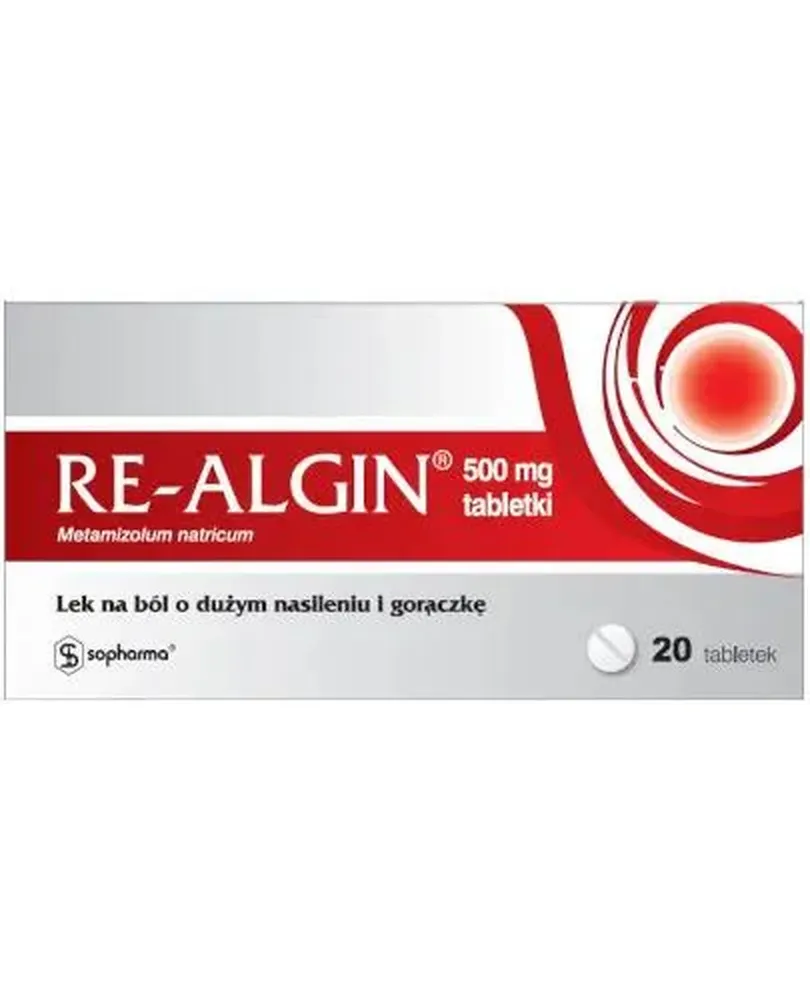
Table of Contents
Patient Information Leaflet
Re-Algin, 500 mg tablets
Metamizolum natricum
Re-Algin may cause a lower than normal number of white blood cells (agranulocytosis), which
can lead to severe and life-threatening infections (see section 4).
The medicine must be discontinued and immediate contact with a doctor is required if any of
the following symptoms occur: fever, chills, sore throat, painful sores in the nose, mouth and
throat or in the genital or anal area.
If the patient has ever experienced agranulocytosis while taking metamizole or similar
medicines, this medicine must never be taken again in the future (see section 2).
Please read this leaflet carefully before taking the medicine, as it contains important
information for the patient.
This medicine should always be taken exactly as described in this patient leaflet or as directed by a
doctor or pharmacist.
- Keep this leaflet, as you may need to read it again.
- If you need advice or further information, please consult your pharmacist.
- If you experience any adverse reactions, including any possible adverse reactions not listed in this leaflet, inform your doctor or pharmacist. See section 4.
- If there is no improvement or if you feel worse, contact your doctor.
Contents of the leaflet
- What Re-Algin is and what it is used for
- Important information before taking Re-Algin
- How to take Re-Algin
- Possible side effects
- How to store Re-Algin
- Contents of the pack and other information
1. What Re-Algin is and what it is used for
| Re-Algin contains the active substance metamizole sodium, which has analgesic | |
| and antipyretic effects. | |
Indications
Severe pain of various origins or fever, when other medications are contraindicated or ineffective.
Re-Algin is indicated for use in adults and adolescents aged 15 years and older (with body weight above 53 kg).
2. Important information before using Re-Algin
When not to use Re-Algin
- if the patient is allergic to metamizole sodium or other pyrazolone derivatives, or any of the other ingredients of this medicine (listed in section 6),
- asthma triggered or worsened by non-steroidal anti-inflammatory drugs,
- hypersensitivity reactions to any non-steroidal anti-inflammatory or pain-relieving medicine, particularly manifested by angioedema, urticaria, or rhinitis,
- in acute hepatic porphyria,
- in congenital deficiency of glucose-6-phosphate dehydrogenase enzyme,
- in severe liver or kidney failure,
- in haematological disorders (blood diseases), including aplastic anaemia (reduced number of blood cells leading to fainting, bruising and increased risk of infections), agranulocytosis (severe, life-threatening reduction in the number of white blood cells called granulocytes, increasing the risk of serious infections) and leukopenia (reduced total number of white blood cells),
- if the patient is in the last three months of pregnancy,
- in children under 15 years of age,
- if the patient has previously experienced a significant reduction in granulocyte count caused by metamizole or other similar medicines known as pyrazolones or pyrazolidines,
- if the patient has bone marrow dysfunction or a disease affecting blood cell production or function.
Warnings and precautions
Before starting to take Re-Algin, discuss this with your doctor or
pharmacist.
Low white blood cell count (agranulocytosis)
Re-Algin may cause agranulocytosis, i.e. a very low number of a type of white blood cells called granulocytes, which play an important role in fighting infections (see section 4). You must stop taking metamizole and contact your doctor immediately if any of the following symptoms occur, as they may indicate possible agranulocytosis: chills, fever, sore throat and painful ulcers of the mucous membranes, particularly in the mouth, nose and throat, or around the genital organs or anus.
Your doctor will order laboratory tests to check your blood cell count.
If metamizole is taken for fever, some symptoms of developing agranulocytosis may remain unnoticed. Similarly, symptoms may also be masked if the patient is receiving antibiotics.
Agranulocytosis may develop at any time during treatment with Re-Algin, and even shortly after discontinuing metamizole.
Agranulocytosis may occur even if metamizole was previously administered without complications.
Stop using the medicine immediately and contact your doctor if you experience:
- symptoms of agranulocytosis, such as fever, sore throat or larynx, pain when swallowing, oral inflammation, nasal mucosal inflammation, oral mucosal inflammation, genital or anal area inflammation;
- symptoms of severe allergic reaction, such as shortness of breath, swelling of the tongue or throat causing swallowing difficulties, angioedema, rash or urticaria, itching, heart rhythm disturbances, or decreased blood pressure.
Special caution is advised:
- in case of allergy to painkillers or anti-rheumatic drugs, other products or food,
- in patients with bronchial asthma (shortness of breath, asthma attacks), especially if associated with nasal polyposis and sinus mucosal inflammation, and allergic diseases,
- in patients with diseases associated with reduced white blood cell count,
- in patients with hypotension, dehydration, or heart failure,
- in patients with impaired kidney or liver function,
- in peptic ulcer disease of the stomach or duodenum.
Liver-related disorders
Cases of hepatitis have been reported in patients taking metamizole, with symptoms appearing from several days to several months after starting treatment.
You should stop taking Re-Algin and contact your doctor if you experience any liver-related symptoms such as: malaise (nausea or vomiting), fever, fatigue, loss of appetite, dark urine, pale stools, yellowing of the skin or whites of the eyes (jaundice), itching, rash, or upper abdominal pain. Your doctor will check your liver function.
You should not take Re-Algin if you have previously taken any medicinal products containing metamizole and experienced liver-related problems.
Severe skin reactions
Severe skin reactions have been reported in association with metamizole treatment, including Stevens-Johnson syndrome, toxic epidermal necrolysis, and drug reaction with eosinophilia and systemic symptoms (DRESS syndrome). If any of these symptoms related to severe skin reactions listed in section 4 occur, you must stop taking metamizole and seek immediate medical attention.
If you have ever experienced severe skin reactions, Re-Algin should never be used again in the future (see section 4).
Re-Algin and other medicines
You must inform your doctor about all medicines you are currently taking or have recently taken, as well as any medicines you plan to take, including those available without a prescription.
Before using Re-Algin, consult your doctor, especially if you are taking any of the following medicines:
- anticoagulants of the coumarin group (e.g. warfarin, acenocoumarol),
- oral antidiabetic drugs,
- phenytoin (an anticonvulsant),
- antibacterial drugs (sulfonamides) – metamizole enhances their effect,
- cyclosporine (a medicine used after organ transplantation and in cancer treatment) – metamizole reduces its effect,
- chlorpromazine (used in psychiatric disorders) or other phenothiazine derivatives – may cause a significant drop in body temperature,
- bupropion, a medicine used to treat depression or as an aid in smoking cessation,
- efavirenz, a medicine used to treat HIV infection (AIDS),
- methadone, a medicine used in opioid addiction treatment,
- valproate, a medicine used to treat epilepsy or bipolar affective disorder,
- tacrolimus, a medicine used to prevent organ rejection in transplant patients,
- sertraline, a medicine used to treat depression.
Metamizole (a substance with analgesic and antipyretic effects) may reduce the effect of acetylsalicylic acid on platelet aggregation (clumping of blood cells and clot formation) when these medicines are used simultaneously. Therefore, caution is required when using metamizole in patients receiving acetylsalicylic acid.
Do not take Re-Algin simultaneously with:
- sedatives,
- antidepressants,
- oral contraceptives,
- painkillers and antipyretics (non-steroidal anti-inflammatory drugs),
- allopurinol (a medicine used in gout),
- alcohol.
The use of Re-Algin is contraindicated with medicines of the pyrazolone group (aminophenazone, phenylbutazone, oxyphenbutazone).
Re-Algin and alcohol
Do not consume alcohol while taking Re-Algin. Alcohol may increase the risk of adverse effects of the medicine.
Pregnancy, breastfeeding and effects on fertility
Pregnancy
Available data on the use of metamizole during the first three months of pregnancy are limited, but do not indicate harmful effects on the embryo. In selected cases, if no other treatment options are available, after consultation with a doctor or pharmacist, a patient may take single doses of metamizole during the first and second trimesters, provided that the benefits and risks of taking the medicine are carefully considered. In principle, administration of metamizole during the first and second trimesters is not recommended.
Do not take Re-Algin during the last three months of pregnancy due to increased risk of complications for both mother and child (bleeding, premature closure of a vital blood vessel, the so-called ductus arteriosus Botalli, in the unborn child, which normally closes only after birth).
Breastfeeding
Metamizole metabolites pass into breast milk in significant amounts, and a risk to the breastfed infant cannot be excluded. Therefore, repeated use of metamizole should be particularly avoided during breastfeeding.
After a single dose of metamizole, mothers should be advised to express and discard breast milk for 48 hours after administration of the medicine.
Driving and operating machinery
Re-Algin at recommended doses does not have a significant effect on the ability to drive motor vehicles or operate machinery.
Driving, operating machinery, and performing other tasks requiring active attention are not recommended during treatment with high doses of metamizole, as it may adversely affect reaction time in unexpected situations.
This medicine contains wheat starch.
This medicine contains a very small amount of gluten (derived from wheat starch). Therefore, it is very unlikely to cause any problems in patients with coeliac disease. Each tablet contains no more than 3.4 micrograms of gluten. This medicine should not be used by patients with wheat allergy (other than coeliac disease).
Re-Algin contains sodium
The medicine contains 32.7 mg of sodium (main component of table salt) in each tablet. This corresponds to 1.64% of the maximum recommended daily dietary sodium intake for adults.
3. How to use Re-Algin
This medicine should always be taken exactly as described in this patient information leaflet or as directed by your doctor. If in doubt, consult your doctor or pharmacist.
Re-Algin should be taken orally with an adequate amount of water, preferably after food.
The tablet may be divided into halves.
The dose depends on the severity of pain or fever and the individual response to Re-Algin.
Always use the lowest effective dose required to control pain and fever.
The recommended dose of the medicine is:
Use in adults and adolescents aged 15 years and older:
Adults and adolescents aged 15 years and older (with body weight above 53 kg) may receive up to 1000 mg of metamizole as a single dose (2 tablets), not more frequently than 4 times daily at intervals of 6–8 hours. The maximum daily dose is 4000 mg (equivalent to 8 tablets).
A clear therapeutic effect can be expected within 30 to 60 minutes after oral administration.
Re-Algin should not be used in children under 15 years of age.
Duration of treatment
Do not use the medicine for longer than 3 to 5 days.
Elderly patients and patients in poor general health or with renal impairment
In elderly patients, weakened patients, and patients with impaired renal function, the dose should be reduced due to the possibility of prolonged elimination of metamizole metabolites.
Patients with impaired renal or hepatic function
Due to reduced elimination rate in patients with impaired renal or hepatic function, repeated administration of high doses should be avoided. For short-term use, dose adjustment is not required. There is no experience with long-term use.
Use in children and adolescents
Re-Algin is contraindicated in children under 15 years of age (see section 4.3).
Overdose of Re-Algin
If more than the recommended dose of Re-Algin has been taken, seek immediate medical advice.
Symptoms of overdose may include dizziness, abdominal pain, nausea, vomiting, disturbances of consciousness, hypothermia, sudden drop in arterial blood pressure, and cardiac arrhythmias. There is a risk of severe shock, acute renal and hepatic failure, convulsions, and coma.
Missed dose of Re-Algin
Do not take a double dose to make up for a missed dose.
Discontinuation of Re-Algin
If you have any doubts about using this medicine, consult your doctor or pharmacist.
4. Possible adverse reactions
Like all medicines, this medicine can cause adverse reactions, although not everybody gets them.
You should stop taking Re-Algin and seek immediate medical help if any of the following symptoms occur:
Feeling unwell (nausea or vomiting), fever, feeling tired, loss of appetite, dark urine, pale stools, yellowing of the skin or whites of the eyes, itching, rash, or pain in the upper part of the abdomen. These may be symptoms of liver damage. See also section 2 "Warnings and precautions".
The following may occur during treatment with this medicine:
Uncommon (in 1 to 10 patients out of 1,000):
- Drug-induced skin rash.
Rare (in 1 to 10 patients out of 10,000):
- Hypersensitivity reactions, such as anaphylactic reaction or anaphylactic shock (a life-threatening, severe allergic reaction); symptoms of hypersensitivity may include itching, urticaria, generalised or localised swelling, skin redness (erythema), angioedema, cardiac arrhythmias, decrease in blood pressure, tachycardia, dyspnoea, bronchospasm, or collapse.
| difficulty breathing. | |
| leukopenia (decrease in total white blood cell count). |
Very rare (less than 1 patient in 10,000):
- Skin and mucosal blisters inside the mouth, or skin peeling, which may indicate a severe skin reaction known as Stevens-Johnson syndrome;
- Life-threatening Lyell’s syndrome (toxic epidermal necrolysis), characterized by blistering and necrosis leading to detachment of large areas of the epidermis;
- Asthma attack (episode of breathlessness);
- Agranulocytosis (severe, life-threatening reduction in the number of white blood cells – granulocytes), manifested by: fever, chills, sore throat, difficulty swallowing, and inflammatory conditions of the mucous membranes of the mouth, nose, throat, genital organs, and anus;
- Thrombocytopenia (reduced number of blood platelets);
- Hemolytic anemia (reduction in the number of red blood cells, which may cause pallor or jaundice, weakness, or shortness of breath);
- Aplastic anemia (severe reduction in all types of blood cells, which may lead to bleeding, bruising, petechiae, or infections);
- Kidney function disorders, proteinuria (protein in urine), oliguria (reduced urine output), polyuria (increased urine output), interstitial nephritis.
Frequency unknown (cannot be estimated from available data):
- Nausea, vomiting, abdominal pain; with high doses of the drug – vomiting blood, blood in stool (tarry stools);
- Hepatitis, jaundice (yellowing of the skin and whites of the eyes), increased liver enzyme activity in blood;
- Severe skin reactions.
Metamizole should be discontinued immediately and medical help sought promptly if the patient develops any of the following serious adverse reactions:
- Reddish, flat lesions on the trunk in a target-like or circular shape, often with blisters in the center, skin peeling, ulceration in the mouth, throat, nose, genital organs, or around the eyes. Such severe skin rashes may be preceded by fever and flu-like symptoms (Stevens-Johnson syndrome, toxic epidermal necrolysis);
- Widespread rash, high body temperature, and enlarged lymph nodes (DRESS syndrome or drug-induced hypersensitivity syndrome).
Reporting of adverse reactions
If any adverse effects occur, including any adverse effects not listed in this leaflet, inform a doctor, pharmacist, or nurse. Adverse reactions can be reported directly to the Department of Monitoring Adverse Drug Reactions, Office for Registration of Medicinal Products, Medical Devices and Biocidal Products, Al. Jerozolimskie 181C, 02-222 Warsaw, tel. (22) 49-21-301, fax (22) 49-21-309,
Website: https://smz.ezdrowie.gov.pl
Adverse reactions can also be reported to the marketing authorization holder.
Reporting adverse reactions helps to enhance the safety information regarding the use of the medicinal product.
5. How to store Re-Algin
Keep this medicine out of sight and reach of children. Store in the original packaging, at a temperature not exceeding 25°C.
Do not use this medicine after the expiry date stated on the packaging. The expiry date refers to the last day of the stated month.
If you have any questions or doubts, consult your doctor or pharmacist.
Medicines must not be disposed of via wastewater or household waste. Ask your pharmacist how to dispose of medicines no longer required. This will help protect the environment.
6. Contents of the packaging and other information
What Re-Algin contains
- The active substance is metamizole sodium.
- Each tablet contains 500 mg of metamizole sodium.
- Other components of the medicine are wheat starch, microcrystalline cellulose (type 101), povidone K25, talc, magnesium stearate.
What Re-Algin looks like and contents of the packaging
Re-Algin is a white or almost white, odourless, round, biconvex tablet with a diameter of
13 mm, with a break line on one side.
The tablet can be divided into equal doses.
Packaging:
6 tablets, 10 tablets or 20 tablets in an Al/PVC foil blister, with a package leaflet in a
cardboard box.
Marketing Authorisation Holder and Manufacturer
Marketing Authorisation Holder
Sopharma Warszawa Sp. z o.o.
Al. Jerozolimskie 136, 02-305 Warsaw
tel.: 22 613 39 30
Manufacturer
SOPHARMA AD
16, Iliensko Shosse str.
1220 Sofia, Bulgaria