Racedryl go
Poland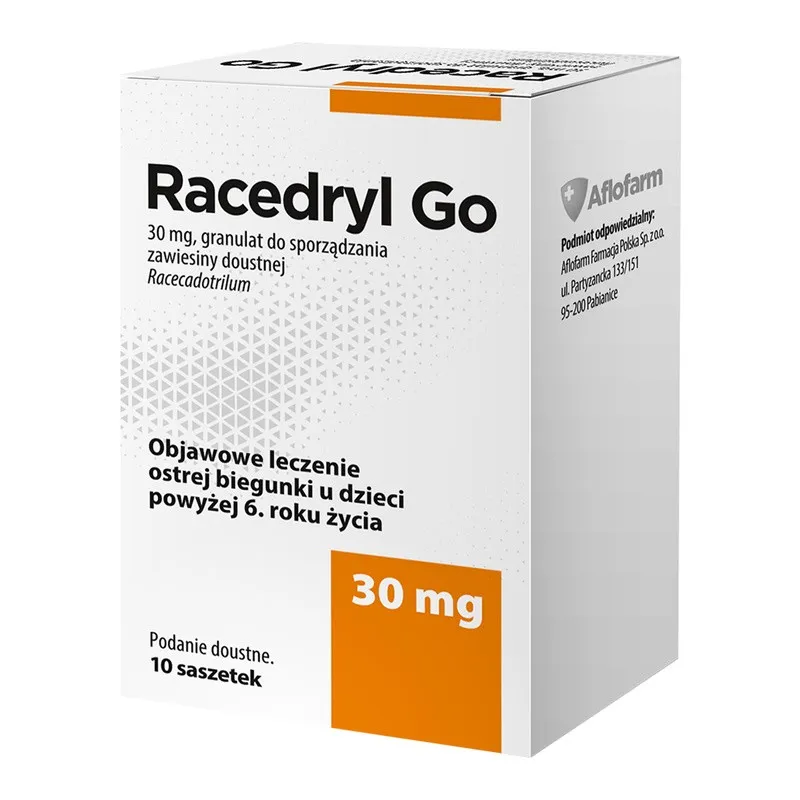
Table of Contents
Package leaflet: Information for the patient
Racedryl Go, 30 mg, granules for oral suspension
Racecadotril
Please read all of this leaflet carefully before taking this medicine, because it contains
important information for you.
This medicine should always be taken exactly as described in this patient leaflet or as directed by your
doctor or pharmacist.
- Keep this leaflet, so that you can read it again if necessary.
- If you need advice or further information, please consult your pharmacist.
- If your child experiences any adverse reactions, including any not listed in this leaflet, inform your doctor or pharmacist (see section 4).
- If there is no improvement after 2 days, or if the patient feels worse, contact your doctor.
Table of contents
- What Racedryl Go is and what it is used for
- Important information before taking Racedryl Go
- How to take Racedryl Go
- Possible side effects
- How to store Racedryl Go
- Contents of the pack and other information
1. What Racedryl Go is and what it is used for
Racedryl Go is a medicine used as an adjunctive treatment for the symptomatic management of acute diarrhoea in children over 6 years of age, alongside oral rehydration and standard supportive care, when such treatment alone does not control clinical symptoms and causal treatment is not possible. When causal treatment is feasible, Racedryl Go may be used as an adjunctive therapy.
This medicine is intended for children over 6 years of age.
If there is no improvement after 2 days, or if the patient feels worse, consult your doctor.
2. Important information before taking Racedryl Go
When not to take Racedryl Go
- if the child is allergic to racecadotril or any of the other ingredients of this medicine (listed in section 6);
- if the patient has ever experienced severe skin rash, skin peeling, blisters, and/or oral mucosal ulcers after taking racecadotril;
- if the child has chronic diarrhoea or diarrhoea caused by antibiotic treatment;
- in children with impaired kidney or liver function, regardless of the severity of the condition;
- if the child has prolonged, uncontrolled vomiting;
- if the child has an intolerance to certain sugars, consult a doctor before administering Racedryl Go to the child;
- in children under 6 years of age.
Warnings and precautions
Before starting treatment with Racedryl Go, consult a doctor or pharmacist if:
- the child has blood or pus in the stool and has fever. This may be due to a bacterial infection or other serious diseases;
- the child has prolonged or uncontrolled vomiting;
- the child has diabetes (see "Racedryl Go contains sucrose");
- the child's diarrhoea is very severe, vomiting persists, signs of dehydration appear (pallor, dry mucous membranes, lethargy), or loss of appetite—such conditions may require intravenous rehydration and hospital treatment;
- the child has a history of angioedema unrelated to racecadotril therapy, as such patients may be at increased risk of developing angioedema.
Extreme caution is required when using racecadotril.
Severe skin reactions, including drug reaction with eosinophilia and systemic symptoms (DRESS), have been reported during treatment with racecadotril. If the patient notices any of the symptoms associated with serious skin reactions described in section 4, they should stop taking racecadotril immediately and seek medical advice without delay.
Taking this medicine does not replace standard rehydration therapy.
Adequate hydration of children during treatment of acute diarrhoea is very important.
Racedryl Go and other medicines
Inform the doctor about all medicines currently taken or recently taken by the child, as well as any medicines planned for administration.
Particularly inform the doctor about medicines taken by the child such as:
- angiotensin-converting enzyme (ACE) inhibitors (e.g. captopril, enalapril, lisinopril, perindopril, ramipril) used to lower blood pressure or to support heart function.
Pregnancy and breastfeeding
This medicine is intended for children.
If the patient is pregnant or breastfeeding, suspects she may be pregnant, or is planning to have a child, she should consult a doctor or pharmacist before using this medicine. Always seek advice from a doctor or pharmacist before using any medicine.
Racedryl Go must not be used during pregnancy or while breastfeeding.
Driving and operating machinery
Racedryl Go has no effect or has a negligible effect on the ability to drive and operate machinery.
Racedryl Go contains sucrose
If the child has been diagnosed with an intolerance to certain sugars, consult a doctor before administering Racedryl Go to the child.
Each sachet of Racedryl Go contains 2.9 g of sucrose.
In children with diabetes, the amount of sucrose ingested with Racedryl Go should be included in the child's daily carbohydrate intake.
3. How to take Racedryl Go
This medicine should always be taken exactly as described in this patient leaflet or as directed by
your doctor or pharmacist. If in doubt, consult your doctor or pharmacist.
Racedryl Go is a granulate for oral suspension, which when dissolved in water forms a white
suspension.
The medicine can be added to food, sprinkled into a glass of water or into a bottle of food, then
mixed well and given immediately to the child.
This medicine is intended for children over 6 years of age.
Recommended dose
Children weighing from 13 kg to 27 kg: 1 sachet 3 times daily, at regular intervals.
Children weighing over 27 kg: 2 sachets 3 times daily, at regular intervals.
Treatment should continue until two normal bowel movements have occurred and should not
last longer than 7 days.
If there is no improvement after 2 days, or if the patient feels worse, consult a doctor.
To replace fluids lost due to diarrhoea, this medicine should be used together with an adequate
amount of fluids and salt solutions (electrolytes). The best way to replace fluids and electrolytes is
by drinking oral rehydration solutions (in case of doubt, consult your doctor or pharmacist).
Taking more Racedryl Go than recommended
If a child has taken more Racedryl Go than recommended, contact a doctor or pharmacist
immediately.
Missing a dose of Racedryl Go
Do not take a double dose to make up for a missed dose. Take the next dose at the usual time.
4. Possible adverse reactions
Like all medicines, this medicine can cause adverse reactions, although not everyone will experience them.
You must stop taking racekadotryl and seek immediate medical help if any of the following symptoms occur:
- symptoms of angioedema, such as: swelling of the face, tongue or throat, difficulty swallowing, hives and breathing difficulties;
- widespread rash, high fever and swollen lymph nodes (DRESS syndrome);
- breathing difficulties, swelling, dizziness, rapid heartbeat, sweating and feeling faint, which are symptoms of a sudden, severe allergic reaction.
The following adverse reactions have been reported:
Common (may occur in less than 1 in 10 people):
- headache.
Uncommon (may occur in less than 1 in 100 people):
- tonsillitis;
- rash;
- erythema (redness of the skin).
Frequency not known (frequency cannot be estimated from available data):
- erythema multiforme (pinkish skin lesions on limbs and inside the mouth);
- tongue swelling;
- facial swelling;
- lip swelling;
- eyelid swelling;
- urticaria (hives);
- nodular erythema (inflammatory nodular lesions of subcutaneous tissue);
- papular rash (skin eruptions with small, firm, bump-like changes);
- prurigo (itchy skin lesions);
- pruritus (generalised itching);
- toxic skin eruption.
Reporting of adverse reactions
If any adverse reactions occur, including any adverse reactions not listed in this leaflet, inform your doctor or pharmacist. Adverse reactions can be reported directly to the Department of Monitoring Adverse Drug Reactions of the Office for Registration of Medicinal Products, Medical Devices and Biocidal Products:
Al. Jerozolimskie 181C
02-222 Warsaw
Tel.: +48 22 49 21 301
Fax: +48 22 49 21 309
Website: https://smz.ezdrowie.gov.pl
Adverse reactions can also be reported to the marketing authorization holder.
Reporting adverse reactions helps provide more information on the safety of this medicine.
5. How to store Racedryl Go medicine
There are no special storage requirements for this medicine.
The medicine should be stored out of sight and out of reach of children.
Do not use this medicine after the expiry date stated on the carton and sachet after "EXP". The expiry date refers to the last day of the stated month.
Medicines must not be disposed of via wastewater or household waste. Ask your pharmacist how to dispose of medicines no longer required. This will help protect the environment.
6. Contents of the pack and other information
What Racedryl Go contains
- The active substance is racecadotril. Each Racedryl Go sachet contains 30 mg of racecadotril.
- The other ingredients are: sucrose, colloidal anhydrous silica, povidone K-30.
What Racedryl Go looks like and contents of the pack
Racedryl Go is a white or almost white granulate for oral suspension, which forms a white suspension when dissolved in water. The medicine is packed in sachets made of Paper/Polyester/Aluminum/Polyester, placed in a cardboard box.
Each pack contains: 10, 16 sachets.
Marketing Authorisation Holder
Aflofarm Farmacja Polska Sp. z o.o.
ul. Partyzancka 133/151
95-200 Pabianice
Tel. + 48 42 22-53-100
Importer
Aflofarm Farmacja Polska Sp. z o.o.
ul. Szkolna 31
95-054 Ksawerów