Pyrazinamide farmapol
Poland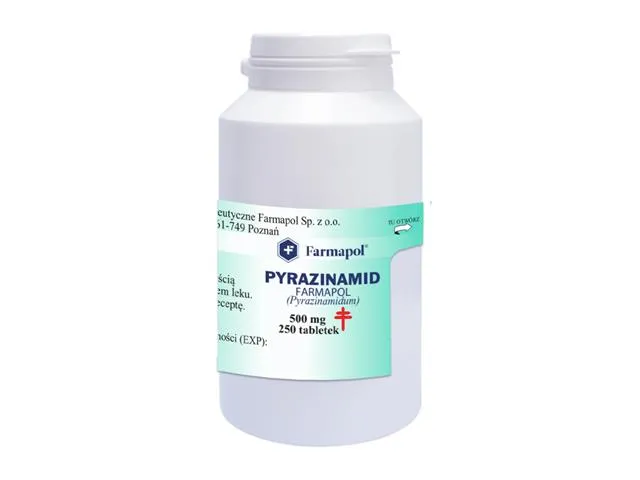
Table of Contents
- Package leaflet: Information for the user
- 1. What Pyrazinamid Farmapol is and what it is used for
- 2. Important information before using Pyrazinamid Farmapol
- 3. How to take Pyrazinamid Farmapol
- 4. Possible adverse effects
- 5. How to store Pyrazinamid Farmapol
- 6. Contents of the pack and other information
Package leaflet: Information for the user
PYRAZINAMID FARMAPOL
500 mg, tablets
Pyrazinamide
Please read this leaflet carefully before taking this medicine, as it contains
important information for you.
- Keep this leaflet. You may need to read it again.
- If you have any further questions, ask your doctor, pharmacist, or nurse.
- This medicine has been prescribed for a specific individual. Do not pass it on to others. It may harm them even if their symptoms are the same.
- If you experience any adverse reactions, including any possible adverse reactions not listed in this leaflet, inform your doctor, pharmacist, or nurse. See section 4.
Leaflet contents
- What Pyrazinamid Farmapol is and what it is used for
- What you need to know before taking Pyrazinamid Farmapol
- How to take Pyrazinamid Farmapol
- Possible side effects
- How to store Pyrazinamid Farmapol
- Contents of the pack and other information
1. What Pyrazinamid Farmapol is and what it is used for
Pyrazinamid Farmapol contains pyrazinamide – the active substance, which has strong antituberculosis activity (inhibits the growth of Mycobacterium tuberculosis).
Pyrazinamid Farmapol is used in combination with other antituberculosis medicines to increase treatment efficacy and reduce the number of disease recurrences.
Indications:
- in the initial phase of tuberculosis treatment, i.e., during intensive treatment (first two months), in combination with rifampicin and isoniazid; this increases treatment efficacy, accelerates bacillary clearance, and reduces the number of relapses;
- in the treatment of pulmonary and extrapulmonary tuberculosis caused by strains resistant to main antituberculosis chemotherapeutics (isoniazid or rifampicin), always in combination with other antituberculosis medicines.
2. Important information before using Pyrazinamid Farmapol
When not to use Pyrazinamid Farmapol
Do not use Pyrazinamid Farmapol if the patient:
- is allergic to the active substance or to any of the other ingredients of this medicine (listed in section 6);
- has liver failure;
- has gout (a disease characterized by excessive production of uric acid in the body, which deposits as crystals in joints and periarticular tissues, causing severe pain);
- has porphyria (a disease involving abnormal heme production—a component of hemoglobin). If the patient is pregnant or breastfeeding.
Warnings and precautions
Pyrazinamid Farmapol may cause:
- increased blood uric acid levels and symptoms of gout. At the beginning of treatment, the doctor will recommend measuring uric acid concentration in the blood. If the patient develops symptoms of acute arthritis, discontinue the drug and contact the doctor.
- liver damage. If any disturbances in liver function occur, discontinue the drug and contact the doctor. The doctor will recommend liver function tests before starting treatment and periodically during therapy.
Pyrazinamid Farmapol should be used:
- with caution in patients with a history of liver disease and in patients at increased risk of hepatitis (e.g., those who abuse alcohol). The drug should not be used in such patients if liver function tests performed before treatment initiation indicate liver failure.
- with caution in patients with renal impairment; the doctor will determine the dosage and duration of treatment.
- with caution in patients with diabetes, as the drug may interfere with its management.
In adults, it is recommended to initiate treatment in a hospital setting, after which the drug may be continued under the supervision of a specialist physician.
Children
Pyrazinamid Farmapol may be used in children only under hospital conditions.
Pyrazinamid Farmapol and other medicines
Inform the doctor or pharmacist about all medicines currently or recently taken, as well as any medicines the patient plans to take.
Before using Pyrazinamid Farmapol, the patient should inform the doctor if they are taking:
- insulin or oral antidiabetic drugs (used in diabetes treatment);
- allopurinol, colchicine, probenecid, sulfinpyrazone (medicines used in the treatment of gout), because Pyrazinamid Farmapol reduces their effectiveness; the doctor will adjust the doses of these drugs;
- cyclosporine (a medicine used in organ transplant recipients), because Pyrazinamid Farmapol may reduce its effectiveness; therefore, the doctor will monitor cyclosporine levels and adjust its dosage;
- levofloxacin (a medicine used to treat certain bacterial infections)—concomitant use with Pyrazinamid Farmapol is not recommended due to the risk of adverse effects.
Pregnancy, breastfeeding, and fertility
If the patient is pregnant or breastfeeding, suspects she may be pregnant, or is planning to become pregnant, she should consult a doctor or pharmacist before using this medicine. This medicine should not be used if the patient is pregnant, breastfeeding, or if there is suspicion of pregnancy.
Driving and operating machinery
There is no data available regarding the effect on psychomotor performance, ability to drive vehicles, or operate machinery.
3. How to take Pyrazinamid Farmapol
This medicine should always be taken as prescribed by your doctor. If in doubt, consult your doctor.
Recommended dosage
The usual dose is 20 to 30 mg per kilogram of body weight as a single daily dose.
In adults, the most commonly used dose is 3 tablets (1.5 g) once daily.
Do not take more than 4 tablets (2 g) per day.
The medicine should be taken orally, with water.
This medicine may be taken regardless of meals.
Patients with renal impairment
Your doctor will recommend a lower than usual dose.
Taking more Pyrazinamid Farmapol than prescribed
If you take more than the prescribed dose, contact your doctor immediately.
Missed dose of Pyrazinamid Farmapol
If you forget to take a dose of Pyrazinamid Farmapol but remember within 12 hours of your usual dosing time, take the missed dose immediately, then take the next dose at your regular time.
If you remember more than 12 hours after the missed dose, simply take the next dose at your regular time.
Do not take a double dose to make up for a missed dose.
Stopping treatment with Pyrazinamid Farmapol
The decision to discontinue treatment should be made by your doctor.
4. Possible adverse effects
Like all medicinal products, this medicine can cause adverse effects, although not everybody will experience them.
The following adverse effects may occur:
- liver damage (initial signs may include jaundice, increased blood liver enzyme activity, such as AlAT and AspAT); the harmful effect of the drug on the liver is dose-dependent and may occur at any time during treatment;
- increased blood uric acid levels, leading to gout (an inflammatory joint condition with redness, swelling, warmth, and acute pain);
- nausea, vomiting, loss of appetite (anorexia);
- iron deficiency anaemia (also known as anaemia, manifested by, among others: progressive weakness, easy fatigue, pale skin and mucous membranes, concentration disturbances, brittle nails, hair loss);
- sideroblastic anaemia (a type of anaemia caused by excessive iron deposition in the bone marrow);
- thrombocytopenia (reduced number of blood platelets, leading to increased risk of bleeding and bruising);
- blood coagulation disorders (rare);
- mild joint pain and muscle pain;
- malaise;
- allergic reactions (such as: skin rash, urticaria, itching);
- fever (rare);
- photosensitivity;
- porphyria (a disorder characterized by abnormal haem production, a component of haemoglobin);
- difficulty in urination;
- kidney function disorders (interstitial nephritis).
Reporting of adverse effects
If any adverse effects occur, including any adverse effects not listed in this leaflet, inform your doctor, pharmacist, or nurse. Adverse effects can also be reported directly to the Department of Monitoring Adverse Drug Reactions, Office for Registration of Medicinal Products, Medical Devices and Biocidal Products, Al. Jerozolimskie 181C, 02-222 Warsaw, tel.: +48 22 49 21 301, fax: +48 22 49 21 309
Website: https://smz.ezdrowie.gov.pl
Adverse effects can also be reported to the marketing authorization holder.
Reporting adverse effects helps to provide more information on the safety of the medicine.
5. How to store Pyrazinamid Farmapol
Keep the medicine out of sight and reach of children.
Do not store above 25°C.
Store in the original packaging to protect from moisture.
Do not use this medicine after the expiry date stated on the packaging.
The expiry date refers to the last day of the stated month.
Medicines must not be disposed of via wastewater or household waste. Ask your pharmacist how to dispose of medicines no longer in use. This will help protect the environment.
6. Contents of the pack and other information
What Pyrazinamid Farmapol contains
- The active substance is pyrazinamide. One tablet contains 500 mg of pyrazinamide.
- The other ingredients are: potato starch, talc, sodium carboxymethyl starch (type C).
What Pyrazinamid Farmapol looks like and contents of the pack
Pyrazinamid Farmapol is in the form of white, round tablets with the imprint “PYRAZINAMID”
embossed on one side.
The pack contains 250 tablets.
Marketing Authorisation Holder and Manufacturer
Farmaceutical Company Farmapol Sp. z o.o.
Święty Wojciech 29
61-749 Poznań
tel.: +48 61 852 63 53 e-mail: [email protected]
For further information, please contact the Marketing Authorisation Holder's representative.
Information for blind and partially sighted people: the package leaflet content is available free of charge by calling the toll-free number: 800 706 848.