Procto-glyvenol
Poland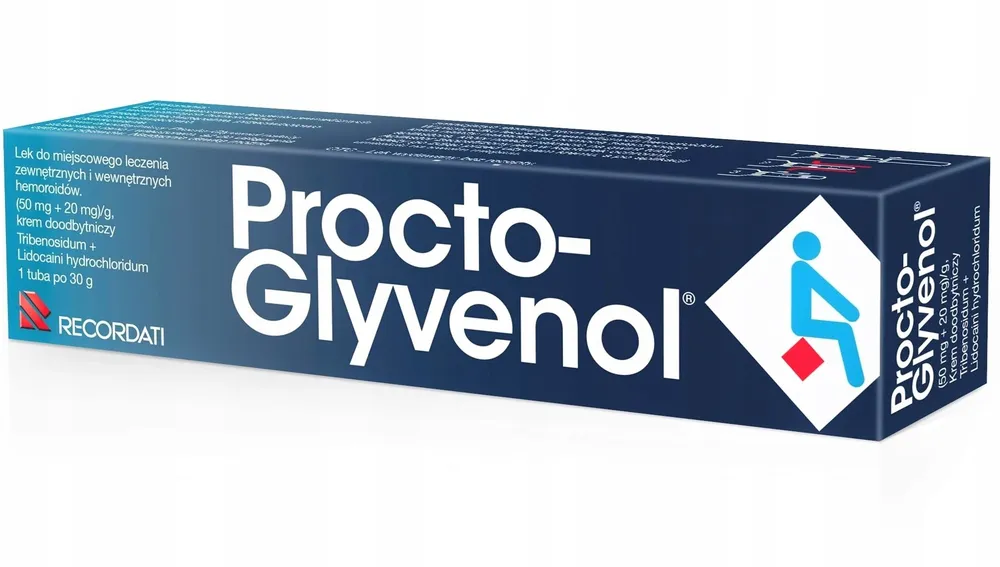
Table of Contents
Package leaflet: Information for the patient
Warning! Keep this leaflet! Information on the immediate packaging is in a foreign language.
Procto-Glyvenol
(50 mg + 20 mg)/g, rectal cream
Tribenosidum + Lidocaini hydrochloridum
Please read the following information carefully before using the medicine, as it contains
important information for the patient.
This medicine should always be used exactly as described in this patient information leaflet or as
directed by the physician or pharmacist.
- Keep this leaflet for future reference.
- If advice or additional information is needed, consult a pharmacist.
- If the patient experiences any adverse reactions, including any possible adverse reactions not listed in this leaflet, inform a doctor or pharmacist. See section 4.
- If there is no improvement within 7 days, or if the patient feels worse, consult a doctor.
Table of contents of the leaflet:
- What Procto-Glyvenol is and what it is used for
- Important information before using Procto-Glyvenol
- How to use Procto-Glyvenol
- Possible side effects
- How to store Procto-Glyvenol
- Contents of the pack and other information
1. What Procto-Glyvenol is and what it is used for
Procto-Glyvenol rectal cream is a medicine intended for local treatment of external and internal hemorrhoids.
Tribenosidum exerts anti-inflammatory, anti-edematous, analgesic, anti-pruritic effects, and also protects against vascular endothelial damage.
Lidocaine is a local anesthetic substance that relieves discomfort caused by hemorrhoids, such as itching, burning, and pain.
Procto-Glyvenol rectal cream acts locally and has practically no systemic effects.
2. Important information before using Procto-Glyvenol
When not to use Procto-Glyvenol:
- if the patient is allergic to tribenoside, lidocaine hydrochloride, or any of the other ingredients of this medicine (listed in section 6), or to other local anaesthetics of amide structure.
Warnings and precautions
Before using Procto-Glyvenol cream for rectal application in patients with liver function disorders, consult a doctor.
Procto-Glyvenol rectal cream should be used with caution in patients with severe liver impairment.
As an adjunct to the treatment of haemorrhoids with Procto-Glyvenol, it is recommended to maintain proper anal hygiene, perform appropriate physical exercises, and follow a suitable diet to ensure appropriately soft stool consistency.
Do not take this medicine orally.
Avoid contact with the eyes.
Children
This medicine should not be used in children, as there are no data available on safety of use in this age group.
Procto-Glyvenol and other medicines
No interactions with other medicines have been reported so far.
Inform your doctor or pharmacist about any other medicines the patient is currently taking, has recently taken, or plans to take, including those obtained without a prescription.
Pregnancy and breastfeeding
If the patient is pregnant or breastfeeding, suspects she may be pregnant, or is planning to become pregnant, she should consult a doctor or pharmacist before using this medicine.
Procto-Glyvenol rectal cream should not be used during the first 3 months of pregnancy.
Procto-Glyvenol rectal cream may be used from the 4th month of pregnancy and during breastfeeding, provided the recommended doses are not exceeded.
Driving and operating machinery
Procto-Glyvenol rectal cream has no effect or has negligible effect on the ability to drive and operate machinery.
Procto-Glyvenol contains cetyl alcohol, methyl parahydroxybenzoate, and propyl
parahydroxybenzoate
Cetyl alcohol may cause local skin reactions (e.g. contact dermatitis).
Methyl parahydroxybenzoate and propyl parahydroxybenzoate may cause allergic reactions (delayed-type reactions possible).
3. How to use Procto-Glyvenol
This medicine should always be used exactly as described in this patient information leaflet or as directed by your doctor or pharmacist. If in doubt, consult your doctor or pharmacist.
Procto-Glyvenol cream for rectal use should be applied in the morning and evening until acute symptoms subside. Afterwards, the dose may be reduced to once daily.
When treating internal haemorrhoids, the cream should be applied using the provided applicator, which should be screwed onto the thread of the tube. The applicator is equipped with a protective cap. This should be removed before using the cream and replaced after application.
Do not exceed the recommended doses of the medicine.
Avoid contact of the medicine with the eyes.
Hands should be thoroughly washed after each application.
Do not take this medicine by mouth.
Children
This medicine should not be used in children, as there are no data available on safety of use in this age group.
How long to use Procto-Glyvenol
Procto-Glyvenol rectal cream should be used until symptoms resolve.
If there is no improvement after 7 days of treatment, or if new, previously unobserved symptoms occur, consult your doctor to rule out other potential causes of these symptoms.
Use of more than the recommended dose of Procto-Glyvenol
No cases of overdose with Procto-Glyvenol rectal cream have been reported. There is no specific antidote for lidocaine.
Overdose should not occur when the medicine is used according to the recommended dosing regimen.
In case of overdose, seek medical advice immediately.
Missed dose of Procto-Glyvenol
Do not use a double dose to make up for a missed dose.
Stopping Procto-Glyvenol
If you have any further questions about the use of this medicine, consult your doctor or pharmacist.
4. Possible adverse reactions
Like all medicines, this medicine can cause adverse reactions, although not everybody gets them.
The following terms are used to describe the frequency of adverse reactions:
| Very common | occurs in more than 1 in 10 people |
| Common | occurs in 1 to 10 people in 100 |
| Uncommon | occurs in 1 to 10 people in 1,000 |
| Rare | occurs in 1 to 10 people in 10,000 |
| Very rare | occurs in fewer than 1 in 10,000 people |
| Not known | frequency cannot be estimated from the available data |
Rarely occurring adverse reactions (more than 1 person per 10,000 treated, less
than 1 person per 1,000 treated):
- urticaria,
- itching at the application site, rash at the application site, pain at the application site.
Very rarely occurring adverse reactions (may occur in no more than 1 person per
10,000):
- anaphylactic reaction,
- cardiovascular disorders,
- bronchospasm,
- angioedema,
- facial swelling.
Reporting of adverse reactions
If any adverse symptoms occur, including any adverse symptoms not listed
in the leaflet, inform your doctor or pharmacist. Adverse reactions can be reported
directly to the Department of Monitoring Adverse Drug Reactions of the Office for Registration of Medicinal Products, Medical Devices and Biocidal Products,
Al. Jerozolimskie 181C, 02-222 Warsaw, phone: + 48 22 49 21 301, fax: + 48 22 49 21 309,
website: https://smz.ezdrowie.gov.pl.
Reporting adverse reactions helps to collect more information on the safety of using the medicine.
5. How to store Procto-Glyvenol
Keep this medicine out of sight and reach of children.
Store below 25°C in the original packaging.
Do not use this medicine after the expiry date stated on the packaging. The expiry date refers to the last day of the stated month.
Medicines must not be disposed of via the sewage system or household waste. Ask your pharmacist how to dispose of medicines no longer required. Such measures help protect the environment.
6. Contents of the package and other information
What Procto-Glyvenol contains
- The active substances are: tribenozide and lidocaine hydrochloride. Each 1 g of cream contains 50 mg of tribenozide and 20 mg of lidocaine hydrochloride.
- Other ingredients are: sorbitan stearate (Arlacel 60), polyoxyethylene cetostearyl ether (Cetomacrogol 1000), cetyl alcohol, isopropyl palmitate, liquid paraffin, methyl parahydroxybenzoate, propyl parahydroxybenzoate, sorbitol liquid, non-crystallizing, stearic acid, purified water.
What Procto-Glyvenol looks like and contents of the pack
Procto-Glyvenol is a white, homogeneous rectal cream.
Available pack: an aluminium tube containing 30 g of rectal cream, with a polyethylene cap and an applicator made of LDPE, in a cardboard carton.
For more detailed information, please contact the Marketing Authorisation Holder or the Parallel Importer.
Marketing Authorisation Holder in Bulgaria, the country of export:
Haleon Hungary Kft.
Csörsz utca 43
1124 Budapest
Hungary
Manufacturer:
Haleon Germany GmbH
Barthstrasse 4
80339 Munich
Germany
Parallel Importer:
InPharm Sp. z o.o.
Strumykowa 28/11
03-138 Warsaw
Poland
Repackaged in:
InPharm Sp. z o.o. Services sp. k.
Chełmżyńska 249
04-458 Warsaw
Poland
Marketing Authorisation number in Bulgaria, the country of export: 20000821
Parallel Import Authorisation number: 276/20