Predox
Poland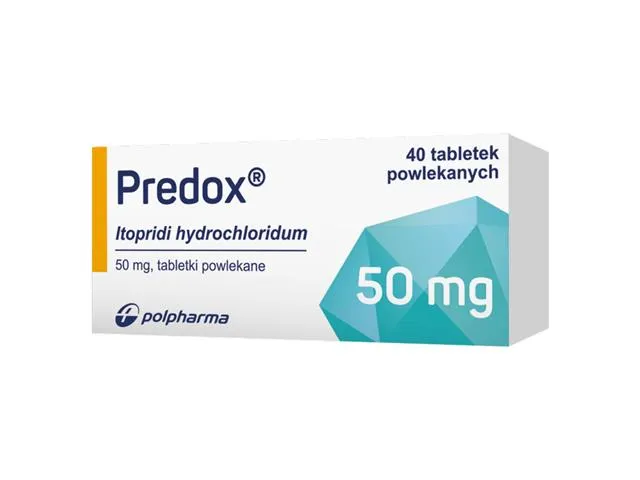
Table of Contents
Patient Information Leaflet
Predox, 50 mg, film-coated tablets
Itopridi hydrochloridum
Please read this leaflet carefully before taking this medicine, as it contains
important information for you.
- Keep this leaflet for future reference.
- If you have any questions, consult your doctor or pharmacist.
- This medicine has been prescribed for a specific individual. Do not give it to others. This medicine may harm others, even if their symptoms are the same.
- If you experience any adverse reactions, including those not listed in this leaflet, inform your doctor or pharmacist. See section 4.
Table of contents
- What Predox is and what it is used for
- Important information before taking Predox
- How to take Predox
- Possible side effects
- How to store Predox
- Contents of the pack and other information
1. What Predox is and what it is used for
Predox belongs to a group of medicines called prokinetic agents. Prokinetic agents improve, stimulate, and enhance gastrointestinal motility (movement). These medicines accelerate gastric emptying and the passage of food through the small intestine, and increase the tone of the lower esophageal sphincter. Additionally, Predox has antiemetic properties.
Predox is indicated for the treatment of symptoms associated with delayed gastric emptying, such as abdominal bloating, feeling of excessive fullness in the stomach, upper abdominal pain, loss of appetite, heartburn, nausea, and vomiting in gastrointestinal disorders not caused by peptic ulcer disease or organic disease affecting the rate of food passage through the gastrointestinal tract.
Predox is also indicated for the symptomatic treatment of gastroesophageal reflux disease, either as monotherapy or as an add-on therapy to proton pump inhibitors (medicines that reduce gastric hydrochloric acid secretion).
Predox is intended for use in adults.
2. Important information before using Predox
When not to take Predox
- if the patient is allergic to itopride or any of the other ingredients of this medicine (listed in section 6).
- if accelerated gastric emptying may be harmful, e.g. in patients with gastrointestinal bleeding, mechanical obstruction, or gastrointestinal perforation.
Predox is not indicated for use in children and adolescents under 18 years of age, pregnant women,
or breastfeeding women.
Predox and other medicines
You should tell your doctor or pharmacist about all medicines the patient is currently taking or has recently taken, as well as any medicines the patient plans to take.
Predox and other concomitantly used medicines may affect each other's action.
- Anticholinergic medicines (used in the treatment of asthma, chronic obstructive pulmonary disease, diarrhoea, Parkinson's disease, or to reduce smooth muscle contractions, e.g. of the urinary bladder) may reduce the effect of itopride.
- Due to itopride's action on the gastrointestinal tract, it may affect the absorption of other medicines, especially those with a narrow therapeutic index, extended-release formulations, or those released in the small intestine.
Predox with food and drink
Predox should be taken before meals.
Pregnancy and breastfeeding
If the patient is pregnant or breastfeeding, suspects she may be pregnant, or is planning to have a child, she should consult her doctor or pharmacist before using this medicine.
The safety of itopride during pregnancy has not been established. Itopride may be considered during pregnancy only if the potential benefits of treatment outweigh the risks to the mother and the foetus.
Predox is not recommended for use in breastfeeding women due to lack of experience with itopride during lactation.
Driving and operating machinery
No influence of the medicine on the ability to drive or operate machinery has been observed; however, reduced attention cannot be excluded. Dizziness may occur. If such symptoms occur, the patient should not drive or operate machinery.
Predox contains lactose
If the patient has previously been diagnosed with intolerance to certain sugars, the patient should consult their doctor before taking this medicine.
3. How to use Predox
This medicine should always be taken according to the instructions given by your doctor or pharmacist. If you are unsure,
please consult your doctor or pharmacist.
For gastrointestinal functional dyspepsia not related to peptic ulcer disease, the recommended daily dose for adults is 1 tablet three times a day before meals for up to 8 weeks.
In the case of gastroesophageal reflux disease, the recommended daily dose for adults is 1 tablet three times a day before meals for up to 6 weeks when Predox is used as monotherapy,
and up to 12 weeks when Predox is used as an add-on therapy to proton pump inhibitors (PPIs).
The dose may be adjusted depending on the patient's age and course of the disease. The exact dosage of Predox and duration of treatment will be determined by the doctor.
Patients with impaired liver or kidney function and elderly patients
Patients with impaired liver or kidney function, as well as elderly patients, will be closely monitored by the doctor. If any adverse effects occur, you should contact your doctor.
The doctor may recommend reducing the dose or discontinuing the medicine.
Taking more Predox than recommended
If you take more Predox than recommended, or if the medicine is accidentally taken by a child, contact your doctor or pharmacist immediately.
Missed dose of Predox
If you miss a dose of Predox, continue taking it according to the regular dosing schedule. Do not take a double dose to make up for the missed dose.
Stopping Predox
If you stop taking Predox too early, your symptoms may worsen. Before discontinuing the medicine, consult your doctor.
If you have any further questions about the use of this medicine, consult your doctor or pharmacist.
4. Possible adverse reactions
Like all medicines, this medicine can cause adverse reactions, although not everybody will experience them.
You should immediately stop taking Predox and contact your doctor:
- If swelling of the hands, feet, face, lips or throat occurs, causing difficulty in swallowing or breathing. A rash and itching may also occur. These may be symptoms of an allergic reaction.
The following adverse reactions may occur during treatment with Predox:
Uncommon (may affect up to 1 in 100 people)
- diarrhoea
- constipation
- abdominal pain
- excessive salivation
- headache
- irritability
- sleep disturbances
- dizziness
- fatigue
- chest pain or back pain
- increased prolactin hormone levels
- changes in blood laboratory test results (decreased number of white blood cells, increased blood urea nitrogen and creatinine levels)
Rare (may affect up to 1 in 1,000 people)
- skin rash, redness and itching
Unknown (frequency cannot be estimated from the available data)
- increased blood test values (AspAT, AlAT, GGTP, alkaline phosphatase, bilirubin)
- decreased number of platelets (which may manifest as bruising and increased bleeding)
- tremor
- nausea
- jaundice
- breast enlargement in males
If galactorrhea (production and secretion of milk unrelated to breastfeeding) or
gynaecomastia (breast enlargement in males) occurs, treatment with this medicine should be discontinued or stopped.
Reporting of adverse reactions
If any adverse reactions occur, including any adverse reactions not listed
in this leaflet, inform your doctor or pharmacist. Adverse reactions can be
reported directly to the Department of Monitoring Adverse Drug Reactions of the Office for Registration of Medicinal Products, Medical Devices and Biocidal Products
Al. Jerozolimskie 181C
02-222 Warsaw
Tel.: + 48 22 49 21 301
Fax: + 48 22 49 21 309
Website: https://smz.ezdrowie.gov.pl
Adverse reactions can also be reported to the marketing authorization holder.
Reporting adverse reactions helps to provide more information on the safety of the medicine.
5. How to store the medicine Predox
Keep the medicine out of the sight and reach of children.
Store below 25 °C.
Do not use this medicine after the expiry date stated on the packaging.
The expiry date refers to the last day of the stated month.
The marking on the packaging following the abbreviation EXP indicates the expiry date, and following the abbreviation Lot/LOT indicates the batch number.
Medicines must not be disposed of via wastewater or household waste. Ask your pharmacist how to dispose of medicines no longer required. This will help protect the environment.
6. Contents of the pack and other information
What Predox contains
- The active substance is itopride hydrochloride. Each coated tablet contains 50 mg of itopride hydrochloride.
- Other components: monohydrate lactose, pregelatinized maize starch, microcrystalline cellulose, magnesium stearate, colloidal anhydrous silica. Film-coat composition: hypromellose 2910, macrogol 6000, talc, titanium dioxide (E 171).
What Predox looks like and contents of the pack
Predox is white, round, biconvex coated tablets with a diameter of 7 mm.
The pack contains 40, 90 or 100 coated tablets in PVC/PVDC/Aluminium blisters.
Marketing Authorisation Holder and Manufacturer
Marketing Authorisation Holder
Zakłady Farmaceutyczne POLPHARMA S.A.
ul. Pelplińska 19, 83-200 Starogard Gdański
tel. + 48 22 364 61 01
Manufacturer
Medochemie Limited - Factory AZ
Agios Athanassios Industrial Area, Michail Irakleous 2, Agios Athanassios, 4101, Limassol, Cyprus