Posorutin
Poland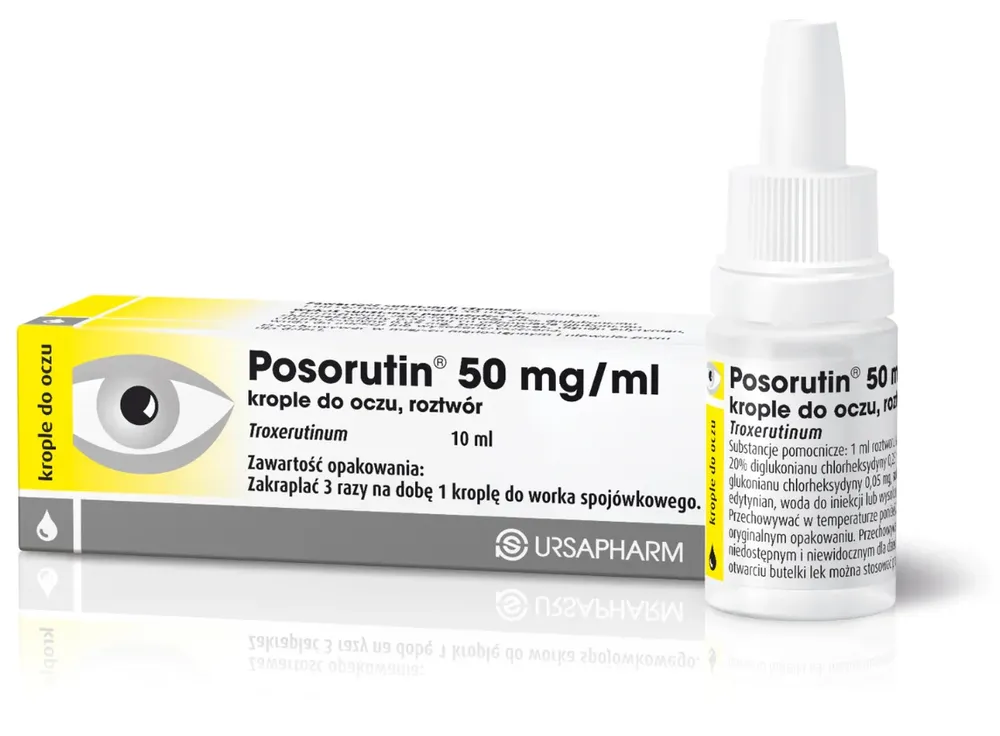
Table of Contents
1.3.1 SPC, labelling and package leaflet
Package leaflet: Information for the patient
Posorutin
Troxerutinum
Read the entire leaflet carefully before using the medicine, as it contains important information for the patient.
- Keep this leaflet for future reference.
- If you have any questions, consult your doctor or pharmacist.
- This medicine has been prescribed for a specific individual. Do not pass it on to others. The medicine may harm other people, even if their symptoms are the same.
- If any adverse reactions occur in the patient, including any adverse reactions not listed in this leaflet, inform your doctor or pharmacist immediately. See section 4.
Table of contents of the leaflet:
- What Posorutin is and what it is used for
- Important information before using Posorutin
- How to use Posorutin
- Possible adverse reactions
- How to store Posorutin
- Contents of the pack and other information
1. What Posorutin is and what it is used for
Posorutin is a medicine used to stabilize the blood vessels of the eye. Posorutin is used as an adjunctive treatment in conditions involving weakened blood vessels, such as changes in the fundus of the eye caused by diabetic retinopathy, or in cases of subconjunctival haemorrhage.
2. Important information before using Posorutin
When not to use Posorutin
If the patient is allergic to troxerutin or any of the other ingredients of this medicine
(listed in section 6).
Warnings and precautions
Before starting to use Posorutin, discuss this with your doctor or pharmacist.
While using Posorutin, contact lenses should not be used.
However, if there are no contraindications to their use, contact lenses should be removed before instilling the drops, and the medicine should be administered into the conjunctival sac. Contact lenses may be reinserted 15 minutes after instillation. To avoid possible damage, contact between soft contact lenses and the medicine should be avoided.
Posorutin and other medicines
You should tell your doctor or pharmacist about all medicines the patient is currently taking or has recently taken, as well as any medicines the patient plans to use.
Edition 07/2024
1.3.1 SPC, labelling and package leaflet
Interactions with other medicines are not known. If other eye drops or ointments are used simultaneously, they should be administered at least 15 minutes apart.
Ophthalmic ointments should be administered last.
Pregnancy and breastfeeding
If the patient is pregnant or breastfeeding, suspects she may be pregnant, or is planning to have a child, she should consult her doctor or pharmacist before using this medicine.
Pregnancy:
Consult a doctor before using this medicine.
There is insufficient data on the use during pregnancy.
Breastfeeding:
Consult a doctor before using this medicine.
There is insufficient data on the use during breastfeeding.
Driving and operating machinery
No special precautions are required.
3. How to use Posorutin
This medicine should always be used as directed by the physician. In case of doubt, consult your
doctor or pharmacist.
To administer Posorutin, wash hands thoroughly, unscrew the container cap, slightly tilt the head backward, gently pull down the lower eyelid, then squeeze the bottle gently but not too hard and instill one drop into the conjunctival sac. Close the eyelids slowly.
Avoid contact of the dropper tip with the eye or facial skin. After instillation, close the container tightly with the cap.
The administration of the drops should be evenly distributed throughout the day.
Posorutin is a medicine intended for long-term therapy. The duration of treatment is determined by the physician.
Usually, 1 drop into the conjunctival sac is administered 3 times daily.
If you feel that the effect of the medicine is too strong or too weak, consult your doctor.
If you have any further doubts regarding the use of this medicine, consult your doctor or pharmacist.
4. Possible adverse reactions
Like all medicines, this medicine can cause adverse reactions, although not everybody gets them.
Rarely (in 1 patient out of 1,000 to 10,000 treated individuals), eye burning has been reported.
Very rarely (in 1 patient out of 10,000 treated individuals or less frequently), hypersensitivity symptoms
such as allergic reactions to one of the components of the medicine may occur. In such a case, a doctor
or pharmacist should be informed.
Other adverse reactions may occur in some individuals during use. If any adverse reactions not listed in
this leaflet occur, inform a doctor about them.
Reporting of adverse reactions
If any adverse reactions occur, including any adverse reactions not listed in this leaflet, inform a doctor or
pharmacist. Adverse reactions can be reported directly to the Department of Monitoring of Adverse Drug
Reactions, Office for Registration of Medicinal Products, Medical Devices and Biocidal Products, Al. Jerozolimskie
Edition 07/2024
1.3.1 SPC, labelling and package leaflet
181C, 02-222 Warsaw; tel: +48 22 492 13 01; fax: +48 22 492 13 09; website:
https://smz.ezdrowie.gov.pl. Adverse reactions can also be reported to the marketing authorization holder.
By reporting adverse reactions, more information on the safety of the medicine can be collected.
5. How to store Posorutin
Keep this medicine out of sight and reach of children.
Do not use this medicine after the expiry date stated on the carton. The expiry date refers to the last day of the stated month.
Store below 25°C. Keep in the original packaging.
After first opening the bottle, the medicine may be used for a period of 6 weeks.
Medicines must not be disposed of via the sewage system or household waste. Ask your pharmacist how to dispose of medicines no longer required. Such practices help protect the environment.
6. Contents of the pack and other information
What Posorutin contains
The active substance is troxerutin.
The other ingredients are chlorhexidine digluconate solution 20%, sodium chloride, disodium edetate, water for
injections or highly purified water.
What Posorutin looks like and contents of the pack
Posorutin is a clear, colourless or slightly yellow solution contained in a plastic bottle with a dropper and a stopper.
Each pack contains 1 plastic bottle of 10 ml with a dropper and a cap.
Marketing Authorisation Holder and Manufacturer
Marketing Authorisation Holder
URSAPHARM Poland Sp. z o.o.,
Wybrzeże Gdyńskie 27,
01-531 Warsaw
Telephone: 022 732 07 90
Telefax: 022 732 07 99
e-mail: [email protected]
Manufacturer:
URSAPHARM Arzneimittel GmbH
Industriestraße 35
66129 Saarbrücken, Germany
Edition 07/2024