Poltram 100
Poland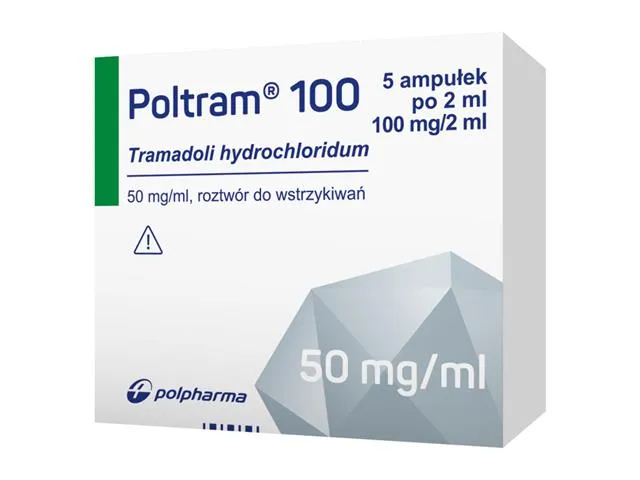
Table of Contents
- Package leaflet: Information for the patient
- 1. What Poltram is and what it is used for
- 2. Important information before using Poltram
- 3. How to use Poltram
- 4. Possible adverse reactions
- 5. How to store Poltram
- 6. Contents of the pack and other information
- Information intended exclusively for healthcare professionals:
Package leaflet: Information for the patient
Poltram 50, 50 mg/ml, solution for injection
Poltram 100, 50 mg/ml, solution for injection
Tramadoli hydrochloridum
Please read the entire leaflet carefully before using the medicine, as it contains
important information for the patient.
- Keep this leaflet, so that you can read it again if necessary.
- If you have any doubts, consult your doctor or pharmacist.
- This medicine has been prescribed for a specific individual. Do not pass it on to others. The medicine may harm another person, even if their symptoms are the same.
- If any adverse reactions occur in the patient, including any adverse reactions not listed in this leaflet, inform your doctor or pharmacist. See section 4.
Table of contents
- What Poltram is and what it is used for
- Important information before using Poltram
- How to use Poltram
- Possible adverse reactions
- How to store Poltram
- Contents of the pack and other information
1. What Poltram is and what it is used for
Poltram is an analgesic medicine acting on the central nervous system (brain and spinal cord).
Poltram is indicated for the treatment of moderate to severe pain.
2. Important information before using Poltram
When not to use Poltram:
- if the patient is allergic to tramadol, other opioid painkillers, or any of the other ingredients of this medicine (listed in section 6);
- in case of acute alcohol intoxication, or intoxication with sedatives, painkillers, or psychotropic medicines (medicines affecting mood or feelings);
- if the patient is taking or has taken MAO inhibitors (antidepressant medicines, selegiline used in Parkinson's disease) within the previous 14 days before treatment with Poltram;
- if the patient suffers from epilepsy that is not adequately controlled by medication;
- if the patient is addicted to narcotics;
- in withdrawal syndrome.
Warnings and precautions
Before starting treatment with Poltram, discuss the following with your doctor or pharmacist:
- if the patient is addicted to strong central nervous system-acting painkillers (opioids);
- if the patient has suffered a head injury or is in shock (characterized by low blood pressure, pale skin, rapid breathing, cold sweats, weakness, and fainting), or if the patient has unexplained disturbances in consciousness;
- if the patient has respiratory disorders or impaired function of the respiratory center;
- if the patient has increased intracranial pressure;
- if the patient has increased sensitivity to opioids;
- if the patient has epilepsy or has previously experienced brain-originated seizures. The risk of seizures increases when exceeding the recommended daily dose (400 mg). Additionally, tramadol may increase the risk of seizures in patients taking other medicines that lower the seizure threshold. Such patients may only be treated with tramadol if other pain treatments are ineffective.
- if the patient has a tendency to drug abuse or drug dependence, or if the therapy is long-term. In such cases, treatment should be closely supervised by a physician.
- if the patient has depression and is taking antidepressants, because some of them may interact with tramadol (see "Poltram with other medicines").
Taking tramadol together with certain antidepressants or tramadol alone carries a small risk of developing serotonin syndrome. If the patient experiences any symptoms of this serious condition, they should seek medical advice immediately (see section 4 "Possible side effects"). - if the patient has liver and/or kidney impairment. In cases of long-term treatment with Poltram, monitoring of blood drug levels is recommended.
- if the patient is taking sedatives, anxiolytics, neuroleptics, muscle relaxants, antidepressants, or other central nervous system depressants.
Taking tramadol-containing medicines in high doses, alone or in combination with other central nervous system depressants, including alcohol, may result in death due to drug dependence. Do not exceed the dose prescribed by the doctor.
Caution is advised in patients with respiratory depression, as well as when used together with other central nervous system depressants or in cases of significant overdose, since respiratory depression cannot be ruled out (see section 2 "Poltram with other medicines").
Sleep-related breathing disorders
Poltram may cause sleep-related breathing disorders such as sleep apnea (pauses in breathing during sleep) and hypoxemia (low blood oxygen levels). Symptoms may include breathing pauses during sleep, nocturnal awakenings due to breathlessness, difficulty maintaining sleep, or excessive daytime sleepiness. If the patient or someone else notices these symptoms, contact a doctor. The doctor may consider reducing the dose.
If any of the following symptoms occur during treatment with Poltram, inform your doctor or pharmacist:
- excessive fatigue, loss of appetite, severe abdominal pain, nausea, vomiting, or low blood pressure. These may indicate adrenal insufficiency (low cortisol levels). If such symptoms occur, contact your doctor, who will decide whether hormone replacement is necessary.
Tolerance, dependence, and addiction
This medicine contains tramadol, an opioid medicine. Repeated use of opioids may lead to reduced effectiveness of the medicine (the patient's body becomes accustomed to the medicine, known as tolerance). Repeated use of Poltram may also lead to dependence, abuse, and addiction, which may result in life-threatening overdose. The risk of these adverse effects may increase with higher doses and longer duration of treatment.
Dependence or addiction may cause the patient to lose control over the amount or frequency of medicine intake.
The risk of dependence or addiction varies among individuals. Higher risk of dependence on Poltram may apply to individuals in the following situations:
- the patient or someone in their family has ever abused or been dependent on alcohol, prescription medicines, or illegal drugs ("addiction");
- the patient is a smoker or uses nicotine products;
- the patient has ever had mood problems (depression, anxiety, or personality disorders) or has been treated by a psychiatrist for other mental illnesses.
If the patient notices any of the following symptoms during treatment with Poltram, this may indicate dependence or addiction:
- Need to take the medicine for longer than prescribed by the doctor.
- Need to take a higher dose than recommended.
- The patient uses the medicine for reasons other than those for which it was prescribed, e.g., "to calm down" or "to sleep better."
- The patient has made multiple unsuccessful attempts to stop or control medicine use.
- After stopping the medicine, the patient feels unwell, and feels better after taking it again ("withdrawal effects").
If the patient notices any of these symptoms, they should consult their doctor to discuss the best treatment approach, including when and how to safely discontinue the medicine (see section 3, subsection "Discontinuing Poltram").
Tramadol should not be used in substitution treatment for opioid-dependent patients, as it does not relieve symptoms occurring after morphine withdrawal.
Tramadol is metabolized in the liver by an enzyme. Some patients have a variation of this enzyme, which may lead to different effects. In some patients, pain relief may be insufficient, while in others, severe adverse effects are more likely. Discontinue the medicine and contact your doctor immediately if any of the following adverse effects (due to tramadol toxicity) occur: slowed or shallow breathing, confusion, drowsiness, pinpoint pupils, nausea or vomiting, constipation, or loss of appetite.
Children and adolescents
Use after surgical procedures in children
Extreme caution is required when administering tramadol to children for postoperative pain relief; careful monitoring for signs of tramadol toxicity (see above), including respiratory depression, is essential.
Use in children with breathing disorders
Tramadol is not recommended in children with breathing disorders, as tramadol toxicity symptoms (see above) may be intensified.
Poltram with other medicines
Inform your doctor or pharmacist about all medicines currently used, recently used, or planned for use.
Poltram should not be used simultaneously with MAO inhibitors (medicines containing: isocarboxazid, iproniazid, tranylcypromine, pargyline, selegiline, mocllobemide) – see section "When not to use Poltram".
Concomitant use of Poltram with the following medicines is not recommended:
- carbamazepine (usually used to treat epilepsy or severe facial pain known as trigeminal neuralgia);
- buprenorphine, nalbuphine, pentazocine (opioid painkillers). This may reduce the analgesic effect.
- gabapentin or pregabalin (used to treat epilepsy or nerve-related pain (neuropathic pain)).
The risk of adverse effects is increased when Poltram is taken together with:
- certain antidepressants – Poltram may interact with them and cause serotonin syndrome (see section 4 "Possible side effects");
- sedatives, sleeping pills, other painkillers such as morphine or codeine (which also has antitussive effects), baclofen (muscle relaxant), antihypertensives, antidepressants, or antiallergic medicines. Drowsiness or dizziness may occur. If such symptoms occur, inform your doctor.
- other medicines that may cause seizures (fits), such as certain antidepressants or antipsychotics, bupropion, mirtazapine, tetrahydrocannabinol. The risk of seizures may increase if the patient takes Poltram together with these medicines. The doctor should inform the patient whether Poltram is suitable for them.
- coumarin derivatives, e.g., warfarin (used to thin the blood). The effect of these medicines may be disturbed, leading to bleeding. Any prolonged or unexpected bleeding should be reported to the doctor immediately.
- other central nervous system depressants and alcohol.
The effectiveness of Poltram may be reduced if taken together with:
- ondansetron (a medicine used to treat nausea and vomiting);
- ketoconazole or erythromycin (medicines used to treat infections).
Poltram and alcohol
Do not drink alcohol during treatment.
Pregnancy and breastfeeding
If the patient is pregnant, breastfeeding, suspects she may be pregnant, or plans to become pregnant, she should consult her doctor or pharmacist before using this medicine.
Poltram should not be used during pregnancy or breastfeeding.
Breastfeeding
Tramadol is excreted in breast milk. Therefore, during breastfeeding, Poltram should not be taken more than once, or if Poltram has been taken more than once, breastfeeding should be discontinued.
Driving and operating machinery
Poltram may prolong reaction time, even when used at recommended doses, especially when taken together with other psychotropic medicines.
Do not drive or operate machinery while taking this medicine.
Poltram contains sodium
Poltram contains less than 1 mmol (23 mg) of sodium per 1 ml of solution, meaning the medicine is considered "sodium-free". The medicine contains 0.42 mg of sodium per 1 ml of solution.
The medicine may be diluted – see section "Information intended exclusively for healthcare professionals". The sodium content from the diluent should be considered when calculating the total sodium content in the prepared diluted solution. For precise information on the sodium content of the diluent used, refer to the patient leaflet of the diluent.
3. How to use Poltram
This medicine should always be used as directed by a doctor or pharmacist. If in doubt,
consult a doctor or pharmacist.
Before starting treatment and regularly during treatment, the doctor will discuss with the patient
what to expect from using Poltram, when and for how long it should be taken, when to contact the
doctor, and when the medicine should be discontinued (see also section 2).
The dose should be adjusted according to the intensity of pain and the individual patient's response
to treatment. The lowest effective dose that adequately relieves pain should be used.
Adults and adolescents over 12 years of age
Depending on the severity of pain, the usual dose is 1–2 ml of Poltram (equivalent to 50–100 mg
of tramadol) every 4–6 hours.
The maximum daily dose is 8 ml of Poltram (equivalent to 400 mg of tramadol). Exceptionally,
if clinically justified, a doctor may prescribe higher daily doses.
Children over 1 year of age
The usual single dose is 1 to 2 mg of tramadol per kilogram of body weight. The lowest effective
dose should be used.
The total daily dose should not exceed 8 mg of tramadol per kilogram of body weight, and the
maximum total daily dose should not exceed 400 mg of tramadol.
Elderly patients
In patients over 75 years of age, elimination of tramadol from the body may be delayed. In these
patients, the doctor may recommend extending the time interval between doses.
Patients with renal impairment, those undergoing dialysis, and/or hepatic impairment
Poltram should not be used in cases of severe hepatic and/or renal impairment.
In cases of mild or moderate impairment, the doctor may recommend longer intervals between
doses.
Method of administration
Poltram should be administered by slow intravenous injection, e.g. into the antecubital vein, or
by intramuscular (usually gluteal) or subcutaneous injection.
It may also be diluted and administered as an intravenous infusion.
Detailed instructions on the method of administration for medical personnel are provided at the
end of this leaflet.
Duration of treatment
Poltram must not be used for longer than absolutely necessary. In long-term pain treatment, the
doctor should periodically assess the patient's condition to determine whether, and at what dose,
treatment should continue (if necessary, treatment breaks should be introduced) (see section 2
"Warnings and precautions").
In patients with a history of drug abuse or dependence, tramadol treatment should be short-term
and under strict medical supervision (see section 2 "Warnings and precautions").
Use of a higher than recommended dose of Poltram
If a higher dose is taken, contact a doctor immediately.
Symptoms of overdose include disturbances of consciousness up to coma (a state of deep
unconsciousness), seizures, drop in blood pressure, rapid heartbeat (tachycardia), pinpoint pupils,
slowed breathing up to respiratory arrest, and inhibition of intestinal peristalsis.
Missed dose of Poltram
If a dose is missed, take it as soon as possible. If it is almost time for the next dose, do not take the
missed dose. Do not use a double dose to make up for a missed dose.
Stopping Poltram
Do not stop using this medicine abruptly without medical advice. If the patient wishes to stop
treatment, this should be discussed with the doctor, especially if the medicine has been used for a
long time.
The doctor will advise when and how to discontinue the medicine; this may involve gradually
reducing the dose to minimize the likelihood of adverse effects (withdrawal symptoms).
If there are any further doubts regarding the use of this medicine, consult a doctor or pharmacist.
4. Possible adverse reactions
Like any medicine, this medicine can cause adverse reactions, although not everyone will experience them.
If any of the following severe adverse reactions occur, you should immediately contact your
treating physician or go to the emergency department of the nearest hospital:
anaphylactic shock (a life-threatening sudden drop in blood pressure due to an allergic reaction,
manifesting as dizziness, disorientation and fainting) – occurs rarely
allergic reactions (shortness of breath, feeling of tightness in the chest due to bronchospasm,
wheezing, angioedema, whose symptoms include swelling of the skin and mucous membranes, e.g.
throat or tongue, and difficulty breathing (occur rarely) and (or) itching, rash, urticaria (occur not very frequently))
cardiovascular collapse, whose symptoms include, among others, fainting (occurs not very frequently);
slower than normal heart rate (occurs rarely)
slowed breathing, shortness of breath up to complete respiratory arrest (occur rarely), worsening of
bronchial asthma, although a causal relationship has not been established
urinary retention, inability to urinate (occurs rarely)
dependence
withdrawal symptoms: agitation, restlessness, anxiety, nervousness, insomnia, motor agitation,
tremor and gastrointestinal disturbances. See also section 3.
During the use of the medicine, the following may occur:
Very common (affects more than 1 in 10 patients):
- nausea
- dizziness.
Common (affects less than 1 in 10 patients):
- vomiting
- constipation
- dry mouth
- excessive sweating
- headache
- drowsiness
- fatigue.
Uncommon (affects less than 1 in 100 patients):
- palpitations
- rapid heartbeat
- low blood pressure when sitting or standing up
- belching
- stomach discomfort
- feeling of fullness in the abdominal cavity
- diarrhoea.
Rare (affects less than 1 in 1,000 patients):
- high blood pressure
- appetite disturbances
- burning or tingling sensations in the limbs without apparent cause (paresthesia)
- tremor
- muscle weakness, involuntary muscle contractions
- coordination disturbances
- slowed breathing, shortness of breath
- seizures
- restlessness
- hallucinations
- disorientation
- sleep disturbances and nightmares
- blurred vision
- urinary disturbances, urinary retention.
Psychiatric disorders may occur after administration of Poltram. Their severity and type may vary
(depending on the patient's personality and duration of treatment). These may include, for example,
mood disturbances (usually excitement, sometimes irritability), changes in activity (usually reduced,
sometimes increased), excessive fatigue, and reduced sensory and cognitive perception (changes in
sensation and recognition which may lead to incorrect assessment of the situation).
Frequency not known (cannot be estimated from the available data):
- facial flushing, hot flushes
- speech disturbances
- pupil dilation
- swelling
- hiccups
- serotonin syndrome, whose symptoms may include changes in mental status (e.g. agitation, hallucinations, coma), as well as other symptoms such as fever, rapid heartbeat, unstable blood pressure, involuntary muscle contractions, muscle stiffness, lack of coordination and (or) gastrointestinal symptoms (e.g. nausea, vomiting, diarrhoea) (see section 2 "Important information before using Poltram").
Adverse reactions which may occur after abrupt discontinuation of the medicine are identical to those
occurring after discontinuation of other opioids: agitation, restlessness, anxiety, nervousness, insomnia,
motor agitation, tremor and gastrointestinal disturbances.
Other adverse reactions which have occurred rarely after discontinuation of tramadol include:
panic attacks, severe restlessness, hallucinations, paresthesia, tinnitus and other symptoms related to
the central nervous system (e.g. disorientation, delusions, depersonalization, derealization, paranoia).
Rapid intravenous administration may be associated with a higher frequency of adverse reactions,
therefore it should be avoided.
Reporting of adverse reactions
If any adverse effects occur, including any adverse effects not listed in this leaflet, you should inform
your doctor or pharmacist. Adverse reactions can be reported directly to the Department of Monitoring
of Adverse Drug Reactions of the Office for Registration of Medicinal Products, Medical Devices and
Biocidal Products
Al. Jerozolimskie 181C
02-222 Warsaw
Phone: +48 22 49 21 301
Fax: +48 22 49 21 309
Website: https://smz.ezdrowie.gov.pl
Adverse reactions can also be reported to the marketing authorization holder.
By reporting adverse reactions, more information on the safety of this medicine can be collected.
5. How to store Poltram
Do not store above 25°C.
Keep the medicine in a place that is out of sight and out of reach of children.
This medicine should be stored in a closed and secure place, inaccessible to others. It may cause serious harm or be fatal to individuals for whom it has not been prescribed.
Do not use this medicine after the expiry date stated on the carton and on the ampoule. The expiry date refers to the last day of the stated month.
The label on the packaging indicates the expiry date after the abbreviation EXP, and the batch number after the abbreviation Lot.
Medicines must not be disposed of via wastewater or household waste. Ask your pharmacist how to dispose of medicines no longer in use. This will help protect the environment.
6. Contents of the pack and other information
What Poltram contains
- The active substance is tramadol hydrochloride. Poltram 50: each 1 ml ampoule contains 50 mg of tramadol hydrochloride. Poltram 100: each 2 ml ampoule contains 100 mg of tramadol hydrochloride.
- Other ingredients: sodium acetate trihydrate, water for injections.
What Poltram looks like and contents of the pack
Poltram, injection solution, is a clear, almost odourless solution.
Poltram 50: 1 pack contains 5 ampoules of colourless glass, each with 1 ml.
Poltram 100: 1 pack contains 5 ampoules of colourless glass, each with 2 ml.
Marketing Authorisation Holder and Manufacturer
Zakłady Farmaceutyczne POLPHARMA S.A.
ul. Pelplińska 19, 83-200 Starogard Gdański
tel. + 48 22 364 61 01
Information intended exclusively for healthcare professionals:
Pharmaceutical incompatibilities
Poltram, injection solution, should not be used simultaneously with injection solutions of: sodium diclofenac, indomethacin, phenylbutazone, diazepam, flunitrazepam, midazolam, piroxicam, nitroglycerin.
Estimation of injection volume
- Estimation of total dose of tramadol hydrochloride (mg):
body weight (kg) × dose (mg/kg bw); - Estimation of volume (ml) of diluted solution to be injected:
divide the total dose (mg) by the appropriate concentration of the diluted solution (mg/ml; see table below).
Table: Dilution of Poltram injection solution
| Volume of solution containing | Volume of solution containing | Final concentration of diluted solution | |-------------------------------|-------------------------------|-----------------------------------------| | 50 mg tramadol hydrochloride in 1 ml | 100 mg tramadol hydrochloride in 2 ml | (mg tramadol hydrochloride/ml) | | + diluent volume | + diluent volume | | | 1 ml + 1 ml | 2 ml + 2 ml | 25.0 mg/ml | | 1 ml + 2 ml | 2 ml + 4 ml | 16.7 mg/ml | | 1 ml + 3 ml | 2 ml + 6 ml | 12.5 mg/ml | | 1 ml + 4 ml | 2 ml + 8 ml | 10.0 mg/ml | | 1 ml + 5 ml | 2 ml + 10 ml | 8.3 mg/ml | | 1 ml + 6 ml | 2 ml + 12 ml | 7.1 mg/ml | | 1 ml + 7 ml | 2 ml + 14 ml | 6.3 mg/ml | | 1 ml + 8 ml | 2 ml + 16 ml | 5.6 mg/ml | | 1 ml + 9 ml | 2 ml + 18 ml | 5.0 mg/ml |
According to the calculations, the contents of Poltram ampoule should be diluted with an appropriate diluent, mixed thoroughly, and the calculated volume of the diluted solution administered. Any unused portion of the solution must be discarded.
Mixing with metamizole
It has been demonstrated that Poltram 50 and Poltram 100, 50 mg/ml, injection solution can be mixed with Pyralgin, 0.5 g/ml, injection solution.
The most commonly used mixture of tramadol and metamizole is prepared in a 1:10 mass ratio, after prior dilution.