Poltechmbrida
Poland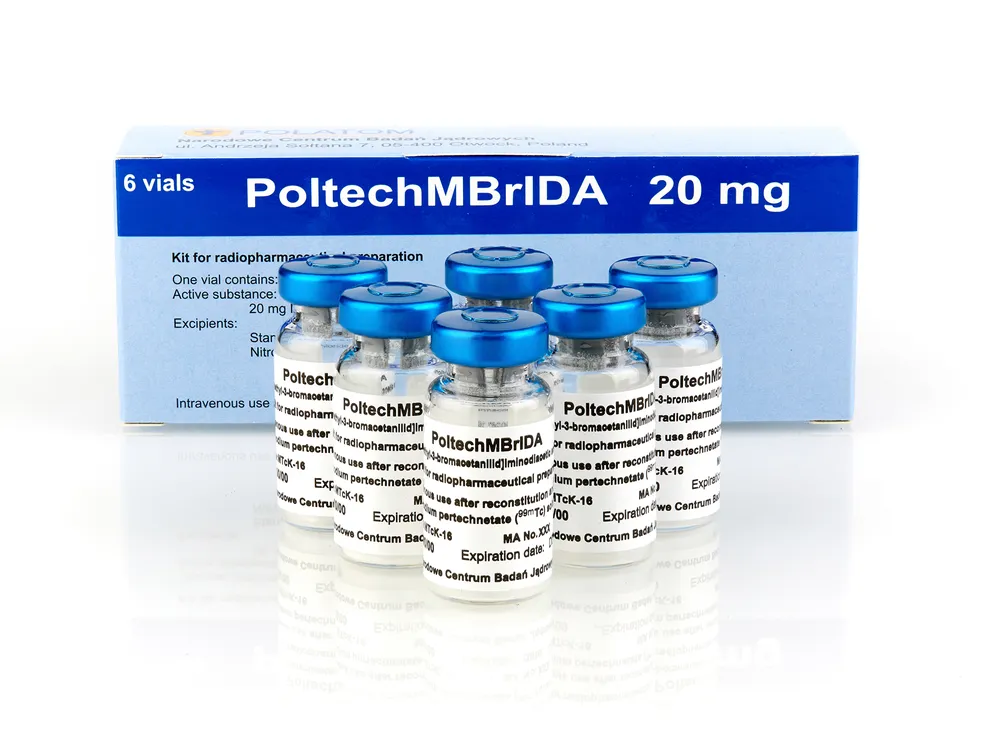
Table of Contents
Package leaflet: Information for the user
PoltechMBrIDA, 20 mg, kit for the preparation of a radiopharmaceutical preparation
Sodium N-[3-bromo-2,4,6-trimethyl-acetanilido]-iminodiacetate
Read the entire leaflet carefully before using this medicine, as it contains important information for the patient.
- Keep this leaflet for future reference.
- If you have any questions, consult your attending physician or the nuclear medicine specialist supervising the examination.
- If you experience any adverse reactions, including those not listed in this leaflet, inform the nuclear medicine specialist immediately. See section 4.
Leaflet contents:
- What PoltechMBrIDA is and what it is used for
- Important information before using PoltechMBrIDA kit
- How to use PoltechMBrIDA kit
- Possible side effects
- How to store PoltechMBrIDA kit
- Contents of the pack and other information
1. What PoltechMBrIDA is and what it is used for
PoltechMBrIDA is a radiopharmaceutical preparation intended solely for diagnostic use.
The radiopharmaceutical agent PoltechMBrIDA, after being radiolabeled (i.e. combined with) the radioactive isotope technetium (Tc), is used in imaging diagnostics (scintigraphy) of the liver and biliary tract.
Due to its labeling with the radioactive isotope technetium-99m (Tc-99m), use of PoltechMBrIDA involves exposure to a small radiation dose. The physician has determined that the benefits derived from the diagnostic procedure outweigh the potential risks associated with ionizing radiation.
2. Important information before using the PoltechMBrIDA kit
When not to use the PoltechMBrIDA kit
PoltechMBrIDA must not be used if the patient has a known allergy to the active substance or to any of the other components of this medicinal product (listed in section 6).
Warnings and precautions
Inform the nuclear medicine specialist in the following cases:
- if the woman is pregnant or suspects she may be pregnant,
- if the woman is breastfeeding.
Administration of radiopharmaceuticals poses a risk of exposure to ionizing radiation for other individuals, as well as potential contamination from urine, vomit, etc. Therefore, basic personal hygiene rules should be followed, and residues of urine or vomit should be cleaned up promptly as recommended by the physician.
Special care should be taken when handling radiopharmaceuticals to avoid unnecessary exposure of staff and patients.
The biliary tract may not be adequately visualized under the following conditions:
- parenteral nutrition,
- prolonged fasting (over 24 hours),
- after a meal (the examination should be performed at least 2 hours, preferably 6 hours, after the last meal),
- severe liver damage.
Children and adolescents
Inform the nuclear medicine specialist if the patient is under 18 years of age.
Administration of the medicinal product in children should be carefully considered, taking into account clinical indications and benefit-risk assessment in this patient group.
PoltechMBrIDA and other medicinal products
Inform your doctor about all medicinal products currently used, recently used, or planned to be used during the examination.
Some narcotic analgesics may affect the flow of the radiopharmaceutical through the extrahepatic biliary tract. Morphine sulfate is commonly used in scintigraphic examinations of the biliary tract.
Cholecystokinin and its analogs cause contraction of the gallbladder and may alter the flow of the radiopharmaceutical through the biliary tract. Similar effects may be caused by fatty meals and certain dietary supplements.
In patients receiving parenteral nutrition or fasting for over 24–48 hours, increased biliary pressure in the gallbladder may impair the normal flow of the radiopharmaceutical.
Phenobarbital and ursodeoxycholic acid enhance the excretion of the radiopharmaceutical via the biliary tract.
Other drugs and substances affecting the gallbladder, biliary tract, or altering the biodistribution of Tc-labeled iminodiacetic acid derivatives are listed in the table below:
Atropine
Benzodiazepines
Erythromycin
Estrogens
Ethanol
Glycerol triazotate
Glucagon
Naloxone
Nicotine
Nifedipine
Nicardipine
Nitrous oxide
Pancreatic enzymes
Pirenzepine
Progesterone
Prostigmine
Somatostatin analogs
Theophylline
In patients treated with chemotherapeutic (anticancer) agents administered via hepatic artery infusion, cholecystitis may develop, which could result in non-visualization of the gallbladder during scintigraphy performed with Tc-MBrIDA.
Pregnancy and breastfeeding
During pregnancy, suspected pregnancy, planning pregnancy, or during breastfeeding, consult a physician before administration of this medicinal product.
Before administration of the radiopharmaceutical, inform the nuclear medicine specialist if:
- pregnancy is suspected,
- menstruation is absent at the expected time,
- the woman is breastfeeding.
In case of uncertainty, consultation with the attending physician or a nuclear medicine specialist supervising the examination is required.
If the patient is pregnant, it is important to inform the physician. The use of radiopharmaceuticals during pregnancy should be carefully evaluated. The physician will only proceed with a radiopharmaceutical examination during pregnancy if absolutely necessary.
In case of breastfeeding and when administration of a radiopharmaceutical is required, the physician may advise temporarily discontinuing breastfeeding and expressing milk. Breastfeeding should be interrupted for at least 4 hours after injection of the radiopharmaceutical, and milk expressed during this period should be discarded. Resumption of breastfeeding should be discussed with the nuclear medicine specialist supervising the examination.
Driving and operating machinery
The effect of the medicinal product on the ability to drive and operate machinery has not been studied.
The PoltechMBrIDA kit contains sodium ions.
Inform the nuclear medicine specialist if the patient is on a low-sodium diet.
3. How to use PoltechMBrIDA kit
Radiopharmaceuticals may be administered only by authorized personnel.
There are strict regulations regarding the use, transfer, and disposal of radiopharmaceuticals.
The PoltechMBrIDA kit is used exclusively under appropriate clinical conditions and only by appropriately qualified individuals. These individuals take special precautionary measures to ensure the safe use of the radiopharmaceutical and will continuously report on their actions.
The radiopharmaceutical is intended for intravenous administration.
The nuclear medicine specialist supervising the procedure decides the dose of the medicinal product to be administered in each individual case. This will be the minimum dose necessary to obtain the required diagnostic information. The recommended dose ranges between 111 and 185 MBq (MBq = megabecquerel, a unit of radioactivity measurement). However, higher doses may be considered in cases of elevated blood bilirubin levels.
Use in children and adolescents
In children and adolescents, the amount of medicinal product to be administered is determined based on the patient's body weight.
Administration of the medicinal product and performance of the examination
The ready-to-inject solution will be administered intravenously before the examination.
The radioactive radiopharmaceutical Tc-MBrIDA is intended for intravenous administration under the strict supervision of qualified personnel.
During the preparation of the medicinal product, safety procedures for working with ionizing radiation must be strictly followed.
Fasting for 6–24 hours prior to the examination is recommended (this duration may vary depending on the indication), and intake of products that may affect the test results should be avoided.
Duration of the procedure
The physician will inform you about the standard duration of the procedure.
After administration of PoltechMBrIDA
The physician will advise whether special precautionary measures are necessary following administration of the radiopharmaceutical.
In case of any doubts, please consult your treating physician or the nuclear medicine specialist.
Administration of a higher than recommended dose of PoltechMBrIDA
Overdose is practically impossible, as the dose of radiopharmaceutical administered to the patient is strictly controlled by the nuclear medicine specialist supervising the examination. However, in the event of an overdose, the physician may recommend laxatives and/or increased fluid intake to help eliminate residual radiopharmaceutical from the body.
In case of any doubts regarding the use of the medicinal product, please consult the physician or the nuclear medicine specialist supervising the examination.
4. Possible adverse reactions
Like all medicines, PoltechMBrIDA can cause adverse reactions, although not everyone experiences them.
Serious adverse reactions
Adverse reactions with unknown frequency of occurrence:
- Allergic reactions: If an allergic reaction occurs in a patient during imaging procedures at a hospital or clinic, inform the doctor or nurse immediately. Symptoms may include: skin rash, itching or redness of the skin, facial swelling, breathing difficulties. If any of the above-mentioned adverse reactions occur after the patient has left the hospital or clinic, go directly to the emergency department of the nearest hospital.
Administration of a radiopharmaceutical results in exposure to a small dose of ionizing radiation, which is associated with the risk of inducing neoplastic diseases and hereditary defects. Current evidence indicates a low probability of such adverse reactions occurring in diagnostic procedures in nuclear medicine.
Reporting of adverse reactions
If any adverse symptoms occur, including any possible adverse reactions not listed in this leaflet, inform your doctor or nurse.
Adverse reactions can be reported directly to the Department of Monitoring Adverse Drug Reactions of the Office for Registration of Medicinal Products, Medical Devices and Biocidal Products
Al. Jerozolimskie 181 C
02-222 Warsaw
Phone: +48 22 49 21 301
Fax: +48 22 49 21 309
Website: https://smz.ezdrowie.gov.pl
Adverse reactions can also be reported to the responsible entity.
By reporting adverse reactions, additional information on the safety of the medicine can be collected.
5. How to store PoltechMBrIDA kit
The patient will not be required to store this medicine.
Radiopharmaceuticals are stored exclusively by authorized personnel
under appropriate clinical conditions. Storage of radiopharmaceuticals is carried out in accordance with local regulations concerning radioactive substances.
The following information is intended solely for medical staff.
Do not use the medicine after the expiry date stated on the packaging.
6. Contents of the pack and other information
What PoltechMBrIDA contains
- The active substance is sodium N-[3-bromo-2,4,6-trimethyl-acetanilide]-iminodiacetate
- The other components are: tin(II) chloride dihydrate, sodium hydroxide (for pH adjustment), hydrochloric acid (for pH adjustment)
What PoltechMBrIDA looks like and contents of the pack
A kit for the preparation of a radiopharmaceutical agent.
White powder.
The kit is supplied in 10 ml glass vials, closed with a rubber stopper and sealed with an aluminium cap, packed in a cardboard box.
Pack contents:
3 vials or 6 vials.
Each vial contains a lyophilisate for the preparation of an injection solution.
Marketing Authorisation Holder and Manufacturer
National Centre for Nuclear Research
Andrzeja Sołtana Street 7
05-400 Otwock
Phone: 22 7180700
Fax: 22 7180350
e-mail: [email protected]
For further information, please contact your doctor or representative of the Marketing Authorisation Holder.
The full Product Information (SmPC) for PoltechMBrIDA is included as a separate document within the product packaging, providing healthcare professionals with additional scientific and practical information regarding the administration and use of this radiopharmaceutical.