Pneumovax 23
Poland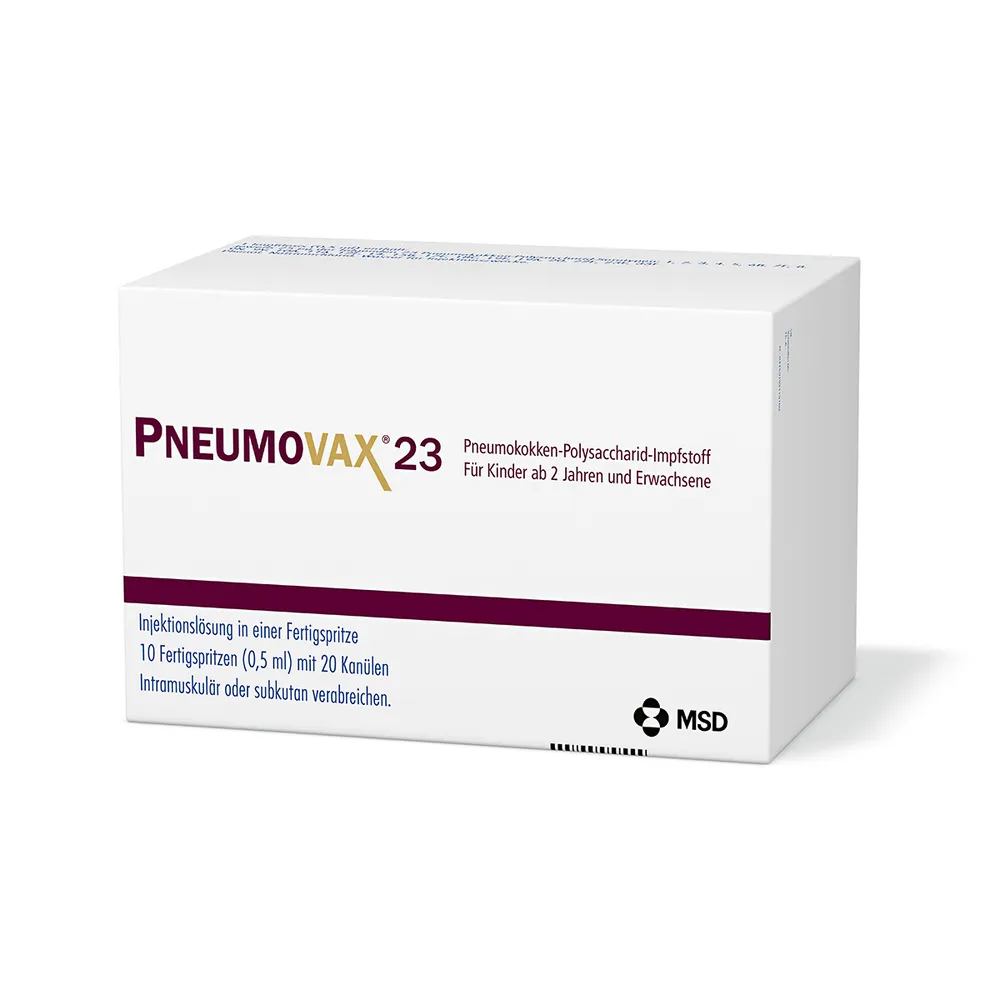
Table of Contents
Package leaflet: Information for the patient
PNEUMOVAX 23
Pneumococcal vaccine, polysaccharide
Injection solution
Please read all of this leaflet carefully before the vaccine is administered, because it
contains important information for the patient.
- Keep this leaflet so that you can read it again if necessary.
- If you have any further questions, please consult your doctor or nurse.
- If you experience any adverse reactions after vaccination, including any adverse reactions not listed in this leaflet, inform your doctor, pharmacist, or nurse. See section 4.
Table of contents
- What PNEUMOVAX 23 is and what it is used for
- Important information before vaccination with PNEUMOVAX 23
- How to use PNEUMOVAX 23
- Possible side effects
- How to store PNEUMOVAX 23
- Contents of the pack and other information
1. What PNEUMOVAX 23 is and what it is used for
PNEUMOVAX 23 is available in a vial containing 0.5 ml of vaccine.
PNEUMOVAX 23 is intended for use in children (aged 2 years and older) and adults to prevent infections caused by Streptococcus pneumoniae.
Vaccination is recommended for the following individuals:
Individuals with normal immune system function
- persons over 50 years of age;
- individuals aged 2 years and older with chronic heart or vascular disease (including congestive heart failure and cardiomyopathy), chronic respiratory disease (including chronic obstructive pulmonary disease and emphysema), or diabetes mellitus;
- individuals aged 2 years and older with chronic liver disease (including cirrhosis), alcohol dependence, or at risk of cerebrospinal fluid leakage;
- individuals aged 2 years and older with congenital asplenia or splenic dysfunction (including those with sickle cell anemia and those who have undergone splenectomy);
- individuals aged 2 years and older living in specific settings or social groups, e.g., in long-term care facilities.
Individuals with impaired immune system function
- individuals aged 2 years and older, including those infected with HIV, those with leukemia, lymphoma, Hodgkin's disease, multiple myeloma, generalized malignancy, chronic renal failure or nephrotic syndrome; individuals undergoing immunosuppressive chemotherapy (including those treated with corticosteroids); individuals who have received organ or bone marrow transplantation.
Pneumococci cause infections of the lungs (mainly pneumonia), of the membranes surrounding the brain and spinal cord (meningitis), and of the blood (bacteremia or sepsis).
PNEUMOVAX 23 protects only against infections caused by the pneumococcal serotypes whose antigens are included in the vaccine. The vaccine contains antigens of 23 serotypes responsible for the majority of pneumococcal infections (approximately 9 out of 10).
Administration of the vaccine in both children and adults induces the production of antibodies in the body that protect against pneumococcal infection.
Pneumococcal infections occur worldwide, are not age-dependent, and most commonly affect:
- elderly individuals;
- individuals who have had their spleen removed or whose spleen does not function properly;
- individuals with reduced resistance to infectious diseases due to chronic illness or infection (e.g., certain types of cancer, HIV infection, heart, lung, kidney, or liver disease, or diabetes);
- individuals with reduced resistance to infectious diseases due to treatments used for other conditions (e.g., cancer therapy or organ or bone marrow transplantation).
Pneumococcal meningitis may occur following head trauma or skull fracture and, rarely, after certain surgical procedures. The PNEUMOVAX 23 vaccine may not protect against all infections arising under such circumstances.
The PNEUMOVAX 23 vaccine does not protect against milder respiratory tract infections (e.g., sinus or ear infections).
2. Important information before using PNEUMOVAX 23 vaccine
If any of the conditions listed below apply, inform your doctor
or nurse. They will decide whether PNEUMOVAX 23 vaccine can be administered.
If any of the points listed below are unclear, please consult your doctor or
nurse for clarification.
When not to use PNEUMOVAX 23 vaccine
- if the patient is allergic to any of the components of this vaccine (listed in section 6);
- if the patient has previously experienced an allergic reaction to any of the components of this vaccine (listed in section 6).
Warnings and precautions
Do not use the vaccine in case of a severe illness accompanied by fever.
Vaccination should be postponed until recovery.
Even if vaccination is delayed, it may not protect against pneumococcal infection to the same extent as in healthy individuals if:
- there is reduced immunity to infections due to current treatment (e.g. use of cytotoxic anticancer drugs or ongoing radiotherapy);
- there is a chronic disease or infection that may lead to reduced immunity to infections.
If any of the above points apply, vaccination may be performed at the scheduled time or postponed to a later date.
Children and adolescents
PNEUMOVAX 23 vaccine can be administered to individuals aged 2 years and older. Use in younger individuals results in inadequate immunological response.
PNEUMOVAX 23 and other medicines
This vaccine can be given simultaneously with the influenza vaccine.
For information on administering PNEUMOVAX 23 vaccine together with ZOSTAVAX vaccine, please consult your doctor or healthcare provider.
Do not discontinue antibiotic prophylaxis currently used against pneumococci. Even after vaccination, if there is suspicion of infection or high risk of pneumococcal infection, it remains important that the doctor promptly prescribes antibiotic therapy (e.g. in individuals who have had their spleen removed or whose spleen does not function properly).
Inform your doctor or pharmacist about all medicines currently taken or recently taken, including those obtained without a prescription, as well as any medicines the patient plans to use.
Pregnancy and breastfeeding
If the patient is pregnant or breastfeeding, suspects she may be pregnant, or is planning to become pregnant, she should consult her doctor or pharmacist before using this vaccine.
It is not known whether administration of PNEUMOVAX 23 vaccine to a pregnant woman may pose a risk to the fetus. The decision to vaccinate is made by the doctor.
Inform your doctor about ongoing or planned breastfeeding. The decision to vaccinate is made by the doctor.
Driving and operating machinery
There are no data indicating that PNEUMOVAX 23 vaccine may impair the ability to drive or operate machinery.
PNEUMOVAX 23 contains phenol
PNEUMOVAX 23 vaccine contains phenol as an excipient. Inform your doctor if the patient or their child has ever had an allergic reaction to this component.
PNEUMOVAX 23 contains sodium
This medicine contains less than 1 mmol (23 mg) of sodium per dose, i.e. the medicine is considered "sodium-free".
3. How to use PNEUMOVAX 23
The vaccination should be administered by a doctor or nurse experienced in giving vaccines.
It should be given in a medical setting where necessary medications are available in case of a rare, serious allergic reaction to the vaccine.
PNEUMOVAX 23 is usually administered into the upper arm, as an intramuscular or deep subcutaneous injection.
Vaccines must not be administered intradermally or intravascularly.
The vaccine is generally given at least 2 weeks before a planned splenectomy or before starting a planned, specialized anticancer therapy.
If such therapy is started or completed, vaccination may be delayed by approximately 3 months.
For individuals who are HIV seropositive, the vaccine is usually administered immediately after test results are obtained.
A second dose of the vaccine is generally not necessary unless at least 3 years have passed since the first vaccination. Healthy individuals do not usually require a second dose of the vaccine. For individuals at particularly high risk of severe pneumococcal infection (e.g. individuals without a spleen or those with impaired spleen function), revaccination may be recommended 3 to 5 years after the previous dose.
The decision to administer an additional dose of the vaccine lies with the physician.
4. Possible adverse reactions
Like any medicine, this vaccine can cause adverse reactions, although not everyone will experience them.
If any of the following symptoms occur after vaccination, you should immediately inform your doctor,
as these symptoms may indicate an allergic reaction or other serious adverse reactions:
- difficulty breathing
- wheezing
- redness
- rash
There is a risk of serious, rare allergic reactions following any vaccination. These may include
difficulty breathing, bluish discoloration of the lips or tongue, low blood pressure (causing dizziness),
and fainting. If such reactions occur, they usually appear shortly after vaccination, while the patient
is still under medical supervision. However, if any of the listed symptoms occur after leaving
the clinic, you should immediately contact your doctor.
Other symptoms of allergic reactions may also occur. These include fever and general malaise
associated with pain or even inflammation and swelling in the joints, muscle pain, swelling
of the face and neck, urticaria, and rash. If any of these symptoms occur, you should immediately
contact your doctor, in case appropriate treatment is needed.
Very common adverse reactions (in around 1 in 10 vaccinated individuals) include pain, redness,
increased warmth, swelling, induration at the injection site, and fever. These reactions occur
more frequently after administration of the second dose than after the first dose.
Adverse reactions observed during clinical trials and following vaccine introduction to the market include:
- feeling tired or weak
- chills
- nausea, vomiting
- swollen lymph nodes and/or inflammation
- decreased platelet count in individuals who had low platelet counts before vaccination due to idiopathic thrombocytopenic purpura, increasing the risk of bleeding and bruising; if increased frequency of bruising or bleeding is observed, you should immediately inform your doctor, in case appropriate treatment is needed
- headache, altered skin sensation or tingling, numbness, and limb weakness (including Guillain-Barré syndrome). You should inform your doctor if you notice any problems with sensation or movement.
In the post-marketing period, significant swelling of the limb in which the vaccine was administered
has been rarely reported.
Reporting of adverse reactions
If any adverse reactions occur, including any not listed in this leaflet, you should inform your doctor
or nurse. Adverse reactions can be reported directly to the Department of Monitoring Adverse Drug
Reactions of the Office for Registration of Medicinal Products, Medical Devices and Biocidal Products:
Al. Jerozolimskie 181 C, 02-222 Warsaw, Tel.: +48 22 49 21 301, Fax: +48 22 49 21 309, Website: https://smz.ezdrowie.gov.pl .
Adverse reactions can also be reported to the marketing authorization holder.
Reporting adverse reactions helps to provide more information on the safety of the vaccine.
5. How to store PNEUMOVAX 23 vaccine
Keep out of sight and reach of children.
Store in a refrigerator (2°C - 8°C).
Do not freeze.
Do not use this vaccine after the expiry date stated on the label and carton after:
"EXP". The expiry date refers to the last day of the stated month.
Before administration, check that the solution is clear and free from
particles or discoloration.
6. Contents of the pack and other information
What PNEUMOVAX 23 contains
- The active substance in the vaccine is 25 µg of capsular polysaccharide from each of 23 serotypes of Streptococcus pneumoniae: 1, 2, 3, 4, 5, 6B, 7F, 8, 9N, 9V, 10A, 11A, 12F, 14, 15B, 17F, 18C, 19F, 19A, 20, 22F, 23F, 33F.
The antigens listed above have been purified so they can be administered by injection
to both children and adults.
- The other components are: sodium chloride, phenol, and water for injections.
This medicine contains less than 1 mmol (23 mg) of sodium per dose, i.e. this medicine is considered
“sodium-free”.
What PNEUMOVAX 23 looks like and contents of the pack
The vaccine is a clear, colourless solution.
Solution for intramuscular or subcutaneous injection.
PNEUMOVAX 23 is available in the following pack sizes:
- 1 vial of 0.5 ml;
- 10 vials of 0.5 ml;
- 1 pre-filled syringe of 0.5 ml;
- 10 pre-filled syringes of 0.5 ml.
Vials made of Type I glass with a butyl rubber stopper.
Pre-filled syringe made of Type I glass with a bromobutyl plunger stopper laminated with a fluoropolymer layer, and tip cap (synthetic blend of isoprene-bromobutyl polyisoprene or styrene-butadiene rubber).
Not all pack sizes may be marketed.
Marketing Authorisation Holder and Manufacturer
Marketing Authorisation Holder: Manufacturer:
MSD Polska Sp. z o.o. Merck Sharp & Dohme B.V.
ul. Chłodna 51 Waarderweg 39
00-867 Warsaw, Poland 2031 BN Haarlem, The Netherlands
Tel.: (+48) 22 549 51 00
[email protected]