Pikopil
Poland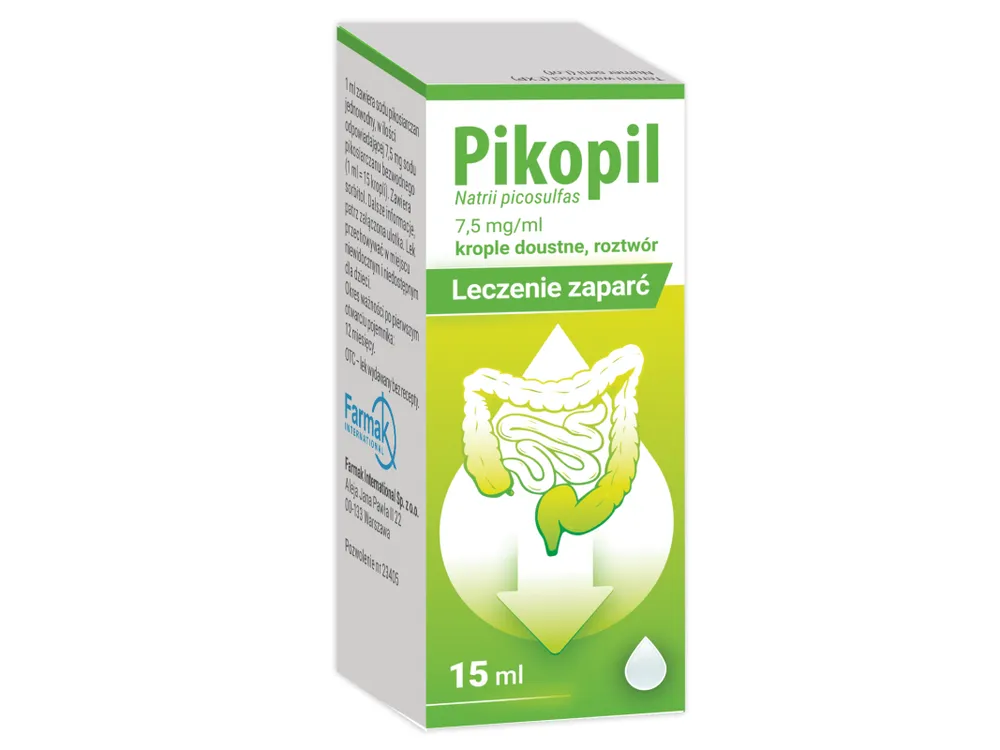
Table of Contents
Package leaflet: Information for the patient
Pikopil, 7.5 mg/ml, oral drops, solution
Natrii picosulfas
Please read this leaflet carefully before taking the medicine, as it contains important information for the patient.
This medicine should always be taken exactly as described in this patient leaflet or as directed by the physician or pharmacist.
- Keep this leaflet, so that you can read it again if necessary.
- If you need advice or further information, please consult your pharmacist.
- If you experience any adverse reactions, including any possible adverse reactions not listed in this leaflet, inform your doctor or pharmacist. See section 4.
- If there is no improvement after 3 days, or if you feel worse, consult your doctor.
Contents of the leaflet
- What Pikopil is and what it is used for
- Important information before taking Pikopil
- How to take Pikopil
- Possible side effects
- How to store Pikopil
- Contents of the pack and other information
1. What Pikopil is and what it is used for
Pikopil contains sodium picosulfate as the active substance. Pikopil belongs to a group of medicines called laxatives.
Pikopil works by stimulating intestinal movements. The medicine also increases the amount of water in the intestines.
Pikopil is used for the short-term relief of symptoms associated with chronic or recurrent constipation.
If there is no improvement after 3 days, or if you feel worse, consult your doctor.
2. Important information before taking Pikopil
When not to take Pikopil:
- if the patient is allergic to sodium picosulfate, other substances belonging to the group of triarylmethane derivatives (e.g. bisacodyl), or any of the other ingredients of this medicine (listed in section 6);
- in case of severe dehydration (i.e. loss of excessive amount of water from the body);
- if the intestine is blocked (intestinal obstruction);
- in case of serious abdominal disorders such as appendicitis;
- if acute inflammatory bowel disease is present;
- if severe abdominal pain occurs, accompanied by nausea or vomiting;
- if sudden, acute abdominal pain occurs shortly before taking the medicine;
- in case of a condition called intestinal obstruction, which occurs when the small intestine is blocked.
If any of the above situations apply to the patient, Pikopil must not be taken.
If in doubt, consult a doctor or pharmacist before taking Pikopil.
Warnings and precautions
If the patient takes Pikopil for a long time or in high doses, it may affect the amount of fluids and electrolytes in the body. This may lead, in particular, to decreased potassium levels (hypokalaemia), reduced fluid volume (dehydration), or diarrhoea.
Dizziness or fainting may occur during bowel movements or due to abdominal pain caused by constipation.
Pikopil should not be taken daily or for prolonged periods. If the patient finds that daily use of this medicine is necessary, or if symptoms do not resolve or recur frequently, a doctor should be consulted to diagnose the underlying cause of constipation.
If intestinal movements do not increase after taking Pikopil, treatment with this medicine should be discontinued.
If any of the above situations apply to the patient (or if the patient is uncertain), the matter should be discussed with a doctor or pharmacist before starting Pikopil.
Children and adolescents
Before giving Pikopil to a child, consult a doctor or pharmacist. Pikopil is less effective in children under 4 years of age.
Pikopil and other medicines
Inform the doctor or pharmacist about all medicines currently taken or recently used, as well as any medicines the patient plans to take. This includes also over-the-counter medicines and herbal remedies.
This should be done because Pikopil may affect the action of other medicines. Likewise, other medicines may affect the action of Pikopil.
Especially inform the doctor or pharmacist if the patient is taking any of the following medicines:
- prescription medicines that may affect fluid levels in the body, such as:
- diuretics (water pills) like bendroflumethiazide or furosemide,
- steroid medicines like prednisolone.
- certain medicines used for heart conditions (e.g. digoxin, digitoxin). Fluid and electrolyte imbalances in the body may increase the patient's sensitivity to these medicines.
- antibiotics (used to treat infections). Concurrent use of broad-spectrum antibiotics may reduce the effectiveness of Pikopil.
Pregnancy and breastfeeding
If the patient is pregnant or breastfeeding, suspects she may be pregnant, or is planning to have a child, she should consult a doctor or pharmacist before using this medicine.
Pikopil should not be used during pregnancy unless a doctor decides it is necessary.
Driving and operating machinery
Dizziness or fainting may occur, usually during bowel movements or due to abdominal pain associated with constipation. If the patient experiences such symptoms, caution should be exercised when driving or operating machinery.
Pikopil contains sorbitol
If the patient has previously been diagnosed with intolerance to certain sugars, the patient should consult a doctor before taking this medicine.
3. How to take Pikopil
This medicine should always be taken according to the recommendations of a doctor or pharmacist. If in doubt,
consult a doctor or pharmacist.
It is recommended to start treatment with the lowest possible dose. The dose may be increased up to the maximum recommended dose in order to achieve regular bowel movements.
Do not exceed the maximum recommended daily dose of the medicine.
Dosage in adults
The recommended dose is 8 to 12 drops at a time.
You may take fewer or more drops to determine the optimal dose for you.
Use in children and adolescents
Before administering Pikopil to a child, consult a doctor or pharmacist. Pikopil is less effective in children under 4 years of age.
The recommended daily dose for children is:
- Children over 6 years of age: 8 to 12 drops at a time;
- Children from 4 to 6 years of age: 6 drops at a time.
Administration method
- To administer the oral solution, count the required number of drops onto a spoon;
- Hold the vial upside down with the dropper vertically downward and gently squeeze the vial;
- The rate of drop flow should not exceed 2 drops per second;
- If a drop contains an air bubble, do not count it and add another drop.
Pikopil should be taken in the evening, before going to bed, with or without liquid. The effect usually occurs about 6 to 12 hours after administration, so sleep will not be interrupted.
During treatment with this medicine, drink plenty of water throughout the day. This will help prevent dehydration.
Duration of treatment
Do not take Pikopil for longer than 3 consecutive days. If there is no improvement after 3 days, or if the patient feels worse, consult a doctor.
Overdose of Pikopil
If a patient has taken more medicine than recommended, contact a doctor immediately or go to the nearest hospital. Take the medicine packaging with you so the doctor knows which medicine has been taken. Drink plenty of water.
In such cases, severe diarrhoea or strong abdominal cramps may occur. Additionally, with significant fluid loss, disturbances in electrolyte concentrations in the body may occur (mainly low potassium levels). In cases of severe overdose, reduced blood flow to the intestinal mucosa has been reported.
Laxatives may cause chronic diarrhoea, abdominal pain, decreased potassium levels in the blood, which in severe cases may lead to muscle cramps or weakness, fatigue, impaired kidney function, and kidney stone formation.
Missed dose of Pikopil
Do not take a double dose to make up for a missed dose.
If you have any further doubts concerning the use of this medicine, consult your doctor or pharmacist.
4. Possible side effects
Like all medicines, this medicine can cause side effects, although not everybody will experience them.
Some side effects may be serious. You must stop taking the medicine immediately
and contact your doctor or call emergency services if any of the following
symptoms occur:
- Allergic reaction. Symptoms may include itching, rash, swelling of the lips, mouth, tongue, throat, difficulty breathing.
The following side effects may also occur:
Very common side effects (may affect more than 1 in 10 people):
- diarrhoea;
Common side effects (may affect less than 1 in 10 people):
- abdominal cramps;
- abdominal pain;
- discomfort in the upper abdomen;
Rare side effects (may affect less than 1 in 100 people):
- dizziness*;
- fainting*;
- vomiting;
- nausea;
- skin reactions.
*Dizziness and fainting may occur especially during bowel movements or abdominal pain
caused by constipation.
Reporting of side effects
If any side effects occur, including any side effects not listed
in this leaflet, inform your doctor or pharmacist. Side effects can be reported
directly to the Department of Monitoring Adverse Drug Reactions at the Office for Registration of Medicinal Products, Medical Devices and Biocidal Products,
Al. Jerozolimskie 181 C, 02-222 Warsaw,
Phone: +48 22 49 21 301,
Fax: +48 22 49 21 309,
website: https://smz.ezdrowie.gov.pl
Side effects can also be reported to the marketing authorization holder.
Reporting side effects helps to provide more information on the safety of the medicine.
5. How to store Pikopil
Keep the medicine out of the sight and reach of children.
Do not use this medicine after the expiry date stated on the label of the container and carton after:
Expiry date (EXP). The expiry date refers to the last day of the stated month.
No special storage conditions required.
Shelf life after first opening of the container: 12 months.
Medicines must not be disposed of via wastewater or household waste. Ask your pharmacist how to dispose of medicines you no longer use. Such measures will help protect the environment.
6. Contents of the pack and other information
What Pikopil contains
- The active substance is sodium picosulfate. 1 ml contains sodium picosulfate equivalent to 7.5 mg of anhydrous sodium picosulfate (1 ml = 15 drops).
- The other ingredients are: benzyl alcohol, sorbitol, citric acid monohydrate, sodium citrate, water for injections.
What Pikopil looks like and contents of the pack
Pikopil, 7.5 mg, oral drops, solution, is a colourless or slightly yellow solution.
Pikopil is supplied in white, opaque polyethylene containers with a dropper and green cap, secured with a tamper-evident ring, containing 15 ml or 30 ml of oral drops in solution form.
Not all pack sizes may be marketed.
Marketing Authorisation Holder and Importer
Marketing Authorisation Holder
Farmak International Sp. z o.o.
ul. Koszykowa 65
00-667 Warsaw
Importer
Farmak International Sp. z o.o.
ul. Chełmżyńska 249
04-458 Warsaw
This medicinal product is authorised in the member states of the European Economic Area under the following names:
Poland: Pikopil
General information intended for the user
What is constipation?
The concept of "normal and regular" bowel movements is individual for each person. For some people,
bowel movements occur daily, while for others they are less frequent. Regardless of how it occurs
for a given individual, it is best if bowel movements are regular.
- Constipation is a problem for some people that occurs sporadically. For others, it may occur more frequently.
- Constipation occurs when the normal functioning of intestinal muscles (in the large intestine) is slowed down. This may cause intestinal contents not to be easily eliminated from the body.
Often, the causes of constipation are unknown. It may be caused by:
- A sudden change in diet;
- A diet low in fiber;
- Loss of intestinal muscle tone in elderly people;
- Pregnancy;
- Medications such as morphine or codeine;
- Prolonged bed rest;
- Lack of physical exercise. Regardless of the cause, constipation causes discomfort. The patient may feel bloated and heavy or generally unwell. Constipation sometimes causes headaches.
The following health recommendations may help prevent constipation:
- Eat a varied diet, including fresh fruit and vegetables;
- Drink adequate amounts of water to prevent dehydration;
- Perform physical exercise and maintain fitness;
- If the body signals an upcoming bowel movement, allow sufficient time for it.