Piascledine
Poland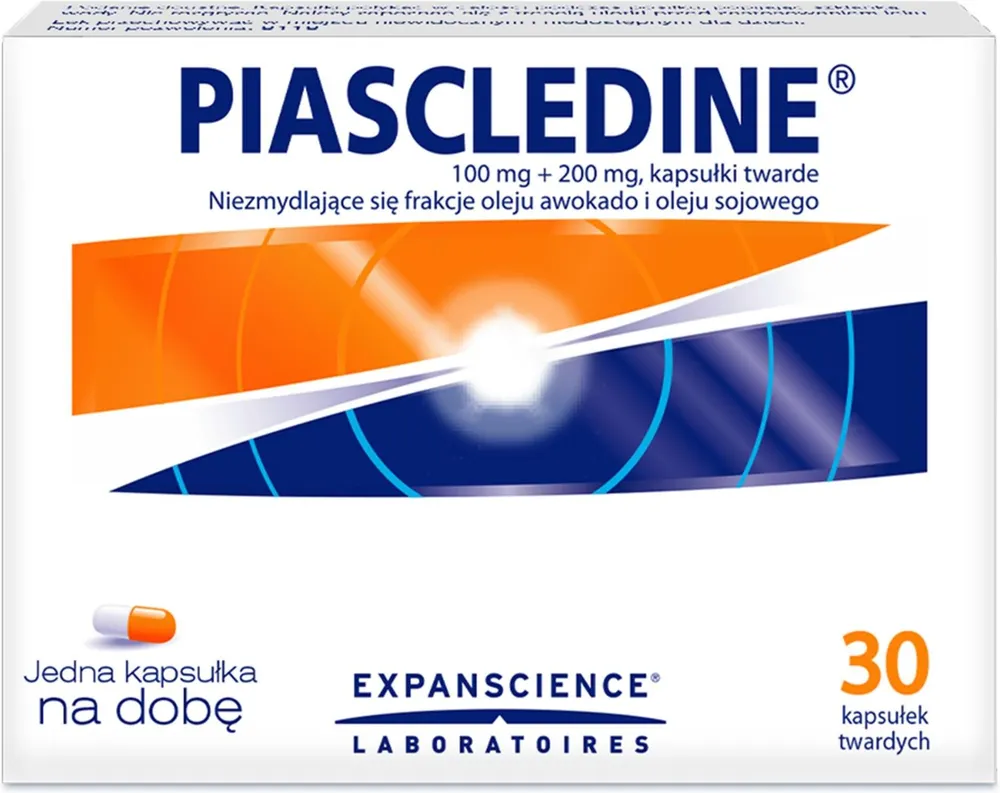
Table of Contents
Package leaflet: Information for the patient
Piascledine, 100 mg + 200 mg, hard capsules
Unsaponifiable fractions of avocado and soybean oils
Please read this leaflet carefully before using the medicine, as it contains
important information for the patient.
This medicine should always be taken exactly as described in this patient leaflet or as directed by
the doctor or pharmacist.
- Keep this leaflet for future reference.
- If advice or further information is needed, please consult your pharmacist.
- If the patient experiences any side effects, including any possible side effects not listed in this leaflet, inform the doctor or pharmacist. See section 4.
- If there is no improvement after several weeks, or if the patient feels worse, contact the doctor.
Contents of the leaflet:
- What Piascledine is and what it is used for
- Important information before taking Piascledine
- How to take Piascledine
- Possible side effects
- How to store Piascledine
- Contents of the pack and other information
1. What Piascledine is and what it is used for
Piascledine contains unsaponifiable fractions of avocado and soybean oils. Piascledine belongs to a group of medicines called other non-steroidal anti-inflammatory and anti-rheumatic drugs, also known as symptomatic, slow-acting drugs in osteoarthritis (SYSADOA).
Piascledine is used in adults to relieve symptoms of osteoarthritis of the knee, such as pain and difficulty in movement.
The full effect of Piascledine may take several weeks to develop and usually persists after treatment has ended.
If there is no improvement after several weeks, or if the patient feels worse, contact the doctor.
2. Important information before using Piascledine
When not to use Piascledine:
- if the patient is allergic to the unsaponifiable fractions of avocado oil and (or) soybean oil or to any of the other ingredients of this medicine (listed in section 6),
Warnings and precautions
Before starting treatment with Piascledine, discuss it with your doctor or pharmacist.
If the patient suffers or has previously suffered from liver or gallbladder disease,
he or she should inform the doctor or pharmacist before using Piascledine. If any symptoms indicating liver or biliary tract problems occur, such as unexplained nausea, vomiting, abdominal pain, fatigue, loss of appetite, yellowing of the skin and eyes (jaundice), or dark urine, treatment should be discontinued immediately and the patient should contact a doctor without delay.
The use of the medicine should be stopped and immediate contact made with a doctor if any symptoms of allergic reactions occur, such as urticaria, itching and (or) skin rash, redness of the skin, facial swelling and (or) difficulty breathing.
If the patient is taking anticoagulants, this should be reported to the doctor or pharmacist before using Piascledine (see section "Piascledine with other medicines").
The use of the medicine should be stopped and immediate contact made with a doctor if any symptoms of coagulation disorders occur, such as red or purple spots on the skin, spontaneous appearance of bruises or petechiae, or bleeding from mucous membranes.
Children and adolescents
Piascledine is a medicine intended exclusively for adults. It should not be used in children and adolescents under 18 years of age.
Piascledine and other medicines
Inform your doctor or pharmacist about all medicines the patient is currently taking or has recently taken, as well as any medicines planned for future use.
Caution is advised when using Piascledine in patients who are simultaneously taking anticoagulants, due to the potential risk of coagulation disorders.
Inform your doctor if the patient is taking Piascledine together with other medicines used in the treatment of osteoarthritis.
Piascledine with food, drink or alcohol
The patient may eat and drink normally while taking this medicine.
Pregnancy, breastfeeding and fertility
If the patient is pregnant or breastfeeding, suspects she may be pregnant, or is planning to have a baby, she should consult her doctor or pharmacist before using this medicine.
This medicine should not be used during pregnancy or breastfeeding.
Piascledine is not recommended for women of childbearing potential who are not using effective contraception. There is insufficient information regarding the effect of the medicine on fertility.
Driving and operating machinery
This medicine does not affect the ability to drive or operate machinery.
3. How to use Piascledine
This medicine should always be taken exactly as described in this patient leaflet or as directed by a doctor or pharmacist. If in doubt, consult a doctor or pharmacist.
Adults
The recommended dose is one capsule per day, taken with a meal.
The capsule should be swallowed whole with a glass of water. Do not chew or crush it.
The recommended duration of treatment is 3 to 6 months.
The effect of Piascledine may be delayed by several weeks.
If the patient feels that improvement is not occurring quickly enough, treatment should not be discontinued without consulting a doctor or pharmacist.
If the effect of the medicine seems too strong or too weak, consult a doctor.
Taking more Piascledine than recommended
Overdosing on Piascledine (taking more than 1 capsule per day) may cause or worsen gastrointestinal disturbances and (or) liver function abnormalities.
If more than the recommended dose of Piascledine has been taken, contact a doctor or pharmacist immediately.
Missed dose of Piascledine
Do not take a double dose to make up for a missed capsule.
Take the next dose at the usual time.
If there are any further doubts regarding the use of this medicine, consult a doctor or pharmacist.
4. Possible adverse reactions
Like all medicines, this medicine can cause adverse reactions, although not everybody will experience them.
The most common adverse reactions associated with the use of Piascledine are: diarrhoea,
abdominal pain, epigastric discomfort and nausea.
Possible serious adverse reactions:
You should immediately inform your doctor and stop taking this medicine if any of the following serious adverse reactions occur, as they may require urgent medical attention:
Symptoms which may indicate severe allergic reactions (occurring not very often):
itching, urticaria, skin rash, skin redness, facial swelling, breathing difficulties,
mucosal changes, persistent gastrointestinal symptoms, low blood pressure.
Severe skin eruptions (occurring rarely).
Liver function disorders (occurring not very often):
liver damage or biliary tract disorders, sometimes associated with abdominal pain, nausea,
pale stools, dark urine, yellowing of the skin, and increased liver enzyme activity in blood (i.e. transaminases, alkaline phosphatase, bilirubin and gamma-glutamyltransferase) may occur not very often (see "Warnings and precautions" in section 2).
The following adverse reactions have also been reported:
Common (may affect up to 1 in 10 patients)
- Diarrhoea
Not very common (may affect up to 1 in 100 patients)
- Epigastric discomfort, heartburn, nausea, unpleasant taste in mouth, abdominal pain, change in stool colour,
- Headache,
- Dark urine,
- Weakness, fatigue,
- Chest pain, breast swelling and vaginal bleeding.
Rare (may affect up to 1 in 1000 patients)
- Gastrointestinal disorders such as: enteritis, vomiting, dry mouth, belching,
- Eczema,
- Kidney stones,
- Coagulation disorders such as reduced platelet count (see "Warnings and precautions" in section 2),
- Increased blood pressure.
Reporting of adverse reactions
If any adverse reactions occur, including any possible adverse reactions not listed in this leaflet, inform your doctor or pharmacist. Adverse reactions can be reported directly to: Department of Monitoring Adverse Drug Reactions, Office for Registration of Medicinal Products, Medical Devices and Biocidal Products, Al. Jerozolimskie 181C, 02-222 Warsaw, tel. +48 22 4921301,
fax: +48 22 4921309, website: https://smz.ezdrowie.gov.pl
Reporting adverse reactions helps to provide more information on the safety of this medicine.
5. How to store Piascledine
This medicine does not require any special storage conditions.
The medicine should be stored in a place inaccessible and out of sight of children.
Do not use this medicine after the expiry date stated on the carton and blister after: EXP.
The expiry date refers to the last day of the stated month.
Do not use this medicine if you notice any visible signs of deterioration.
Medicines must not be disposed of via wastewater or household waste. Ask your pharmacist how to dispose of medicines no longer required. This will help protect the environment.
6. Contents of the pack and other information
What Piascledine contains
The active substances in this medicine are unsaponifiable fractions of avocado oil and soybean oil. Each capsule contains 100 mg of unsaponifiable fraction of avocado oil and 200 mg of unsaponifiable fraction of soybean oil.
The other ingredients are: butylated hydroxytoluene, colloidal anhydrous silica, titanium dioxide (E 171), gelatin, erythrosine (E 127), yellow iron oxide (E 172), bovine gelatin (Type B), polysorbate 80.
What Piascledine looks like and contents of the pack
Piascledine is an orange-capped, opaque grey capsule with the imprint "P 300".
The capsules are packed in a cardboard box containing 2 blisters with 15 capsules each (30 capsules in total).
Marketing Authorisation Holder and Manufacturer:
Marketing Authorisation Holder
Laboratoires Expanscience
1 place des Saisons, 92048 Paris La Défense Cedex, France
Manufacturer
Laboratoires Expanscience
Rue des Quatre Filles, 28230 Epernon, France
For any information about this medicinal product, please contact the local representative of the Marketing Authorisation Holder
Angelini Pharma Polska Sp. z o.o.
Aleje Jerozolimskie 181B, 02-222 Warsaw, Poland
Tel.: (22) 70-28-200
E-mail: [email protected]