Physiotens 0.2
Poland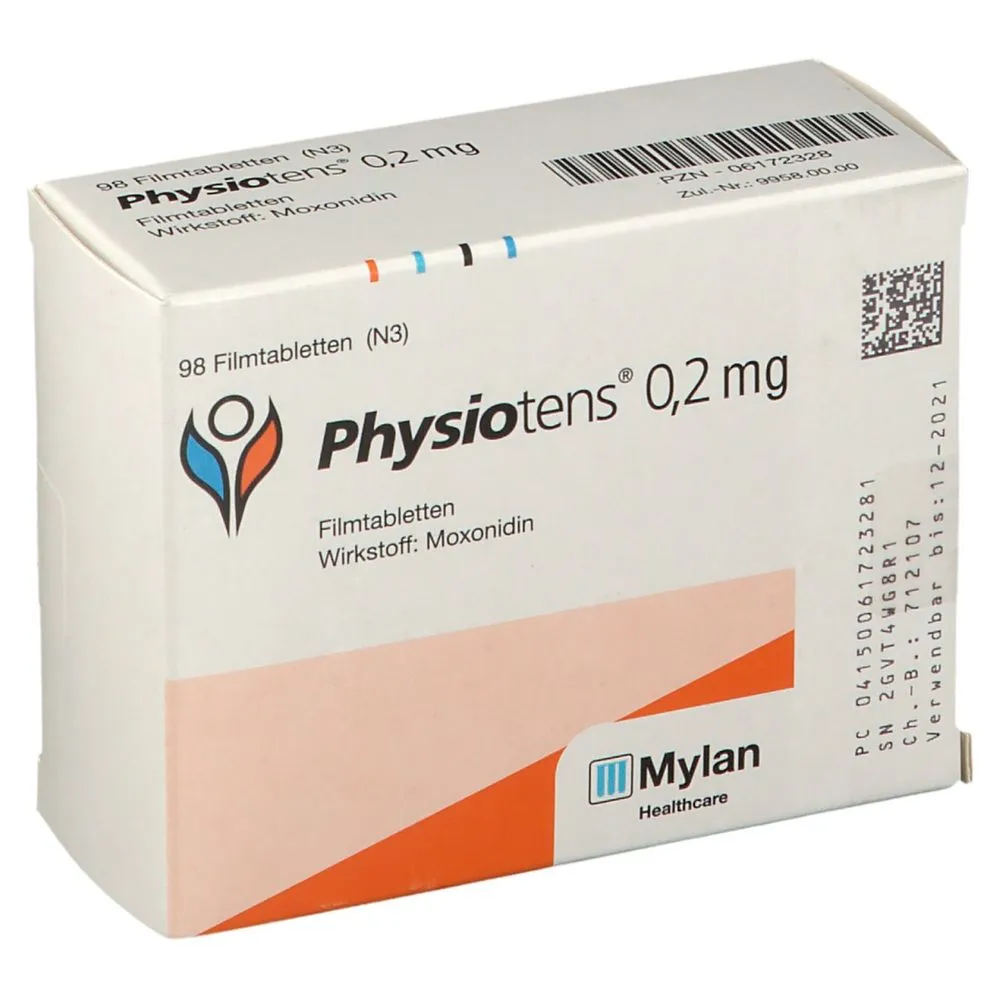
Table of Contents
Patient Information Leaflet
Warning! Keep this leaflet! The information on the immediate packaging is in a foreign language.
Physiotens 0.2
0.2 mg, coated tablets
Moxonidinum
Please read this leaflet carefully before taking this medicine, as it contains
important information for you.
- Keep this leaflet so that you can read it again if necessary.
- If you have any questions, please consult your doctor or pharmacist.
- This medicine has been prescribed for a specific individual. Do not give it to others. This medicine may harm another person, even if their symptoms are the same.
- If you experience any adverse reactions, including any adverse reactions not listed in this leaflet, inform your doctor or pharmacist. See section 4.
Table of Contents
- What is Physiotens 0.2 and what is it used for
- Important information before taking Physiotens 0.2
- How to take Physiotens 0.2
- Possible side effects
- How to store Physiotens 0.2
- Contents of the pack and other information
1. What is Physiotens 0.2 and what is it used for
Physiotens 0.2 contains moxonidine. This medicine belongs to a group of medicines known as antihypertensives.
Physiotens 0.2 is used to treat high blood pressure (hypertension).
It works by relaxing and widening blood vessels. This helps to lower blood pressure.
2. Important information before taking Physiotens 0.2
When not to take Physiotens 0.2:
- if the patient is allergic (hypersensitive) to moxonidine or to any of the other ingredients of Physiotens 0.2 (listed in section 6);
- if the patient has a slow heart rate caused by a condition called "sick sinus syndrome" or "second- or third-degree atrioventricular block";
- if the patient has heart failure. Do not take Physiotens 0.2 if any of the above conditions apply. If in doubt, consult a doctor or pharmacist before taking Physiotens 0.2.
Warnings and precautions
Before starting treatment with Physiotens 0.2, consult a doctor or pharmacist if:
- the patient has a heart condition called "first-degree atrioventricular block";
- the patient has severe coronary insufficiency or unstable angina pectoris;
- the patient has renal impairment. A dose adjustment by the doctor may be necessary. If any of the above conditions apply or if there are any doubts, speak to a doctor or pharmacist before taking Physiotens 0.2. Physiotens 0.2 and other medicines Inform the doctor or pharmacist about all medicines currently being taken, including
those obtained without a prescription, as well as herbal medicines. Physiotens 0.2 may affect the action of other medicines. Likewise, other medicines may affect the action of Physiotens 0.2.
In particular, inform the doctor or pharmacist if the following medicines are being taken:
- other medicines that lower blood pressure. Physiotens 0.2 may enhance the effect of these medicines;
- medicines used for depression, such as imipramine or amitriptyline;
- sedatives or sleeping medicines such as benzodiazepines;
- β-blockers (see "Discontinuation of Physiotens 0.2" in section 3);
- Physiotens 0.2 is eliminated from the body via the kidneys through a process called "tubular secretion". Other medicines eliminated by the kidneys in the same way may influence the action of Physiotens 0.2. If any of the above apply or if there are any doubts, consult a doctor or pharmacist before taking Physiotens 0.2.
Taking Physiotens 0.2 with food and drink
- Tablets may be taken with or without food.
- Do not drink alcohol while taking Physiotens 0.2. Physiotens 0.2 may intensify the effects of alcohol.
Pregnancy and breastfeeding
- Inform the doctor if the patient is pregnant or suspects pregnancy. The doctor will usually advise discontinuation of treatment with Physiotens 0.2 and will prescribe an alternative medicine.
- Inform the doctor if the patient is breastfeeding or intends to breastfeed. Physiotens 0.2 is not recommended for breastfeeding women. The doctor may prescribe an alternative medicine or advise discontinuation of breastfeeding.
- Before taking any medicine during pregnancy or breastfeeding, consult a doctor or pharmacist. Driving and operating machinery Drowsiness or dizziness may occur while taking Physiotens 0.2. If these symptoms occur, contact a doctor before driving or operating machinery. Physiotens 0.2 contains lactose monohydrate (a type of sugar). If the patient has an intolerance or inability to digest certain sugars, consult a doctor before taking Physiotens 0.2.
3. How to take Physiotens 0.2
Physiotens 0.2 should always be taken exactly as your doctor has instructed. If you are unsure,
you should contact your doctor or pharmacist again.
Instructions for administration
- Swallow the tablets whole with a full glass of water.
- The tablets should be taken at approximately the same time each day. This will help you remember to take them.
Dosage
- The usual starting dose is 0.2 mg once daily.
- Your doctor may increase the dose up to 0.6 mg daily.
- If your doctor prescribes 0.6 mg daily, this dose should be divided into two doses.
- The maximum single dose is 0.4 mg.
- Your doctor may prescribe a lower dose if you have kidney disease. Use in children and adolescents Physiotens 0.2 must not be given to children and adolescents under 18 years of age.
If you take more Physiotens 0.2 than you should
If you take more Physiotens 0.2 than prescribed, tell your doctor immediately or go to the nearest hospital.
Take the medicine pack with you. The following symptoms may occur: headache, drowsiness (sedation),
low blood pressure (hypotension), slow heart rate (bradycardia), dizziness, dry mouth, nausea (vomiting),
feeling of fatigue, weakness, and abdominal pain.
If you forget to take Physiotens 0.2
- If you forget to take a dose of Physiotens 0.2, take it as soon as possible. However, if it is almost time for your next dose, skip the missed dose.
- Do not take a double dose to make up for a forgotten dose. Stopping Physiotens 0.2
- You should continue taking the tablets until your doctor decides that you should stop.
- If you need to stop taking the medicine, your doctor will gradually reduce the dose over a period of several weeks. If you are taking more than one medicine to lower your blood pressure (such as a β-blocker), your doctor will decide which medicine to stop first. This is to help your body adjust to the change. If you have any doubts about how to use this medicine, ask your doctor or pharmacist.
4. Possible adverse reactions
Like all medicines, Physiotens 0.2 may cause adverse reactions, although not everybody gets them. The following undesirable effects may occur after taking this medicine:
Stop taking Physiotens 0.2 immediately if any of the following serious adverse reactions occur – urgent treatment may be required:
- swelling of the face, tongue or lips (angioedema). This is an uncommon adverse reaction, occurring in less than 1 in 100 people.
Other adverse reactions include:
Very common (occur in more than 1 in 10 people)
- dryness of the oral mucosa.
Common (occur in less than 1 in 10 people)
- back pain
- headache
- fatigue
- dizziness
- rash or itching
- sleep disorders (insomnia), feeling of drowsiness (somnolence)
- nausea, diarrhoea, vomiting, digestive disorders (dyspepsia)
Uncommon (occur in less than 1 in 100 people)
- neck pain
- nervousness
- fainting
- oedema
- ringing or noise in the ears (tinnitus)
- abnormally slow heart rate (bradycardia)
- low blood pressure, including low blood pressure upon standing (orthostatic hypotension)
Reporting of adverse reactions
If any adverse reactions occur, including any adverse reactions not listed in this leaflet, inform your doctor or pharmacist. Adverse reactions can be reported directly to the Department of Monitoring of Adverse Drug Reactions at the Office for Registration of Medicinal Products, Medical Devices and Biocidal Products, Al. Jerozolimskie 181C, 02-222 Warsaw, phone: +48 22 49 21 301, fax: +48 22 49 21 309, website: https://smz.ezdrowie.gov.pl.
Reporting adverse reactions helps to provide more information on the safety of the medicine.
5. How to store Physiotens 0.2
- Keep this medicine out of the sight and reach of children.
- Do not store above 25°C.
- Do not use this medicine after the expiry date stated on the packaging. The expiry date refers to the last day of the stated month.
- Medicines should not be disposed of via wastewater or household waste. Ask your pharmacist how to dispose of medicines no longer in use. This will help protect the environment.
6. Contents of the packaging and other information
What Physiotens 0.2 contains
- The active substance is moksonidine. Each tablet contains 0.2 mg of moksonidine.
- The other ingredients are: monohydrate lactose, povidone, crospovidone, magnesium stearate.
Coating ingredients: hypromellose, ethylcellulose, polyethylene glycol 6000, talc, iron oxide red (E 172), titanium dioxide (E 171).
What Physiotens 0.2 looks like and contents of the pack
The 0.2 mg tablets are round, light pink, with the imprint “0.2”. The packaging contains 28 or 98 film-coated tablets.
For more detailed information, please contact the responsible party or the parallel importer.
Marketing Authorisation Holder in Lithuania, country of export:
Mylan Healthcare SIA
Mūkusalas 101
Riga, LV 1004, Latvia
Manufacturer:
Mylan Laboratories SAS
Route de Belleville
Lieu-dit “Maillard”
01400 Chatillon sur Chalaronne, France
Parallel importer:
InPharm Sp. z o.o.
ul. Strumykowa 28/11
03-138 Warsaw, Poland
Repackaged in:
InPharm Sp. z o.o. Services sp. k.
ul. Chełmżyńska 249
04-458 Warsaw, Poland
Marketing Authorisation numbers in Lithuania, country of export: LT/1/97/1627/001
LT/1/97/1627/002
Parallel import authorisation number: 317/17