Pentaxim
Poland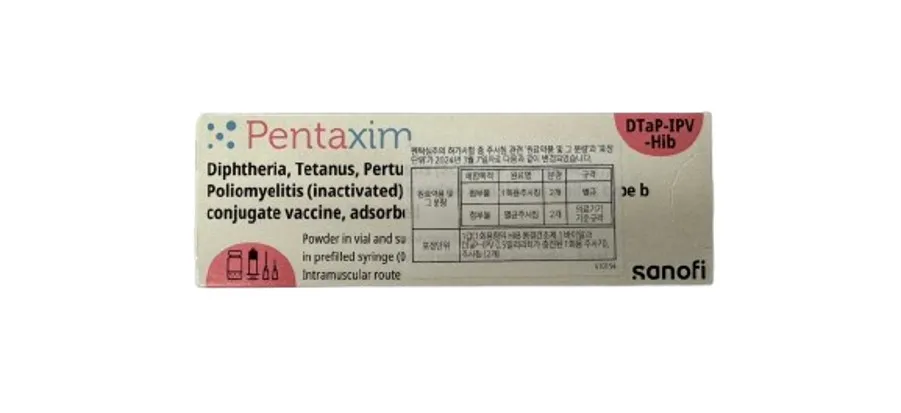
Table of Contents
- Package leaflet: Information for the user
- 1. What the vaccine is and what it is used for
- 2. Information before using the vaccine
- 3. How to administer the vaccine
- 4. Possible side effects
- 5. How to store the vaccine
- 6. Contents of the pack and other information
- Information intended exclusively for healthcare professionals:
Package leaflet: Information for the user
, powder and solvent for suspension for injection in pre-filled syringe
Diphtheria, tetanus, pertussis (acellular, component), poliomyelitis (inactivated) and Haemophilus influenzae type b (conjugate) vaccine, adsorbed
Please read all of this leaflet carefully before the vaccine is administered, because it contains important information for you.
- Keep this leaflet until the end of the vaccination cycle, so that you can read it again if necessary.
- If you have any further questions, please consult your doctor, pharmacist or nurse.
- This vaccine has been prescribed for a specific individual. Do not pass it on to others.
- If any adverse reactions occur in the patient, including any adverse reactions not listed in this leaflet, inform your doctor, pharmacist or nurse. See section 4.
Table of contents of the leaflet
- What the vaccine is and what it is used for
- Important information before vaccination
- How to use the vaccine
- Possible side effects
- How to store the vaccine
- Contents of the pack and other information
1. What the vaccine is and what it is used for
is a vaccine. Vaccines are used to protect against infectious diseases.
After injection, the vaccine (against diphtheria, tetanus, pertussis, poliomyelitis
and invasive infections caused by Haemophilus influenzae type b) stimulates the immune system
to produce protection against these diseases.
(DTaP-IPV/Hib) helps protect children against diphtheria, tetanus, pertussis and poliomyelitis,
as well as against invasive infections caused by Haemophilus influenzae type b (meningitis, septicaemia and others) in children from 6 weeks of age.
This vaccine does not protect against infections caused by other types of Haemophilus influenzae
or against meningitis caused by other microorganisms.
2. Information before using the vaccine
When not to use the vaccine:
- if the child is allergic (hypersensitive):
- to any of the components of the vaccine (listed in section 6, "Contents"),
- to glutaraldehyde, neomycin, streptomycin, and polymyxin B (which are used during manufacturing and may be present in trace amounts),
- to pertussis vaccines (acellular or whole-cell),
- if the child has experienced an allergic reaction after previous administration of the same vaccine or a vaccine containing the same substances,
- if the child has progressive encephalopathy (brain damage),
- if the child developed encephalopathy (brain damage) within 7 days after a previous dose of pertussis vaccine (acellular or whole-cell),
- if the child has fever or an acute illness, vaccination should be postponed.
Warnings and precautions
When to exercise special caution when using the vaccine:
- if the child has blood disorders such as low platelet count (thrombocytopenia) or coagulation disorders, as there is a risk of bleeding following intramuscular injection,
- if the child previously experienced febrile seizures unrelated to prior vaccination, it is especially important to monitor body temperature within 48 hours after vaccination and to administer antipyretic medications during this period,
- if any of the following symptoms occurred after a previous dose of vaccine (the decision to administer further doses of a pertussis-containing vaccine should be carefully considered):
- fever of 40°C or higher within 48 hours, not caused by another identified condition,
- collapse or shock-like state with hypotensive-hyporesponsive syndrome (decreased activity) within 48 hours after vaccination,
- prolonged, inconsolable crying lasting 3 hours or more, occurring within 48 hours after vaccination,
- seizures with or without fever occurring within 3 days after vaccination,
- if the child currently has or has previously experienced medical conditions or allergic reactions, particularly allergic reactions after vaccination,
- if the child previously developed Guillain-Barré syndrome (unusual sensitivity, paralysis) or brachial neuritis (paralysis, diffuse pain in the arm and shoulder) after receiving a tetanus toxoid-containing vaccine (e.g. tetanus vaccine), the decision to administer any tetanus toxoid-containing vaccine should be evaluated by a physician,
- if the child previously developed swelling (edematous reactions) of the lower limbs after receiving a vaccine containing Haemophilus influenzae type b antigen, the two vaccines—diphtheria, tetanus, pertussis, poliomyelitis vaccine and Haemophilus influenzae type b conjugate vaccine—should be administered at two different sites of the body, on separate days,
- in children with immunodeficiency or undergoing treatment with corticosteroids, cytotoxic drugs, radiotherapy, or other medications that may suppress the immune system, the immune response to the vaccine may be diminished. It is recommended to postpone vaccination until completion of treatment or recovery. However, vaccination of children with chronic immunodeficiency, such as HIV infection, is recommended even though the immune response may be limited,
- does not protect against invasive diseases caused by serotypes other than Haemophilus influenzae type b or against meningitis caused by other microorganisms.
Fainting may occur after, or even before, any injection. Therefore,
inform the doctor or nurse if the patient has previously fainted following an
injection.
Vaccine and other medicines
This vaccine may be administered simultaneously with the measles, mumps, and rubella vaccine (M-M-RVAXPRO) or with hepatitis B vaccine (HBVAXPRO), but at two different sites of the body, i.e., two different limbs (arms or legs).
If the child is to receive this vaccine together with other vaccines not mentioned above, consult the doctor or pharmacist for additional information.
Inform the doctor or pharmacist about all medicines currently taken or recently taken by the patient, as well as any medicines planned for future use.
Vaccine contains phenylalanine, ethanol, and sodium
The vaccine contains 12.5 micrograms of phenylalanine in each 0.5 ml dose.
Phenylalanine may be harmful for patients with phenylketonuria, a rare genetic disorder in which phenylalanine accumulates in the body because it is not properly eliminated.
The vaccine contains 2 mg of alcohol (ethanol) in each 0.5 ml dose. The small amount of alcohol in this vaccine will not cause noticeable effects.
The vaccine contains less than 1 mmol of sodium per dose; therefore, the vaccine is considered "sodium-free".
3. How to administer the vaccine
Dosage
The vaccine is administered to infants from the completed 6th week of life.
Primary vaccination: 3 injections given at intervals of 1 to 2 months.
Booster dose: 1 injection administered one year after the third dose of the primary vaccination, usually between 16 and 18 months of age.
Missed dose
If a dose of the vaccine is missed, inform the doctor, who will decide when the missed dose should be administered.
Ensure that the child completes the full vaccination course; otherwise, protection may be ineffective.
4. Possible side effects
Like any medicine, this vaccine may cause side effects, although not everybody gets them.
Serious allergic reactions
Serious allergic reactions, although rare, may occur after vaccination, usually while the child is still at the vaccination site.
If any of the symptoms listed below occur after leaving the vaccination facility, contact a doctor or emergency services IMMEDIATELY:
- Swelling of the face (facial oedema), sudden swelling of the face or neck (angioedema, Quincke's oedema).
- Sudden and severe feeling of being unwell with low blood pressure causing dizziness and loss of consciousness, rapid heartbeat associated with respiratory disturbances (anaphylactic reaction and shock).
Other side effects
If any of the following side effects occur in your child, persist or worsen, contact your doctor or pharmacist.
Very common side effects (may affect more than 1 in 10 children):
- loss of appetite
- restlessness, irritability
- unusual crying
- sleepiness
- vomiting
- redness at the injection site (erythema)
- fever of 38°C or higher
- swelling (oedema) at the injection site
- pain at the injection site
Common side effects (may affect less than 1 in 10 children but more than 1 in 100 children):
- diarrhoea
- hardening at the injection site
- insomnia, sleep disturbances
Uncommon side effects (may affect less than 1 in 100 children but more than 1 in 1,000 children):
- redness and swelling (oedema) at the injection site with a diameter of 5 centimetres or more
- fever of 39°C or higher
- persistent and prolonged crying (lasting longer than 3 hours)
Rare side effects (may affect less than 1 in 1,000 children but more than 1 in 10,000 children):
- fever above 40°C
- swelling of legs and feet (oedematous reactions affecting lower limbs) with bluish skin discoloration (cyanosis) or redness, small transient red spots (petechiae) appearing within a few hours after vaccination and resolving without treatment and without sequelae. Swelling may be accompanied by high-pitched crying.
Side effects with unknown frequency (frequency cannot be estimated because these reactions are reported very rarely):
- convulsions with or without fever
- reduced activity or periods when the child appears pale, unresponsive to stimuli, or in a shock-like state (hypotensive-hyporesponsive episode)
- rash, redness (erythema), itching (urticaria)
- extensive local reactions at the injection site larger than 5 centimetres, including swelling (oedema) of the limb extending to joints on both sides of the injection site. These reactions occur within 24 to 72 hours after vaccination and may be accompanied by redness (erythema), warmth, tenderness or pain at the injection site. These reactions resolve spontaneously within 3 to 5 days.
Potential side effects (i.e. not reported directly after this vaccine, but after other vaccines containing one or more of the antigens present in this vaccine) include:
- Guillain-Barré syndrome (unusual sensitivity, paralysis) and brachial neuritis (paralysis, diffuse pain in the arm and shoulder) following administration of vaccines containing tetanus toxoid.
Additional information for specific populations
In prematurely born infants (born at 28 weeks of gestation or earlier), prolonged breathing pauses may occur within 2 to 3 days after vaccination.
Reporting of side effects
If any side effects occur, including any side effects not listed in this leaflet, inform your doctor, pharmacist or nurse. Side effects can be reported directly to the Department of Monitoring Adverse Drug Reactions, Office for Registration of Medicinal Products, Medical Devices and Biocidal Products:
Al. Jerozolimskie 181C
02 222 Warsaw
Tel.: +48 22 49 21 301
Fax: +48 22 49 21 309
Website: https://smz.ezdrowie.gov.pl
Side effects can also be reported to the marketing authorisation holder.
Reporting side effects helps provide more information on the safety of the vaccine.
5. How to store the vaccine
The vaccine should be stored out of sight and reach of children.
Store in a refrigerator (2 °C - 8 °C). Do not freeze.
Do not use this vaccine after the expiry date (EXP) stated on the label and carton. The expiry date refers to the last day of the month indicated.
Medicines must not be disposed of via wastewater or household waste. Ask your pharmacist how to dispose of medicines that are no longer required. This will help protect the environment.
6. Contents of the pack and other information
What the vaccine contains
The active substances in one dose (0.5 ml) of the vaccine after reconstitution are:
Diphtheria toxoid not less than 20 IU (30 Lf)
Tetanus toxoid not less than 40 IU (10 Lf)
Bordetella pertussis antigens:
- Pertussis toxoid 25 micrograms
- Filamentous haemagglutinin 25 micrograms
Inactivated poliovirus:
- Type 1 (Mahoney strain) 29 D-antigen units
- Type 2 (MEF-1 strain) 7 D-antigen units
- Type 3 (Saukett strain) 26 D-antigen units
Haemophilus influenzae type b polysaccharide 10 micrograms conjugated to tetanus toxoid
adsorbed on aluminium hydroxide, hydrated (0.3 milligrams Al)
lower limit of the confidence interval (p = 0.95) and not less than 30 IU as mean value
or equivalent activity determined by immunogenicity assessment
lower limit of the confidence interval (p = 0.95)
grown in Vero cells
these antigen amounts are exactly the same as previously expressed as 40-8-32 D-antigen units, respectively for virus types 1, 2 and 3, measured by another appropriate immunochemical method
Aluminium hydroxide is included in this vaccine as an adsorbent. Adsorbents are substances included in certain vaccines to accelerate, enhance and/or prolong the protective effect of the vaccine.
Other components are:
Suspension for injection:
- Hanks' medium without phenol red
- Glacial acetic acid and (or) sodium hydroxide (for pH adjustment)
- Formaldehyde
- Phenoxyethanol
- Anhydrous ethanol
- Water for injections
Hanks' medium is a complex mixture of amino acids (including phenylalanine), mineral salts, vitamins and other components (such as glucose) diluted in water.
Powder:
- Sucrose
- Tromethamine
- Concentrated hydrochloric acid (for pH adjustment)
What the vaccine looks like and contents of the pack
The vaccine is available as a powder and suspension for the preparation of a suspension for injection (0.5 ml in a pre-filled syringe with or without needle. Pack sizes of 1, 10 or 20).
Marketing Authorisation Holder and Manufacturer
Marketing Authorisation Holder
Sanofi Winthrop Industrie
82 Avenue Raspail
94250 Gentilly, France
Manufacturer
Sanofi Winthrop Industrie
1541 avenue Marcel Mérieux
69280 Marcy l’Etoile
France
Sanofi Winthrop Industrie
Voie de l’Institut - Parc Industriel d’Incarville
B.P 101
27100 Val de Reuil
France
Information intended exclusively for healthcare professionals:
Administration method:
For syringes without attached needles, a separate needle must be firmly attached to the syringe by turning it a quarter turn.
Shake the syringe until a homogeneous suspension is obtained and reconstitute the vaccine by injecting the suspension of the combined diphtheria, tetanus, acellular pertussis and poliomyelitis vaccine into the vial containing the powder of the Haemophilus influenzae type b vaccine.
Shake the vial until the powder is completely dissolved. After reconstitution, a whitish, cloudy appearance of the suspension is normal.
Immediately withdraw the reconstituted suspension into a syringe.
The whitish, cloudy suspension must be used immediately after reconstitution and shaken before administration.
After reconstitution and withdrawal into the syringe, separation of the suspension into a clear phase and a gel phase may occur. In such case, the contents of the syringe should be shaken vigorously again before administration.
Administer intramuscularly.
It is recommended to administer the vaccine into the anterolateral mid-thigh in infants and into the deltoid muscle in children.
This vaccine must never be administered intravenously.
The vaccine should be used immediately after reconstitution and shaken before injection until the contents become whitish and cloudy.
Do not use this vaccine if abnormal color or presence of particulate matter is observed.
Effect on laboratory test results:
After vaccination, Hib capsular polysaccharide may be excreted in urine; therefore, positive urine test results for Hib infection may be observed within 1–2 weeks following vaccination. During this period, other diagnostic tests should be performed to confirm Hib infection.