Pentasa
Poland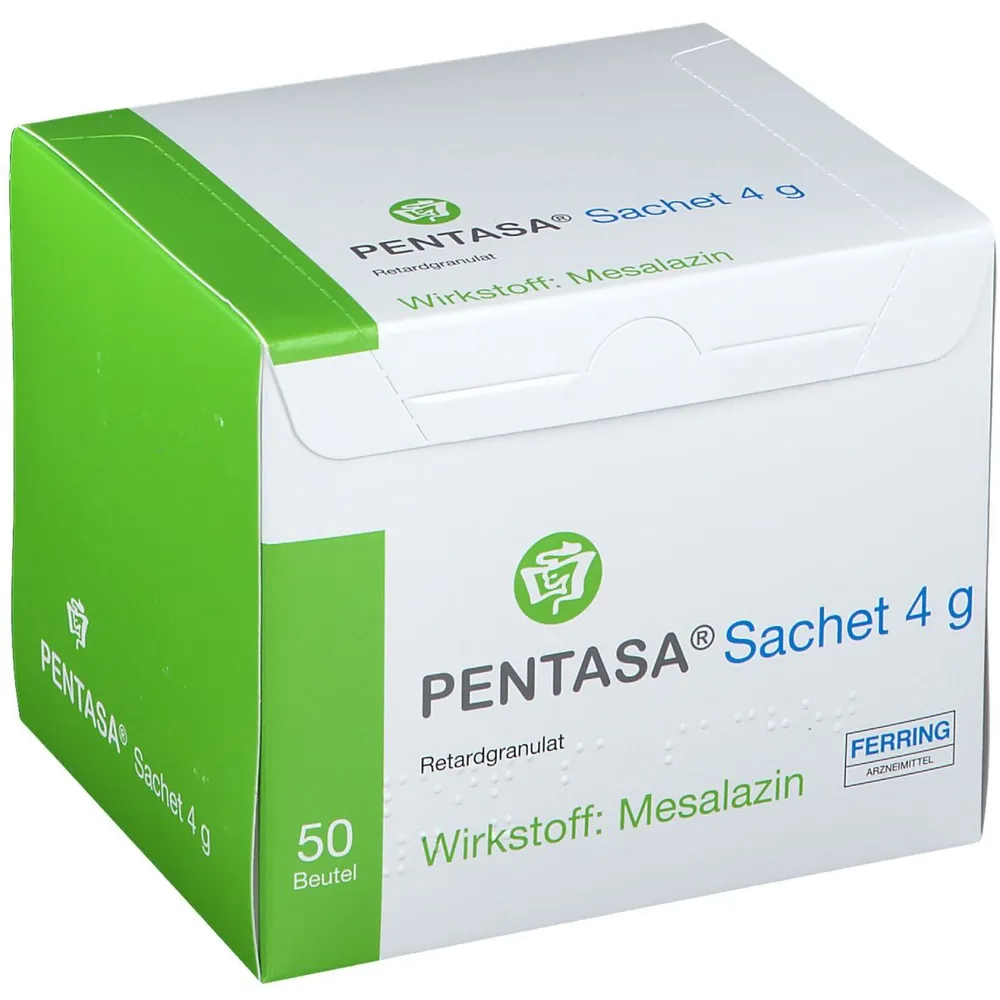
Table of Contents
Patient Information Leaflet
PENTASA, 4 g, prolonged-release granules
Mesalazinum
Please read this leaflet carefully before taking this medicine, as it contains
important information for you.
- Keep this leaflet, as you may need to read it again.
- If you have any questions, please consult your doctor.
- This medicine has been prescribed for a specific individual. Do not pass it on to others. This medicine may harm others, even if their symptoms are the same.
- If you experience any adverse reactions, including any not listed in this leaflet, inform your doctor. See section 4.
Leaflet Contents:
- What Pentasa is and what it is used for
- Important information before taking Pentasa
- How to take Pentasa
- Possible side effects
- How to store Pentasa
- Contents of the pack and other information
1. What Pentasa is and what it is used for
Mesalazine, the active substance in Pentasa, acts locally as an anti-inflammatory agent on the diseased wall of the small and large intestine. Mesalazine is continuously released from the granules throughout the entire length of the intestine, independent of pH value.
Pentasa is used in the treatment of mild to moderate forms of ulcerative colitis and Crohn's disease.
2. Information before using Pentasa
BEFORE STARTING MESALAZINE TREATMENT, INFORM YOUR DOCTOR:
- If the patient has ever experienced the following after taking mesalazine: severe skin rash, skin peeling, blisters, or mouth ulcers.
When not to use Pentasa
if the patient is allergic to mesalazine or to any of the other ingredients of this medicine
(listed in section 6),
if the patient is allergic to salicylates, e.g. aspirin,
if the patient has severe impairment of liver and/or kidney function,
if the patient has peptic ulcer disease of the stomach or duodenum,
if the patient has a bleeding disorder.
Warnings and precautions
Discuss this with your doctor before starting treatment with Pentasa.
Exercise caution:
if the patient is allergic to sulfasalazine,
if there are impairments of liver and/or kidney function,
if the patient is concurrently being treated with medicines that may impair kidney function,
if the patient is concurrently being treated with azathioprine (a medicine that suppresses the immune system),
6-mercaptopurine (an anticancer and immunosuppressive medicine), or thioguanine (an anticancer medicine),
if the patient has lung disorders, especially bronchial asthma,
if the patient experiences severe or recurring headache, visual disturbances, or ringing or buzzing in the ears,
they should contact their doctor immediately.
Treatment with mesalazine may lead to the formation of kidney stones. Symptoms may include flank pain and haematuria. During treatment with mesalazine, an adequate fluid intake should be maintained.
Serious skin reactions have been reported with mesalazine treatment, including drug reaction with eosinophilia and systemic symptoms (DRESS), Stevens-Johnson syndrome (SJS), and toxic epidermal necrolysis (TEN). Mesalazine must be discontinued immediately and medical help sought without delay if any of the symptoms of these serious skin reactions, listed in section 4, occur.
Myocardial hypersensitivity reactions (myocarditis and pericarditis) caused by mesalazine have been rarely reported.
Very rarely, serious blood disorders have been reported.
If acute intolerance symptoms occur during treatment, such as colicky abdominal pain, acute abdominal pain, fever, severe headache, or rash, treatment must be stopped immediately and the doctor contacted.
Usually, before starting and during treatment, the doctor will order blood and urine tests to monitor liver, kidney, or blood-forming system function.
Mesalazine may cause a reddish-brown discoloration of urine upon contact with sodium hypochlorite bleach present in toilet water. This is due to a chemical reaction between mesalazine and the bleach and is harmless.
Children and adolescents
Pentasa should not be used in children under 6 years of age. Clinical data on use in children (from 6 to 18 years of age) are limited.
Pentasa with other medicines
Tell your doctor about all medicines the patient is currently taking or has recently taken, as well as any medicines they plan to take. This particularly includes medicines such as:
sulfasalazine, azathioprine, 6-mercaptopurine, thioguanine, or warfarin.
Pregnancy, breastfeeding and fertility
If the patient is pregnant or breastfeeding, suspects she might be pregnant, or is planning to become pregnant, she should consult her doctor before using this medicine.
Mesalazine crosses the placenta.
Mesalazine is excreted into human milk.
Driving and using machines
No effects of Pentasa on the ability to drive or operate machinery have been observed.
3. How to use Pentasa
This medicine should always be taken exactly as prescribed by the doctor. In case of doubt, consult your
physician.
Recommended dosage:
Ulcerative colitis, treatment of active disease phase:
Adults: the dosage is individually determined by the physician, up to 4 g per day once daily or in divided
doses.
Children aged 6 years and older: the dosage is individually determined by the physician; usually 30 to
50 mg/kg body weight per day in divided doses. Maximum dosage: 75 mg/kg body weight per day in divided
doses. The total daily dose should not exceed 4 g per day (maximum adult dose). Pentasa should not be used
in children under 6 years of age.
Ulcerative colitis, maintenance treatment:
Adults: the recommended dose is 2 g once daily.
Children aged 6 years and older: the dosage is individually determined by the physician; usually 15 to
30 mg/kg body weight per day in divided doses. The total daily dose should not exceed 2 g per day.
Pentasa should not be used in children under 6 years of age.
Crohn's disease, treatment of active disease phase:
Adults: the dosage is individually determined by the physician, up to 4 g per day in divided doses.
Children aged 6 years and older: the dosage is individually determined by the physician; usually 30 to
50 mg/kg body weight per day in divided doses. Maximum dosage: 75 mg/kg body weight per day in divided
doses. The total daily dose should not exceed 4 g per day (maximum adult dose). Pentasa should not be used
in children under 6 years of age.
Crohn's disease, maintenance treatment:
Adults: the dosage is individually determined by the physician, up to 4 g per day in divided doses.
Children aged 6 years and older: the dosage is individually determined by the physician; usually 15 to
30 mg/kg body weight per day in divided doses. The total daily dose should not exceed 2 g per day.
Pentasa should not be used in children under 6 years of age.
When treating with doses lower than 4 g, available Pentasa prolonged-release granules with strengths of
2 g or 1 g should be used.
In patients with active Crohn's disease who do not show the desired response to treatment with a dose of
4 g per day within 6 weeks, and in patients with Crohn's disease who experience disease flare during
maintenance treatment with 4 g per day, alternative therapy should be considered.
Dosage adjustment is not required in elderly patients.
The medicine is taken orally.
The granules must not be chewed or crushed.
The contents of the sachet should be poured onto the tongue and swallowed with water or juice.
The entire contents of the sachet may also be mixed with yogurt and consumed immediately, without
chewing the granules.
To achieve the desired therapeutic effect, the recommended doses should be taken regularly and
consistently.
Taking more Pentasa than recommended
In case of overdose, symptomatic treatment in hospital is indicated, along with monitoring of kidney
function.
Missed dose of Pentasa
Do not take a double dose to make up for a missed dose.
4. Possible adverse reactions
Like all medicines, this medicine can cause adverse reactions, although not everyone will experience them.
Treatment with mesalazine must be discontinued and immediate medical help should be sought if the patient develops any of the following symptoms:
- Red, flat, disc-shaped or circular spots on the trunk, often with blisters in the center, skin peeling, oral, throat, nasal, genital or ocular ulcers, extensive rash, fever and swollen lymph nodes. Such severe skin rashes may be preceded by fever and flu-like symptoms.
If acute intolerance symptoms occur during treatment, such as colicky abdominal pain, severe abdominal pain, fever, severe headache or rash, treatment must be stopped immediately and the patient should contact a doctor.
Severe adverse reactions of unknown frequency (cannot be estimated based on available data):
Immediate medical help should be sought if:
- The patient experiences severe or recurrent headache, visual disturbances, or ringing or buzzing in the ears. These may be symptoms of increased intracranial pressure (idiopathic intracranial hypertension).
The following adverse reactions occur frequently (may affect 1 to 10 out of 100 treated patients):
- Diarrhoea
- Nausea
- Abdominal pain
- Headache
- Vomiting
- Flatulence
- Rash
- Urticaria
The following adverse reactions occur rarely (may affect 1 to 10 out of 10,000 treated patients):
- Dizziness
- Myocarditis
- Pericarditis
- Increased amylase activity
- Acute pancreatitis
- Increased skin sensitivity to sunlight and ultraviolet radiation (photosensitivity)
The following adverse reactions occur very rarely (may affect less than 1 out of 10,000 treated patients):
- Muscle pain
- Joint pain
- Transient alopecia
- Allergic alveolitis, allergic reactions and fibrotic changes in the lungs (including dyspnoea, cough, bronchospasm), pulmonary eosinophilia – i.e. pulmonary infiltrate due to hypersensitivity with accompanying blood eosinophilia (increased number of acidophilic white blood cells), interstitial lung disease, pulmonary infiltrate, pneumonia
- Renal function disorders (acute and chronic interstitial nephritis, nephrotic syndrome – i.e. a syndrome of disease symptoms caused by excessive loss of protein in urine, renal failure), urine discoloration
- Increased liver enzyme activity, increased levels of cholestasis markers (substances indicating bile stasis in the liver) and bilirubin, hepatotoxic effects (including: hepatitis, cholestatic hepatitis, cirrhosis, liver failure)
- Blood disorders such as: anaemia, aplastic anaemia, agranulocytosis – i.e. very low granulocyte count, neutropenia – i.e. low neutrophil count, leukopenia – i.e. low white blood cell count (including granulocytopenia, i.e. low granulocyte count), pancytopenia – i.e. low count of all blood cells, thrombocytopenia – i.e. low platelet count, and eosinophilia (as part of an allergic reaction)
- Lupus-like reactions
- Peripheral neuropathy – i.e. dysfunction of peripheral nerves
- Pancolitis – i.e. a severe form of ulcerative colitis affecting the entire colon
- Transient oligospermia (low sperm count in male semen)
- Hypersensitivity reactions, including allergic rash, anaphylactic reaction, erythema multiforme
- Drug fever
Frequency not known (cannot be estimated from available data):
- Kidney stones and associated renal pain (see also section 2)
- Drug reaction with eosinophilia and systemic symptoms (DRESS), Stevens-Johnson syndrome (SJS) – severe skin reactions, i.e. transient blisters appearing on mucous membranes, mainly in the oral cavity and genital organs.
Reporting of adverse reactions
If any adverse reactions occur, including any not listed in this leaflet, the patient should inform their doctor. Adverse reactions can be reported directly to the Department of Monitoring Adverse Drug Reactions at the Office for Registration of Medicinal Products, Medical Devices and Biocidal Products:
Aleje Jerozolimskie 181C, 02-222 Warsaw
Tel: +48 22 49 21 301
Fax: +48 22 49 21 309
Website: https://smz.ezdrowie.gov.pl
Adverse reactions can also be reported to the marketing authorization holder.
Reporting adverse reactions helps to provide more information on the safety of the medicine.
5. How to store Pentasa
Keep this medicine out of sight and reach of children.
Do not store above 30 °C.
Store in the original packaging to protect from light.
Do not use this medicine after the expiry date stated on the packaging after the EXP label.
The expiry date refers to the last day of the stated month.
Medicines should not be disposed of via wastewater or household waste. Ask your pharmacist how to dispose of medicines no longer required. This will help protect the environment.
6. Contents of the package and other information
What Pentasa contains
The active substance is mesalazine. One sachet of prolonged-release granules contains 4 g of mesalazine.
The other ingredients are: ethylcellulose (40-52 cP), povidone (K 29-32).
What Pentasa looks like and contents of the pack
Pentasa is available as prolonged-release granules.
The granules are white-grey to light brown in colour.
Pack:
30 sachets containing prolonged-release granules, placed in a cardboard box.
Marketing Authorisation Holder
Ferring GmbH
Wittland 11
D-24109 Kiel
Germany
Manufacturer
Ferring GmbH
Wittland 11
D-24109 Kiel
Germany
For further information, please contact the marketing authorisation holder:
Ferring Pharmaceuticals Poland Sp. z o.o.
Szamocka Street 8
01-748 Warsaw
Tel.: +48 22 246 06 80, Fax: +48 22 246 06 81