Pegorion
Poland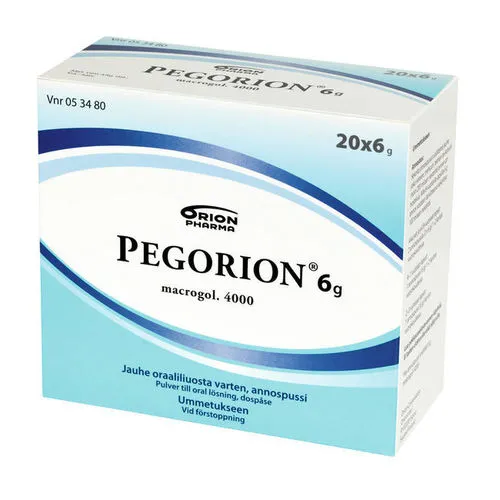
Table of Contents
Patient Information Leaflet
Pegorion, 12 g, powder for oral solution
Macrogol
Please read all of this leaflet carefully before taking this medicine, because it contains
important information for you.
This medicine should always be taken exactly as described in this patient leaflet or as directed by
your doctor or pharmacist.
- Keep this leaflet so that you can read it again if necessary.
- If you need advice or further information, please contact your pharmacist.
- If you experience any side effects, including any possible side effects not listed in this leaflet, tell your doctor or pharmacist. See section 4.
- If there is no improvement after 14 days, or if you feel worse, you should contact your doctor.
Leaflet Contents:
- What Pegorion is and what it is used for
- Important information before taking Pegorion
- How to take Pegorion
- Possible side effects
- How to store Pegorion
- Contents of the pack and other information
1. What Pegorion is and what it is used for
Pegorion is used for the treatment of constipation and to soften and loosen dry, hard stools (intestinal fecal impaction or intestinal obstruction due to fecal stones). Macrogol – the active substance in this medicine – binds water. As a result, the amount of water in the intestinal contents increases, stools become softer, and normal intestinal motility is restored.
If there is no improvement after 14 days, or if you feel worse, you should contact your doctor.
2. Important information before taking Pegorion
When not to use Pegorion
- if the patient is allergic to macrogol;
- if the patient has intestinal obstruction (bowel blockage) due to physiological or functional disorders of the intestinal wall;
- if the patient has intestinal perforation;
- if the patient has severe inflammatory bowel disease (e.g. Crohn's disease, ulcerative colitis, toxic megacolon);
- if the patient has abdominal pain of unknown cause.
Warnings and precautions
Before starting to take Pegorion, discuss this with your doctor or pharmacist.
- if constipation has suddenly occurred or worsened. This may be due to intestinal obstruction;
- if, during treatment with Pegorion for bowel cleansing, the patient experiences sudden abdominal pain or rectal bleeding, medical advice should be sought immediately;
- if the patient has impaired liver or kidney function, or if the patient is taking diuretics and develops diarrhoea;
- if constipation is accompanied by pain, fever or gastrointestinal upset.
It should be remembered that treatment of constipation with any medicinal product is only an adjunct to
a healthy lifestyle and diet, for example:
- increased intake of fluids and dietary fibre,
- appropriate physical activity and rehabilitation of intestinal rhythm.
Children and adolescents
Pegorion 12 g powder for oral solution in sachets is not intended for use in children under 8 years of age.
For children aged 2 to 7 years, 6 g sachets are available (Pegorion Junior 6 g powder for oral solution).
In children, treatment of constipation should not last longer than 3 months, due to lack of adequate clinical data beyond this 3-month period. Therefore, after 3 months of treatment, a full clinical evaluation should be performed to determine the cause of constipation in the patient.
In case of diarrhoea, caution should be exercised in patients prone to disturbances in water-electrolyte balance.
Pegorion and other medicines
Inform your doctor or pharmacist about all medicines the patient is currently taking or has recently taken, as well as any medicines the patient plans to take. Pegorion may reduce the absorption of other medicinal products.
If the patient requires thickened fluids to safely swallow them, Pegorion may counteract the thickening effect.
Pregnancy and breastfeeding
Pegorion can be used during pregnancy and breastfeeding.
Driving and operating machinery
Pegorion has no influence on the ability to drive or operate machinery.
3. How to take Pegorion
This medicine should always be taken exactly as described in this patient information leaflet or as directed by your doctor or pharmacist. If in doubt, consult your doctor or pharmacist.
Dissolve one sachet of powder (12 g) in 200 ml (one glass) of liquid: water, juice, tea, or coffee. The solution should be prepared immediately before drinking.
Treatment of chronic constipation
Adults and children over 8 years of age:
The recommended dose is one sachet (12 g) once or twice daily.
The dose may be increased or decreased depending on the response to treatment, so as to achieve regular bowel movements and soft stools.
Pegorion powder for oral solution in 12 g sachets is not intended for use in children under 8 years of age. For children aged 2 to 7 years, 6 g sachets are available (Pegorion Junior powder for oral solution 6 g).
Treatment with Pegorion usually lasts up to 2 weeks. If symptoms do not improve after 2 weeks of treatment, consult your doctor. Your doctor may recommend longer treatment. Long-term treatment may be necessary if the patient is taking medicines that cause constipation or has a medical condition causing constipation.
Softening of hardened stools (treatment of intestinal faecal impaction/rectal faecal obstruction)
Adults and children over 12 years of age:
5–10 sachets (5–10 sachets of 12 g each) per day for 1–3 days.
Patients with cardiovascular disorders:
The dose should be divided so that no more than two sachets are taken within one hour.
Taking more Pegorion than recommended
Large doses may cause abdominal pain, diarrhoea, and vomiting. In case of overdose, stop taking the medicine.
4. Possible side effects
Like all medicines, this medicine can cause side effects, although not everybody will get them.
Some of the possible side effects can be serious. These include, for example:
Very rare side effects (may affect less than 1 in 10,000 people):
- Allergic reactions such as anaphylactic shock (sudden drop in blood pressure and other possible symptoms such as fever, rash, and swelling of the face, mouth or throat), angioedema (sudden, episodic swelling of the skin, mucous membranes or internal organs).
If any of these symptoms occur, or other serious symptoms, seek immediate medical attention
from a doctor or the nearest hospital emergency department to receive appropriate
treatment.
If you experience any allergic reaction, do not take another dose of this medicine
and contact your doctor.
Other side effects
Common side effects (may affect less than 1 in 10 people):
- abdominal pain, bloating, nausea, flatulence or diarrhoea
Uncommon side effects (may affect less than 1 in 100 people):
- vomiting, urgent need to defecate, faecal incontinence
Very rare side effects (may affect less than 1 in 10,000 people):
- allergic reactions such as rash, itching
Frequency not known (cannot be estimated from the available data):
- electrolyte disturbances and dehydration, particularly in elderly patients
Additional side effects in children and adolescents
Common side effects (may affect less than 1 in 10 people):
- abdominal pain, diarrhoea (which may cause anal pain)
Uncommon side effects (may affect less than 1 in 100 people):
- vomiting, bloating, nausea
Frequency not known (cannot be estimated from the available data):
- hypersensitivity reactions such as urticaria, rash, itching
Reporting of side effects
If any side effects occur, including any side effects not listed
in this leaflet, tell your doctor or pharmacist. Side effects can
be reported directly to the Department of Monitoring Adverse Drug Reactions of the Office for Registration of Medicinal Products, Medical Devices and Biocidal Products, Al. Jerozolimskie 181 C, 02-222 Warsaw, Tel.: +48 22 49 21 301,
Fax: +48 22 49 21 309, Website: https://smz.ezdrowie.gov.pl
Side effects can also be reported to the marketing authorisation holder.
By reporting side effects, additional information on the safety of the medicine can be collected.
5. How to store Pegorion
Keep this medicine out of the sight and reach of children.
No special storage conditions are required for this medicine.
Do not use this medicine after the expiry date stated on the carton and sachet following
"Expiry date (EXP)". The expiry date refers to the last day of the stated month.
Medicines must not be disposed of via wastewater or household waste. Ask your pharmacist
how to dispose of medicines no longer required. These measures will help protect the
environment.
6. Contents of the package and other information
What Pegorion contains
- The active substance is macrogol 4000. One sachet contains 12 grams of macrogol 4000.
- The medicine contains no other ingredients.
What Pegorion looks like and contents of the pack
White or almost white powder.
Pack contents: 10, 20 or 50 sachets per pack.
Not all pack sizes may be marketed.
Marketing Authorisation Holder
Orion Corporation
Orionintie 1
02200 Espoo
Finland
For further information on this medicine, contact the local representative of the Marketing Authorisation Holder:
Orion Pharma Poland Sp. z o.o.
[email protected]