Peditrace novum
Poland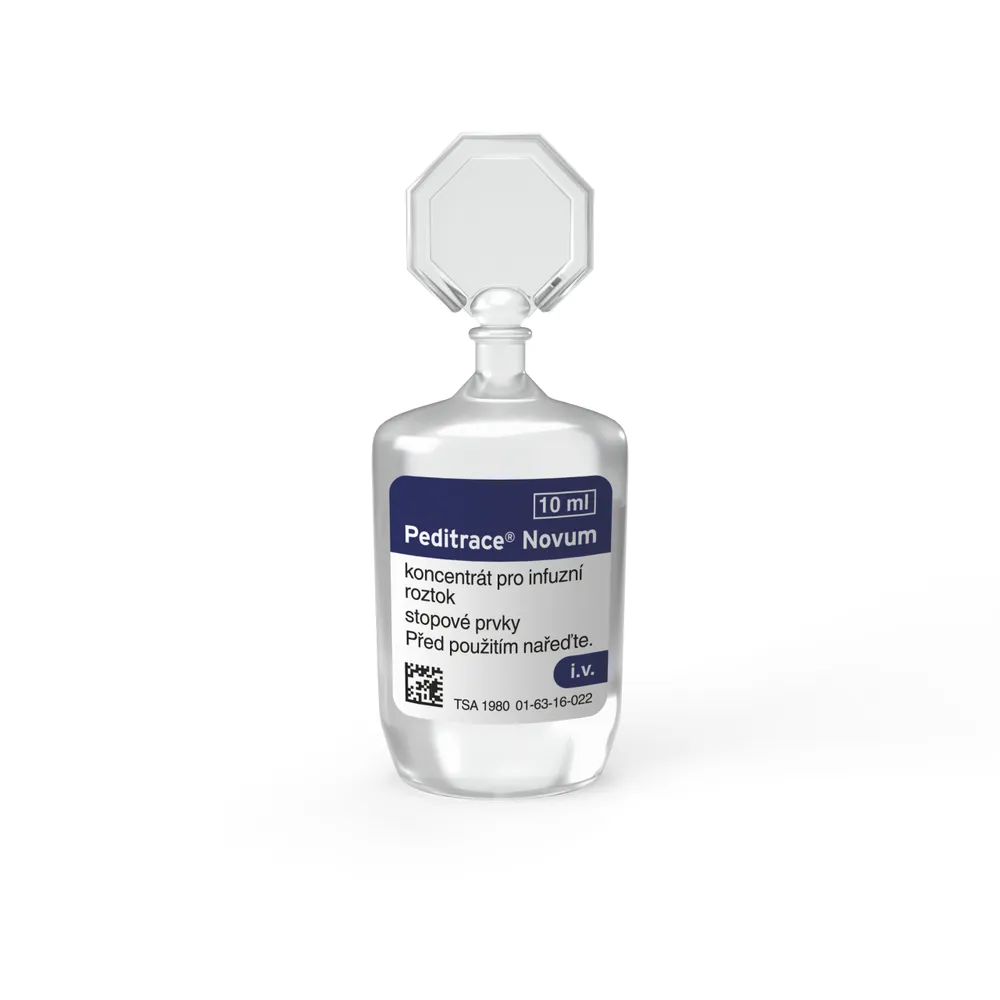
Table of Contents
- Package leaflet: Information for the patient
- 1. What Peditrace Novum is and what it is used for
- 2. Important information before using Peditrace Novum
- 3. How to use Peditrace Novum
- 4. Possible adverse reactions
- 5. How to store Peditrace Novum
- 6. Contents of the package and other information
- Information intended exclusively for healthcare professionals:
Package leaflet: Information for the patient
Peditrace Novum, concentrate for solution for infusion
Please read all of this leaflet carefully before the medicine is administered, as it contains
important information for the patient.
- Keep this leaflet, as you may need to read it again.
- If you have any questions, please consult your doctor or nurse.
- If you experience any adverse reactions, including any not listed in this leaflet, inform your doctor or nurse. See section 4.
Table of contents of the leaflet
- What Peditrace Novum is and what it is used for
- Important information before receiving Peditrace Novum
- How to use Peditrace Novum
- Possible side effects
- How to store Peditrace Novum
- Contents of the packaging and other information
1. What Peditrace Novum is and what it is used for
Peditrace Novum is a trace element mixture administered to the patient via intravenous infusion (intravenous infusion). Peditrace Novum contains five trace elements (zinc, copper, manganese, selenium, and iodine) in very small amounts, which are normally supplied through nutrition. These trace elements are essential for the proper functioning of the body.
Peditrace Novum is indicated to supplement the basic requirement of trace elements in premature infants, full-term newborns, infants, children, and adolescents who are unable to ingest or absorb sufficient food via enteral feeding and therefore require nutrition administered intravenously (known as parenteral nutrition or intravenous feeding). Peditrace Novum is added to parenteral nutrition solutions containing all the nutrients the body requires.
2. Important information before using Peditrace Novum
When not to use Peditrace Novum:
- if the child is allergic (hypersensitive) to the active substances or to any of the other ingredients of this medicine (listed in section 6);
- if the child has Wilson's disease.
Warnings and precautions
Before starting treatment, consult a doctor if the child has:
- impaired kidney function;
- impaired liver function;
- reduced bile secretion;
- thyroid disorders (hyperthyroidism).
During treatment, the doctor will regularly monitor trace element levels in the blood and adjust the dosage of Peditrace Novum accordingly.
Children and adolescents
Peditrace Novum is intended for preterm infants, full-term newborns, infants, children, and adolescents.
Peditrace Novum with other medicines
Inform the doctor about all medicines currently used or recently used in the child, as well as any medicines planned for future use.
Pregnancy and breastfeeding
If the adolescent patient is pregnant or breastfeeding, parents or caregivers should consult a doctor or pharmacist before administering this medicine.
Peditrace Novum contains sodium and potassium
Peditrace Novum contains less than 1 mmol (23 mg) of sodium per 10 mL (1 vial), meaning the medicine is considered "sodium-free".
Peditrace Novum contains less than 1 mmol (39 mg) of potassium per 10 mL (1 vial), meaning the medicine is considered "potassium-free".
3. How to use Peditrace Novum
The medicine is administered by healthcare professionals as an intravenous infusion (via an intravenous drip into a vein).
Peditrace Novum must always be diluted before use in another parenteral nutrition solution.
The dosage is determined individually by the physician for each child depending on body weight and health status.
For parenteral nutrition lasting longer than 3 weeks, daily administration of iron via intravenous infusion is recommended, and molybdenum should be added if parenteral nutrition continues beyond 4 weeks.
Administration of a higher than recommended dose of Peditrace Novum
It is unlikely that a child would receive too high a dose of Peditrace Novum, as administration of the medicine is controlled by healthcare professionals. However, if you suspect that a child has received an excessive dose of Peditrace Novum, inform the physician immediately.
If you have any further questions regarding the use of this medicine, consult your doctor or nurse.
4. Possible adverse reactions
No adverse reactions have been reported.
Reporting of adverse reactions
If any adverse reactions occur, including any adverse reactions not listed
in this leaflet, inform a doctor, pharmacist, or nurse. Adverse reactions
can be reported directly to the Department of Monitoring Adverse Drug Reactions of the Office for Registration of Medicinal Products, Medical Devices and Biocidal Products
Al. Jerozolimskie 181C
02-222 Warsaw
tel.: +48 22 49 21 301
fax: +48 22 49 21 309
website: https://smz.ezdrowie.gov.pl
Adverse reactions can also be reported to the marketing authorization holder.
Reporting adverse reactions helps to obtain further information on the safety of the medicinal product.
5. How to store Peditrace Novum
Keep the medicine out of the sight and reach of children.
Do not store above 25°C. Do not freeze.
Do not use this medicine if visible signs of deterioration are observed.
Do not use this medicine after the expiry date stated on the carton
and vial label after: EXP. The expiry date refers to the last day of the stated month.
Stability after reconstitution
Stability after reconstitution has been demonstrated for up to 7 days at 2–8°C, followed by 48 hours
at 20–25°C, including the duration of infusion. From a microbiological point of view, the medicine should be used immediately. Otherwise, the responsibility for the storage conditions and the duration of storage prior to use lies with the user. This period should not normally exceed 24 hours at 2–8°C.
6. Contents of the package and other information
What Peditrace Novum contains
The active substances in the medicine are:
| Peditrace Novum | 1 mL | 1 ampoule (10 mL) |
| Zinc chloride | 1042 micrograms | 10420 micrograms |
| Copper(II) chloride dihydrate | 107.4 micrograms | 1074 micrograms |
| Manganese(II) chloride tetrahydrate | 3.600 micrograms | 36.00 micrograms |
| Sodium selenite | 15.33 micrograms | 153.3 micrograms |
| Potassium iodide | 2.567 micrograms | 25.67 micrograms |
corresponds to (in 1 mL):
Zinc (Zn) 7.64 micromoles 500 micrograms
Copper (Cu) 0.630 micromoles 40.0 micrograms
Manganese (Mn) 0.0182 micromoles 1.00 microgram
Selenium (Se) 0.0887 micromoles 7.00 micrograms
Iodine (I) 0.0155 micromoles 1.96 micrograms
Other components: hydrochloric acid concentrated (for pH adjustment), water for injections.
What Peditrace Novum looks like and contents of the pack
Peditrace Novum, concentrate for solution for infusion, is a clear, almost colourless solution available in 10 mL clear polypropylene ampoules.
Pack size:
20 x 10 mL in a cardboard box
Marketing Authorisation Holder and Manufacturer
Marketing Authorisation Holder
Fresenius Kabi AB
751 74 Uppsala
Sweden
Manufacturer
HP Halden Pharma AS
Svinesundsveien 80
1788 Halden
Norway
For further information about this medicinal product, please contact the representative of the Marketing Authorisation Holder:
Fresenius Kabi Polska Sp. z o.o.
Al. Jerozolimskie 134
02-305 Warsaw
tel.: +48 22 345 67 89
This medicinal product is authorised in the European Economic Area countries and in the United Kingdom (Northern Ireland) under the following names:
| Austria | Kidtrayze concentrate for solution for infusion |
| Belgium | Kidtrayze concentrate for solution for infusion Kidtrayze solution to be diluted for infusion Kidtrayze concentrate for solution for infusion |
| Bulgaria | Peditrace Novum concentrate for solution for infusion Peditrace Novum concentrate for solution for infusion |
| Croatia | Peditrace Novum concentrate for solution for infusion |
| Cyprus | Kidtrayze concentrate for solution for infusion |
| Denmark | Peditrace Novum |
| Estonia | Infutraze |
| Finland | Kidtrayze |
| France | Peditrace solution to be diluted for infusion |
| Greece | Kidtrayze concentrate for solution for infusion |
| Spain | Infutraze |
| Netherlands | Kidtrayze concentrate for solution for infusion |
| Ireland | Infutraze concentrate for solution for infusion |
| Iceland | Peditrace Novum |
| Lithuania | Infutraze concentrate for infusion solution |
| Luxembourg | Kidtrayze |
| Latvia | Infutraze concentrate for infusion solution |
| Malta | Kidtrayze concentrate for solution for infusion |
| Germany | Kidtrayze concentrate for solution for infusion |
| Norway | Kidtrayze |
| Poland | Peditrace Novum |
| Portugal | Kidtrayze |
| Czech Republic | Peditrace Novum |
| Romania | Kidtrayze concentrate for infusion solution |
| Slovakia | Peditrace |
| Slovenia | Kidtrayze concentrate for infusion solution |
| Sweden | Peditrace Novum |
| Hungary | Infutraze concentrate for infusion solution |
| Italy | Kidtrayze |
| United Kingdom (Northern Ireland) | Infutraze concentrate for solution for infusion |
Information intended exclusively for healthcare professionals:
Special warnings and precautions for use
Peditrace Novum should be used with caution in patients with renal impairment, in whom urinary excretion of selenium, zinc, and iodine may be significantly reduced. In these patients, there is an increased risk of accumulation of trace elements in the body.
Peditrace Novum should be used with caution in patients with hepatic impairment (especially with cholestasis), in whom excretion of copper and manganese may be reduced.
In patients with impaired biliary secretion, elimination of manganese, copper, and zinc may be decreased. Clinical symptoms of accumulation of these trace elements may require dose reduction or discontinuation of Peditrace Novum in these patients.
Dose adjustment of Peditrace Novum may be necessary in patients with renal or hepatic impairment or in cases of mild cholestasis.
Peditrace Novum should be used with caution in patients with hyperthyroidism. In these patients, iodine may exacerbate symptoms of hyperthyroidism (e.g. goiter).
There is no need to adjust the dose of Peditrace Novum when additional iodine is administered in the form of an antiseptic product containing iodine.
Long-term parenteral nutrition
In patients receiving long-term parenteral nutrition, accumulation of trace elements, especially manganese, may occur. If treatment continues for longer than 4 weeks, manganese concentration should be monitored. The appearance of neurological symptoms (e.g. restlessness, rapid eye movements) may indicate possible manganese overload, which may also result from certain disease states and from parenteral nutrition. Accumulation of manganese may require dose reduction or discontinuation of Peditrace Novum.
In patients receiving long-term parenteral nutrition, deficiency of trace elements, especially copper, zinc, and selenium, may occur. In such cases, additional supplementation should be provided.
Dosage
Preterm infants
The recommended maximum dose is 1.0 mL of Peditrace Novum per kilogram of body weight per day, which meets the basic requirement for the trace elements contained in this medicinal product.
Term newborns, infants, and children with body weight below 20 kg
The recommended maximum dose is 0.5 mL of Peditrace Novum per kilogram of body weight per day, which meets the basic requirement for the trace elements contained in this medicinal product.
Children with body weight above 20 kg and adolescents
The recommended maximum daily dose is 10 mL of Peditrace Novum, which meets the basic requirement for the trace elements contained in this medicinal product.
The following amounts of trace elements are present in 0.5 mL, 1.0 mL, and 10 mL of Peditrace Novum:
| 0.5 mL | 1.0 mL | 10 mL | |
| Zn | 250 micrograms | 500 micrograms | 5000 micrograms |
| Cu | 20.0 micrograms | 40.0 micrograms | 400 micrograms |
| Mn | 0.50 microgram | 1.00 microgram | 10.0 micrograms |
| Se | 3.50 micrograms | 7.00 micrograms | 70.0 micrograms |
| I | 0.98 microgram | 1.96 micrograms | 19.6 micrograms |
If the patient is receiving parenteral nutrition for longer than 3 weeks, it is recommended to also administer iron daily via intravenous infusion.
If the patient is receiving parenteral nutrition for longer than 4 weeks, it is also recommended to add molybdenum to the parenteral nutrition.
Method of administration
Peditrace Novum must not be used undiluted. Peditrace Novum is administered by intravenous infusion after dilution in a solution or emulsion for parenteral nutrition. The rate and duration of infusion depend on the rate and duration of infusion of the parenteral nutrition solution.
Peditrace Novum may only be mixed with medicinal nutritional products for which compatibility has been demonstrated; see section “Compatibility” below.
Special precautions for disposal and preparation for administration
Before use, check whether the concentrate for infusion solution is clear and free from solid particles.
Compatibility
Dilute before use.
Peditrace Novum is used as an additive to parenteral nutrition mixtures for which compatibility data are available.
Compatibility data are available for the following medicinal products: Aminoven Infant 10%, Vaminolact, Vamin 14 Electrolyte-Free, Vamin 18 Electrolyte-Free, SMOFlipid, Intralipid 20%, Vitalipid N Adult, Vitalipid N Infant, Soluvit N, ADDIPHOS and GLYCOPHOS, in specified amounts in combination with glucose and electrolyte solutions of specified concentrations. Peditrace Novum may also be added to SmofKabiven and SmofKabiven EF, with or without Vitalipid N Infant/Adult, Soluvit N and electrolytes.
Available data confirm the possibility of adding the above-mentioned medicinal products according to the table below:
| Peditrace Novum | Mixtures |
| 0-10 mL/L | Aqueous mixtures for parenteral nutrition containing the components listed above |
| 0-10 mL/L | Parenteral nutrition mixtures containing fats and the components listed above |
| 0-10 mL | SmofKabiven and SmofKabiven EF (activated bags 986 mL, 1477 mL, 1970 mL or 2463 mL) with electrolytes and vitamins as stated above |
| 0-5 mL | SmofKabiven and SmofKabiven EF (activated bag 493 mL) with electrolytes and vitamins as stated above |
Peditrace Novum should never be added directly to a fat emulsion due to destabilizing effects. It is recommended to mix macronutrients (amino acid and glucose solutions with or without fat emulsion) before adding trace elements. All additions must be combined with the medicinal product under aseptic conditions.
Any unused residues or waste of the medicinal product must be disposed of according to local regulations.
Stability after mixing
Stability after mixing has been demonstrated (see section "Compatibility") for up to 7 days at 2–8 °C, followed by 48 hours at 20–25 °C, including infusion duration.
From a microbiological point of view, the medicinal product should be used immediately. Otherwise, the user is responsible for the storage duration during use and the storage conditions prior to use. This period should not generally exceed 24 hours at 2–8 °C.