Paramig fast junior
Poland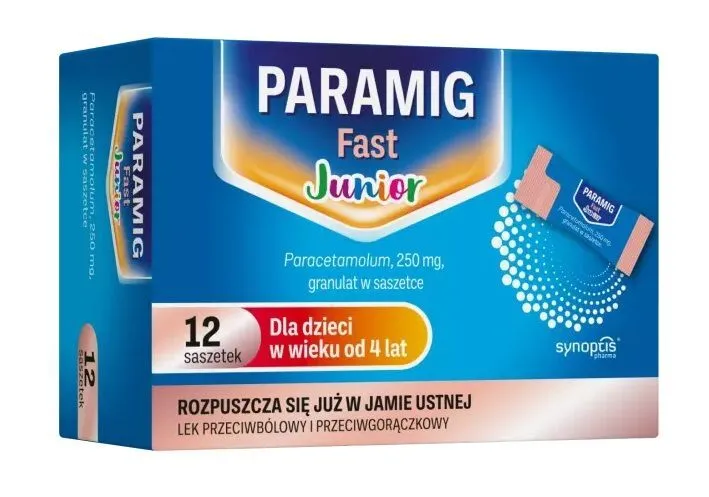
Table of Contents
- Package leaflet: Information for the user
- 1. What Paramig Fast Junior is and what it is used for
- 2. Important information before taking Paramig Fast Junior
- 3. How to take Paramig Fast Junior
- 4. Possible adverse effects
- 5. How to store Paramig Fast Junior
- 6. Contents of the packaging and other information
Package leaflet: Information for the user
PARAMIG Fast Junior, 250 mg, granules in sachet
Paracetamolum
Please read all of this leaflet carefully before taking this medicine, because it contains
important information for you.
This medicine should always be taken exactly as described in this patient leaflet or as directed by
your doctor or pharmacist.
- Keep this leaflet so that you can read it again if necessary.
- If you need advice or further information, please consult your pharmacist.
- If you experience any adverse reactions, including any adverse reactions not listed in this leaflet, inform your doctor or pharmacist. See section 4.
- If there is no improvement after 3 days, or if you feel worse, you should contact your doctor.
Contents of the leaflet:
- What Paramig Fast Junior is and what it is used for
- What you need to know before taking Paramig Fast Junior
- How to take Paramig Fast Junior
- Possible side effects
- How to store Paramig Fast Junior
- Contents of the pack and other information
1. What Paramig Fast Junior is and what it is used for
Paramig Fast Junior contains paracetamol as the active substance.
Paracetamol belongs to the pharmacotherapeutic group of analgesics (pain-relieving medicines), which also act as antipyretics (fever-reducing medicines) with weak anti-inflammatory activity.
Paramig Fast Junior is used for symptomatic treatment of mild to moderate pain and fever.
Do not use the medicinal product Paramig Fast Junior for longer than three days without medical advice.
2. Important information before taking Paramig Fast Junior
When not to take Paramig Fast Junior:
- if the patient is allergic (hypersensitive) to paracetamol or any of the other ingredients of this medicine (listed in section 6),
- if the patient has severe liver failure,
- if the patient has acute hepatitis,
- if the patient has severe kidney failure,
- if the patient is taking this medicine together with other medicines that have an adverse effect on liver function,
- if the patient has severe haemolytic anaemia,
- if the patient is taking monoamine oxidase inhibitors (MAO inhibitors) or within 2 weeks after discontinuation of such treatment.
Warnings and precautions
Before starting treatment with Paramig Fast Junior, consult a doctor or
pharmacist if the patient has:
- liver function disorders, including Gilbert's syndrome (familial hyperbilirubinaemia),
- severe kidney or liver function disorders,
- alcoholic liver disease,
- anorexia, bulimia or cachexia, prolonged malnutrition,
- low glutathione reserves in the liver, e.g. due to eating disorders, cystic fibrosis, HIV infection, fasting or starvation, sepsis,
- dehydration,
- hypovolemia.
Do not exceed the recommended dose of the medicine.
Long-term or frequent use of this medicine is not recommended. Do not take other medicines containing paracetamol simultaneously. Taking multiple daily doses at once may cause severe liver damage. In such cases, loss of consciousness does not occur, but immediate medical attention is required. Prolonged use without medical supervision may be harmful. In children treated with paracetamol at a daily dose of 60 mg/kg, simultaneous administration of another antipyretic is not justified unless paracetamol alone is ineffective.
The risk of overdose is higher in patients with alcohol-related liver damage without cirrhotic features. Caution is advised in cases of chronic alcoholism. In such cases, the total daily dose should not exceed 2 grams.
If the patient is alcohol-dependent or has liver damage, paracetamol should not be used unless prescribed by a doctor. Alcohol should not be consumed during paracetamol treatment. Paracetamol does not enhance the effects of alcohol.
If high fever or signs of secondary infection occur, or if symptoms persist beyond 3 days, the treatment should be re-evaluated.
If symptoms worsen or do not improve within 3 days, or if high fever develops, consult a doctor.
If the patient has severe illnesses, including severe kidney disorders or sepsis (when bacteria and their toxins circulate in the blood, leading to organ damage) or malnutrition, chronic alcoholism, or is also taking flucloxacillin (an antibiotic). In these situations, patients have been reported to develop a serious condition called metabolic acidosis (an abnormality in blood and body fluids) when paracetamol was used regularly over a long period or when paracetamol was taken together with flucloxacillin. Symptoms of metabolic acidosis may include: severe breathing difficulties, including rapid deep breathing, drowsiness, nausea, vomiting.
The total daily dose of paracetamol should not exceed 3 g in adults and children weighing at least 50 kg. If the patient is also taking other pain-relieving medicines containing paracetamol, Paramig Fast Junior should not be taken without prior consultation with a doctor or pharmacist.
Never take Paramig Fast Junior in a dose higher than recommended. Higher doses do not provide stronger pain relief but may cause severe liver damage. The first signs of liver damage may appear after several days. Therefore, immediate contact with a doctor is essential if Paramig Fast Junior has been taken in a dose higher than recommended in this leaflet.
Prolonged or inappropriate use of pain-relieving medicines, or taking them in high doses, may lead to headaches that should not be treated with higher doses of this medicine.
Regular use of pain-relieving medicines, especially combinations of several analgesic substances, may lead to permanent kidney damage with risk of kidney failure (analgesic nephropathy).
Sudden discontinuation after prolonged, inappropriate use of high-dose pain-relieving medicines may cause headache, weakness, muscle pain, restlessness, and autonomic symptoms. These withdrawal symptoms resolve within a few days. During this time, further use of pain-relieving medicines should be avoided, and their re-initiation should not occur without consulting a doctor.
Do not take Paramig Fast Junior for a prolonged period or in high doses without consulting a doctor or dentist.
Paramig Fast Junior and other medicines
Inform your doctor or pharmacist about all medicines currently taken or recently taken, including those available without a prescription.
Medicines that may interfere with the action of Paramig Fast Junior:
- probenecid, used in the treatment of gout (gouty arthritis);
- medicines potentially harmful to the liver, e.g. phenobarbital (sleeping tablets), phenytoin, carbamazepine, primidone (antiepileptic medicines), and rifampicin (used in the treatment of tuberculosis). Concurrent use of these medicines with paracetamol may cause liver damage;
- metoclopramide and domperidone (used to treat nausea). These medicines may accelerate the absorption and onset of action of paracetamol;
- medicines that delay gastric emptying. These medicines may delay the absorption and onset of action of paracetamol;
- cholestyramine (used to reduce elevated serum lipid levels) may reduce absorption and delay the onset of action of paracetamol. Therefore, cholestyramine should not be taken within the first hour after paracetamol administration;
- anticoagulant medicines (oral anticoagulants, especially warfarin).
Inform your doctor or pharmacist if the patient is taking:
- flucloxacillin (an antibiotic), due to the serious risk of blood and body fluid disorders (called metabolic acidosis), which require urgent treatment (see section 2).
Concomitant administration of paracetamol and AZT (zidovudine, a medicine used in HIV infections) increases the tendency to reduced white blood cell count (neutropenia), which may impair immune function and increase the risk of infections. Therefore, Paramig Fast Junior may be taken together with zidovudine only on a doctor's advice.
Repeated use of paracetamol for more than one week increases the tendency to bleeding. Therefore, long-term use of paracetamol should only occur under medical supervision. Occasional use of paracetamol does not significantly affect bleeding tendency.
Effect of paracetamol on laboratory test results
Paracetamol may affect laboratory measurements of uric acid and blood glucose levels.
Paramig Fast Junior with food and drink
Do not consume alcohol during treatment with paracetamol. Do not take the medicinal product Paramig Fast Junior after a meal.
Pregnancy and breastfeeding
If the patient is pregnant or breastfeeding, suspects she may be pregnant, or is planning to become pregnant, she should consult a doctor before using this medicine.
Pregnancy
Paramig Fast Junior may be administered to pregnant women if necessary. The lowest effective dose that adequately relieves pain or reduces fever should be used, and the medicine should be taken for the shortest possible duration.
Breastfeeding
The medicine passes into breast milk. Therapeutic doses of this medicine may be used during breastfeeding.
Driving and operating machinery
Paramig Fast Junior has no effect on the ability to drive or operate machinery.
Warnings concerning excipients
Paramig Fast Junior contains per sachet:
- 0.64 mg sucrose. Patients with rare hereditary disorders of fructose intolerance, glucose-galactose malabsorption syndrome, or sucrase-isomaltase deficiency should not take this medicine;
- trace amounts of glucose. Patients with glucose-galactose malabsorption syndrome should not take this medicinal product;
- 11.81 mg aspartame (E 951), a source of phenylalanine, which may be harmful to persons with phenylketonuria. This is a rare genetic disorder in which phenylalanine accumulates in the body due to impaired excretion;
- 20.25 mg glycerol per sachet. The medicine may cause headache, gastrointestinal disturbances, and diarrhoea;
- 57.5 mg sodium per sachet, equivalent to 2.9% of the WHO-recommended maximum daily sodium intake of 2 g for adults. This should be taken into account in patients on a sodium-controlled diet.
3. How to take Paramig Fast Junior
Paramig Fast Junior should always be taken exactly as directed in this leaflet.
If in doubt, consult your doctor or pharmacist.
Dosages used in children depend on age and body weight. The single dose is 10 mg/kg body weight (b.w.) every 4 hours, or 15 mg/kg b.w. every 6 hours. The maximum daily dose is 60 mg/kg body weight.
The interval between individual doses should not be less than 4 hours.
Do not use Paramig Fast Junior for longer than three days without medical advice.
The dose should be determined based on the information provided in the table below.
Sachet 250 mg
Body weight (b.w.) Single dose Maximum daily dose
(age)
17–25 kg 250 mg paracetamol 1000 mg paracetamol
(4–8 years) (1 sachet) (4 sachets)
| 26-40 kg (8-12 years) | 500 mg paracetamol (2 sachets) | 1500 mg paracetamol (6 sachets) |
Children aged 4 to 8 years (body weight 17–25 kg)
Single dose: 250 mg paracetamol (1 sachet) every 4–6 hours. Do not exceed
the maximum daily dose of 1000 mg paracetamol (i.e. 4 sachets).
Children aged 8 to 12 years (body weight 26–40 kg)
Single dose: 500 mg paracetamol (2 sachets) every 4–6 hours. Do not exceed
the maximum daily dose of 1500 mg paracetamol (i.e. 6 sachets).
Method of administration
For oral use only.
The granules should be taken directly into the mouth (onto the tongue) and swallowed without water. The granules dissolve immediately in the oral cavity; additionally, the mild effervescent effect of the medicinal product causes increased salivation, which facilitates swallowing. Do not take Paramig Fast Junior after a meal.
Special patient groups
Children
Do not use in children under 4 years of age or weighing less than 17 kg. For this group of children, other paracetamol preparations with different formulations and strengths are available.
Elderly patients
Dose adjustment is not required in elderly patients.
Patients with renal or hepatic impairment
In patients with impaired kidney or liver function, the dose should be reduced or the intervals between doses extended. Consult a physician or pharmacist.
Chronic alcoholism
Chronic alcohol consumption may lower the toxic threshold of paracetamol. In these patients, the interval between doses should be at least 8 hours. Do not exceed a daily dose of 2 g paracetamol.
Use of a higher than recommended dose of Paramig Fast Junior
In case of overdose of Paramig Fast Junior, contact a physician or emergency department immediately. Overdose has very serious consequences and may even lead to death.
Immediate treatment is necessary, even if the patient feels well, due to the risk of delayed severe liver damage. Symptoms may be limited to nausea or vomiting and may not reflect the severity of the overdose or the risk of organ damage.
Missed dose of Paramig Fast Junior
Do not take a double dose to make up for a missed dose.
If you have any further questions about the use of this medicine, consult your physician or pharmacist.
4. Possible adverse effects
Like all medicines, PARAMIG Fast Junior may cause adverse effects, although not everyone will experience them.
If any of the following symptoms occur, treatment should be discontinued and you should contact your doctor immediately:
- Rarely occurring (may affect fewer than 1 in 1,000 people):
- itching, rash, sweating, purpura, angioedema (swelling of the face, lips, throat, breathing difficulties), urticaria, edema,
- bleeding,
- abdominal pain, diarrhoea, nausea, vomiting, liver failure, liver necrosis, jaundice,
- acute and chronic pancreatitis (severe abdominal pain, vomiting, bloating, fever, muscle pain, diarrhoea, itching),
- Very rarely occurring (may affect fewer than 1 in 10,000 people):
- severe skin reactions (rash with blisters all over the body or erosions in the mouth, eyes, genital organs and skin, red spots on the body, often with blisters in the center, rupturing blisters, large peeling skin sheets, weakness, fever and joint pain).
- Occurring with unknown frequency (cannot be estimated from available data):
- serious condition that may cause acidification of the blood (so-called metabolic acidosis) in patients with severe disease taking paracetamol (see section 2).
Other adverse effects occurring rarely (may affect fewer than 1 in 1,000 people):
- anaemia,
- non-haemolytic anaemia and bone marrow suppression,
- thrombocytopenia (reduced platelet count, nose and gum bleeding, bruising),
- kidney disorders.
Paracetamol is a commonly used medicine, and reports of adverse effects are rare and usually associated with overdose.
Nephrotoxic effects are rare; no association with therapeutic doses has been reported, except in cases of prolonged use.
If any of the adverse symptoms worsen or if any adverse effect not listed in this leaflet occurs, inform your doctor or pharmacist.
Reporting of adverse effects
If any adverse effects occur, including any adverse effects not listed in this leaflet, inform your doctor or pharmacist. Adverse effects can be reported directly to the Department of Monitoring Adverse Drug Reactions of the Office for Registration of Medicinal Products, Medical Devices and Biocidal Products
Al. Jerozolimskie 181C, 02-222 Warsaw
tel.: +48 22 49 21 301, fax: +48 22 49 21 309
website: https://smz.ezdrowie.gov.pl
Adverse effects can also be reported to the marketing authorisation holder.
Reporting adverse effects helps to provide more information on the safety of the medicine.
5. How to store Paramig Fast Junior
Do not use Paramig Fast Junior after the expiry date stated on the sachet and
the cardboard box (marked as EXP). The expiry date refers to the last day of the specified month.
There are no special storage requirements for this medicinal product.
Keep the medicine out of the sight and reach of children.
Medicines must not be disposed of via wastewater or household waste. Ask your
pharmacist what to do with medicines no longer required. This will help protect
the environment.
6. Contents of the packaging and other information
What Paramig Fast Junior contains
One sachet contains 250 mg of paracetamol ( Paracetamolum ) as the active substance.
Other ingredients of the medicine:
ethylcellulose, hypromellose, macrogol 400, calcium carbonate, sodium bicarbonate, citric acid,
disodium hydrogen citrate, aspartame (E 951), glyceryl distearate (E 422) type I, mannitol,
sodium croscarmellose, sodium carboxymethyl starch type A, colloidal anhydrous silica, flavour-masking agent (501482 TP0424) containing natural flavouring preparations, nature-identical flavouring substances, maltodextrin, sucrose, aspartame (E 951), potassium acesulfame (E950); lemon flavour (502336 TP0551) containing natural flavouring preparations, synthetic flavouring substances, maltodextrin and alpha-tocopherol (E 307).
What Paramig Fast Junior looks like and contents of the packaging
Packaging in the form of a sachet; polyester/aluminium/polyethylene (LDPE).
White to yellowish-white granules with a lemon scent.
The outer packaging contains 12 or 24 sachets in a cardboard box.
Not all pack sizes may be marketed.
Marketing Authorisation Holder and Manufacturer
Marketing Authorisation Holder:
Synoptis Pharma Sp. z o.o.
Krakowiaków 65 Street
02-255 Warsaw
Tel.: 22 321 62 40
Manufacturers:
Zinereo Pharma, S.L.U.
A Relva s/n, O Porriño
36410 Pontevedra
Spain
Farmalider S.A.
C/Aragoneses, 2
28108 Alcobendas (Madrid)
Spain
Edefarm S.L.
Poligono Industrial Enchilagar del Rullo 117
46191 Vilamarxant
Spain