Paracetamol doz
Poland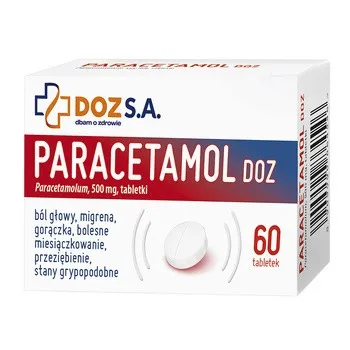
Table of Contents
Package leaflet: Information for the user
PARACETAMOL DOZ, 500 mg, tablets
Paracetamolum
Please read all of this leaflet carefully before taking this medicine, because it contains information
important for the patient.
This medicine should always be taken exactly as described in this patient leaflet or as directed by a
physician, pharmacist, or nurse.
- Keep this leaflet, as you may need to read it again.
- If you need advice or further information, consult your pharmacist.
- If you experience any adverse reactions, including any possible adverse reactions not listed in this leaflet, inform your physician, pharmacist, or nurse. See section 4.
- If there is no improvement after 3 days, or if symptoms worsen, consult a physician.
Contents of the leaflet
- What Paracetamol DOZ is and what it is used for
- Important information before taking Paracetamol DOZ
- How to take Paracetamol DOZ
- Possible side effects
- How to store Paracetamol DOZ
- Contents of the pack and other information
1. What Paracetamol DOZ is and what it is used for
Paracetamol DOZ is an analgesic and antipyretic medicine. It is used in the treatment of: headache, sore throat, migraine, toothache, bone, joint and muscle pain, and painful menstruation. Additionally, the medicine may be used in colds and influenza-like conditions.
If there is no improvement after 3 days, or if symptoms worsen, consult a physician.
2. Important information before taking Paracetamol DOZ
When not to take Paracetamol DOZ:
- if the patient is allergic (hypersensitive) to paracetamol or to any of the other ingredients of this medicine (listed in section 6),
- if the patient suffers from alcoholic liver disease,
- if the patient has severe liver or kidney failure.
Warnings and precautions
Before taking Paracetamol DOZ, discuss it with your doctor, pharmacist, or nurse.
When to take special precautions when using Paracetamol DOZ:
- if the patient suffers from impaired liver and/or kidney function,
- in patients with deficiency of an enzyme called glucose-6-phosphate dehydrogenase (in these patients, damage to red blood cells may occur) or methemoglobin reductase deficiency,
- during treatment, alcohol should not be consumed, as this may lead to liver damage; the risk of liver damage is increased in individuals who regularly consume alcohol and in those who are fasting,
- due to the risk of paracetamol overdose, do not take other medicines containing paracetamol at the same time. This medicine contains paracetamol. Do not exceed the recommended doses. Taking higher than recommended doses may lead to severe liver failure.
While using Paracetamol DOZ, inform your doctor immediately if:
- the patient has severe medical conditions, including severe kidney impairment or sepsis (when bacteria and their toxins circulate in the blood, leading to organ damage), malnutrition, chronic alcoholism, or if the patient is also taking flucloxacillin (an antibiotic). In these situations, severe metabolic acidosis (a blood and body fluid disorder) has been reported in patients taking paracetamol at regular doses over a prolonged period or taking paracetamol together with flucloxacillin. Symptoms of metabolic acidosis may include: severe breathing difficulties, including rapid deep breathing, drowsiness, nausea, and vomiting.
Paracetamol DOZ and other medicines
Tell your doctor or pharmacist about all medicines the patient is currently taking or has recently taken, as well as any medicines the patient plans to take.
- Medicines that accelerate gastric emptying (e.g. metoclopramide, domperidone) may increase the absorption of paracetamol.
- Cholestyramine (a medicine that lowers blood cholesterol levels) may reduce the absorption of paracetamol.
- Regular daily use of paracetamol may enhance the effect of anticoagulant medicines (from the coumarin group), which may lead to bleeding.
- Concurrent use of paracetamol and medicines that increase liver metabolism, such as certain sedatives or antiepileptic drugs (e.g. phenobarbital, phenytoin, carbamazepine), and rifampicin (an antibiotic), may lead to liver damage even when recommended doses of paracetamol are used.
- Salicylamide (an anti-inflammatory, antipyretic, and analgesic medicine) prolongs the elimination time of paracetamol from the body.
- Caffeine enhances the analgesic effect of paracetamol.
- Paracetamol used simultaneously with MAO inhibitors (antidepressant medicines) may cause agitation and high fever.
- The use of paracetamol may cause false results in certain laboratory tests (e.g. blood glucose measurement).
- Concomitant administration of paracetamol and non-steroidal anti-inflammatory drugs (e.g. ibuprofen) increases the risk of kidney function disorders.
Inform your doctor or pharmacist if the patient is taking:
- flucloxacillin (an antibiotic) due to the serious risk of blood and body fluid disorders (called metabolic acidosis), which require urgent treatment (see section 2).
Paracetamol DOZ with food, drink, and alcohol
Do not consume alcohol while taking Paracetamol DOZ.
Pregnancy, breastfeeding, and fertility
If the patient is pregnant or breastfeeding, suspects she might be pregnant, or is planning to have a baby, she should consult her doctor or pharmacist before using this medicine.
Paracetamol DOZ may be used during pregnancy if necessary and clinically justified.
The lowest recommended dose that reduces pain and/or fever should be taken for the shortest possible duration and as infrequently as possible. Consult your doctor if pain and/or fever do not subside or if the patient needs to take the medicine more frequently.
Driving and operating machinery
Paracetamol DOZ has no influence on the ability to drive or operate machinery.
3. How to take Paracetamol DOZ
The usual recommended dose of Paracetamol DOZ is:
Adults and adolescents over 12 years of age
Orally, 2 tablets. The dose may be repeated every 4 hours if necessary, up to 4 times daily.
The maximum daily dose of paracetamol is 4000 mg. Do not exceed 8 tablets in 24 hours.
Children aged 6 to 12 years
Orally, from half to 1 tablet. The dose may be repeated every 4 hours if necessary, up to 4 times daily.
Do not exceed 4 tablets in 24 hours.
Do not give this medicine to children under 6 years of age unless advised by a doctor.
Do not exceed the recommended dose.
Do not use this medicine for longer than 3 days without consulting a doctor.
Taking more than the recommended dose of Paracetamol DOZ
If more than the recommended dose is taken, contact a doctor immediately, even if the patient feels well.
Taking more than the recommended dose may cause liver damage.
Symptoms such as nausea, vomiting, excessive sweating, drowsiness, and general weakness may appear earlier.
If the patient is conscious, induce vomiting (preferably within the first hour after taking the medicine).
It is advisable to give 60 to 100 g of activated charcoal orally, preferably mixed with water.
Missing a dose of Paracetamol DOZ
Do not take a double dose to make up for a missed dose.
Stopping Paracetamol DOZ
If you have any further questions about the use of this medicine, consult your doctor, pharmacist, or nurse.
4. Possible adverse reactions
Like all medicines, Paracetamol DOZ may cause adverse reactions, although not everyone experiences
them.
When taken at the recommended doses, adverse reactions occur rarely (may affect 1 to 10 people in
10,000). The following may occur:
- allergic reactions, e.g. skin rash,
- epigastric burning, nausea, vomiting, pancreatitis,
- liver damage, liver enlargement, jaundice.
Very rarely (may affect fewer than 1 in 10,000 people), the following may occur:
- decreased platelet count (thrombocytopenia),
- increased concentration of oxidized hemoglobin in blood (methemoglobinemia),
- life-threatening severe reduction in the number of white blood cells called granulocytes (agranulocytosis),
- severe skin reactions: acute generalized pustular rash over the entire body or blisters and erosions on the skin, in the oral cavity, eyes, and genital organs, accompanied by fever and joint pain, or rupturing giant blisters, extensive skin erosions, peeling of large sheets of epidermis with fever (Stevens-Johnson syndrome, toxic epidermal necrolysis).
Frequency not known (cannot be estimated from available data):
- a serious condition that may cause blood acidification (so-called metabolic acidosis), in patients with severe illness receiving paracetamol (see section 2).
After overdose, disturbances in liver and/or kidney function may occur.
If any of the adverse reactions worsen or if any adverse reactions not listed in this leaflet occur,
inform a doctor, pharmacist, or nurse immediately.
Reporting of adverse reactions
If any adverse reactions occur, including those not listed in this leaflet, inform your doctor, pharmacist,
or nurse. Adverse reactions can be reported directly to the Department of Monitoring Adverse Drug
Reactions of the Office for Registration of Medicinal Products, Medical Devices and Biocidal Products,
Al. Jerozolimskie 181C
02-222 Warsaw
Tel.: +48 22 49 21 301
Fax: +48 22 49 21 309
Website: https://smz.ezdrowie.gov.pl
Adverse reactions may also be reported to the responsible entity.
Reporting adverse reactions helps provide more information on the safety of this medicine.
5. How to store Paracetamol DOZ
No special precautions regarding storage temperature are required.
Store in the original packaging.
Keep out of sight and reach of children.
Do not use Paracetamol DOZ after the expiry date stated on the packaging.
Medicines must not be disposed of via wastewater or household waste. Ask your pharmacist what to do with medicines no longer required. This will help protect the environment.
6. Contents of the packaging and other information
What Paracetamol DOZ contains
- The active substance is paracetamol. One tablet contains 500 mg of paracetamol. The tablet can be divided into equal doses.
- Other ingredients are: povidone K29-32, maize starch, colloidal anhydrous silica, magnesium stearate.
What Paracetamol DOZ looks like and contents of the pack
Paracetamol DOZ is a tablet.
The cardboard box contains:
- 10 tablets (1 blister made of PVC/Aluminium) or 20 tablets (2 blisters made of PVC/Aluminium) and a patient leaflet, or
- 60 tablets packed in a HDPE container with a tamper-evident closure made of LDPE or in a HDPE container with a cap and sealing liner, together with a patient leaflet.
Marketing Authorisation Holder and Manufacturer
Marketing Authorisation Holder:
DOZ S.A.
Al. Jerozolimskie 134
02-305 Warsaw
Telephone number: 800 110 110
Manufacturer:
Laboratorium Galenowe Olsztyn Sp. z o.o.
ul. Spółdzielcza 25A
11-001 Dywity