Owix
Poland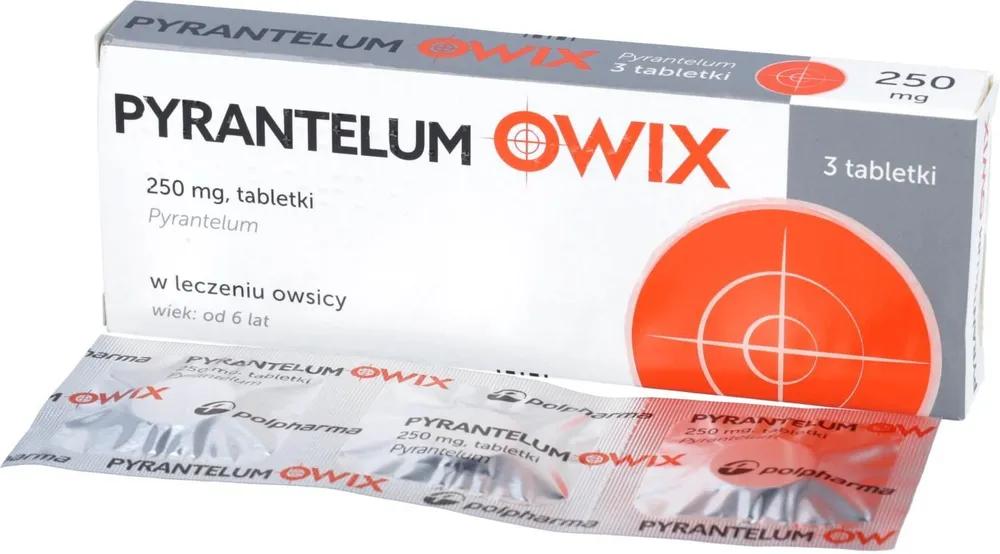
Table of Contents
Package leaflet: Information for the patient
OWIX, 250 mg, tablets
Pyrantelum
Please read this leaflet carefully before taking the medicine, as it contains important information for the patient.
This medicine should always be taken exactly as described in this patient leaflet or as directed by a doctor or pharmacist.
- Keep this leaflet so that you can read it again if necessary.
- If you need advice or further information, consult your pharmacist.
- If you experience any side effects, including any possible side effects not listed in this leaflet, inform your doctor or pharmacist. See section 4.
- If there is no improvement or if you feel worse, consult your doctor.
Table of contents
- What Owix is and what it is used for
- Important information before taking Owix
- How to take Owix
- Possible side effects
- How to store Owix
- Contents of the package and other information
1. What Owix is and what it is used for
The active substance in Owix is pyrantel. Owix is an anthelmintic medicine intended for children aged 6 years and older and adults, used to treat intestinal infection with pinworms – white thread-like roundworms. The medicine acts on the muscles of intestinal parasites. The immobilized parasites are expelled from the intestine by peristaltic movements. Pyrantel does not irritate the intestines nor cause migration of worms. It acts on adult forms and early developmental stages of parasites, but has no effect on larvae migrating through tissues.
Indications:
- Enterobiasis (pinworm infection)
The use of this medicine requires confirmation of the presence of pinworms in the stool and/or in the anal area. Pinworms are small, white parasitic worms living in the intestine. They resemble threads of white cotton, with females measuring about 10 mm in length. Individual worms may be difficult to detect, but when they multiply excessively, white, moving one-centimeter-long worms are clearly visible in the stool. The presence of pinworms can also be observed by examining the anal area of a sleeping child in the evening (preferably 2 hours after falling asleep, when egg-laying occurs).
Pinworms lay a large number of small eggs, invisible to the naked eye. After being swallowed, the eggs travel through the human gastrointestinal tract down to the large intestine, where they develop into mature worms within 2–6 weeks. Mature females lay eggs around the anus, causing persistent itching, leading to constant scratching. As a result, the area becomes irritated, and eggs are transferred first to the hands, then via nail-biting or finger-licking into the mouth, leading to self-reinfection. Alternatively, eggs can be transmitted to other family members through direct or indirect contact, e.g. via towels, bed linen, toys, or furniture.
Symptoms of enterobiasis are mainly observed in children, although the disease can occur at any age. Children are often the main carriers (infection may occur, for example, in nurseries, kindergartens, or sandpits). If a child has pinworms, it is very easy for other household members to become infected. Enterobiasis is characterized by intense anal itching (not present in all infected individuals), usually at night, which may often lead to inflammatory conditions. Infected children may experience irritability, nervousness, insomnia, nocturnal enuresis, abdominal pain, or loss of appetite. In girls, infection may sometimes lead to vulvovaginitis, manifested by itching, burning, and white vaginal discharge. In such cases, consult your doctor.
Maintaining proper hygiene, especially personal hygiene, is very important to prevent self-reinfection or transmission to others. The following rules should be observed for at least 6 weeks after completion of treatment.
Prevention of enterobiasis includes:
- thorough and frequent handwashing before preparing or eating meals, after using the toilet, and after touching the anal area
- thorough washing of vegetables and fruits before consumption
- keeping children's nails short and discouraging nail-biting or finger-licking
- frequent, regular changing of underwear (including personal underwear and bed linen)
- washing and ironing personal underwear and bed linen at high temperatures
- frequent cleaning of household rooms, especially bedrooms and bathrooms (pinworm eggs can survive for several weeks under household conditions, particularly with adequate humidity and warmth)
- avoiding children playing in dirty sandboxes
- daily morning hygiene of the anal area
- wearing pajamas, underwear, and for young children, diapers before bedtime.
It is important that the entire family of an infected person follows enhanced personal hygiene. Due to the frequent occurrence of enterobiasis in groups, treatment should be administered simultaneously to all household members and should be repeated if necessary.
If re-infection is suspected, consult your doctor.
2. Important information before using Owix
When not to use Owix
- If the patient is allergic to pyrantel or any of the other ingredients of this medicine (listed in section 6).
- If the patient is taking piperazine.
- If the patient is being treated for myasthenia gravis (a skeletal muscle disorder).
Warnings and precautions
Before starting treatment with Owix, consult your doctor if:
- the patient has impaired liver function;
- the patient is undernourished or has anaemia.
If any of the above warnings apply to the patient currently or relate to past medical conditions, consult a doctor.
Owix and other medicines
Tell your doctor or pharmacist about all medicines the patient is currently taking, has recently taken, or plans to take.
- This medicine may increase the plasma concentration of theophylline (used in the treatment of bronchial asthma).
- This medicine should not be used concomitantly with piperazine, as the efficacy of both medicines may be reduced.
Owix with food and drink
The medicine should be taken during or after a meal.
Pregnancy and breastfeeding
If the patient is pregnant, breastfeeding, suspects she may be pregnant, or is planning to have a baby, she should consult a doctor or pharmacist before using this medicine.
Pregnancy
Use of Owix is not recommended during pregnancy. If treatment is necessary, consult a doctor.
Breastfeeding
Use of Owix is not recommended in breastfeeding women. If treatment with this medicine is necessary, breastfeeding should be discontinued during treatment.
Fertility
There are no data available on the effect of this medicine on fertility.
Driving and using machines
There is no information available on the influence of Owix on the ability to drive or operate machinery.
3. How to use Owix
This medicine should always be used exactly as described in the patient leaflet or as directed by a
doctor or pharmacist. If in doubt, consult a doctor or pharmacist.
Dosage
The dose should be repeated two or three weeks after taking the first dose. Do not exceed the recommended dose of the medicine.
Fourteen days after completion of treatment, a follow-up parasitological examination should be performed.
If symptoms persist after administration of the second dose, consult a doctor.
Due to the pharmaceutical form, Owix 250 mg tablets are not intended for use in children under 6 years of age.
An oral suspension formulation containing pyrantel is available on the market and is suitable for use in young children.
The following table shows the dosage of Owix tablets according to patient body weight.
| Body weight (b.w.) | Single dose | Single dose [mg] |
| 17-28 kg | 1 tablet | 250 mg |
| 29-39 kg | 1½ tablets | 375 mg |
| 40-50 kg | 2 tablets | 500 mg |
| 51-62 kg | 2½ tablets | 625 mg |
| 63-75 kg | 3 tablets | 750 mg |
| Adults with b.w. >75 kg | 4 tablets | 1 000 mg |
Patients with liver function disorders
Patients with liver function disorders should consult a doctor before taking the medicine.
The doctor may recommend a lower dose, as the medicine may adversely affect the liver.
Method of administration
The medicine is taken orally during or after a meal, with water.
Before swallowing, the tablet must be thoroughly chewed or crushed.
Use of a higher than recommended dose of Owix medicine
If a higher than recommended dose of the medicine is taken, seek immediate advice from a doctor or
pharmacist.
Symptoms following overdose may include: visual disturbances, disorientation,
dizziness, fainting or feeling dizzy upon standing up from a lying or sitting position,
sweating, new onset of fatigue or weakness, irregular heartbeat; muscle cramps,
tremor and muscle weakness; feeling exhausted, breathing difficulties, loss of consciousness.
If you have any further questions regarding the use of this medicine, consult a
doctor or pharmacist.
4. Possible adverse reactions
Like any medicine, this medicine can cause adverse reactions, although not everyone experiences them.
After administration, adverse reactions occur infrequently and resolve after discontinuation of treatment.
Adverse reactions occurring rarely (less than 1 in 1,000 patients)
- nausea, vomiting, stomach pain and cramps, diarrhoea, loss of appetite
- headache, dizziness, somnolence, insomnia
- rash
- weakness
- transient increase in aminotransferase activity (enzymes indicating liver function).
Adverse reactions occurring with unknown frequency (frequency cannot be estimated from
available data)
- urge to defecate
- hallucinations with disorientation, paresthesia (tingling, numbness sensations in limbs)
- fever
- hearing disturbances.
Reporting of adverse reactions
If any adverse symptoms occur, including any adverse symptoms not listed
in this leaflet, inform your doctor or pharmacist. Adverse reactions can be reported
directly to the Department of Monitoring Adverse Drug Reactions at the Office for Registration of Medicinal Products, Medical Devices and Biocidal Products
Al. Jerozolimskie 181C
02-222 Warsaw
Phone: +48 22 49 21 301
Fax: +48 22 49 21 309
Website: https://smz.ezdrowie.gov.pl
Adverse reactions can also be reported to the marketing authorization holder.
Reporting adverse reactions enables further collection of information on the safety of using the medicine.
5. How to store Owix medicine
Keep this medicine out of sight and reach of children.
Store below 25°C. Keep in the original packaging.
Do not use this medicine after the expiry date stated on the carton. The expiry date refers to the last day of the stated month.
The label on the packaging shows the expiry date after the abbreviation EXP, and the batch number after the abbreviation Lot.
Medicines must not be disposed of via wastewater or household waste. Ask your pharmacist how to dispose of medicines no longer in use. This will help protect the environment.
6. Contents of the package and other information
What Owix contains
- The active substance is pyrantel. Each tablet contains 250 mg of pyrantel in the form of pyrantel embonate.
- The other ingredients are: potato starch, povidone, colloidal anhydrous silica, ethylcellulose, magnesium stearate, orange flavor.
What Owix looks like and contents of the pack
Owix tablet is round, biconvex, with a dividing line; sand-yellow in color with a greenish-grey tint and slight specks on the surface, with an orange odor.
The tablet can be divided into equal doses.
The pack contains 3 tablets.
Marketing authorisation holder and manufacturer
Zakłady Farmaceutyczne POLPHARMA S.A.
Pelplińska 19, 83-200 Starogard Gdański
tel. + 48 22 364 61 01