Otrivin
Poland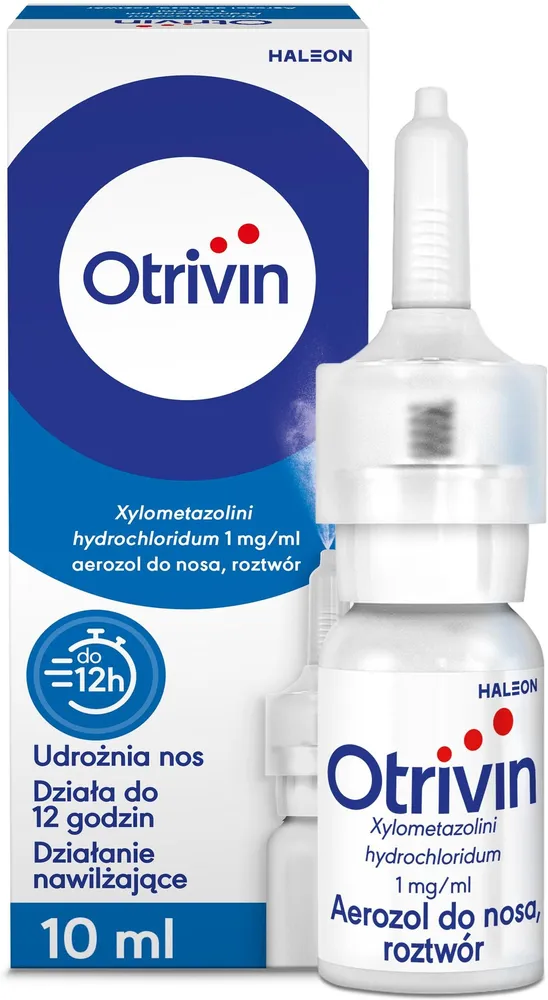
Table of Contents
Package leaflet: Information for the user
Warning! Keep this leaflet. Information on the immediate packaging in a foreign language.
Otrivin, 1 mg/ml, nasal spray, solution
Xylometazolini hydrochloridum
Please read the entire leaflet carefully before use, as it contains important information for the patient.
This medicine should always be used exactly as described in this patient leaflet or as directed by a doctor or pharmacist.
- Keep this leaflet for future reference.
- If advice or further information is needed, please consult a pharmacist.
- If the patient experiences any adverse reactions, including any not listed in this leaflet, inform a doctor or pharmacist. See section 4.
- If there is no improvement after 10 days, or if symptoms worsen, consult a doctor.
Table of contents of the leaflet:
- What Otrivin is and what it is used for
- Important information before using Otrivin
- How to use Otrivin
- Possible side effects
- How to store Otrivin
- Contents of the pack and other information
1. What Otrivin is and what it is used for
The active substance in Otrivin is xylometazoline hydrochloride.
Otrivin is a locally acting medicine that reduces nasal mucosal congestion and swelling by constricting blood vessels, thereby decreasing nasal discharge.
It helps patients with a blocked nose to breathe more easily through the nose. The special formulation (ingredients with moisturizing properties) helps prevent drying and irritation of the nasal mucosa.
The effect of Otrivin begins within 2 minutes and lasts up to twelve hours.
Otrivin is indicated for use in adults and adolescents aged 12 years and older.
Indications:
Excessive nasal mucosal congestion occurring during colds, hay fever, allergic rhinitis, and sinusitis. The medicine facilitates drainage of secretions from inflamed paranasal sinuses. By reducing congestion of the nasopharyngeal mucosa, it may be used as supportive treatment in acute otitis media.
Otrivin facilitates nasal endoscopy (examination of the nasal cavity).
2. Important information before using Otrivin
When not to use Otrivin
- if the patient is allergic to xylometazoline hydrochloride or any of the other ingredients of this medicine (listed in section 6),
- if the patient has undergone surgery performed through the nose, e.g. removal of the pituitary gland or surgery involving exposure of the dura mater (brain surgery performed through the nose or mouth),
- if the patient has narrow-angle glaucoma (increased pressure in the eye),
- if the patient has very dry nasal mucosa (atrophic rhinitis or rhinitis sicca),
- in children under 12 years of age.
Warnings and precautions
Before using Otrivin, consult a doctor if the patient:
- has high blood pressure,
- has heart disease (e.g. long QT syndrome),
- has hyperthyroidism,
- has diabetes,
- has benign prostatic hyperplasia,
- has a benign tumour of the adrenal gland producing large amounts of adrenaline and noradrenaline (pheochromocytoma),
- is taking certain antidepressants known as monoamine oxidase inhibitors (MAOIs) or has taken them within the previous 2 weeks,
- is taking tricyclic or tetracyclic antidepressants,
- is hypersensitive to substances with effects similar to xylometazoline. In sensitive patients, Otrivin may cause insomnia, dizziness, irregular heartbeat, high blood pressure or tremor.
Otrivin should not be used for longer than 10 consecutive days. If symptoms persist,
contact a doctor.
Prolonged use beyond 10 days or use in doses higher than recommended may
worsen symptoms or cause their recurrence.
Otrivin should not be applied to the eyes or inside the mouth.
Do not exceed the recommended dose, especially in children and elderly patients.
Children and adolescents
Otrivin should not be used in children under 12 years of age.
Otrivin with other medicines
Tell your doctor or pharmacist about all medicines the patient is currently taking or has recently taken, as well as any medicines the patient plans to take.
Do not use Otrivin if taking certain medicines used to treat depression. These include:
- monoamine oxidase inhibitors (MAOIs): DO NOT use Otrivin if taking MAOIs or have taken such medicines within the last 14 days,
- tricyclic and tetracyclic antidepressants. If taking any of the above medicines, consult a doctor before using Otrivin.
Pregnancy and breastfeeding
If the patient is pregnant or breastfeeding, suspects she may be pregnant, or is planning to become pregnant, she should consult a doctor or pharmacist before using this medicine.
Otrivin should not be used during pregnancy.
During breastfeeding, Otrivin should only be used after consulting a doctor.
Driving and operating machinery
Otrivin, when used at recommended doses, has no effect or has a negligible effect on the ability to
drive or operate machinery.
Otrivin contains benzalkonium chloride
This medicine contains 0.014 mg of benzalkonium chloride per spray dose, equivalent to 0.1 mg of
benzalkonium chloride per 1 ml of solution. Benzalkonium chloride may cause irritation
or swelling inside the nose, especially if used for prolonged periods.
3. How to use Otrivin
This medicine should always be used exactly as described in this patient information leaflet or as directed by a doctor. If in doubt, consult a doctor or pharmacist.
Otrivin should be used only in the nose (including during middle ear infection).
To avoid spreading infection, one package of the medicine should be used by only one patient.
Adults and adolescents over 12 years of age:
1 dose of Otrivin into each nostril up to 3 times daily.
Do not use more than 3 times a day. It is recommended to take the last dose immediately before going to sleep.
Do not use for longer than 10 consecutive days.
Otrivin should not be used in children under 12 years of age.
Instructions for use
The medicine is intended for nasal use.
Take care not to spray the aerosol into the eyes.
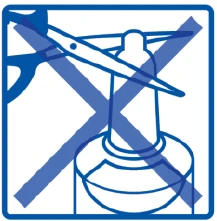
- Do not cut the tip of the applicator. The aerosol is ready for use.
- Remove the protective cap.
- Before first use, press the pump 5 times. The pump is then ready for use throughout the recommended treatment period (do not use for longer than 10 consecutive days). If, after fully pressing the pump, no aerosol is released, or if the medicine has not been used for more than 7 days, re-prime the pump by pressing it 4 times.
- Clear the nose.
- Hold the bottle upright, supporting the bottom with the thumb, and hold the tip between two fingers.
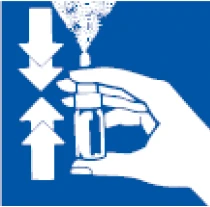
- Tilt the head forward and insert the tip into the nostril.
- Press the pump while inhaling through the nose to ensure optimal distribution of the aerosol.

- Repeat the procedure when administering the medicine into the other nostril.
- Replace the protective cap after use.
The nasal aerosol allows precise dosing and ensures proper distribution of the solution over the entire nasal mucosal surface.
This eliminates the risk of accidental overdose.
Use of more than the recommended dose of Otrivin
If more than the recommended dose has been used, consult a doctor or pharmacist immediately.
Symptoms of overdose may include headache, dizziness, sweating, lowered body temperature, slowed heart rate, high blood pressure, breathing difficulties, coma, and seizures.
Symptomatic treatment should be administered.
Missed dose of Otrivin
Do not use a double dose to make up for a missed dose.
If you have any further questions about the use of this medicine, consult your doctor or pharmacist.
4. Possible adverse reactions
Like all medicines, this medicine may cause adverse reactions, although not everybody will experience them.
You should STOP using Otrivin and immediately consult a doctor if any of the following adverse reactions occur, as they may be symptoms of an allergic reaction:
- difficulty breathing or swallowing,
- swelling of the face, lips, tongue or throat,
- itching with red rash or blisters. These reactions occur very rarely (less frequently than in 1 out of 10,000 people using the medicine).
Common adverse reactions (occur less frequently than in 1 out of 10 patients):
dryness or irritation of the nasal mucosa, nausea, headache, burning at the site of administration.
Uncommon adverse reactions (occur less frequently than in 1 out of 100 patients):
nosebleeds.
Very rare adverse reactions (occur less frequently than in 1 out of 10,000 patients):
allergic reaction (skin rash, itching), transient visual disturbances, arrhythmia or
accelerated heart rate.
Reporting of adverse reactions
If any adverse reactions occur, including any adverse reactions not listed in this leaflet, inform your doctor, pharmacist or nurse. Adverse reactions can be reported directly to the Department of Monitoring Adverse Drug Reactions of the Office for Registration of Medicinal Products, Medical Devices and Biocidal Products
Al. Jerozolimskie 181C, 02-222 Warsaw, phone: + 48 22 49 21 301, fax: + 48 22 49 21 309, website: https://smz.ezdrowie.gov.pl
By reporting adverse reactions, more information on the safety of this medicine can be collected.
5. How to store Otrivin
Keep the medicine out of the sight and reach of children.
Store below 30°C.
Do not use this medicine after the expiry date stated on the packaging. The expiry date refers to the last day of the stated month.
After first opening, the nasal spray can be used until the end of the expiry period.
Medicines should not be disposed of via wastewater or household waste. Ask your pharmacist how to dispose of medicines no longer in use. This will help protect the environment.
6. Contents of the pack and other information
What Otrivin contains
- The active substance in Otrivin is xylometazoline hydrochloride. One ml of solution contains 1 mg of xylometazoline hydrochloride.
- Other components of the medicine are: benzalkonium chloride, disodium edetate, sodium dihydrogen phosphate dihydrate, disodium phosphate dodecahydrate, sodium chloride, liquid sorbitol, non-crystallizing 70% (E 420), hypromellose 4000, purified water.
What Otrivin looks like and contents of the pack
The Otrivin package consists of an HDPE bottle with a metered dose pump and a protective cap containing 10 ml of solution, packed in a cardboard box.
For more detailed information, please contact the responsible entity or the parallel importer.
Marketing Authorisation Holder in Lithuania, country of export:
Haleon Hungary Kft.
1124 Budapest, Csörsz utca 43
Hungary
Manufacturer:
Haleon Germany GmbH
Barthstraße 4
80339 Munich
Germany
Parallel Importer:
Delfarma Sp. z o.o.
ul. Św. Teresy od Dzieciątka Jezus 111
91-222 Łódź
Repackaged in:
Delfarma Sp. z o.o.
ul. Św. Teresy od Dzieciątka Jezus 111
91-222 Łódź
Marketing Authorisation number in Lithuania, country of export: LT/1/95/0102/001
Parallel Import Authorisation number: 124/25