Osteoteri
PolandTable of Contents
Package leaflet: Information for the user
Osteoteri, 20 micrograms/80 microlitres, solution for injection in a pre-filled pen
Teryparatide
Please read all of this leaflet carefully before using this medicine, because it contains
important information for you.
- Keep this leaflet, as you may need to read it again.
- If you have any further questions, please ask your doctor or pharmacist.
- This medicine has been prescribed for you personally. Do not pass it on to others. It may harm them, even if their symptoms are the same as yours.
- If you experience any side effects, including any not listed in this leaflet, please inform your doctor or pharmacist. See section 4.
Contents of the leaflet
- What Osteoteri is and what it is used for
- What you need to know before using Osteoteri
- How to use Osteoteri
- Possible side effects
- How to store Osteoteri
- Contents of the pack and other information
1. What Osteoteri is and what it is used for
Osteoteri contains the active substance teryparatide, which strengthens bones and reduces the risk of fractures by stimulating bone formation.
Osteoteri is used in the treatment of osteoporosis in adults. In people with osteoporosis, bones become thinner and more fragile. Osteoporosis commonly occurs in women after menopause, but may also occur in men. Osteoporosis may also occur in patients taking glucocorticosteroids.
2. Important information before using Osteoteri
When not to use Osteoteri:
- if the patient is allergic to teriparatide or any of the other ingredients of this medicine (listed in section 6);
- if elevated calcium levels in the blood have been diagnosed (pre-existing hypercalcemia);
- if the patient has severe kidney disease;
- if the patient has ever been diagnosed with bone cancer or any other cancer with bone metastases;
- if the patient has bone diseases. You should inform your doctor if you have bone diseases;
- if there is increased alkaline phosphatase activity in the blood of unknown cause, as this may indicate Paget's disease (a disorder characterized by abnormal bone changes). In case of doubt, consult your doctor;
- if the patient has previously undergone radiotherapy affecting the bones;
- if the patient is pregnant or breastfeeding.
Warnings and precautions
Osteoteri may increase calcium levels in the blood or urine.
Before starting or during treatment with Osteoteri, discuss the following with your doctor or pharmacist:
- if you experience prolonged nausea, vomiting, constipation, fatigue, or muscle weakness. These may be symptoms of excessive calcium levels in the blood;
- if you have or have had kidney stones;
- if you have kidney disease (moderate impairment of kidney function).
After the first few doses of the medicine, some patients may experience dizziness or rapid heartbeat. If dizziness occurs after the first doses, Osteoteri should be administered while sitting or lying down.
Do not exceed the recommended 24-month treatment period.
Osteoteri must not be used in adult individuals who are still growing.
Children and adolescents
Osteoteri must not be used in children and adolescents (under 18 years of age).
Osteoteri and other medicines
Tell your doctor or pharmacist about all medicines you are currently taking or have recently taken, as they may interact with Osteoteri (e.g. digoxin or cardiac glycosides used in the treatment of heart diseases).
Pregnancy and breastfeeding
Women who are pregnant or breastfeeding must not use Osteoteri. Women of childbearing potential must use an effective method of contraception during treatment with Osteoteri. If pregnancy occurs, treatment with Osteoteri must be discontinued. Consult your doctor or pharmacist before taking any medicine.
Driving and operating machinery
Some patients may experience dizziness after injection of Osteoteri. If dizziness occurs, do not drive or operate machinery until this symptom resolves.
Osteoteri contains sodium:
The medicine contains less than 1 mmol (23 mg) of sodium per dose, meaning the medicine is considered "sodium-free".
3. How to use Osteoteri
This medicine should always be used as directed by your doctor. If you have any doubts, consult your
doctor or pharmacist.
The recommended dose is 20 micrograms (corresponding to 80 microliters), administered once daily
as a subcutaneous injection into the thigh or abdomen. To help you remember to take the medicine,
injections should be given at approximately the same time each day.
Before first use, the injection device must be prepared. You should also read the instructions for use
provided.
Injections should be given every day for the duration prescribed by your doctor. The total duration of
treatment with Osteoteri should not exceed 24 months. A patient may receive treatment for 24 months
only once in a lifetime.
Osteoteri may be administered around mealtimes.
Please refer to the instructions for use supplied with the package, which contain information on how
to use the Osteoteri injection device.
Needles are not supplied with the injection devices. You may use, for example, needles for injection
devices from Becton Dickinson and Company, size 29 to 31 (diameter 0.25–0.33 mm) and length 12.7,
8 or 5 mm.
The injection should be administered shortly after removing the injection device from the refrigerator,
as described in the instructions for use. After use, the injection device should be returned to the
refrigerator immediately. A new needle should be used for each injection and discarded after use.
Never store the injection device with a needle attached. Never share the Osteoteri injection device
with other people.
Your doctor may recommend taking calcium and vitamin D supplements with Osteoteri. In such cases,
your doctor will determine the appropriate doses of these additional medicines.
Osteoteri may be used independently of meals.
Use of a higher than recommended dose of Osteoteri
If you accidentally inject more than the recommended dose of Osteoteri, contact your doctor or
pharmacist immediately.
Expected symptoms of overdose may include nausea, vomiting, dizziness, and headache.
Missing a dose of Osteoteri
If you forget or are unable to administer the medicine at the usual time, inject it as soon as possible
on the same day. Do not use a double dose to make up for a missed dose. Do not administer more than
one injection per day. Do not attempt to make up for a missed dose.
Stopping treatment with Osteoteri
If you are considering stopping treatment with Osteoteri, contact your doctor. Your doctor will advise
you and decide how long you should continue treatment with Osteoteri.
If you have any further questions about the use of this medicine, consult your doctor or pharmacist.
4. Possible side effects
Like all medicines, this medicine can cause side effects, although not everyone experiences them.
The most commonly occurring side effects are: pain in the limbs (very common, may occur in more than 1 out of 10 patients), nausea, headache and dizziness (common).
If dizziness occurs after injection of the medicine, you should sit or lie down until you feel better. If symptoms do not improve, contact your doctor before continuing treatment. Cases of fainting have been reported in connection with the use of teriparatide.
If symptoms of discomfort occur, such as redness, pain, swelling, itching, bruising or minor bleeding at the injection site (common symptoms), they should resolve within a few days or weeks. If not, you should inform your doctor as soon as possible.
In some patients, allergic reactions may occur shortly after injection of the medicine, such as shortness of breath, facial swelling, rash and chest pain (rare). In rare cases, severe and potentially life-threatening allergic reactions may occur, including anaphylaxis.
Other side effects:
Common: may occur in 1 out of 10 patients
- Increased blood cholesterol levels
- Depression
- Neuralgia in the legs
- Weakness
- Sensation of spinning
- Irregular heartbeat
- Shortness of breath
- Increased sweating
- Muscle cramps
- Feeling of lack of energy
- Fatigue
- Chest pain
- Low blood pressure
- Heartburn (a feeling of pain or burning below the breastbone)
- Vomiting
- Hiatal hernia – a condition in which part of the stomach pushes up into the chest through an opening in the diaphragm
- Low hemoglobin levels or low number of red blood cells (anemia)
Uncommon: may occur in 1 out of 100 patients
- Rapid heartbeat
- Abnormal heart sounds
- Shortness of breath
- Hemorrhoidal nodules (hemorrhoids)
- Involuntary passing or leakage of urine
- Urge to urinate
- Weight gain
- Kidney stones
- Muscle and joint pain. In some patients, severe muscle cramps or back pain occurred, requiring hospital treatment.
- Increased calcium levels in the blood
- Increased uric acid levels in the blood
- Increased activity of the enzyme alkaline phosphatase
Rare: may occur in 1 out of 1000 people
- Kidney dysfunction, including kidney failure
- Swelling, mainly in the hands, feet and legs
Reporting of side effects
If you experience any side effects, including any not listed in this leaflet, tell your doctor, pharmacist or nurse. Side effects can also be reported directly to the Department of Monitoring Adverse Drug Reactions at the Office for Registration of Medicinal Products, Medical Devices and Biocidal Products:
Al. Jerozolimskie 181C,
02-222 Warsaw
Phone: +48 22 4921 301
Fax: +48 22 4921 309
Website: https://smz.ezdrowie.gov.pl
Side effects can also be reported to the marketing authorization holder.
Reporting side effects helps to provide more information on the safety of this medicine.
5. How to store Osteoteri
Keep this medicine out of sight and reach of children.
Do not use this medicine after the expiry date stated on the carton and the syringe after EXP. The expiry date refers to the last day of the stated month.
After use, replace the cap on the syringe (due to the solution for injection being light-sensitive). Osteoteri must always be stored in a refrigerator (2°C to 8°C). After the first injection, the medicine may be used for up to 28 days, provided it is stored in the refrigerator (2°C to 8°C).
Do not freeze Osteoteri. Avoid placing syringes in the refrigerator near the freezer compartment to prevent accidental freezing of the medicine. Do not use Osteoteri if it has been frozen.
After 28 days, the syringe must be disposed of properly, even if it is not completely empty.
Osteoteri contains a clear, colourless solution. Do not use Osteoteri if solid particles are visible, or if the solution is cloudy or has changed colour.
Medicines should not be disposed of via wastewater or household waste. Ask your pharmacist how to dispose of medicines no longer in use. Doing so helps protect the environment.
6. Contents of the package and other information
What Osteoteri contains
- The active substance is teriparatide. One millilitre of solution for injection contains 250 micrograms of teriparatide.
- Other components are: glacial acetic acid, anhydrous sodium acetate, mannitol, metacresol, water for injections, hydrochloric acid (for pH adjustment), sodium hydroxide (for pH adjustment).
What Osteoteri looks like and contents of the pack
Osteoteri is a clear, colourless solution. The medicine is contained in a cartridge inside the
injection device. Each device contains 2.4 ml of solution, sufficient for 28 doses.
Injection devices are available in cardboard boxes containing 1 or 3 devices. Not all pack sizes may be marketed.
Marketing Authorisation Holder
G.L. Pharma GmbH
Schlossplatz 1
8502 Lannach
Austria
Manufacturer
G.L. Pharma GmbH
Schlossplatz 1
8502 Lannach
Austria
GP-PHARM, S.A.
Polígono Industrial Els Vinyets-Els Fogars, Sector 2, Carretera Comarcal C-244, Km 22
08777 Sant Quintí de Mediona
Spain
For further information and information on the medicinal product names in other EEA member states, please contact the representative of the Marketing Authorisation Holder:
G.L. PHARMA POLAND Sp. z o.o.
Al. Jana Pawła II 61/313
01-031 Warsaw, Poland
Tel: 022/ 636 52 23; 636 53 02
[email protected]
INJECTION DEVICE USER INSTRUCTIONS
User instructions for the injection device
Parts of the injection device
Osteoteri is a medicine supplied in an injection device. The device contains enough medicine for daily injection for 28 consecutive days.
A new needle must be used for each injection. Needles are not supplied with the device.
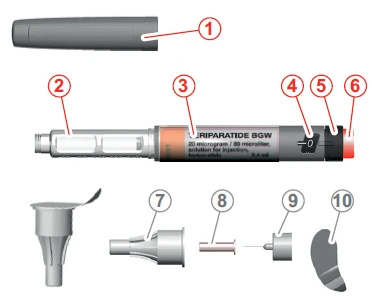
- Device cap
- Medicine cartridge
- Label
- Dose window
- Dose selector dial
- Injection button
- Large outer needle cap
- Small inner needle cap
- Needle
- Sealing foil
Patient safety
Important information
- Read the entire user instructions carefully and follow the instructions exactly.
- Read the leaflet included with the injection device.
- If you have any questions or doubts, contact your doctor, pharmacist, or caregiver.
Prevention of infectious diseases
- Do not share the injection device with other people, as this may lead to transmission of infectious diseases.
- Use a new sterile needle for each injection. Used needles pose a risk of transmitting infectious diseases.
Using the injection device
- When removing the device from the refrigerator, check the label to ensure you are using the correct medicine.
- Check the expiry date of the medicine. Do not use the medicine after the expiry date.
- Check the appearance of the medicine: the solution must be clear, colourless, and free from particles.
- Do not transfer the medicine to another syringe. Osteoteri must be administered using this injection device.
- Do not use the device for more than 28 injections. Record the date of the first injection in the injection diary located on the reverse side of this instruction leaflet. Calculate the date of the 28th injection using a calendar and record it in the injection diary.
- The injection device is not intended for use by blind or visually impaired persons without assistance.
Storage
- Store the injection device in the refrigerator, preferably on the door.
- Keep the injection device and needles out of sight and reach of children.
Troubleshooting
- If you experience difficulties during injection, do not administer a second injection on the same day.
- Read the section “What to do if…” in this instruction leaflet.
- Do not use the injection device if it is damaged.
- The injection device may only be used if the medicine inside is clear, colourless, and free from particles.
- If the patient cannot resolve difficulties independently or has questions, contact your doctor, pharmacist, or caregiver.
Preparing the injection device before first use
Before the FIRST injection, prepare the device as described below.
These steps are performed only once. THERE IS NO NEED to repeat this procedure for the second and subsequent injections.
Attaching the needle
- Remove the cap from the injection device.
- Take a new needle and remove the protective foil from the needle hub.
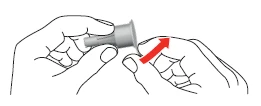
- Attach the needle to the injection device using the large outer cap. Screw the cap clockwise until firmly seated.
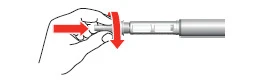
- Remove the large outer cap from the needle and keep it for future use.
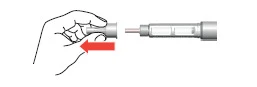
Setting the dose
- Turn the dose selector dial fully clockwise. Ensure that the number “80” is fully visible in the centre of the dose window, aligned with the white marker in the cut-out of the window.
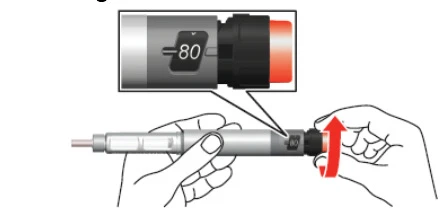
- Remove the small inner needle cap and discard it.
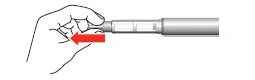
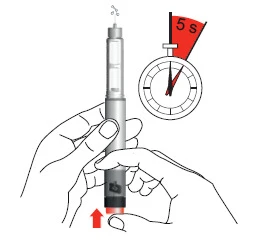
- Hold the device with the needle pointing upwards. Press the injection button fully and hold for 5 seconds. Absorb any expelled liquid with a tissue.
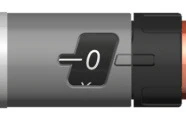
- Confirm the dose. Ensure that the number “0” is fully visible in the centre of the dose window, the white marker is aligned with the cut-out, and the embossed markings on the dose dial and device body are aligned.
Removing the needle
After preparing the device, remove the needle, as it may be contaminated.
- Carefully insert the needle into the large outer cap. Do not touch the needle to avoid accidental needlestick.
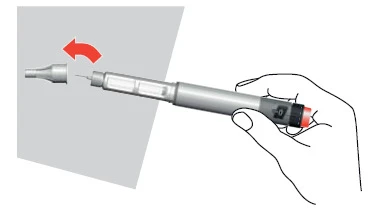
- Unscrew the needle by turning the cap counterclockwise and remove the needle from the device.
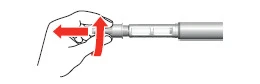
- Dispose of the needle together with the cap in a safe sharps container.
Keeping the injection diary
- Record the date of the first injection and the date of the 28th injection in the injection diary located on the reverse side of this instruction leaflet.
The injection device is now ready for the first and all subsequent injections, as described below.
Administering Osteoteri
Preparing for injection
- Wash your hands before each injection.
- Prepare the injection site (on the thigh or abdomen) according to your doctor’s, pharmacist’s, or caregiver’s instructions.
Use a new needle for each injection, as an unused needle is sharp and allows for an almost painless injection. A used needle may be blocked or contaminated.
Attaching the needle
- Remove the cap from the injection device.
- Take a new needle and remove the protective foil from the needle hub.
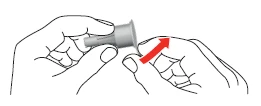
- Attach the needle to the injection device using the large outer cap. Screw the cap clockwise until firmly seated.
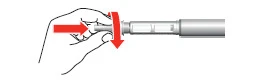
- Remove the large outer cap from the needle and keep it for future use.
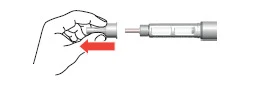
Setting the dose
- Turn the dose selector dial fully clockwise. Ensure that the number “80” is fully visible in the centre of the dose window, aligned with the white marker in the cut-out of the window.
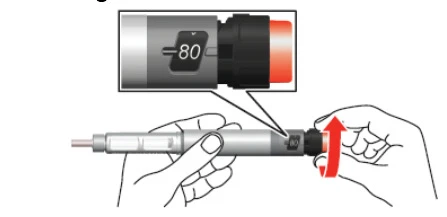
- Remove the small inner needle cap and discard it.
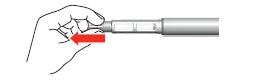
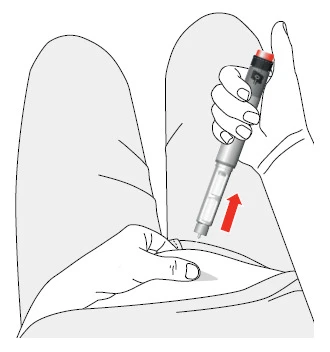
- Gently pinch the skin fold on the thigh or abdomen.
- Insert the needle at a 90° angle into the prepared injection site. Press the injection button fully and hold for 5 seconds. Count slowly to five.
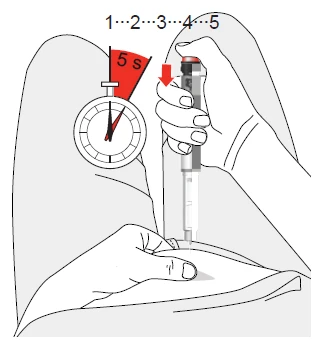
- Remove the needle from the skin.
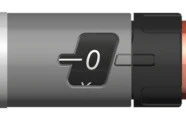
- Confirm the dose. Ensure that the number “0” is fully visible in the centre of the dose window, the white marker is aligned with the cut-out, and the embossed markings on the dose dial and device body are aligned.
Removing the needle
After using the device, always remove the needle immediately.
- Carefully insert the needle into the large outer cap. Do not touch the needle to avoid accidental needlestick.
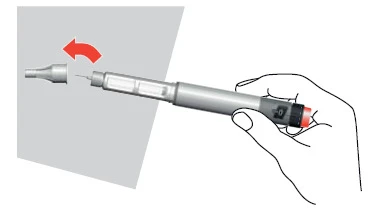
- Unscrew the needle by turning the cap counterclockwise and remove the needle from the device.
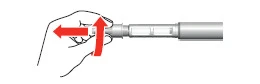
- Dispose of the needle together with the cap in a safe sharps container.
- Replace the cap on the injection device.
Storing the injection device
Do not store the injection device with a needle attached, as this may cause air bubbles to form in the medicine cartridge. Always replace the cap on the device.
Remove the injection device from the refrigerator only when ready to use. Store the device in the refrigerator, preferably on the door. Do not store the device near the back wall of the refrigerator or in the freezer compartment. If the medicine freezes, it becomes unusable.
If the device has been kept outside the refrigerator for an extended period, do not discard it. Place it back in the refrigerator and contact your doctor, pharmacist, or caregiver.
Disposal of the injection device
Dispose of the injection device on the day of the last injection (see injection diary).
Discard the device even if medicine remains in the cartridge.
Dispose of the device according to your doctor’s or pharmacist’s instructions.
Before disposal, replace the cap on the device. Do not dispose of the device with a needle attached.
What to do if…
There are air bubbles in the medicine cartridge: You may use the device without concern.
No liquid is expelled from the device during preparation for first use: Repeat the steps described in the section “Setting the dose” on page 5 of this instruction leaflet.
The button is blocked or the patient feels that the full dose was not administered: Do not administer a second injection on the same day. Administer the next injection the following day. Ensure that the dose selector dial is turned fully clockwise and that the number “80” is fully visible in the centre of the dose window, aligned with the white marker in the cut-out.
Injection diary
| Date of first injection: Day 1 Day 2 Day 3 Day 4 Day 5 Day 6 Day 7 Day 8 Day 9 Day 10 Day 11 Manufacturer Day 12 G.L. Pharma GmbH Day 13 Schlossplatz 1 Day 14 8502 Lannach Day 15 Austria Day 16 Day 17 GP-PHARM, S.A. Day 18 Polígono Industrial Els Vinyets-Els Day 19 Fogars, Sector 2, Carretera Comarcal Day 20 C-244, Km 22 08777 Sant Quintí de Mediona Spain Day 21 Day 22 Day 23 Day 24 Day 25 Day 26 Day 27 Date of last injection: Day 28 | |
Date of the latest revision of this instruction leaflet