Oseltamivir stada
Poland
Table of Contents
Package leaflet: Information for the user
Oseltamivir Stada, 45 mg, hard capsules
Oseltamivirum
Please read all of this leaflet carefully before taking this medicine because it contains important information for you.
- Keep this leaflet. You may need to read it again.
- If you have any further questions, ask your doctor or pharmacist.
- This medicine has been prescribed for you personally. Do not pass it on to others. It may harm them, even if their symptoms are the same as yours.
- If you experience any side effects, including any not listed in this leaflet, tell your doctor or pharmacist. See section 4.
Contents of the leaflet
- What Oseltamivir Stada is and what it is used for
- What you need to know before taking Oseltamivir Stada
- How to take Oseltamivir Stada
- Possible side effects
- How to store Oseltamivir Stada
- Contents of the pack and other information
1. What Oseltamivir Stada is and what it is used for
- Oseltamivir Stada is used in adults, adolescents, children, and infants (including full-term newborns) for the treatment of influenza (flu). It may be used when flu symptoms are present and when it is known that influenza virus is circulating in the community.
- Oseltamivir Stada may also be prescribed to adults, adolescents, children, and infants over 1 year of age for prevention of influenza. Each case is considered individually—for example, if the patient has been in close contact with someone who has the flu.
- Oseltamivir Stada may be prescribed to adults, adolescents, children, and infants (including full-term newborns) as prophylactic treatment in exceptional circumstances, such as during a global influenza outbreak (influenza pandemic), when the seasonal influenza vaccine does not provide adequate protection.
Oseltamivir Stada contains oseltamivir, which belongs to a group of medicines called neuraminidase inhibitors. These medicines prevent the spread of the influenza virus in the body. They help to relieve symptoms or prevent their occurrence in case of influenza virus infection.
Influenza is an infectious disease caused by a virus. Flu symptoms often include sudden onset of fever (above 37.8 °C), cough, runny or stuffy nose, headache, muscle aches, and extreme fatigue. These symptoms may also be caused by other infections. True influenza infection occurs only during seasonal outbreaks (epidemics), when the influenza virus is spreading in the local community. Outside epidemic periods, flu-like symptoms are usually due to other illnesses.
2. Important information before taking Oseltamivir Stada
When NOT to take Oseltamivir Stada
- if the patient is allergic (hypersensitive) to oseltamivir or to any of the other ingredients of Oseltamivir Stada listed in section 6.
In such a case, you should contact your doctor. Do not take
Oseltamivir Stada.
Warnings and precautions
Before taking Oseltamivir Stada, inform the doctor who prescribed the medicine:
- if the patient is allergic to other medicines
- if the patient has kidney disease. If so, a dose adjustment may be necessary
- if the patient has a severe illness that may require immediate hospital treatment
- if the immune system is not functioning properly
- if the patient has chronic heart disease or respiratory disease.
During treatment with Oseltamivir Stada, you should inform your doctor immediately:
- if the patient notices changes in behaviour or mood ( neuropsychiatric events ), especially in children and adolescents. These symptoms may be rare but serious adverse reactions.
Oseltamivir Stada is not an influenza vaccine
Oseltamivir Stada is not a vaccine: it is used to treat infection or prevent the spread of influenza virus.
A vaccine provides antibodies against the virus. Oseltamivir Stada does not alter the effectiveness of influenza vaccination, and your doctor may prescribe both products.
Other medicines and Oseltamivir Stada
You should tell your doctor or pharmacist about all medicines you are currently taking or have recently taken, including medicines obtained without a prescription. The following medicines are particularly important:
- chlorpropamide (used in the treatment of diabetes)
- methotrexate (used in the treatment, for example, of rheumatoid arthritis)
- phenylbutazone (used in the treatment of pain and inflammatory conditions)
- probenecid (used in the treatment of gout)
Pregnancy and breastfeeding
You should inform your doctor if you are pregnant, think you may be pregnant, or plan to become pregnant, so that the doctor can decide whether Oseltamivir Stada is an appropriate medicine.
The effect of Oseltamivir Stada on breastfed infants is unknown. You should inform your doctor if you are breastfeeding, so that he or she can decide whether Oseltamivir Stada is an appropriate medicine.
Before taking this medicine, consult your doctor or pharmacist.
Driving and operating machinery
Oseltamivir Stada has no effect on the ability to drive and operate machinery.
Information about certain ingredients of Oseltamivir Stada
This medicine contains less than 1 mmol (23 mg) of sodium per capsule, i.e. this medicine is considered "sodium-free".
3. How to take Oseltamivir Stada
This medicine should always be taken exactly as prescribed by your doctor. If you are unsure, consult your doctor or pharmacist.
Oseltamivir Stada should be taken as soon as possible, preferably within the first two days after the onset of flu symptoms.
Recommended dosage
For treatment of influenza, take two doses per day, usually best once in the morning and once in the evening. It is important to complete the full 5-day treatment course, even if the patient's condition improves rapidly.
In patients with weakened immune systems, treatment will continue for 10 days.
For prevention of influenza or after contact with an infected person, take one dose per day for 10 days, preferably in the morning with breakfast.
In special situations, such as widespread influenza outbreaks or if the patient has a weakened immune system, treatment may last up to 6 weeks or 12 weeks.
The recommended dose is calculated based on the patient's body weight. Take the number of capsules or oral suspension prescribed by your doctor.
Adults and adolescents aged 13 years and older
| Body weight | Influenza treatment: dose for 5 days | Influenza treatment (patients with reduced immunity): dose for 10 days* | Prevention of influenza: dose for 10 days |
| Over 40 kg | 75 mg** twice daily | 75 mg** twice daily | 75 mg** once daily |
* In patients with weakened immune systems, treatment lasts 10 days.
**The 75 mg dose may consist of one 30 mg capsule and one 45 mg capsule.
Children aged 1 to 12 years
| Body weight | Influenza treatment: dose for 5 days | Influenza treatment (patients with reduced immunity): dose for 10 days* | Prevention of influenza: dose for 10 days |
| 10 to 15 kg | 30 mg twice daily | 30 mg twice daily | 30 mg once daily |
| Over 15 kg to 23 kg | 45 mg twice daily | 45 mg twice daily | 45 mg once daily |
| Over 23 kg to 40 kg | 60 mg twice daily | 60 mg twice daily | 60 mg once daily |
| More than 40 kg | 75 mg** twice daily | 75 mg** twice daily | 75 mg** once daily |
*In children with weakened immune systems, treatment lasts 10 days.
**The 75 mg dose may consist of one 30 mg capsule and one 45 mg capsule.
Infants under 1 year of age (0–12 months)
The decision to administer Oseltamivir Stada to infants under 1 year of age for prophylaxis during an influenza pandemic should be made by a physician after evaluating the potential benefits against the potential risks for the infant.
| Body weight | Influenza treatment: dose for 5 days | Influenza treatment (patients with reduced immunity): dose for 10 days* | Influenza prophylaxis: dose for 10 days |
| 3 kg to 10+ kg | 3 mg per kg body weight**, twice daily | 3 mg per kg body weight**, twice daily | 3 mg per kg** once daily |
In infants with weakened immune systems, treatment lasts 10 days.
**mg per kg = mg per each kilogram of the infant's body weight. For example:
in a six-month-old infant weighing 8 kg, the dose is 8 kg x 3 mg per kg = 24 mg
Administration method
Swallow the capsules whole with water. Do not divide or chew the capsules.
Oseltamivir Stada may be taken with food or on an empty stomach. Taking the medicine with food
reduces the risk of nausea or vomiting.
Patients who have difficulty swallowing capsules may use oseltamivir in the form of an oral
liquid suspension. If a patient requires the suspension, but the suspension is not available at the
pharmacy, the liquid form of Oseltamivir Stada may be prepared from capsules. Instructions, see Preparation
of the liquid form of Oseltamivir Stada at home.
Accidental overdose of Oseltamivir Stada
Stop taking Oseltamivir Stada and contact your doctor or pharmacist immediately.
In most cases of overdose, no adverse reactions were reported. When adverse reactions were
reported, they were similar to those occurring after recommended doses, as described in section 4.
Overdose was reported more frequently in children than in adults and adolescents. Exercise caution
when preparing the liquid form of Oseltamivir Stada for children and when administering Oseltamivir
Stada in capsule or liquid form to children.
Missed dose of Oseltamivir Stada
Do not take a double dose to make up for a missed capsule.
Discontinuation of Oseltamivir Stada
There are no adverse effects if treatment with Oseltamivir Stada is discontinued.
However, if treatment with Oseltamivir Stada is stopped earlier than recommended by the doctor,
influenza symptoms may return. Always complete the treatment as directed by your doctor.
If you have any further doubts regarding the use of this medicine, consult your doctor or pharmacist.
4. Possible side effects
Like all medicines, this medicine can cause side effects, although not everybody gets them.
Many of the side effects listed below may also be caused by influenza itself.
The following serious side effects have been reported rarely after oseltamivir has been marketed:
-
anaphylactic and anaphylactoid reactions: severe allergic reactions with facial and skin swelling, itchy rash, low blood pressure, and breathing difficulties
-
liver disorders (fulminant hepatitis, hepatic dysfunction, and jaundice): yellowing of the skin and whites of the eyes, change in stool colour, changes in behaviour
-
angioedema: sudden, pronounced swelling of the skin, mainly affecting the head and neck area, including eyes and tongue, accompanied by breathing difficulties
-
Stevens-Johnson syndrome and toxic epidermal necrolysis: complex, potentially life-threatening allergic reactions, severe inflammation of external and even internal skin layers, starting with fever, sore throat and fatigue, skin rashes progressing to blisters, peeling, shedding of large areas of skin, possibly accompanied by breathing difficulties and low blood pressure
-
gastrointestinal bleeding: prolonged bleeding from the large intestine or haemoptysis
-
neuropsychiatric disorders, as described below.
If you notice any of these symptoms, seek immediate medical help.
The most commonly (very common and common) reported side effects of oseltamivir are: nausea,
vomiting, stomach pain, diarrhoea, headache, and pain. These symptoms usually occur only after
the first dose and typically resolve during continued treatment. The frequency of these side
effects decreases if the medicine is taken with food.
Rare but serious side effects: consult a doctor immediately
(may occur in up to 1 in 1,000 people)
Rare cases have been reported during oseltamivir use:
- seizures and delirium, including disturbances of consciousness
- confusion, unusual behaviour
- hallucinations, illusions, agitation, anxiety, nightmares
These events, which often had sudden onset and resolution, were observed primarily in children and adolescents. In sporadic cases, they led to self-harm, sometimes resulting in death. Similar neuropsychiatric events have also been observed in patients with influenza who did not take oseltamivir.
- Patients, especially children and adolescents, should be closely observed for any changes in behaviour as described above.
If any of these symptoms occur, especially in young individuals, seek immediate medical advice.
Adults and adolescents aged 13 years and above
Very common side effects (may occur in more than 1 in 10 people)
- headache
- nausea
Common side effects (may occur in up to 1 in 10 people)
- bronchitis
- herpes labialis (cold sores)
- cough
- dizziness
- fever
- pain
- limb pain
- watery nasal discharge
- sleep disturbances
- sore throat
- stomach pain
- fatigue
- feeling of fullness in the upper abdomen
- upper respiratory tract infections (nasal, throat, and sinus infections)
- indigestion
- vomiting
Uncommon side effects (may occur in up to 1 in 100 people)
- allergic reactions
- disturbances of consciousness
- seizures
- cardiac arrhythmias
- mild to severe liver function disorders
- skin reactions (dermatitis, red and itchy rash, skin peeling).
Rare side effects (may occur in up to 1 in 1,000 people)
- thrombocytopenia (low platelet count)
- visual disturbances.
Children aged 1 to 12 years
Very common side effects (may occur in more than 1 in 10 people)
- cough
- nasal congestion
- vomiting
Common side effects (may occur in up to 1 in 10 people)
- conjunctivitis (red eyes with discharge or eye pain)
- ear infections and other ear disorders
- headache
- nausea
- watery nasal discharge
- stomach pain
- feeling of fullness in the upper abdomen
- indigestion
Uncommon side effects (may occur in up to 1 in 100 people)
- dermatitis
- disorders of the tympanic membrane.
Infants under 1 year of age
Adverse reactions observed in infants aged 0 to 12 months are most commonly similar to those
reported in older children (aged 1 year or above). In addition, diarrhoea and diaper rash have been reported.
If any of the adverse effects worsen or if any adverse effects not listed in this leaflet occur, inform your doctor or pharmacist.
- if the patient or their child vomits repeatedly, or
- if flu symptoms worsen or fever persists, inform the doctor as soon as possible.
Reporting of side effects
If any adverse effects occur, including those not listed in this leaflet, tell your doctor. Adverse effects can be reported directly to the Department of Monitoring Adverse Drug Reactions of the Office for Registration of Medicinal Products, Medical Devices and Biocidal Products,
Al. Jerozolimskie 181C,
02-222 Warsaw,
tel.: + 48 22 49 21 301,
fax: + 48 22 49 21 309,
website: https://smz.ezdrowie.gov.pl
Adverse effects can also be reported to the marketing authorisation holder or its representative. Reporting adverse effects helps to provide more information on the safety of this medicine.
5. How to store Oseltamivir Stada
Keep the medicine out of the sight and reach of children.
Do not use this medicine after the expiry date stated on the cardboard box and blister pack after EXP. The expiry date refers to the last day of the stated month.
Store below 30°C.
Do not dispose of medicines via the sewage system or household waste. Ask your pharmacist how to dispose of medicines no longer required. Such measures help protect the environment.
6. Package Contents and Other Information
What Oseltamivir Stada Contains
- Each hard capsule contains oseltamivir equivalent to 45 mg of oseltamivir.
- Other ingredients are:
Capsule core: pregelatinized starch, talc, povidone K-30, sodium croscarmellose, and sodium stearyl fumarate
Capsule cap: gelatin, black iron oxide (E 172), and titanium dioxide (E 171)
Capsule body: gelatin, black iron oxide (E 172), and titanium dioxide (E 171)
Printing ink: shellac (E 904), black iron oxide (E 172)
What Oseltamivir Stada Looks Like and Contents of the Pack
Oseltamivir Stada 45 mg hard capsules are size "4", consisting of a grey, opaque body with a black band and printed with "M", and a grey, opaque cap printed with "45 mg".
Oseltamivir Stada 45 mg hard capsules are available in blister packs containing 10 capsules, packed in a cardboard box.
Marketing Authorisation Holder
STADA Arzneimittel AG
Stadastrasse 2-18
61118 Bad Vilbel
Germany
Manufacturer
STADA Arzneimittel AG
Stadastrasse 2-18
61118 Bad Vilbel
Germany
Pharmadox Healthcare Ltd.
KW20A Kordin Industrial Park
Paola PLA 3000
Malta
For further information about this medicinal product, please contact the local representative of the Marketing Authorisation Holder:
Stada Pharm Sp. z o.o.
ul. Krakowiaków 44
02-255 Warsaw
Poland
Tel. +48 22 737 79 20
This medicinal product is authorised in the Member States of the European Economic Area under the following names:
Poland: Oseltamivir Stada
Germany: Oseltamivir STADA 30 mg Hartkapseln
Oseltamivir STADA 45 mg Hartkapseln
Oseltamivir STADA 75 mg Hartkapseln
Patient Information Leaflet
For patients who have difficulty swallowing capsules, including very young children, an oral liquid formulation of the medicine, oseltamivir oral suspension, is available.
If a liquid formulation is required and is not commercially available, the suspension can be prepared in a pharmacy from Oseltamivir Stada capsules (see Information intended exclusively for healthcare professionals). A pharmacy-prepared product is preferred.
If a pharmacy-prepared product is also unavailable, a liquid formulation of Oseltamivir Stada can be prepared at home from the capsules.
The doses are the same for both treatment and prevention of influenza. The difference lies in the frequency of administration.
Preparing a Liquid Form of Oseltamivir Stada at Home
- If the patient has the appropriate capsules for the required dose (45 mg dose), open the capsule and mix its contents with a teaspoon (or less) of a suitable sweetened food product. This dose is generally suitable for children over 1 year of age. See the top section of the instructions.
- If the patient requires a lower dose, preparing a liquid form of Oseltamivir Stada from capsules involves additional steps. These are appropriate for younger children and infants who usually require a dose of Oseltamivir Stada lower than 45 mg. See the bottom section of the instructions.
Children Aged 1 to 12 Years
To prepare a 45 mg dose, the following will be needed:
- One Oseltamivir Stada 45 mg capsule
- Sharp scissors
- One small bowl
- One teaspoon (5 mL)
- Water
- A sweet food to mask the bitter taste of the powder, e.g., chocolate syrup, cherry syrup, or dessert topping (caramel). Alternatively, sugar water can be prepared: mix one teaspoon of water with three quarters (3/4) of a teaspoon of sugar.
Step 1: Check That the Dose Is Correct
To determine the correct dose, locate the patient's body weight in the left column of the table. Then check the right column for the number of capsules required for a single dose. The amount is the same for both treatment and prevention of influenza.
| Dose 45 mg | 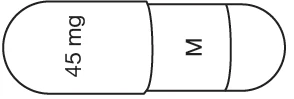 |
To prepare a 45 mg dose, only 45 mg capsules should be used. The 30 mg, 60 mg, or 75 mg doses should not be prepared using the contents of a 45 mg capsule. In such cases, a capsule with the appropriate strength should be used.
| Body weight | Oseltamivir Stada dose | Number of 45 mg capsules |
| Up to 15 kg | 30 mg | Do not use 45 mg capsules |
| Over 15 kg to 23 kg | 45 mg | 1 capsule |
| Over 23 kg to 40 kg | 60 mg | Do not use 45 mg capsules |
Step 2: Empty the entire powder into a bowl
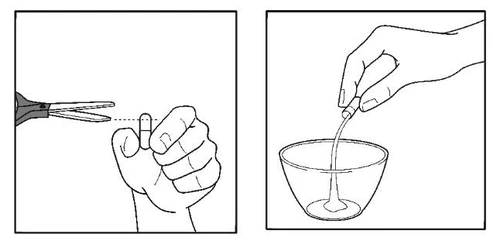
Hold the 45 mg capsule vertically above a bowl and carefully cut off the rounded end with scissors.
Empty the entire powder into the bowl.
Handle the powder carefully, as it may be irritating to the skin and eyes.
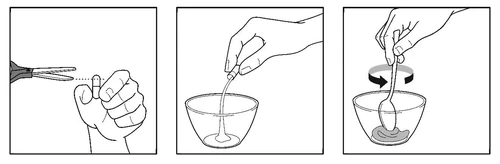
Step 3: Sweeten the powder and administer the dose
Add a small amount – no more than one teaspoon – of sweet food to the
powder in the bowl.
This is to neutralize the bitter taste of Oseltamivir Stada medication.
Mix well.
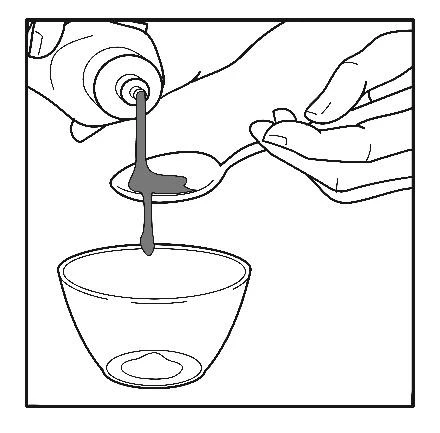
Immediately administer the entire contents of the bowl to the patient.
If any residue of the mixture remains in the bowl, rinse the bowl with a small amount of water
and give all of it to the patient to drink.
Repeat the above steps each time the medication is administered.
Infants under 1 year of age
To prepare a smaller dose, the following are required:
- One 45 mg capsule of Oseltamivir Stada
- Sharp scissors
- Two small bowls (use a separate pair of bowls for each child)
- One large oral syringe to measure water – a 5 mL or 10 mL syringe
- One small oral syringe marked in 0.1 mL increments, for administering the dose
- A teaspoon (5 mL volume)
- Water
- Sweet food to neutralize the bitter taste of Oseltamivir Stada, e.g., chocolate syrup, cherry syrup, or dessert topping (caramel). Alternatively, sugar water can be prepared: mix one teaspoon of water with three quarters (3/4) of a teaspoon of sugar.
Step 1: Empty the entire powder into a bowl
Hold the 45 mg capsule vertically above one of the bowls and carefully cut off the rounded end
with scissors. Handle the powder carefully, as it may be irritating to the skin
and eyes.
Empty the entire powder into the bowl, regardless of the dose being prepared.
The amount is the same for both treatment and prevention of influenza.
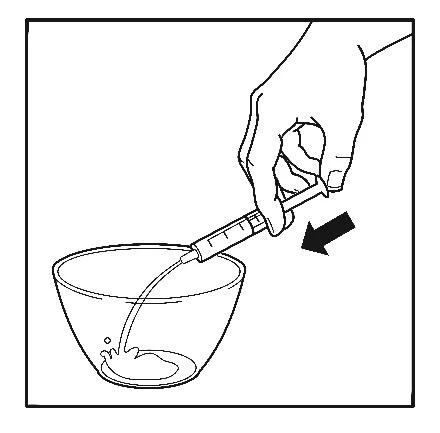
Step 2: Add water to dissolve the medication
Use the larger syringe to draw up 7.5 mL of water.
Add the water to the powder in the bowl.
Mix the contents of the bowl for about 2 minutes using a teaspoon.
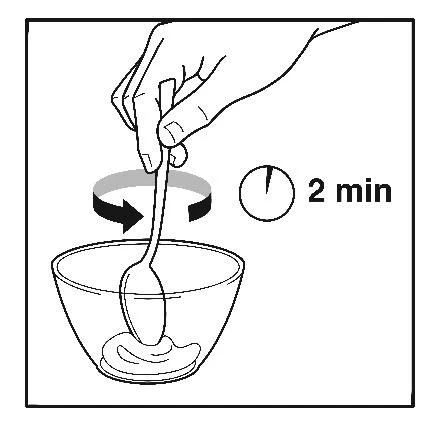
Do not be concerned if some of the powder does not dissolve. The undissolved
powder is inactive ingredient.
Step 3: Select the volume appropriate for the child's body weight
Find the child's body weight in the left column of the table.
The right column of the table indicates the volume of the liquid mixture to be withdrawn.
Infants under 1 year of age (including full-term newborns)
| Body weight (nearest) | Amount of mixture to be administered |
| 3 kg | 1.5 mL |
| 3.5 kg | 1.8 mL |
| 4 kg | 2.0 mL |
| 4.5 kg | 2.3 mL |
| 5 kg | 2.5 mL |
| 5.5 kg | 2.8 mL |
| 6 kg | 3.0 mL |
| 6.5 kg | 3.3 mL |
| 7 kg | 3.5 mL |
| 7.5 kg | 3.8 mL |
| 8 kg | 4.0 mL |
| 8.5 kg | 4.3 mL |
| 9 kg | 4.5 mL |
| 9.5 kg | 4.8 mL |
| 10 kg or more | 5.0 mL |
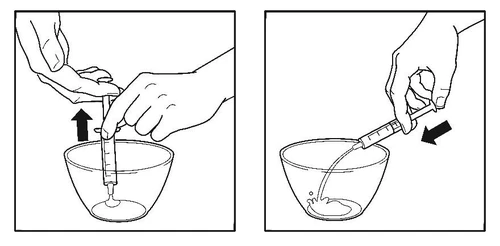
Step 4: Draw up the liquid mixture
Make sure to use the dosing device of the correct volume.
Draw up the appropriate amount of liquid mixture from the first bowl.
Do this carefully to avoid air bubbles.
Gently squeeze the correct dose into the second bowl.
Step 5: Sweeten and administer to the child
Add a small amount – no more than one teaspoon – of sweet food to the second bowl.
This helps neutralize the bitter taste of Oseltamivir Stada.
Mix the sweet food well with the liquid form of Oseltamivir Stada.
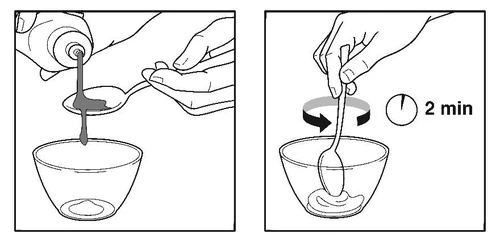
Immediately administer the entire contents of the second bowl (the liquid mixture of Oseltamivir Stada with sweet food) to the child.
If any amount remains in the second bowl, rinse the bowl with a small amount of water and give all of it to the child to drink. For children unable to drink from a bowl, use a spoon or baby feeding bottle to administer the remaining liquid.
Give the child something to drink.
Discard any unused liquid remaining in the first bowl.
Repeat the above steps each time the medicine is administered.
Information intended exclusively for healthcare professionals
Patients unable to swallow capsules:
Manufactured oseltamivir oral suspension (6 mg/mL) is the preferred product for children, adolescents, and adult patients who have difficulty swallowing capsules or when lower doses are required. If oseltamivir powder for oral suspension is not commercially available, the pharmacist may prepare an oral suspension (6 mg/mL) from Oseltamivir Stada capsules. If pharmacy-prepared suspension is also unavailable, patients may prepare the suspension at home using the capsules. Oral dosing devices (oral syringes) of appropriate volume and graduations must be provided for administering both pharmacy-prepared and home-prepared suspensions. In both cases, dosing devices should be clearly marked with the correct volumes. When preparing the suspension at home, separate dosing devices should be used to measure the correct amount of water and to measure the Oseltamivir Stada oral suspension mixed with water. A 5 mL or 10 mL dosing device should be used to measure 5.0 mL of water. The appropriate dosing device capacity to be used for measuring the correct amount of Oseltamivir Stada suspension (6 mg/mL) is indicated below.
Infants under 1 year of age (including full-term newborns)
| Oseltamivir Stada dose | Volume of Oseltamivir Stada suspension | Volume of the oral dispenser to be used (with 0.1 mL graduations) |
| 9 mg | 1.5 mL | 2.0 mL (or 3.0 mL) |
| 10 mg | 1.7 mL | 2.0 mL (or 3.0 mL) |
| 11.25 mg | 1.9 mL | 2.0 mL (or 3.0 mL) |
| 12.5 mg | 2.1 mL | 3.0 mL |
| 13.75 mg | 2.3 mL | 3.0 mL |
| 15 mg | 2.5 mL | 3.0 mL |
| 16.25 mg | 2.7 mL | 3.0 mL |
| 18 mg | 3.0 mL | 3.0 mL (or 5.0 mL) |
| 19.5 mg | 3.3 mL | 5.0 mL |
| 21 mg | 3.5 mL | 5.0 mL |
| 22.5 mg | 3.8 mL | 5.0 mL |
| 24 mg | 4.0 mL | 5.0 mL |
| 25.5 mg | 4.3 mL | 5.0 mL |
| 27 mg | 4.5 mL | 5.0 mL |
| 28.5 mg | 4.8 mL | 5.0 mL |
| 30 mg | 5.0 mL | 5.0 mL |