Orinox
Poland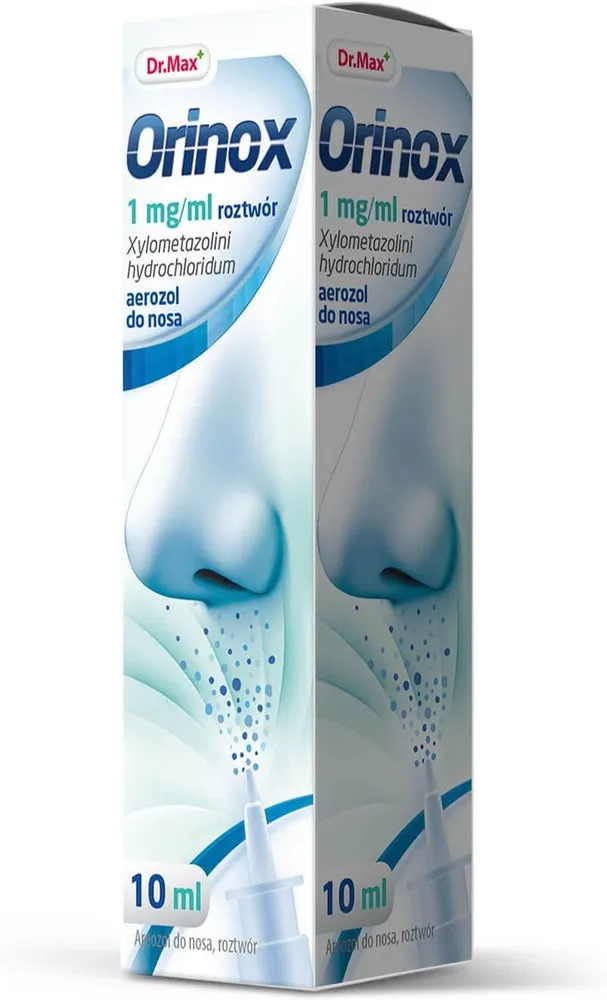
Table of Contents
Package leaflet: Information for the patient
Orinox, 1 mg/ml, nasal spray, solution
Xylometazolini hydrochloridum
Please read all of this leaflet carefully before using this medicine, because it contains
important information for you.
This medicine should always be taken exactly as described in this patient leaflet or as directed by
your doctor or pharmacist.
- Keep this leaflet, so that you can read it again if necessary.
- If you need advice or further information, please consult your pharmacist.
- If you experience any adverse reactions, including any possible side effects not listed in this leaflet, inform your doctor or pharmacist. See section 4.
- If there is no improvement after 7 days, or if you feel worse, consult your doctor.
Table of contents
- What Orinox is and what it is used for
- Important information before using Orinox
- How to use Orinox
- Possible side effects
- How to store Orinox
- Contents of the pack and other information
1. What Orinox is and what it is used for
Orinox contains xylometazoline hydrochloride as the active substance, which belongs to a group of medicines called sympathomimetics. Xylometazoline reduces nasal mucosal congestion, thereby decreasing nasal discharge and returning swollen blood vessels to their normal state. Xylometazoline helps maintain nasal patency and facilitates breathing in patients with nasal congestion.
Orinox is used to relieve nasal congestion caused by acute rhinitis, hay fever or other allergic rhinitis, or sinusitis.
Your doctor may also prescribe it for use prior to a professional nasal examination.
The effect of the medicine begins within 2 minutes and lasts up to 12 hours.
This medicine is suitable for adults and adolescents over 12 years of age.
It is well tolerated, even in patients with sensitive nasal mucosa.
If there is no improvement after 7 days, or if you feel worse, consult your doctor.
2. Important information before using Orinox
When not to use Orinox:
- if the patient is allergic to xylometazoline hydrochloride or any of the other ingredients of this medicine (listed in section 6);
- if the patient has recently undergone surgery performed through the nose, consult a doctor or pharmacist before starting treatment with xylometazoline hydrochloride;
- if the patient has dry rhinitis with formation of crusts (atrophic rhinitis);
- if the patient has narrow-angle glaucoma.
Patients should inform their doctor or pharmacist if any of the above conditions apply, as this means the medicine is not suitable for them.
Warnings and precautions
Before using Orinox, consult a doctor or pharmacist if any of the following apply:
- high blood pressure,
- heart disorders (e.g. long QT syndrome),
- circulatory system disorders,
- hyperthyroidism,
- diabetes,
- benign prostatic hyperplasia,
- adrenal gland tumor (pheochromocytoma),
- if the patient is currently being treated or has been treated in the last two weeks with medicines for depression known as monoamine oxidase inhibitors (MAOIs).
Like other similar medicines, Orinox may cause sleep disturbances, dizziness, tremor, irregular heartbeat, or increased blood pressure in sensitive individuals. Contact a doctor if any of these symptoms occur.
As with other medicines that reduce nasal mucosal congestion, Orinox should not be used continuously for longer than 7 days. Prolonged or excessive use may lead to thickening of the nasal mucosa, resulting in the symptoms for which the medicine is used either failing to resolve or returning.
If there is no improvement within 7 days, contact a doctor.
Do not exceed the recommended dose.
Avoid contact with eyes and mouth.
Children
Orinox 1 mg/ml must not be used in children under 12 years of age.
For children aged 1 to 11 years, another strength of the medicine (0.5 mg/ml) is available.
Orinox and other medicines
Inform your doctor or pharmacist about all medicines currently taken or recently used, as well as any medicines the patient plans to take.
Do not use xylometazoline in patients who are taking (or have taken within the last 2 weeks) any medicines for depression. These include:
- monoamine oxidase inhibitors (MAOIs): this medicine must not be used in patients taking MAOIs or who have taken them within the last 2 weeks;
- tricyclic or tetracyclic antidepressant medicines.
Interactions may occur when xylometazoline is used concomitantly with antihypertensive medicines. There is a risk of impaired effect of beta-adrenergic receptor blocking agents (used in the treatment of high blood pressure, certain heart diseases, and elevated intraocular pressure).
If the patient is taking such medicines, this should be taken into account and medical advice sought from a doctor or pharmacist.
Pregnancy and breastfeeding
If the patient is pregnant or breastfeeding, suspects she may be pregnant, or is planning to become pregnant, she should consult a doctor or pharmacist before using this medicine.
Pregnancy
Orinox should not be used during pregnancy.
Breastfeeding
There are no data on the passage of xylometazoline into human breast milk. Consult a doctor regarding the appropriateness of using this medicine before administration.
Driving and operating machinery
Orinox has no effect or has a negligible effect on the ability to drive vehicles or operate machinery.
Orinox contains benzalkonium chloride
This medicine contains 0.1 mg of benzalkonium chloride per milliliter of solution. Benzalkonium chloride may cause nasal irritation or swelling, especially if used for prolonged periods.
3. How to use Orinox
This medicine should always be used exactly as described in the patient leaflet or as directed by a doctor or pharmacist. If in doubt, consult a doctor or pharmacist.
Orinox should not be used in children under 12 years of age.
Recommended dose:
Adults and adolescents over 12 years of age:
1 spray into each nostril, once or more times daily as needed, but not more than 3 times daily.
An interval of 8–10 hours should be maintained between successive doses.
Method of administration
Remove the protective cap.
Before first use, press the pump 5 times to prime the device. If the pump has not been used for more than 14 days (after first use), press it once to re-prime the spray for subsequent use. The spray is ready for use with regular application.
Ensure that the medicine is not sprayed into the eyes or mouth.
Blow the nose.
Hold the bottle upright and tilt the head slightly forward. Insert the nozzle into the nostril and press the pump. Keep the pump pressed until it is removed from the nostril. Administer one dose into each nostril. Breathe in slowly through the nose during administration.
After use, clean and dry the nozzle and replace the protective cap.
To avoid spreading infection, the bottle should be used by only one person.
Duration of treatment
Xylometazoline hydrochloride should not be used for longer than 7 days. If symptoms persist or recur after 7 days of treatment, consult a doctor. The doctor may provide advice regarding further management of the condition.
Use of a higher than recommended dose of Orinox
If too much of this medicine is used, contact a doctor or pharmacist immediately.
Overdose may occur both after nasal and oral administration.
Overdose, especially in young children, may cause symptoms such as anxiety, agitation, hallucinations, or seizures alternating with decreased body temperature, extreme drowsiness up to loss of consciousness (lethargy) or coma. Other symptoms of overdose may include constricted pupils, or even dilated pupils, sweating, pallor, bluish discoloration (cyanosis) of the skin and mucous membranes, palpitations, and apnoea (temporary cessation of breathing).
Missed dose of Orinox
Do not use a double dose to make up for a missed dose.
Discontinuation of Orinox
If treatment is discontinued, no disturbances should occur.
If you have any further questions about the use of this medicine, consult your doctor or pharmacist.
4. Possible adverse reactions
Like any medicine, this medicine may cause adverse reactions, although not everybody gets them.
You should STOP using the medicine and contact your doctor immediately or go to
the emergency department of the nearest hospital if the patient experiences any of the symptoms
described below, which may be signs of an allergic reaction:
- difficulty breathing or swallowing,
- swelling of the face, lips, tongue or throat,
- severe itching with red rash or blisters (urticaria).
Common ( may occur in less than 1 in 10 people):
- headache,
- nasal dryness or nasal discomfort, burning sensation,
- nausea.
Uncommon (may occur in less than 1 in 100 people):
- nosebleeds.
Very rare (may occur in less than 1 in 10,000 people):
- dizziness,
- tremor,
- insomnia,
- transient visual disturbances,
- irregular and rapid heartbeat,
- increased blood pressure,
- allergic reactions (skin rash, itching, swelling).
Reporting of adverse reactions
If any adverse symptoms occur, including any adverse symptoms not listed
in this leaflet, inform your doctor or pharmacist. Adverse reactions can
be reported directly to the Department of Monitoring Adverse Drug Reactions at the Office for Registration of Medicinal Products, Medical Devices and Biocidal Products, Al. Jerozolimskie 181C, 02-222 Warsaw, tel.: +48 22 49 21 301, fax: +48 22 49 21 309, website: https://smz.ezdrowie.gov.pl
Adverse reactions can also be reported to the marketing authorization holder.
Reporting adverse reactions helps to provide more information on the safety of the medicine.
5. How to store Orinox
Store below 25°C.
Keep the medicine out of sight and reach of children.
Do not use this medicine after the expiry date stated on the label and carton following EXP.
The expiry date refers to the last day of the stated month.
The shelf-life after first opening the bottle is 1 month. To help remember,
write the date of opening in the space provided on the carton.
Medicines should not be disposed of via wastewater or household waste. Ask your pharmacist
how to dispose of medicines no longer required. This will help protect
the environment.
6. Contents of the pack and other information
What Orinox contains
- The active substance is xylometazoline hydrochloride. One ml of Orinox contains 1 mg of xylometazoline hydrochloride. One dose (138 microlitres) contains 140 micrograms of xylometazoline hydrochloride.
- The other ingredients are: benzalkonium chloride, disodium edetate, sodium dihydrogen phosphate dihydrate, disodium phosphate dodecahydrate, sodium chloride, purified water.
What Orinox looks like and contents of the pack
Orinox is a clear, colourless or almost colourless solution.
Orinox is supplied in 10 ml amber glass type III bottles with a metered pump dispenser and a PP or HDPE nozzle, packed in a cardboard box.
Marketing Authorisation Holder and Manufacturer
Marketing Authorisation Holder:
Dr. Max Pharma s.r.o.
Na Florenci 2116/15, Nové Město
110 00 Prague 1
Czech Republic
Tel.: (+420) 516 770 199
Manufacturer:
Basic Pharma Manufacturing B.V.
Burgemeester Lemmensstraat 352
6163 JT Geleen
The Netherlands
This medicinal product is authorised in the European Economic Area under the following names:
Czech Republic Xylomax
Italy Rimet
Poland Orinox
Romania Orinox 1 mg/ml nasal spray, solution
Slovakia Orinox 1 mg/ml