Omegaflex plus
Poland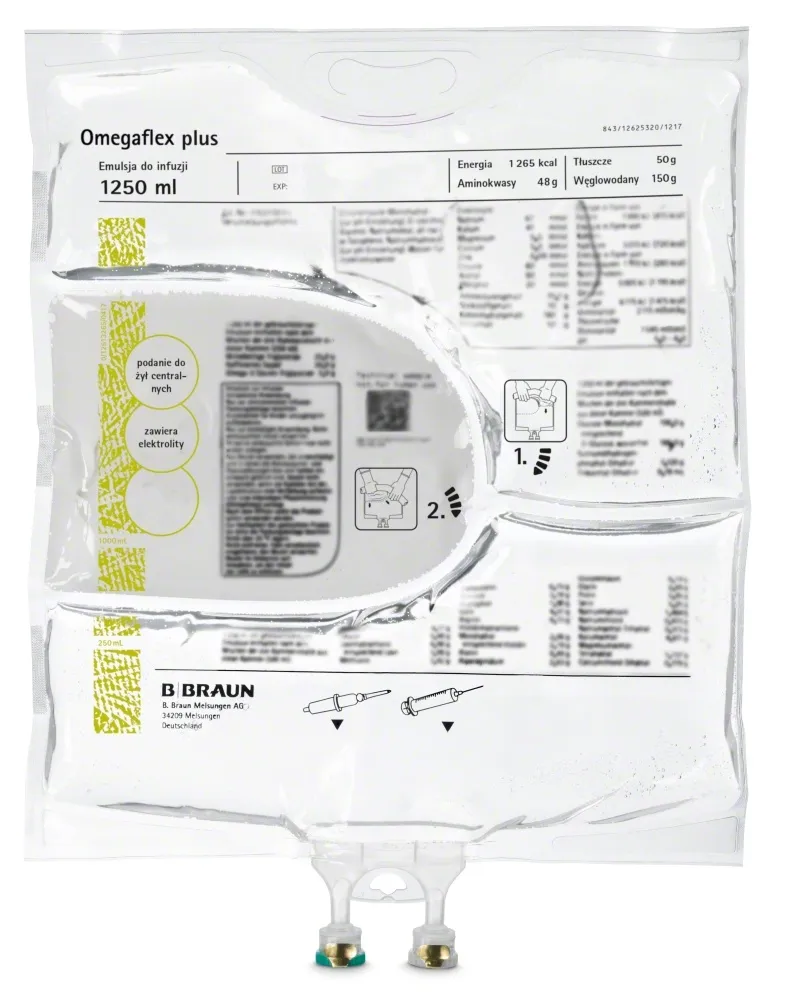
Table of Contents
- Package leaflet: Information for the user
- 1. What Omegaflex plus is and what it is used for
- 2. Important information before using Omegaflex plus
- 3. How to use Omegaflex plus
- 4. Possible adverse reactions
- 5. How to store Omegaflex plus
- 6. Contents of the packaging and other information
- Information intended exclusively for healthcare professionals:
Package leaflet: Information for the user
Omegaflex plus
Infusion emulsion
Please read all of this leaflet carefully before the medicine is administered, because it contains
important information for the patient.
- Keep this leaflet, as you may need to read it again.
- If you have any questions, please ask your doctor, pharmacist, or nurse.
- This medicine has been prescribed for a specific individual. Do not pass it on to others. The medicine may harm someone else, even if their symptoms are the same.
- If you experience any adverse reactions, including any not listed in this leaflet, tell your doctor, pharmacist, or nurse. See section 4.
Contents of the leaflet
- What Omegaflex plus is and what it is used for
- Important information before using Omegaflex plus
- How to use Omegaflex plus
- Possible side effects
- How to store Omegaflex plus
- Contents of the package and other information
1. What Omegaflex plus is and what it is used for
Omegaflex plus contains fluids and substances called amino acids, electrolytes, and fatty acids, which are essential for body growth or recovery. It also provides calories in the form of carbohydrates and fats.
Omegaflex plus is indicated for use in adults, adolescents, and children above the age of two years.
The patient receives Omegaflex plus when they are unable to take food normally. This may occur in various situations, for example, during recovery from surgery, injuries, or burns, or when the patient cannot absorb nutrients from the stomach and intestines.
2. Important information before using Omegaflex plus
When not to use Omegaflex plus
- if the patient is allergic to any active substance, to eggs, peanuts, soy or fish, or to any of the ingredients of this medicine (listed in section 6);
- this medicine must not be given to newborns, infants or young children under two years of age.
Omegaflex plus must not be used also if the patient has any of the following conditions:
- life-threatening circulatory disorders, such as those occurring in shock or collapse;
- heart attack or stroke;
- severe blood coagulation disorders, risk of bleeding (severe coagulopathy, worsening haemorrhagic tendencies);
- blockage of blood vessels by blood clots or fat (embolism);
- severe liver failure;
- disorders of bile flow (intrahepatic cholestasis);
- severe renal failure in the absence of renal replacement therapy;
- disturbances in the body's electrolyte balance;
- fluid deficiency or excess water in the body;
- fluid in the lungs (pulmonary oedema);
- severe heart failure;
- certain metabolic disorders, such as:
- excessively high levels of lipids (fats) in the blood,
- inherited disorders of amino acid metabolism,
- abnormally high blood sugar levels requiring administration of more than 6 units of insulin per hour,
- metabolic disturbances that may occur after surgery or trauma,
- coma of unknown origin,
- inadequate tissue oxygenation,
- abnormally high levels of acidic substances in the blood.
Warnings and precautions
Before starting treatment with Omegaflex plus, discuss this with your doctor.
Inform your doctor if:
- the patient has heart, liver or kidney disorders;
- the patient has certain metabolic disorders, such as diabetes, abnormal blood lipid levels, or disturbances in fluid and electrolyte balance or acid-base balance.
While receiving this medicine, the patient will be closely monitored for early signs of allergic reactions (such as fever, chills, rash or shortness of breath).
To ensure that the patient's body is properly processing the nutrients being administered, further monitoring and tests will be performed, including various blood tests.
Healthcare professionals will also take measures to ensure the patient's needs for fluids and electrolytes are met. In addition to Omegaflex plus, the patient will receive other nutrients to fully meet the body's requirements.
Children
This medicine must not be given to newborns, infants or young children under two years of age.
Omegaflex plus and other medicines
Tell your doctor about all medicines the patient is currently taking or has recently taken, as well as any medicines the patient plans to take.
Omegaflex plus may interact with certain other medicines. Inform your doctor if the patient is taking or receiving any of the following medicines:
- insulin;
- heparin;
- medicines preventing unwanted blood clotting, such as warfarin or other coumarin derivatives;
- medicines that increase urine production (diuretics);
- medicines used to treat high blood pressure or heart disease (ACE inhibitors and angiotensin II receptor antagonists);
- medicines used in organ transplantation, such as cyclosporine and tacrolimus;
- medicines used to treat inflammatory conditions (corticosteroids);
- hormonal preparations affecting fluid balance (adrenocorticotropic hormone [ACTH]).
Pregnancy and breastfeeding
If the patient is pregnant or breastfeeding, suspects she may be pregnant, or is planning to have a child, she should consult her doctor before using this medicine. If the patient is pregnant, she will receive this medicine only if the doctor considers it absolutely necessary for her recovery. There are no data available on the use of Omegaflex plus in pregnant women.
Breastfeeding is not recommended for mothers receiving parenteral nutrition.
Driving and using machines
This medicine is usually administered to immobilized patients, for example in hospital or clinic settings, which excludes driving and operating machinery. However, the medicine itself has no effect on the ability to drive or operate machinery.
Omegaflex plus contains sodium
The medicine contains 0.931 mg/ml of sodium (a main component of table salt). This corresponds to 0.047% of the maximum recommended daily dietary intake of sodium for adults.
The maximum recommended daily dose of this medicinal product contains 2607 mg of sodium (contained in table salt). This corresponds to 130% of the maximum recommended daily dietary intake of sodium for adults.
If one or more bags per day need to be administered over a prolonged period, patients, especially those monitoring their dietary sodium intake, should consult their doctor or pharmacist.
3. How to use Omegaflex plus
This medicine is administered by intravenous infusion (drip), meaning through a thin tube directly into a vein. This medicine will be given exclusively through one of the large (central) veins. The recommended duration of infusion for a single bag of parenteral nutrition emulsion is up to 24 hours.
The doctor will decide how much of this medicine the patient needs and how long the treatment should last.
Use in children
This medicine must not be given to newborns, infants, and young children under 2 years of age.
The doctor will decide how much of this medicine the child needs and how long the treatment should last.
Administration of a higher than recommended dose of Omegaflex plus
If too high a dose of this medicine is administered, the patient may develop so-called overload syndrome, and the following symptoms may occur:
- fluid overload and electrolyte disturbances;
- fluid in the lungs (pulmonary edema);
- loss of amino acids in urine and amino acid imbalance;
- vomiting, nausea;
- chills;
- high blood sugar concentration;
- glucose in urine;
- fluid depletion;
- significantly higher concentration of blood components than normal (hyperosmolality);
- disturbances or loss of consciousness due to extremely high blood sugar concentration;
- enlargement of the liver (hepatomegalia), with or without jaundice;
- enlargement of the spleen (splenomegalia);
- fat deposition in internal organs;
- abnormal liver function test results;
- reduced number of red blood cells (anemia);
- reduced number of white blood cells (leukopenia);
- reduced number of platelets (thrombocytopenia);
- increased number of immature red blood cells (reticulocytosis);
- breakdown of blood cells (hemolysis);
- bleeding or tendency to bleed;
- coagulation disorders (which may be observed as changes in bleeding time, clotting time, prothrombin time, etc.);
- fever;
- high blood fat concentration;
- loss of consciousness.
If any of these symptoms occur, the infusion must be stopped immediately.
4. Possible adverse reactions
Like all medicines, this medicine can cause adverse reactions, although not everyone will experience them.
The adverse reactions listed below may be severe. If any of the following
adverse reactions occur, you must immediately inform your doctor, who will
discontinue the medicine:
Rare (may occur in up to 1 in 1,000 people):
- allergic reactions, for example skin reactions, shortness of breath, swelling of the lips, mouth and throat, breathing difficulties.
Other adverse reactions:
Uncommon (may occur in up to 1 in 100 people):
- nausea, vomiting, loss of appetite.
Rare (may occur in up to 1 in 1,000 people):
- increased tendency for blood to clot,
- bluish discoloration of the skin,
- shortness of breath,
- headache,
- hot flushes,
- skin redness (erythema),
- sweating,
- chills,
- feeling cold,
- high body temperature,
- drowsiness,
- chest, back, bone or lower back pain,
- low or high blood pressure.
Very rare (may occur in up to 1 in 10,000 people):
- abnormally high levels of fat or sugar in the blood,
- high levels of acidic substances in the blood,
- excessive amounts of fats may lead to fat overload syndrome. More information is provided in section 3 "Use of a higher than recommended dose of Omegaflex plus". Symptoms usually resolve after stopping the infusion.
Not known (frequency cannot be estimated from available data):
- decreased number of white blood cells (leukopenia),
- decreased number of platelets (thrombocytopenia),
- bile flow disorders (cholestasis).
Reporting of adverse reactions
If any adverse reactions occur, including any adverse reactions not listed in this leaflet, you should inform your doctor, pharmacist, or nurse. Adverse reactions can be reported directly to the Department of Monitoring Adverse Drug Reactions of the Office for Registration of Medicinal Products, Medical Devices and Biocidal Products:
Al. Jerozolimskie 181C,
02-222 Warsaw,
Tel.: 22 49-21-301, Fax: 22 49-21-309,
Website: https://smz.ezdrowie.gov.pl
Adverse reactions can also be reported to the marketing authorization holder.
Reporting adverse reactions helps provide more information on the safety of the medicine.
5. How to store Omegaflex plus
Keep this medicine out of the sight and reach of children.
Do not store above 25°C.
Do not freeze. If accidentally frozen, discard the bag.
Do not use this medicine after the expiry date stated on the label after EXP. The expiry date refers to the last day of the stated month.
Store the bag in the outer protective pouch to protect it from light.
6. Contents of the packaging and other information
What Omegaflex plus contains
The active substances in this ready-to-use mixture are:
| from upper chamber (glucose solution) | in 1000 ml | in 1250 ml | in 1875 ml | in 2500 ml |
| Glucose monohydrate (equivalent to glucose) | 132.0 g 120.0 g | 165.0 g 150.0 g | 247.5 g 225.0 g | 330.0 g 300.0 g |
| Disodium phosphate dihydrate | 1.872 g | 2.340 g | 3.510 g | 4.680 g |
| Zinc acetate dihydrate | 5.264 mg | 6.580 mg | 9.870 mg | 13.16 mg |
| from middle chamber (fat emulsion) | in 1000 ml | in 1250 ml | in 1875 ml | in 2500 ml |
| Medium-chain triglycerides | 20.00 g | 25.00 g | 37.50 g | 50.00 g |
| Purified soybean oil | 16.00 g | 20.00 g | 30.00 g | 40.00 g |
| Omega-3 triglycerides | 4.000 g | 5.000 g | 7.500 g | 10.00 g |
| from lower chamber (amino acid solution) | in 1000 ml | in 1250 ml | in 1875 ml | in 2500 ml |
| Isoleucine | 2.256 g | 2.820 g | 4.230 g | 5.640 g |
| Leucine | 3.008 g | 3.760 g | 5.640 g | 7.520 g |
| Lysine hydrochloride (equivalent to lysine content) | 2.728 g 2.184 g | 3.410 g 2.729 g | 5.115 g 4.094 g | 6.820 g 5.459 g |
| Methionine | 1.880 g | 2.350 g | 3.525 g | 4.700 g |
| Phenylalanine | 3.368 g | 4.210 g | 6.315 g | 8.420 g |
| Threonine | 1.744 g | 2.180 g | 3.270 g | 4.360 g |
| Tryptophan | 0.544 g | 0.680 g | 1.020 g | 1.360 g |
| Valine | 2.496 g | 3.120 g | 4.680 g | 6.240 g |
| Arginine | 2.592 g | 3.240 g | 4.860 g | 6.480 g |
| Monohydrate histidine hydrochloride (equivalent to histidine content) | 1.624 g 1.202 g | 2.030 g 1.503 g | 3.045 g 2.254 g | 4.060 g 3.005 g |
| Alanine | 4.656 g | 5.820 g | 8.730 g | 11.64 g |
| Aspartic acid | 1.440 g | 1.800 g | 2.700 g | 3.600 g |
| Glutamic acid | 3.368 g | 4.210 g | 6.315 g | 8.420 g |
| Glycine | 1.584 g | 1.980 g | 2.970 g | 3.960 g |
| Proline | 3.264 g | 4.080 g | 6.120 g | 8.160 g |
| Serine | 2.880 g | 3.600 g | 5.400 g | 7.200 g |
| Sodium hydroxide | 0.781 g | 0.976 g | 1.464 g | 1.952 g |
| Sodium chloride | 0.402 g | 0.503 g | 0.755 g | 1.006 g |
| Sodium acetate trihydrate | 0.222 g | 0.277 g | 0.416 g | 0.554 g |
| Potassium acetate | 2.747 g | 3.434 g | 5.151 g | 6.868 g |
| Magnesium acetate tetrahydrate | 0.686 g | 0.858 g | 1.287 g | 1.716 g |
| Calcium chloride dihydrate | 0.470 g | 0.588 g | 0.882 g | 1.176 g |
| in 1000 ml | in 1250 ml | in 1875 ml | in 2500 ml | |
| Amino acid content [g] | 38 | 48 | 72 | 96 |
| Nitrogen content [g] | 5.4 | 6.8 | 10.2 | 13.7 |
| Carbohydrate content [g] | 120 | 150 | 225 | 300 |
| Lipid content [g] | 40 | 50 | 75 | 100 |
| Electrolytes [mmol] | in 1000 ml | in 1250 ml | in 1875 ml | in 2500 ml |
| Sodium | 40 | 50 | 75 | 100 |
| Potassium | 28 | 35 | 52.5 | 70 |
| Magnesium | 3.2 | 4.0 | 6.0 | 8.0 |
| Calcium | 3.2 | 4.0 | 6.0 | 8.0 |
| Zinc | 0.024 | 0.03 | 0.045 | 0.06 |
| Chloride | 36 | 45 | 67.5 | 90 |
| Acetate | 36 | 45 | 67.5 | 90 |
| Phosphate | 12 | 15 | 22.5 | 30 |
| in 1000 ml | in 1250 ml | in 1875 ml | in 2500 ml | |
| Energy from fats [kJ (kcal)] | 1590 (380) | 1990 (475) | 2985 (715) | 3980 (950) |
| Energy from carbohydrates [kJ (kcal)] | 2010 (480) | 2510 (600) | 3765 (900) | 5020 (1200) |
| Energy from amino acids [kJ (kcal)] | 635 (150) | 800 (190) | 1200 (285) | 1600 (380) |
| Non-protein energy [kJ (kcal)] | 3600 (860) | 4500 (1075) | 6750 (1615) | 9000 (2155) |
| Total energy [kJ (kcal)] | 4235 (1010) | 5300 (1265) | 7950 (1900) | 10600 (2530) |
| Osmolality [mOsm/kg] | 1540 |
| Theoretical osmolarity [mOsm/l] | 1215 |
| pH | 5.0-6.0 |
The other ingredients are monohydrate citric acid (for pH adjustment), egg phospholipids for injections, glycerol, sodium oleate, all-rac-α-tocopherol, sodium hydroxide (for pH adjustment) and water for injections.
What Omegaflex plus looks like and contents of the pack
The ready-to-use product is an infusion emulsion, i.e. an emulsion administered through a thin tube into a vein.
Omegaflex plus is supplied in three-compartment flexible bags containing:
- 1250 ml (500 ml amino acid solution + 250 ml fat emulsion + 500 ml glucose solution)
- 1875 ml (750 ml amino acid solution + 375 ml fat emulsion + 750 ml glucose solution)
- 2500 ml (1000 ml amino acid solution + 500 ml fat emulsion + 1000 ml glucose solution)
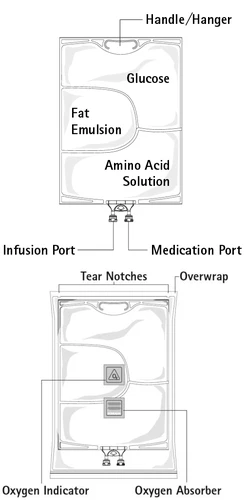
Figure A Figure B
Figure A: The multi-compartment bag is packed in an outer protective bag. Between the inner and outer bags there is an oxygen absorber and an oxygen indicator. The oxygen absorber sachet is made of inert material and contains iron hydroxide.
Figure B: The upper compartment contains the glucose solution, the middle compartment contains the fat emulsion, and the lower compartment contains the amino acid solution.
The glucose and amino acid solutions are clear, colourless to straw-coloured. The fat emulsion is milky white.
The upper compartment and the middle compartment can be connected to the lower compartment by opening the internal seals.
Different pack sizes are supplied in cardboard boxes containing five bags.
Pack sizes: 5 x 1250 ml, 5 x 1875 ml and 5 x 2500 ml
Not all pack sizes may be marketed.
Marketing Authorisation Holder
B. Braun Melsungen AG
Carl-Braun-Straße 1
34212 Melsungen, Germany
Tel.: +49-5661-71-0
Fax: +49-5661-71-4567
Manufacturer
B. Braun Melsungen AG
Carl-Braun-Straße 1
34212 Melsungen, Germany
For further information about this medicinal product, please contact the representative of the Marketing Authorisation Holder in Poland:
Aesculap Chifa sp. z o.o.
ul. Tysiąclecia 14
64-300 Nowy Tomyśl
Telephone: +48 61 442 01 00
Fax: +48 61 443 75 05
E-mail: [email protected]
This medicinal product is authorised in the European Economic Area and in the United Kingdom (Northern Ireland) under the following names:
Austria Nutriflex Omega plus B.Braun Emulsion zur Infusion
Belgium Nutriflex Omega plus 38 g/l Amino + 120 g/l G, emulsie voor infusie
Bulgaria Nutriflex Omega 38/120 emulsion for infusion
Croatia Nutriflex Omega 38/120 plus emulzija infuziju
Czech Republic Nutriflex Omega plus 38/120
Denmark Nutriflex Omega Plus
Finland Nutriflex Omega 38/120/40 infuusioneste, emulsio
France MEDNUTRIFLEX OMEGA E, émulsion pour perfusion
Germany NuTRIflex Omega plus novo Emulsion zur Infusion
Greece Nutriflex Omega 38/120 plus
Ireland Omeflex plus emulsion for infusion
Italy Omegaflex AA38/G120 emulsione per infusione
Luxembourg NuTRIflex Omega plus novo Emulsion zur Infusion
Netherlands Nutriflex Omega plus 38 g/l Amino + 120 g/l G, emulsie voor infusie
Norway Nutriflex Omega Plus infusjonsvæske, emulsjon
Poland Omegaflex plus
Portugal Nutriflex Omega 38/120 P emulsão para perfusão
Romania NuTRIflex Omega Plus novo emulsie perfuzabilă
Slovakia Nutriflex Omega plus 38/120
Spain Nutriflex Omega 38/120 plus emulsión para perfusión
Sweden Nutriflex Omega 38/120/40 infusionsvätska, emulsion
United Kingdom (Northern Ireland) Omeflex plus emulsion for infusion
__________________________________________________________________________
Information intended exclusively for healthcare professionals:
Before using parenteral nutrition products, visually inspect for any damage, discoloration, or emulsion instability.
Do not use bags that are damaged. The outer and inner bags, as well as the seals between compartments, must be intact. The product should be used only if amino acid and glucose solutions are clear and colorless to straw-colored, and the fat emulsion is homogeneous and milky white. Do not use if the solutions contain particulate matter.
After mixing the contents of the three compartments, do not use if the emulsion shows discoloration or signs of phase separation (oil droplets, oil layer). If discoloration or phase separation occurs, discontinue infusion immediately.
Before opening the outer bag, check the color of the oxygen indicator (see Figure A). Do not use if the oxygen indicator has turned pink. Use only if the oxygen indicator is yellow.
Preparation of the mixed emulsion
Strictly follow aseptic handling procedures.
Opening: Tear the outer bag starting from the notches (Fig. 1). Remove the inner bag from the protective packaging. Discard the outer packaging, oxygen indicator, and oxygen absorber.
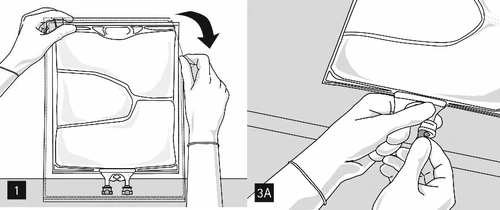
Visually inspect the inner bag for any leaks. Discard any leaking bag, as sterility cannot be guaranteed.
Mixing the contents of the bag and adding additional substances
To sequentially open the compartments and mix their contents, roll the bag with both hands, starting with breaking the seal between the upper compartment (glucose) and lower compartment (amino acids) (Fig. 2).
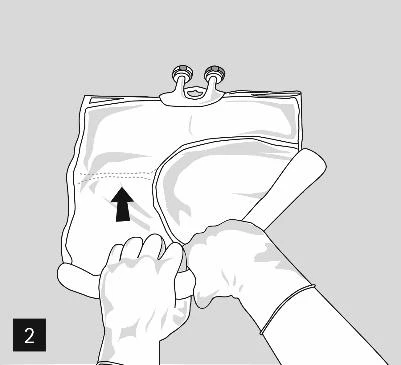
Then continue applying pressure to open the seal between the middle compartment (lipids) and the lower compartment (Fig. 3).
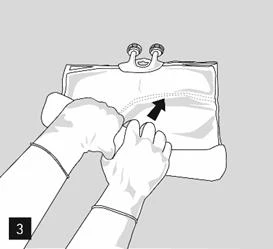
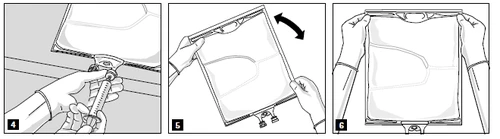
After mixing the contents of all compartments and removing the aluminum foil (Fig. 3A), compatible additives may be added via the medication port (Fig. 4). Mix the contents thoroughly (Fig. 5) and visually inspect the mixture (Fig. 6). The resulting mixture is a homogeneous milky white oil-in-water emulsion. Any signs of emulsion phase separation are unacceptable.
Omegaflex plus can be mixed with the following additives up to the specified upper concentration limits or maximum amounts indicated below. The resulting mixtures are stable for 7 days at +2°C to +8°C plus an additional 2 days at 25°C.
- Electrolytes: consider electrolytes already present in the bag; in a three-chamber mixture, stability has been demonstrated up to a total of 200 mmol/L sodium + potassium (combined), 9.6 mmol/L magnesium, and 6.4 mmol/L calcium.
- Phosphate: stability has been demonstrated up to a maximum concentration of 20 mmol/L inorganic phosphate.
- Alanyl-glutamine up to 24 g/L.
- Trace elements and vitamins: stability has been demonstrated when using commercially available products containing multiple trace elements and vitamins (e.g., Tracutil, Cernevit) at the standard dose recommended by the respective manufacturer of the trace element preparation.
Detailed information regarding the above-mentioned additives and the corresponding shelf life of such mixtures is available upon request from the manufacturer.
Preparation for infusion
Before infusion, warm the emulsion to room temperature.
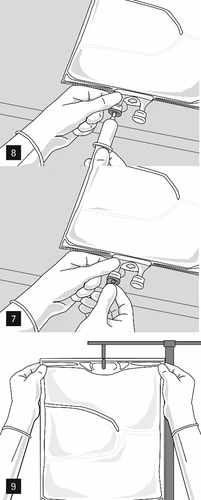
Remove the aluminum seal from the infusion port (Fig. 7) and connect the infusion set (Fig. 8). Use an infusion set without an air vent or, if using a set with an air vent, ensure the vent is closed. Hang the bag on an infusion stand (Fig. 9) and administer using standard infusion technique.
For single use only. After use, discard the packaging and any unused remnants of the product.
Any unused product or waste material must be disposed of in accordance with local regulations.
Do not reconnect partially used containers.
If filters are required, they must be lipid-compatible filters (pore size ≥ 1.2 µm).
Shelf life after opening the outer bag and after mixing the bag contents
Chemical and physicochemical stability of the amino acid, glucose, and lipid mixture has been demonstrated for 7 days when stored at 2–8°C and for an additional 2 days at 25°C prior to use.
Shelf life after addition of compatible additives
From a microbiological standpoint, the product should be used immediately after the addition of additives. If not used immediately, the responsibility for storage duration and conditions prior to use lies with the user.
After first opening (puncturing the infusion port)
The emulsion should be used immediately after opening the container.
The medicinal product Omegaflex plus must not be mixed with other medicinal products unless compatibility has been demonstrated.
Due to the risk of pseudoagglutination, Omegaflex plus should not be administered simultaneously with blood through the same infusion set.