Oftahist
Poland
Table of Contents
Package leaflet: Information for the user
Oftahist, 1 mg/ml, eye drops, solution
Olopatadine
Please read all of this leaflet carefully before using this medicine because it contains
important information for you.
Always use this medicine exactly as described in this patient leaflet or as directed by your doctor or pharmacist.
- Keep this leaflet so that you can read it again if necessary.
- If you need advice or further information, please contact your pharmacist.
- If you experience any side effects, including any possible side effects not listed in this leaflet, inform your doctor or pharmacist. See section 4.
- If there is no improvement or if you feel worse after 3 days, consult your doctor.
Contents of the leaflet
- What Oftahist is and what it is used for
- Important information before using Oftahist
- How to use Oftahist
- Possible side effects
- How to store Oftahist
- Contents of the pack and other information
1. What Oftahist is and what it is used for
Oftahist is indicated for the treatment of ocular symptoms (itching, tearing, redness,
eyelid and conjunctival swelling) in patients diagnosed with seasonal allergic conjunctivitis.
Oftahist may be used only in adults.
Allergic conjunctivitis. Certain substances (allergens), such as plant pollen, house dust mites, or animal dander may cause allergic reactions manifesting as itching, redness, tearing, and swelling of the eye surface. These symptoms appear suddenly and are acute and transient. They are often accompanied by watery nasal discharge, sneezing, or itching in the nose and ears.
Oftahist is a medicine used in the treatment of allergic eye diseases. Its action consists of reducing the severity of allergic reactions.
2. Important information before using Oftahist
When not to use Oftahist:
- if the patient is allergic to olopatadine or to any of the other ingredients of this medicine (listed in section 6).
Warnings and precautions
Contact a doctor if:
- there is uncertainty whether symptoms are caused by allergy. This particularly applies when symptoms affect only one eye, visual disturbances occur, or when eye pain is present without accompanying nasal symptoms.
- symptoms worsen or do not improve within 72 hours despite using Oftahist eye drops.
Contact lenses must be removed before applying Oftahist.
Children and adolescents
Oftahist should not be used in children and adolescents under 18 years of age.
Oftahist and other medicines
Tell your doctor or pharmacist about all medicines the patient is currently taking, has recently taken, or plans to take.
If the patient is using other eye drops or ointments at the same time, at least a 5–10 minute interval should be maintained between the applications of each medicine. Ophthalmic ointments should be used last.
Pregnancy, breastfeeding and fertility
If the patient is pregnant or breastfeeding, suspects she may be pregnant, or is planning to have a child, she should consult a doctor before using this medicine.
Oftahist should not be used during pregnancy and while breastfeeding.
Driving and operating machinery
For a short period after instillation of Oftahist, vision may be blurred.
Do not drive or operate machinery until this effect has subsided.
Oftahist contains benzalkonium chloride
Benzalkonium chloride may cause eye irritation and is known to cause discoloration of soft contact lenses; therefore, contact with soft contact lenses should be avoided. If contact lenses are worn, they should be removed before using this medicine and reinserted only after waiting 15 minutes.
3. How to use Oftahist
This medicine should always be used exactly as described in this patient leaflet or as directed by a doctor or pharmacist. If in doubt, consult a doctor or pharmacist.
This medicine is for topical use in the conjunctival sac.
Before applying the medicine, remove contact lenses and wait at least 15 minutes before reinserting them.
Adults
The recommended dose is one drop into the affected eye or eyes, twice daily – in the morning and evening. There should be at least an 8-hour interval between doses.
If there is no improvement or if symptoms worsen within three days of starting treatment, consult a doctor. The duration of treatment is up to two weeks. If necessary, treatment may be continued for up to four months following medical consultation.
Do not use this medicine for longer than 4 months.
Use in children and adolescents
Oftahist must not be used in children and adolescents under 18 years of age.
Instructions for use:
Oftahist should be used only as eye drops.
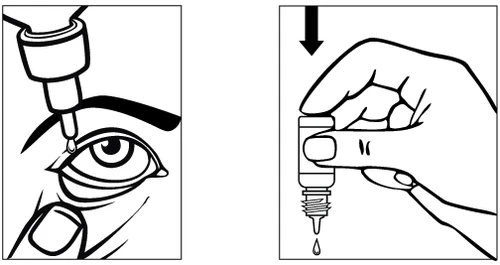
1. 2.
- Prepare the Oftahist bottle and a mirror.
- Wash your hands.
- Hold the bottle in your hand and unscrew the cap.
- If the safety collar is loose after removing the cap, remove it before using the medicine.
- Hold the bottle upside down, with the nozzle pointing downward, using your thumb and middle finger.
- Tilt your head backward. With a clean finger, gently pull down the lower eyelid to create a "pocket" between the eyeball and the eyelid; the drop should be instilled into this pocket (Figure 1).
- Bring the tip of the bottle close to the eye. A mirror may be used to assist.
- Do not touch the dropper tip to the eye, eyelid, surrounding areas, or any other surface, as this may lead to contamination of the remaining drops in the bottle.
- Gently press the bottom of the bottle to release a single drop of Oftahist.
- Do not squeeze the bottle; it is designed so that light pressure on the base is sufficient to dispense a drop (Figure 2).
- If applying drops to both eyes, repeat the above steps for the second eye.
- Immediately after use, tightly replace the cap.
If the drop misses the eye, repeat the instillation.
Accidental overdose of Oftahist
Rinse the eyes with lukewarm water. Do not instill further drops until it is time for the next scheduled dose.
Missed dose of Oftahist
As soon as possible, instill one drop into the eye, then resume the normal dosing schedule. If the next dose is due shortly, skip the missed dose and continue with the regular dosing schedule.
If using other ophthalmic medicinal products, wait at least five to ten minutes between instillation of Oftahist and the other medicines.
Do not use a double dose to make up for a missed dose.
Stopping Oftahist
If you have any further questions about the use of this medicine, consult your doctor or pharmacist.
4. Possible adverse reactions
Like all medicines, this medicine can cause adverse reactions, although not everyone experiences them.
Treatment must be discontinued and immediate contact made with a doctor or the Emergency Department
of the nearest hospital if any symptoms of hypersensitivity occur, including
breathing difficulties, throat or facial swelling.
In the case of a severe allergic reaction, immediate emergency treatment may be necessary.
The following adverse reactions have been observed during use of Oftahist:
Common (occur in less than 1 in 10 patients)
Eye-related effects: eye pain, eye irritation, dry eye, unusual sensations inside the eye.
General symptoms: headache, unpleasant taste in the mouth, dryness of the nasal mucosa, fatigue.
Uncommon (occur in less than 1 in 100 patients)
Eye-related effects: corneal disorders, surface eye inflammation with or without surface damage, eye discharge, light sensitivity, blurred or restricted vision, eyelid spasm, eye discomfort, eye itching, conjunctival disorders, foreign body sensation in the eye, increased tear production, redness or swelling of the eyelids, eyelid abnormalities, eye redness.
General symptoms: nasal mucositis, dizziness, abnormal or impaired sensation, skin inflammation (contact), skin burning sensation, dry skin.
Frequency not known (cannot be estimated from available data)
Eye-related effects: corneal edema, eye swelling, conjunctivitis, change in pupil size, visual disturbances, crusts at the eyelid margins.
General symptoms: hypersensitivity, facial swelling, somnolence, dyspnea, sinusitis, nausea, vomiting, skin inflammation and redness, general weakness, malaise.
In patients with significantly damaged anterior transparent layer of the eye (cornea), corneal opacities caused by calcium deposits have very rarely been observed during treatment.
Reporting of adverse reactions
If any adverse reactions occur, including any not listed in this leaflet, patients should inform their doctor, pharmacist, or nurse. Adverse reactions can be reported directly to the Department of Monitoring of Adverse Drug Reactions, Office for Registration of Medicinal Products, Medical Devices and Biocidal Products, Al. Jerozolimskie 181C, 02-222 Warsaw, Tel.: +48 22 49 21 301, Fax +48 22 49 21 309, e-mail: [email protected]
Adverse reactions may also be reported to the marketing authorization holder.
Reporting adverse reactions helps to improve the safety information available for the medicine.
5. How to store Oftahist
Keep this medicine out of sight and reach of children.
Do not use this medicine after the expiry date stated on the bottle and carton following the
"Exp". The expiry date refers to the last day of the specified month.
This medicine does not require any special storage conditions.
To prevent infection, discard the bottle four weeks after first opening and then use a new
bottle of the medicine. The date of opening should be recorded on the blank space of the label
and carton.
Medicines must not be disposed of via wastewater or household waste. Ask your pharmacist
how to dispose of medicines no longer required. Such measures help protect the environment.
6. Contents of the pack and other information
What Oftahist contains
- The active substance is olopatadine. Each ml of solution contains 1 mg of olopatadine (as hydrochloride). The other ingredients are benzalkonium chloride, sodium chloride, disodium phosphate anhydrous, sodium hydroxide (for pH adjustment), hydrochloric acid (for pH adjustment), water for injections.
What Oftahist looks like and contents of the pack
Oftahist is a clear liquid (solution), supplied in a pack containing a 5 ml plastic bottle with a screw cap.
Marketing Authorisation Holder and Manufacturer
Marketing Authorisation Holder
Adamed Pharma S.A.
Pieńków, ul. M. Adamkiewicza 6A
05-152 Czosnów
Manufacturer/Importer
Adamed Pharma S.A.
Pieńków, ul. M. Adamkiewicza 6A
05-152 Czosnów
This medicinal product is authorised in the Member States of the European Economic Area under the following names:
Poland Oftahist