Oftagel
Poland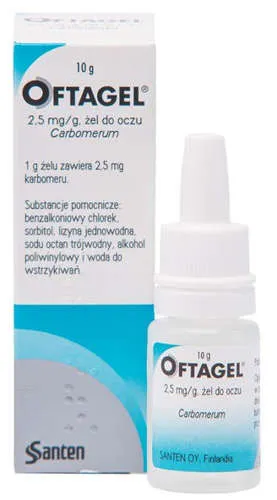
Table of Contents
Oftagel, 2.5 mg/g, eye gel
Carbomerum
Please read the entire leaflet carefully before using the medicine, as it contains
important information for the patient.
This medicine should always be used exactly as described in the patient leaflet or as directed by
the doctor, pharmacist, or nurse.
- Keep this leaflet, so that you can read it again if necessary.
- If you need advice or further information, please consult your pharmacist.
- If you experience any adverse reactions, including any possible side effects not listed in this leaflet, inform your doctor, pharmacist, or nurse. See section 4.
- If there is no improvement or if you feel worse, contact your doctor.
Leaflet Contents
- What Oftagel is and what it is used for
- Important information before using Oftagel
- How to use Oftagel
- Possible side effects
- How to store Oftagel
- Contents of the pack and other information
1. What Oftagel is and what it is used for
Oftagel eye gel is a clear or slightly opalescent solution. It contains carbomer as the active substance. It is used in the treatment of dry keratoconjunctivitis (Keratoconjunctivitis sicca) and symptomatic treatment of other forms of "dry eye" syndrome, i.e. in situations where lacrimal glands secrete less or do not produce any natural secretion at all, and corneal drying causes undesirable symptoms on the eye surface.
Important properties of eye drops intended to relieve symptoms of "dry eye" syndrome are a long contact time with the cornea and good lubricating properties. Carbomer, a cross-linked polymer of high molecular weight, increases the viscosity of the eye drops and forms a protective layer on the cornea.
2. Important information before using Oftagel
When not to use Oftagel
- if the patient is allergic to carbomer or to any of the other ingredients of Oftagel (listed in section 6).
Warnings and precautions
Before starting to use Oftagel, discuss this with your doctor, pharmacist, or nurse.
Children and adolescents
The safety and efficacy of Oftagel in children and adolescents using the dosage recommended for adults have been established based on clinical experience; however, there are no available data from clinical trials.
Oftagel and other medicines
Tell your doctor or pharmacist about all medicines you are currently using or have recently used, as well as any medicines you plan to use.
If other medicines are administered into the conjunctival sac at the same time, Oftagel should be administered last, 15 minutes after the previous medicine has been given.
Pregnancy, breastfeeding, and fertility
If you are pregnant or breastfeeding, suspect you may be pregnant, or are planning to have a baby, consult your doctor or pharmacist before using this medicine.
Appropriate clinical studies in pregnant and breastfeeding women have not yet been conducted. Oftagel may be used during pregnancy and breastfeeding only if the potential benefit to the mother outweighs the potential risk to the fetus or breastfed infant.
Driving and operating machinery
Oftagel, eye gel, may temporarily impair visual acuity. Before driving or operating machinery, wait until any visual disturbances immediately following administration of the medicine have resolved.
Oftagel contains benzalkonium chloride
Oftagel contains approximately 0.002 mg of benzalkonium chloride per drop, equivalent to 0.06 mg/g.
Benzalkonium chloride may be absorbed by soft contact lenses and may change their color. Contact lenses must be removed before instillation and at least 15 minutes should elapse before reinsertion.
Benzalkonium chloride may also cause eye irritation, particularly in patients with dry eye syndrome or corneal disorders (the transparent layer at the front of the eye). If abnormal eye sensations, stinging, or eye pain occur after using this medicine, contact your doctor.
3. How to use Oftagel
This medicine should always be used exactly as described in the patient information leaflet or according to the instructions given by your doctor, pharmacist or nurse. If in doubt, consult your doctor, pharmacist or nurse.
Adults (including elderly people):
The recommended dose of Oftagel is 1 drop into the conjunctival sac 1 to 4 times daily, depending on the severity of symptoms.
Use in children and adolescents:
The safety and efficacy of Oftagel in children and adolescents at the dose recommended for adults have been established based on clinical experience; however, there are no available data from clinical trials.
If you feel that the effect of Oftagel is too strong or too weak, consult your doctor.
Wash your hands before instilling Oftagel.
To avoid contamination of the bottle's contents, do not touch the eye or surrounding areas with the dropper tip or any other surface.
Tilt your head backwards.
Gently pull down the lower eyelid and instill one drop of the medicine into the conjunctival sac between the lower eyelid and the eye.
Close the bottle after each use.
The bottle is intended for individual use only.
4. Possible adverse reactions
Like all medicinal products, this medicine can cause adverse reactions, although not everyone experiences them.
Shortly after administration of the medicine, transient visual disturbances, burning sensation or
local irritation symptoms may occur.
Reporting of adverse reactions
If any adverse reactions occur, including any adverse reactions not listed in this leaflet, inform your doctor, pharmacist or nurse. Adverse reactions can be reported directly to the Department of Monitoring Adverse Drug Reactions at the Office for Registration of Medicinal Products, Medical Devices and Biocidal Products
Al. Jerozolimskie 181 C
02-222 Warsaw
Tel.: +48 22 49 21 301
Fax: +48 22 49 21 309
Website: https://smz.ezdrowie.gov.pl
Adverse reactions can also be reported to the marketing authorization holder.
Reporting adverse reactions helps to provide more information on the safety of using this medicine.
5. How to store Oftagel medicine
Keep the medicine out of sight and reach of children.
Do not use this medicine after the expiry date stated on the bottle label.
The expiry date refers to the last day of the stated month.
After first opening the bottle, the medicine remains stable for 28 days. After this period, the medicine should be
disposed of according to local regulations.
Store below 25°C. Do not freeze. Protect from light.
Between doses, store the bottle in the box in an inverted position ("upside down") to facilitate gel administration.
Medicines must not be disposed of via wastewater or household waste. Ask your pharmacist how to dispose of medicines no longer required.
Such measures help protect the environment.
6. Contents of the package and other information
What Oftagel contains
- The active substance is carbomer. 1 g of gel contains 2.5 mg of carbomer.
- Other ingredients are benzalkonium chloride, sorbitol, lysine monohydrate, sodium acetate trihydrate, polyvinyl alcohol, and water for injections.
What Oftagel looks like and contents of the pack
Oftagel eye gel is a clear or slightly opalescent solution.
Oftagel eye gel is supplied in transparent polyethylene bottles with an eye dropper and a white polyethylene screw cap.
Pack size: 10 g bottle
Marketing Authorisation Holder and Manufacturer
Marketing Authorisation Holder
Santen Oy
Niittyhaankatu 20
33720 Tampere
Finland
Manufacturer
Santen Oy
Kelloportinkatu 1
33100 Tampere
Finland