Oflodinex
Poland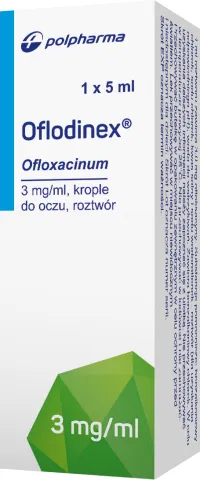
Table of Contents
Package leaflet: Information for the user
Oflodinex, 3 mg/ml, eye drops, solution
Ofloxacinum
Please read the entire leaflet carefully before using this medicine, as it contains
important information for the patient.
- Keep this leaflet, as you may need to read it again.
- If you have any questions, consult your doctor or pharmacist.
- This medicine has been prescribed for a specific individual. Do not pass it on to others. This medicine may harm others, even if their symptoms are the same.
- If you experience any adverse reactions, including any not listed in this leaflet, inform your doctor or pharmacist. See section 4.
Table of contents
- What Oflodinex is and what it is used for
- Important information before using Oflodinex
- How to use Oflodinex
- Possible side effects
- How to store Oflodinex
- Contents of the pack and other information
1. What Oflodinex is and what it is used for
Oflodinex is a medicine in the form of eye drops used to treat superficial eye infections such as:
- conjunctivitis
- keratitis.
Ofloxacin belongs to a group of medicines called quinolone antibacterial agents.
2. Important information before using Oflodinex
When not to use Oflodinex
- if the patient is allergic to ofloxacin, other quinolones, or any of the other ingredients of this medicine (listed in section 6).
Warnings and precautions
Before starting treatment with Oflodinex, discuss the following with a doctor or pharmacist:
- if the patient is exposed to excessive sunlight or UV radiation (e.g. sunlamps, solarium, etc.) during treatment with Oflodinex. Both sources of light should be avoided due to the risk of photosensitivity reactions;
- if the patient is allergic to other quinolone antibacterial agents;
- if the patient wears contact lenses. During treatment with Oflodinex eye drops, solution, contact lenses should not be used (see section "Oflodinex contains benzalkonium chloride").
Caution should be exercised when using this medicine in patients with corneal damage or ulceration.
As with other antibiotics, prolonged use of Oflodinex may result in overgrowth of resistant microorganisms. If such infections occur during treatment, the doctor will take appropriate measures.
Swelling and tendon rupture have been reported in patients taking oral or intravenous fluorochinolones, particularly in elderly patients and in patients receiving concomitant corticosteroid therapy. Treatment with Oflodinex should be discontinued if tendon pain or swelling (tendinitis) occurs.
Children and adolescents
Experience with ofloxacin-containing eye drops in children is limited. Consult a doctor before using this medicine in children.
Oflodinex with other medicines
Inform the doctor about all medicines the patient is currently using, has recently used, or plans to use.
If other eye drops and/or ointments are used simultaneously, at least a 15-minute interval should be maintained between administration of each product. Ophthalmic ointments should always be applied last.
Pregnancy and breastfeeding
Inform the doctor if the patient is pregnant or breastfeeding. The doctor will advise whether this medicine can be used.
Driving and operating machinery
Use of Oflodinex may cause blurred vision. These symptoms may last for several minutes. During this time, patients should not operate machinery, work without proper support, or drive vehicles.
Oflodinex contains benzalkonium chloride
The medicine contains 0.025 mg of benzalkonium chloride per ml.
Benzalkonium chloride may be absorbed by soft contact lenses and may change their color. Contact lenses should be removed before instillation and at least 15 minutes should elapse before reinsertion.
Benzalkonium chloride may also cause eye irritation, particularly in patients with dry eye syndrome or corneal disorders (the transparent layer at the front of the eye). If abnormal sensations, stinging, or eye pain occur after using the medicine, consult a doctor.
Wearing contact lenses during treatment of eye infections is not recommended.
3. How to use Oflodinex
This medicine should always be used exactly as recommended by the doctor. In case of any doubts,
consult a doctor or pharmacist.
In patients of all age groups, the recommended dose is:
1 drop of Oflodinex
- every 2–4 hours into the conjunctival sac of the infected eye (eyes) during the first two days
- and then 4 times daily.
If the infection worsens or there is no improvement after several days, contact a doctor.
Duration of treatment
Do not use this medicine for longer than 14 days.
Use of a higher than recommended dose of Oflodinex
No cases of overdose have been reported so far. If too many drops have been instilled into the eye (eyes), rinse the eye with clean water.
In case of systemic adverse reactions due to incorrect use of the medicine, accidental overdose, or ingestion, systemic treatment should be initiated. In such a case, contact a doctor.
Missed dose of Oflodinex
Do not use a double dose to make up for a missed dose. Apply the next dose as soon as remembered. Then continue using the medicine according to the dosing schedule given above or as directed by the doctor.
If there are any further doubts regarding the use of this medicine, consult a doctor or pharmacist.
4. Possible adverse reactions
Like all medicines, this medicine can cause adverse reactions, although not everyone will experience them.
Frequency unknown (cannot be estimated from the available data):
Life-threatening skin rashes (Stevens-Johnson syndrome, toxic epidermal necrolysis) have been reported during the use of ofloxacin in the form of eye drops, initially appearing as reddish spots or oval lesions on the trunk, often with blisters in the center.
If an allergic reaction occurs (including an allergic reaction of the eye), discontinue use of the eye drops immediately and contact a doctor without delay. The frequency of this adverse reaction is unknown (frequency cannot be estimated from the available data).
The following adverse reactions have been reported:
Common (more than 1 in 100 people but less than 1 in 10 people):
- eye irritation
- sensation of discomfort in the eye
Very rare (less than 1 in 10,000 people):
- allergic reactions (including severe allergic reactions causing swelling of the face, lips, tongue or throat, or other body parts, rash and itching, difficulty breathing or dizziness, anaphylactic shock)
Frequency unknown (cannot be estimated from the available data):
- dizziness
- eye inflammation
- blurred vision
- light sensitivity
- swelling of the eye, face or area around the eyes (including eyelid swelling)
- sensation of a foreign body in the eye
- tearing
- dry eye
- eye pain
- eye allergic reactions (including itching of the eyes or eyelids)
- eye redness
- nausea
Reporting of adverse reactions
If any adverse effects occur, including any adverse effects not listed in this leaflet, inform your doctor or pharmacist. Adverse reactions can be reported directly to the Department of Monitoring Adverse Drug Reactions at the Office for Registration of Medicinal Products, Medical Devices and Biocidal Products
Al. Jerozolimskie 181C
02-222 Warsaw
Phone: +48 22 49 21 301
Fax: +48 22 49 21 309
Website: https://smz.ezdrowie.gov.pl
Adverse reactions can also be reported to the marketing authorization holder.
Reporting adverse reactions helps provide more information on the safety of the medicine.
5. How to store Oflodinex
Keep the medicine out of the sight and reach of children.
Do not use this medicine after the expiry date stated on the label and carton. The expiry date refers to the last day of the stated month.
The marking on the packaging following "EXP" indicates the expiry date, and following "Lot" indicates the batch number.
Shelf life after first opening: 4 weeks.
Do not store above 25 °C. Do not store in the refrigerator or freeze.
Keep the bottle in the outer packaging to protect from light.
Medicines must not be disposed of via the sewage system or household waste. Ask your pharmacist how to dispose of medicines no longer required. This will help protect the environment.
6. Contents of the pack and other information
What Oflodinex contains
- The active substance is ofloxacin. 1 ml of solution contains 3 mg of ofloxacin.
- The other ingredients are: benzalkonium chloride; sodium chloride; hydrochloric acid and sodium hydroxide – solution (for pH adjustment); water for injections.
What Oflodinex looks like and contents of the pack
Oflodinex eye drops are a clear solution with a greenish-yellow tint.
Available packs contain 1 container made of LDPE with a dropper made of LDPE, with a screw cap made of PE and a tamper-evident closure, containing 5 ml of eye drops, or 3 containers with droppers, each containing 5 ml of eye drops.
Not all pack sizes may be marketed.
Marketing Authorisation Holder and Manufacturer
Marketing Authorisation Holder
POLPHARMA S.A. Pharmaceutical Works
ul. Pelplińska 19
83-200 Starogard Gdański
tel. + 48 22 364 61 01
Manufacturer
Pharma Stulln GmbH
Werksstrasse 3
92551 Stulln, Germany