Nomigren
Poland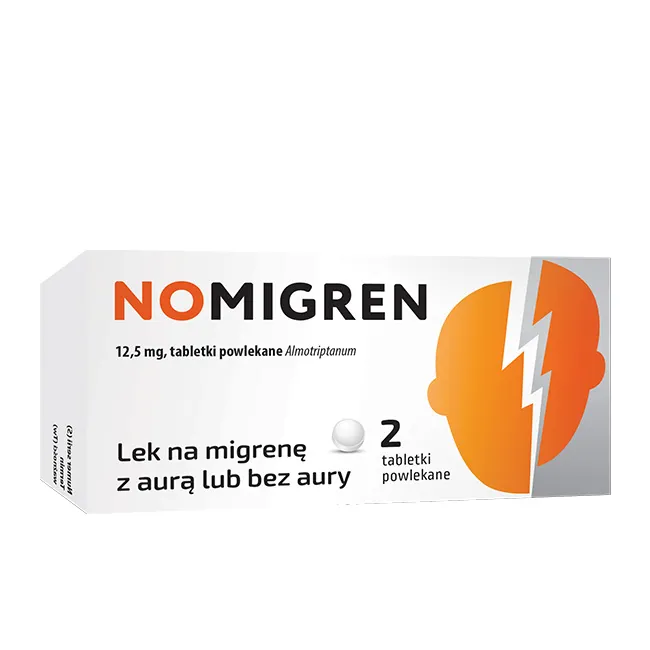
Table of Contents
The medicine may be taken only by patients in whom the doctor has diagnosed
migraine.
Before taking the medicine, read the package leaflet and complete the questionnaire.
Subsequent migraine attacks should be recorded in a Migraine Diary.
Package leaflet: Information for the patient
NOMIGREN
12.5 mg, coated tablets
Almotriptanum
Please read the leaflet carefully before taking this medicine, as it contains
important information for the patient.
This medicine should always be used exactly as described in this patient leaflet or as directed by
your doctor or pharmacist.
- Keep this leaflet, as you may need to read it again.
- If you need advice or further information, please consult your pharmacist.
- If you experience any adverse reactions, including any not listed in this leaflet, inform your doctor or pharmacist. See section 4.
- If there is no improvement or if you feel worse, contact your doctor.
Contents of the leaflet
- What the medicine is and what it is used for
- Important information before taking the medicine
- How to take the medicine
- Possible side effects
- How to store the medicine
- Contents of the pack and other information
1. What the medicine is and what it is used for
NOMIGREN is a migraine medicine belonging to a group of medicines called selective
serotonin receptor agonists. The active substance, almotriptan, binds to serotonin receptors
in blood vessels in the brain (cranium), causing them to constrict, thereby reducing the inflammatory response associated with migraine.
This medicine is used for the acute treatment of headache during migraine attacks, with or without aura.
It may be used only in patients in whom a doctor has diagnosed migraine.
This medicine should not be used for migraine prophylaxis.
If in doubt, consult your doctor or pharmacist.
Migraine is characterized by moderate or severe headache. The pain is usually one-sided, pulsating, and worsens with physical activity. It is accompanied by at least one of the following symptoms: nausea, vomiting, or sensitivity to light, sound, or smells.
The headache may sometimes be preceded by certain symptoms such as temporary mood changes, irritability, anxiety, or loss of appetite. In some individuals, shortly before the headache occurs, a so-called aura may appear (transient visual disturbances such as flashes of light, shimmering spots, or zigzag lines).
2. Important information before using the medicine
When not to use the medicine
- For migraine prophylaxis.
- If the patient is allergic to almotriptan or any of the other ingredients of this medicine (listed in section 6).
- If the patient currently has or has ever had a disease that restricts blood flow to the heart, such as:
- heart attack,
- angina pectoris,
- chest pain or discomfort typically occurring during physical activity or stress,
- heart problems without accompanying pain,
- chest pain occurring at rest,
- severe hypertension (very high blood pressure),
- uncontrolled mild or moderate high blood pressure.
- If the patient has had a stroke or reduced blood flow to the brain.
- If the patient has occlusion (blockage) in large blood vessels of the arms or legs (peripheral vascular disease).
- If the patient is taking other migraine medications containing ergotamine, dihydroergotamine, or methysergide, or other medicines from the group of serotonin agonists (e.g. sumatriptan). See section: "Medicines and other drugs".
- If the patient has severe liver impairment.
Warnings and precautions
Before using this medicine, discuss with your doctor or pharmacist:
- if the type of migraine has not been diagnosed. This medicine should not be used to treat basilar migraine (characterized by double vision, speech and movement disturbances, reduced level of consciousness), hemiplegic migraine (characterized by one-sided muscle weakness), or ophthalmoplegic migraine (characterized by weakness of muscles controlling eye movements);
- if the patient has an allergy (hypersensitivity) to antibacterial medicines, especially those used to treat urinary tract infections (sulfonamides); people allergic to sulfonamides and/or antibiotics may also have hypersensitivity reactions to triptans. If the patient is allergic to antibiotics but is unsure whether they are allergic to sulfonamides, they should consult their doctor or pharmacist;
- if headache symptoms are different than usual during migraine attacks, e.g. the patient experiences sounds in the ears or dizziness, short-term paralysis on one side of the body or in muscles controlling eye movements, or other new symptoms;
- if the patient has risk factors for heart disease, such as: high blood pressure, high cholesterol levels, obesity, diabetes, smoking, family history of heart disease, post-menopausal status in women, or age over 40 years in men;
- if the patient has mild to moderate liver disease;
- if the patient has severe kidney disease (see section 3);
- if the patient experiences four or more migraine attacks per month;
- if the patient does not experience complete symptom-free intervals between migraine attacks;
- if the patient is over 65 years of age, as they may be at increased risk of elevated blood pressure;
- if the patient is taking antidepressant medicines such as SSRIs (selective serotonin reuptake inhibitors) or SNRIs (serotonin-norepinephrine reuptake inhibitors). See section below: "Medicines and other drugs".
It is believed that excessive use of migraine medicines may lead to chronic headache.
This medicine contains less than 1 mmol (23 mg) of sodium per tablet, meaning it is considered "sodium-free".
Children and adolescents
This medicine should not be used in children and adolescents under 18 years of age.
Elderly patients (over 65 years of age)
If the patient is over 65 years of age, they should not use this medicine without consulting a doctor.
Medicines and other drugs
Tell your doctor or pharmacist about all medicines the patient is currently taking or has recently taken, as well as any medicines they plan to take.
Tell your doctor:
- if the patient is taking medicines used to treat depression, such as monoamine oxidase inhibitors (e.g. moclobemide), selective serotonin reuptake inhibitors (e.g. fluoxetine), or serotonin-norepinephrine reuptake inhibitors (e.g. venlafaxine), as these may cause serotonin syndrome—a potentially life-threatening reaction. Symptoms of serotonin syndrome include confusion, agitation, fever, sweating, uncoordinated movements of limbs or eyes, uncontrolled muscle contractions, and diarrhea;
- if the patient is taking products containing St. John's wort (Hypericum perforatum), as this may increase the likelihood of adverse effects.
Do not take almotriptan together with medicines containing ergotamine, which may also be used to treat migraine. However, these medicines may be used one after the other, provided an adequate time interval is maintained between doses:
- after taking almotriptan, wait at least 6 hours before taking ergotamine;
- after taking ergotamine, wait at least 24 hours before taking almotriptan.
Use of medicine N with food
Medicine N can be taken with food or independently of meals. The medicine should be taken with liquid.
Pregnancy and breastfeeding
If the patient is pregnant or breastfeeding, suspects she may be pregnant, or is planning to have a child, she should consult her doctor or pharmacist before using this medicine.
Only limited data are available on the use of almotriptan in pregnant women.
This medicine should not be used during pregnancy unless specifically prescribed by a doctor who has carefully considered the benefits and risks.
Caution should be exercised when using this medicine during breastfeeding. The patient should avoid breastfeeding for 24 hours after taking this medicine.
Driving and operating machinery
This medicine may cause drowsiness. While taking this medicine, patients should not drive or operate tools or machinery.
3. How to use the medicine N
This medicine should always be used exactly as described in the patient leaflet or as directed by a doctor or pharmacist. If in doubt, consult a doctor or pharmacist.
This medicine should only be used to treat an existing migraine attack, and not for the prevention of migraine attacks or headaches.
This medicine may only be used in patients who have been diagnosed with migraine.
Adults (aged 18 to 65 years)
The recommended dose is one tablet (12.5 mg). The tablet should be taken as early as possible after the onset of a migraine attack. If the migraine attack does not subside, do not take more than one tablet during the same attack.
If another migraine attack occurs within 24 hours, a second tablet of 12.5 mg may be taken, provided that at least a 2-hour interval is maintained between the first and second tablet.
The maximum daily dose is two tablets (25 mg) within 24 hours.
The tablet should be swallowed with liquid (e.g. water). The tablet may be taken with food or independently of meals.
The medicine should be taken as early as possible after the onset of a migraine attack; however, it remains effective even if taken at a later stage.
Severe renal impairment
If the patient has severe kidney disease, do not take more than one 12.5 mg tablet every 24 hours.
Consult a doctor or pharmacist and do not take the medicine if the patient has noticed:
- occurrence of 4 or more migraine attacks within the last 30 days, and (or)
- a change in symptoms, or an increase in their severity or frequency, and (or)
- reduced effectiveness of treatment.
Use of a higher than recommended dose of the medicine
If the patient accidentally takes too many tablets, or if someone else or a child takes the medicine, consult a doctor or pharmacist immediately.
Missed dose
Do not take a double dose to make up for a missed dose.
If you have any further questions about the use of this medicine, consult your doctor or pharmacist.
4. Possible adverse effects
Like any medicine, this medicine may cause adverse effects, although not everyone will experience them.
During treatment with this medicine, consult a doctor immediately and do not take any more
tablets of this medicine if the patient experiences any of the following symptoms after taking it:
- allergic reactions (hypersensitivity reactions) or anaphylactic reactions (severe allergic reactions), including swelling of the lips, throat or hands (angioedema), shortness of breath, wheezing, rash;
- chest pain, tightness in the chest or throat, or any other symptoms that may indicate a heart attack.
Other adverse effects:
Common adverse effects (may affect up to 1 in 10 people):
- dizziness
- drowsiness
- fatigue
- nausea
- vomiting
Uncommon adverse effects (may affect up to 1 in 100 people):
- tingling, pricking or numbness (paresthesia)
- headache
- sensation of ringing, buzzing or pulsation in the ears (tinnitus)
- irregular heartbeat (palpitations)
- sensation of tightness in the throat
- diarrhoea
- indigestion
- dry mouth
- muscle pain
- bone pain
- chest pain
- feeling of weakness (asthenia)
Very rare adverse effects (may affect up to 1 in 10,000 people):
- constriction of blood vessels in the heart (coronary vasospasm)
- heart attack (myocardial infarction)
- increased heart rate (tachycardia)
Frequency not known (frequency cannot be estimated from the available data):
- seizure
- visual disturbances, blurred vision (visual disturbances may also occur during a migraine attack itself)
- constriction of blood vessels in the intestines, which may lead to intestinal damage (intestinal ischemia). Abdominal pain and bloody diarrhoea may occur.
Reporting of adverse effects
If any adverse effects occur, including any possible adverse effects not listed in this leaflet, inform your doctor or pharmacist. Adverse effects can be reported directly to the Department of Monitoring Adverse Drug Reactions of the Office for Registration of Medicinal Products, Medical Devices and Biocidal Products:
Aleje Jerozolimskie 181C, 02-222 Warsaw
tel.: +48 22 49 21 301, fax: +48 22 49 21 309
Website: https://smz.ezdrowie.gov.pl
Adverse effects can also be reported to the marketing authorisation holder.
Reporting adverse effects helps to provide more information on the safety of the medicine.
5. How to store the medicine
Keep the medicine out of the sight and reach of children.
Do not use this medicine after the expiry date stated on the packaging. The expiry date refers to the last day of the stated month.
No special storage instructions apply to this medicine.
Medicines must not be disposed of via wastewater or household waste. Ask your pharmacist how to dispose of medicines no longer required. Such measures will help protect the environment.
6. Contents of the pack and other information
What the medicine contains
- The active substance is almotriptan. One tablet contains 12.5 mg of almotriptan (as almotriptan succinate).
- Other ingredients (excipients) are:
- tablet core: microcrystalline cellulose, mannitol, sodium carboxymethyl starch (type A), povidone K29-32, sodium stearyl fumarate,
- coating: hypromellose, titanium dioxide (E 171), macrogol 400, carnauba wax.
What the medicine looks like and contents of the pack
The medicine is in the form of white, round, biconvex coated tablets.
One pack contains 2 or 6 coated tablets in blisters made of
OPA/Aluminium/PVC/Aluminium, packed in a cardboard box.
Marketing Authorisation Holder
"PRZEDSIĘBIORSTWO PRODUKCJI FARMACEUTYCZNEJ HASCO-LEK" S.A.
51-131 Wrocław, ul. Żmigrodzka 242 E
tel.: + 48 71 352 95 22
fax: + 48 71 352 76 36
Manufacturer/Importer
Chanelle Medical Unlimited Company
Dublin Road, H62 FH90 Loughrea
Ireland
Medicine information
tel.: (22) 742 00 22
e-mail: [email protected]