Nimotop s
Poland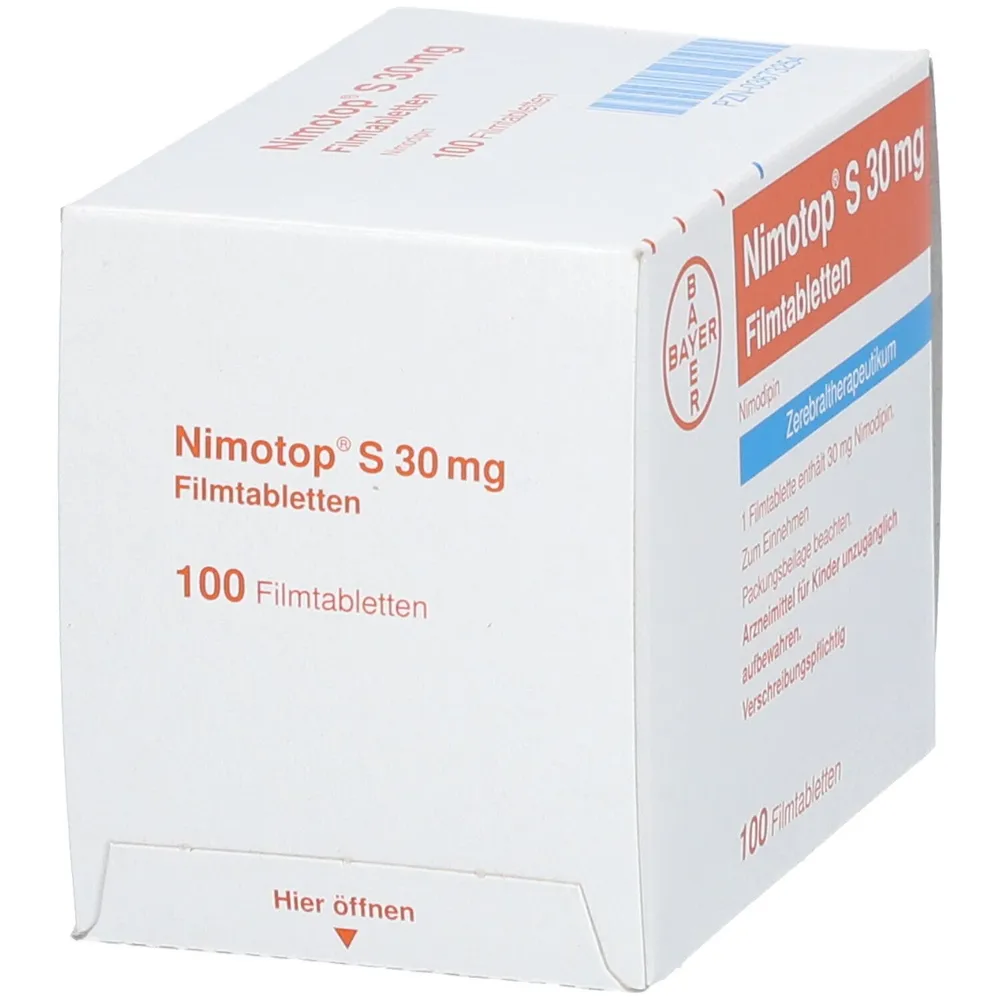
Table of Contents
Package leaflet: Information for the user
Warning! Keep the leaflet! Information on the immediate packaging in a foreign language.
Nimotop S (Nimotop S), 30 mg, coated tablets
Nimodipine
Nimotop S and Nimotop S are different trade names of the same medicinal product written in
Polish and Bulgarian.
Please read the leaflet carefully before using the medicine, as it contains
important information for the patient.
- Keep this leaflet for future reference.
- If you have any questions, consult your doctor or pharmacist.
- This medicine has been prescribed for a specific individual. Do not pass it on to others. It may harm other people, even if their symptoms are the same.
- If you experience any adverse effects, including those not listed in this leaflet, inform your doctor or pharmacist. See section 4.
Table of contents:
- What Nimotop S is and what it is used for
- Important information before taking Nimotop S
- How to take Nimotop S
- Possible side effects
- How to store Nimotop S
- Contents of the pack and other information
1. What Nimotop S is and what it is used for
Nimodipine – the active substance in Nimotop S – is a dihydropyridine derivative belonging to the group of calcium antagonists. It exerts a vasodilatory effect on cerebral blood vessels, thereby preventing cerebral ischemia.
Clinical studies in patients with acute cerebral ischemic disorders have shown that nimodipine dilates cerebral vessels and improves cerebral blood flow. Typically, the increase in blood flow is more pronounced in damaged and hypoperfused areas of the brain compared to unaffected regions.
Nimotop S is indicated for oral continuation of prophylaxis and treatment of ischemic neurological deficits caused by cerebral vasospasm following subarachnoid haemorrhage due to ruptured aneurysm.
2. Important information before taking Nimotop S
When not to take Nimotop S:
- if the patient is allergic to the active substance or to any of the other ingredients of this medicine (listed in section 6).
- if the patient is concurrently taking antiepileptic medicines such as phenobarbital, phenytoin, or carbamazepine, because the efficacy of nimodipine may be considerably reduced.
- if the patient is concurrently taking rifampicin (an antibiotic), because the efficacy of nimodipine may be considerably reduced.
Warnings and precautions
Before starting Nimotop S, discuss this with your doctor or pharmacist.
When to exercise special caution when using Nimotop S:
- in patients with generalized cerebral edema and in cases of significantly increased intracranial pressure,
- in patients with markedly low arterial blood pressure (systolic pressure less than 100 mm Hg),
- in patients with unstable angina pectoris or in patients who have suffered a myocardial infarction within the last 4 weeks.
Children and adolescents
The safety and efficacy of nimodipine have not been established in patients under 18 years of age.
Nimotop S and other medicines
Tell your doctor or pharmacist about all medicines you are currently taking, have recently taken, or plan to take.
Some medicines may affect the action of nimodipine or their action may be altered by nimodipine. Inform your doctor or pharmacist if you are taking any of the following medicines, as monitoring of blood pressure and dose adjustment may be necessary:
- fluoxetine, nefazodone, nortriptyline (antidepressants);
- cimetidine (an H-receptor antagonist used in peptic ulcer disease of the stomach and duodenum);
- valproic acid (an anticonvulsant);
- certain macrolide antibiotics, including erythromycin, and other antibiotics—quinupristin/dalfopristin;
- antifungal medicines such as ketoconazole;
- medicines used in HIV infection (e.g. ritonavir);
- other medicines that lower blood pressure;
- concomitant use of nimodipine with antiepileptic drugs (such as phenobarbital, phenytoin, or carbamazepine) and rifampicin is contraindicated.
Nimotop S with food and drink
Nimotop S may be taken regardless of meals. Do not take Nimotop S tablets with grapefruit juice, and avoid regular consumption of grapefruit or grapefruit products.
Pregnancy, breastfeeding, and fertility
If the patient is pregnant or breastfeeding, suspects she may be pregnant, or is planning to have a child, she should consult her doctor or pharmacist before using this medicine.
Nimotop S may be used during pregnancy only if absolutely necessary. Nimodipine passes into breast milk; therefore, breastfeeding is not recommended during treatment with Nimotop S.
In isolated cases of in vitro fertilization, reversible biochemical changes in sperm heads have been observed, which may lead to semen abnormalities. The significance of this finding for short-term treatment is unknown.
Driving and operating machinery
Nimodipine may cause dizziness and thereby impair the ability to drive or operate machinery.
3. How to take Nimotop S
This medicine should always be taken exactly as prescribed by your doctor. In case of doubt, consult your doctor or pharmacist.
Usually, nimodipine is first administered intravenously for 5–14 days, followed by oral administration at a dose of 360 mg per day, i.e. 2 tablets 6 times daily (6 times 60 mg of nimodipine) for approximately 7 days.
Tablets should be swallowed whole with a small amount of liquid. The medicine can be taken regardless of meals. At least a 4-hour interval should be maintained between consecutive doses.
Do not take Nimotop S tablets with grapefruit juice.
Your doctor will consider whether the dose should be reduced or treatment discontinued in patients with severe hepatic impairment (especially liver cirrhosis) and in patients who experience adverse reactions.
If you feel that the effect of the medicine is too strong or too weak, consult your doctor.
Taking more Nimotop S than recommended
Symptoms of poisoning due to acute overdose include: marked decrease in arterial blood pressure, cardiac arrhythmias, gastrointestinal disturbances, nausea.
In case of acute overdose, Nimotop S should be discontinued immediately. Gastric lavage and administration of activated charcoal may be necessary. In cases of decreased arterial blood pressure, intravenous administration of dopamine or noradrenaline may be required.
Missing a dose of Nimotop S
Take the next dose as soon as possible and inform your doctor. Do not use a double dose to make up for a missed tablet. If you are uncertain about further management, contact your doctor or pharmacist.
Stopping Nimotop S
If you have any further doubts regarding the use of this medicine, consult your doctor, pharmacist, or nurse.
4. Possible adverse reactions
Like all medicines, this medicine can cause adverse reactions, although not everybody will experience them.
Adverse reactions occurring:
- uncommonly (in more than 1 in 1,000 but less than 1 in 100 patients): thrombocytopenia (reduced number of blood platelets), hypersensitivity reactions (allergic reactions, rash), headache, tachycardia (increased heart rate), vasodilation, hypotension (low blood pressure), nausea;
- rarely (in more than 1 in 10,000 but less than 1 in 1,000 patients): bradycardia (slowed heart rate), intestinal obstruction, changes in laboratory test results (transient increase in liver enzyme activity). Other adverse reactions may occur in some individuals during treatment with Nimotop S.
Reporting of adverse reactions
If any adverse effects occur, including any adverse effects not listed in this leaflet, please inform your doctor or pharmacist. Adverse reactions can be reported directly to the Department of Monitoring of Adverse Drug Reactions of the Office for Registration of Medicinal Products, Medical Devices and Biocidal Products, Al. Jerozolimskie 181C, 02-222 Warsaw, telephone: +48 22 4921301, fax: +48 22 4921309, website: https://smz.ezdrowie.gov.pl.
Reporting adverse reactions helps to provide more information on the safety of the medicine.
5. How to store Nimotop S
Keep the medicine out of the sight and reach of children.
Store below 25°C and protect from light.
Do not use Nimotop S after the expiry date stated on the packaging.
The expiry date refers to the last day of the stated month.
Medicines must not be disposed of via wastewater or household waste. Ask your pharmacist
how to dispose of medicines no longer required. Such measures help protect the environment.
6. Contents of the packaging and other information
What Nimotop S contains
The active substance is nimodipine (30 mg).
The other ingredients are: povidone, magnesium stearate, maize starch, microcrystalline cellulose, crospovidone; coating: hypromellose 15 cP, macrogol 4000, titanium dioxide (E 171), yellow iron oxide (E 172).
What Nimotop S looks like and contents of the pack
The cardboard box contains:
20 film-coated tablets (2 blisters of 10 tablets),
or 50 film-coated tablets (5 blisters of 10 tablets),
or 100 film-coated tablets (10 blisters of 10 tablets).
For more detailed information, please contact the marketing authorisation holder or the parallel importer.
Marketing authorisation holder in Bulgaria, country of export:
Bayer AG
Kaiser-Wilhelm-Allee 1
51373 Leverkusen
Germany
Manufacturer:
Bayer AG
51368 Leverkusen
Germany
Parallel importer:
InPharm Sp. z o.o.
Strumykowa 28/11
03-138 Warsaw
Poland
Repackaged in:
Pharma Innovations Sp. z o.o.
Jagiellońska 76
03-301 Warsaw
Poland
InPharm Sp. z o.o. Services sp. k.
Chełmżyńska 249
04-458 Warsaw
Poland
Marketing authorisation number in Bulgaria, country of export: 20020727
Parallel import authorisation number: 325/19