Neoton
Poland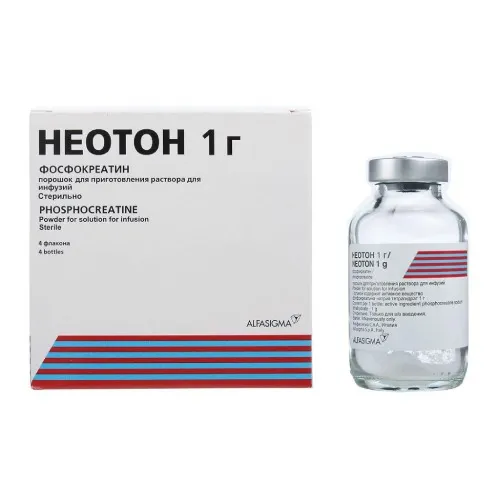
Table of Contents
Neoton
1 g, powder for solution for infusion
Phosphocreatinum natricum
Please read the following information in the leaflet before using this medicine, as it contains
important information for the patient.
- Keep this leaflet, so that you can read it again if necessary.
- If you have any doubts, please consult your doctor or pharmacist.
- This medicine has been prescribed for a specific individual. Do not pass it on to others. This medicine may harm someone else, even if their symptoms are the same.
- If the patient experiences any adverse reactions, including any not listed in this leaflet, inform a doctor or pharmacist immediately. See section 4.
Table of contents of the leaflet:
- What Neoton is and what it is used for
- Important information before using Neoton
- How to use Neoton
- Possible side effects
- How to store Neoton
- Contents of the pack and other information
1. WHAT NEOTON IS AND WHAT IT IS USED FOR
Neoton is a medicine that supplies muscles with energy reserves necessary during muscle contraction. Maintaining adequate levels of such substances helps limit damage to the myocardium and forms the basis of metabolic myocardial protection.
The protective action of phosphocreatine (the active substance of the medicine) on the heart muscle is related to the stabilization of the cellular membrane of muscle fibres and the preservation of intracellular stores of molecules serving as universal energy carriers (adenine nucleotides), achieved by inhibiting enzymes involved in their breakdown.
Neoton is used as a cardioprotective agent in cardiac surgery, as an additive to cardioplegic solution.
2. IMPORTANT INFORMATION BEFORE USING NEOTON
When not to use Neoton:
- if the patient is allergic to phosphocreatine or any of the other ingredients of this medicine (listed in section 6);
- if the patient has chronic renal failure, high doses of phosphocreatine (5–10 g/day) should not be used.
Warnings and precautions:
Before starting Neoton, please discuss it with your doctor.
- if the drug is administered rapidly, because rapid intravenous administration (lasting less than 30–40 minutes) of phosphocreatine in doses exceeding 1 g may cause a decrease in arterial blood pressure;
- when high doses of phosphocreatine (5–10 g/day) are administered, as this may increase serum phosphate levels and affect the metabolism and secretion of hormones regulating calcium homeostasis, kidney function, and purine metabolism (components of nucleic acids).
Neoton with other medicines
No interactions have been reported between phosphocreatine and other medicinal products, either in terms of the effect of other drugs on phosphocreatine or vice versa.
You should inform your doctor about all medicines currently used or recently taken, as well as any medicines the patient plans to take.
Neoton with food and drink
Neoton can be administered regardless of meals.
Pregnancy, breastfeeding, and fertility
If the patient is pregnant or breastfeeding, suspects she may be pregnant, or is planning to have a child, she should consult her doctor before using this medicine.
The medicine may be used during pregnancy and breastfeeding if so decided by the physician.
Driving and operating machinery
Neoton has no influence on the ability to drive or operate machinery.
Neoton 1 g contains sodium.
The medicine contains 180 mg of sodium (the main component of table salt) per dose. This corresponds to 9% of the maximum recommended daily intake of sodium in the diet for adults.
3. HOW TO USE NEOTON
This medicine should always be used according to the physician's instructions. In case of doubts,
you should consult your doctor again.
The recommended dose of Neoton is:
In cardiothoracic surgery, as an additive to cardioplegic solution
For myocardial protection during cardiothoracic surgical procedures, 10 mmol/l (corresponding
to 3 g/l of solution), as an additive to commonly used cardioplegic solutions.
This medicine should always be used according to the physician's instructions. If in doubt,
consult your doctor.
Administration of a higher than recommended dose of Neoton
In preclinical studies, when administering doses significantly higher than therapeutic doses,
and in clinical studies in humans, with rapid intravenous administration of phosphocreatine
in doses exceeding 1 g, a slight decrease in arterial blood pressure was observed.
If a patient suspects having received a higher than recommended dose of Neoton, they should
immediately contact their doctor, who will initiate appropriate treatment if necessary.
Missed administration of Neoton
Do not administer a double dose to make up for a missed dose.
If you have any doubts regarding the use of this medicine, consult your doctor or pharmacist.
4. POSSIBLE ADVERSE REACTIONS
Like all medicines, this medicine can cause adverse reactions, although not everyone will experience them.
The frequency of adverse reactions is defined as follows: very common (affects 1 or more users in 10); common (affects 1 to 10 users in 100); uncommon (affects 1 to 10 users in 1,000); rare (affects 1 to 10 users in 10,000); very rare (affects less than 1 user in 10,000).
Frequency not known (frequency cannot be estimated from available data)
hypersensitivity reactions
If any of the adverse symptoms worsen or if any adverse symptoms not listed in this leaflet occur, inform your doctor or pharmacist.
Reporting of adverse reactions
If any adverse reactions occur, including any possible adverse reactions not listed in this leaflet, inform your doctor or pharmacist.
Adverse reactions can be reported directly to the Department of Monitoring Adverse Drug Reactions at the Office for Registration of Medicinal Products, Medical Devices and Biocidal Products:
ul. Al. Jerozolimskie 181C, PL - 02 222 Warsaw,
tel.: + 48 22 49 21 301,
fax: + 48 22 49 21 309,
Website: https://smz.ezdrowie.gov.pl
Adverse reactions can also be reported to the marketing authorization holder.
Reporting adverse reactions helps to provide more information on the safety of the medicine.
5. HOW TO STORE NEOTON
No special precautions for storage are required.
Keep the medicine out of the reach and sight of children.
Do not use Neoton after the expiry date stated on the label.
6. CONTENTS OF THE PACKAGE AND OTHER INFORMATION
What Neoton contains
- The active substance is sodium phosphocreatine.
What Neoton looks like and contents of the pack
The package (a cardboard box) contains: 1 vial with powder.
Marketing Authorisation Holder
Alfasigma Polska Sp. z o.o.
Al. Jerozolimskie 96
00-807 Warsaw
Tel. +48 22 824 03 64
Manufacturer
ALFASIGMA S.p.A.
Via Enrico Fermi 1,
65020 – Alanno (PE), Italy
Information intended exclusively for healthcare professionals:
Disinfect the rubber stopper of the vial before use.
Dissolve the contents of the vial in 50 ml of water for injections.