Neosynephrin-pos 10%
Poland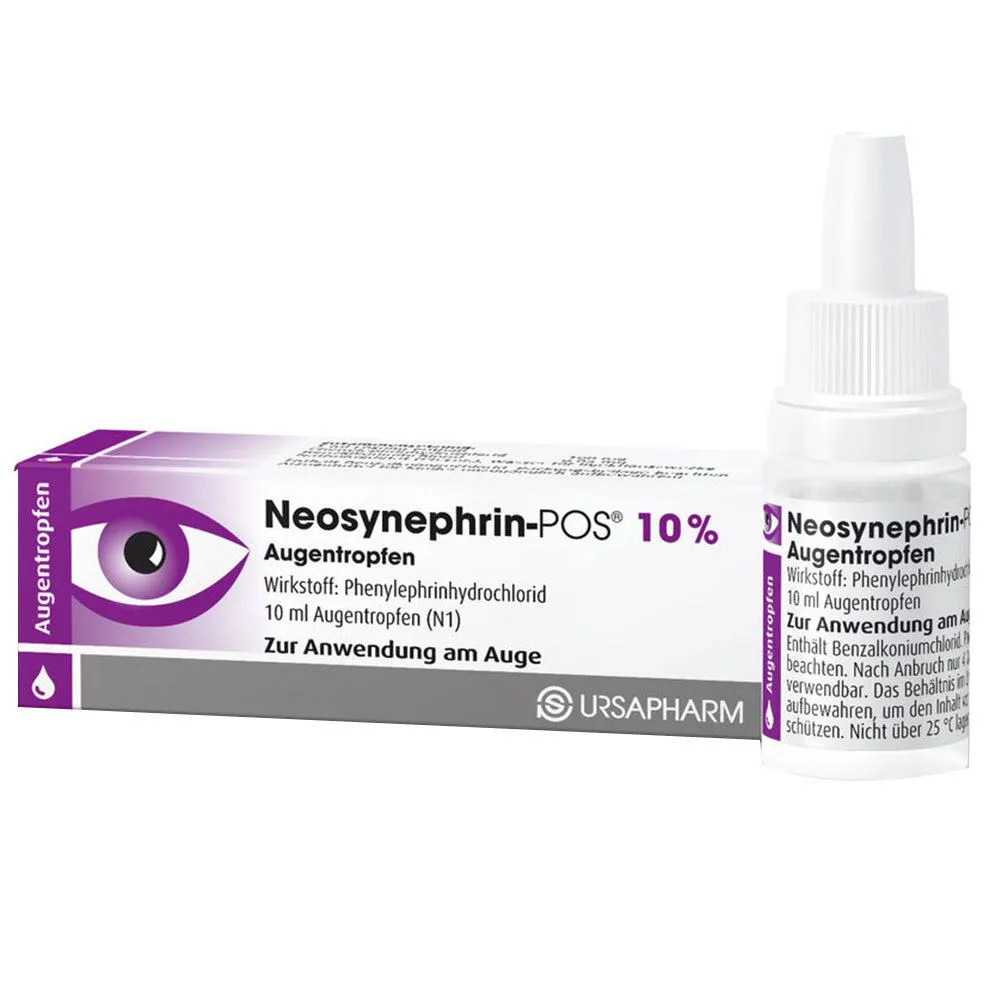
Table of Contents
- Package leaflet: Information for the patient
- 1. What Neosynephrin-POS 10 % is and what it is used for
- 2. Important information before using Neosynephrin-POS 10%
- 3. How to use Neosynephrin-POS 10%
- 4. Possible adverse effects
- 5. How to store Neosynephrin-POS 10%
- 6. Contents of the pack and other information
1.3.1 SPC, labelling and package leaflet
Package leaflet: Information for the patient
Neosynephrin-POS 10 %
100 mg/ml, eye drops, solution
Phenylephrini hydrochloridum
Please read carefully the entire leaflet before using this medicine, as it contains
important information for the patient.
- Keep this leaflet, as you may need to read it again.
- If you have any questions, please consult your doctor or pharmacist.
- This medicine has been prescribed for a specific individual. Do not pass it on to others. The medicine may harm another person, even if their symptoms are identical.
- If any adverse reactions occur, including any adverse reactions not listed in this leaflet, inform your doctor or pharmacist. See section 4.
Table of contents of the leaflet:
- What Neosynephrin-POS 10 % is and what it is used for
- Important information before using Neosynephrin-POS 10 %
- How to use Neosynephrin-POS 10 %
- Possible side effects
- How to store Neosynephrin-POS 10 %
- Contents of the pack and other information
1. What Neosynephrin-POS 10 % is and what it is used for
Neosynephrin-POS 10% is a medicine belonging to the group of alpha-sympathomimetics, acting on the eye through effects on the autonomic nervous system.
It is indicated for achieving short-term pupil dilation for examination of the fundus of the eye (especially its peripheral regions), as well as after ophthalmic surgeries.
It is used to prevent adhesions between the iris and lens, and to break existing adhesions in cases of iritis. It is also indicated for use in diagnosing conjunctivitis and concurrent iritis and ciliary body inflammation.
2. Important information before using Neosynephrin-POS 10%
When not to use Neosynephrin-POS 10%
The medicine is contraindicated in the following cases:
- Hypersensitivity to phenylephrine or any of the other ingredients of this medicine (listed in section 6),
- Dry nasal mucositis,
- Pregnancy and breastfeeding,
- In children under 12 years of age.
Warnings and precautions
Before starting treatment with Neosynephrin-POS 10%, consult your doctor:
- In case of glaucoma, as pupil dilation may be harmful, especially in narrow-angle glaucoma,
- In case of arterial hypertension and cardiac arrhythmias,
- In case of severe heart and vascular diseases.
Edition 07/2024 1
1.3.1 SPC, labelling and package leaflet
There is a risk that the drops may enter the systemic circulation. Therefore, they should be used with great caution in patients with cardiac arrhythmias and other heart diseases, arterial hypertension, aneurysm, advanced arteriosclerosis, and hyperthyroidism.
This also applies to elderly patients and children aged 12 to 18 years.
Neosynephrin-POS 10% may narrow the iridocorneal angle and trigger an attack of glaucoma, manifested by a sudden increase in intraocular pressure associated with eye and headache pain. In patients with existing glaucoma, additional medication to reduce intraocular pressure (e.g. pilocarpine) should be used.
Consult a doctor even if the above warnings refer to conditions that occurred in the past.
Neosynephrin-POS 10% and other medicines
Inform your doctor about all medicines currently or recently taken, as well as any medicines you plan to take.
When treating hypertension with drugs containing guanethidine or reserpine, a significant increase in blood pressure may occur.
Use of Neosynephrin-POS 10% with food and drink
Not applicable.
Children and adolescents
Neosynephrin-POS 10% should not be used in children under 12 years of age, as children appear to be more susceptible to the risk of severe adverse events.
The use of Neosynephrin-POS 10% is not recommended in children aged 12 to 18 years due to lack of adequate clinical experience.
Pregnancy and breastfeeding
If you are pregnant or breastfeeding, suspect you may be pregnant, or are planning to have a baby, you should consult your doctor or pharmacist before using this medicine. Neosynephrin-POS 10% must not be used during pregnancy or breastfeeding.
Driving and operating machinery
Neosynephrin-POS 10% affects visual acuity. Blurred vision may persist for several hours after instillation. Driving motor vehicles should therefore be avoided. Do not operate any machinery or use dangerous tools.
Neosynephrin-POS 10% contains benzalkonium chloride
The medicine contains 0.50 mg of benzalkonium chloride in each 10 ml, equivalent to 0.05 mg/ml.
Benzalkonium chloride may be absorbed by soft contact lenses and may change their color. Contact lenses must be removed before instillation and at least 15 minutes should elapse before reinsertion. Benzalkonium chloride may also cause eye irritation, especially in individuals with dry eye syndrome or corneal disorders (the transparent layer at the front of the eye). If abnormal sensations in the eye, stinging, or pain occur after using the medicine, consult a doctor.
3. How to use Neosynephrin-POS 10%
This medicine should always be used as prescribed by your doctor. In case of doubt, consult your doctor or pharmacist.
The usual dose of Neosynephrin-POS 10% is 1 drop into each eye once or twice daily.
Edition 07/2024 2
1.3.1 SPC, labelling and package leaflet
When administering the medicine to elderly patients or children aged 12 to 18 years, the prescribed dose should be measured particularly carefully.
Avoid contact between the dropper tip and the eye.
To instill the medicine, unscrew the cap, tilt the head backward, gently pull down the lower eyelid, squeeze the bottle gently to release one drop into the conjunctival sac. Close the eyelids slowly and carefully replace the cap.
Use of the medicine for longer than 5 days should only be done under medical supervision.
If the effect of the medicine seems too strong or too weak, consult your doctor.
Use of a higher than recommended dose of Neosynephrin-POS 10%
Immediately rinse the eyes with water.
If the contents of the container are accidentally ingested, the following symptoms may occur:
elevated arterial blood pressure associated with palpitations, headache, vomiting, feeling of fear, tremors, initially rapid heartbeat followed by slowed heartbeat.
Administer activated charcoal and immediately contact a doctor.
In case of bradycardia, the doctor may administer atropine-containing preparation (0.01 to 0.02 mg/kg body weight in children); in case of dangerous elevation of blood pressure, a preparation containing phentolamine may be administered.
Missed dose of Neosynephrin-POS 10%
Do not use a double dose to make up for a missed dose.
Stopping Neosynephrin-POS 10%
If you have any further questions about the use of this medicine, consult your doctor or pharmacist.
4. Possible adverse effects
Like all medicines, this medicine can cause adverse effects, although not everyone will experience them.
Very common: more than 1 in 10 people
Common: more than 1 in 100 people but less than 1 in 10 people
Uncommon: more than 1 in 1,000 people but less than 1 in 100 people
Rare: more than 1 in 10,000 people but less than 1 in 1,000 people
Very rare: less than 1 in 10,000 people
Not known: frequency cannot be estimated from the available data
Hyperaemia, burning eye pain.
Rarely, prolonged blurred vision associated with blurred images may occur, lasting for several hours (in isolated cases, accommodative amplitude up to 3 dioptres may occur).
Rarely, increased blood pressure may occur. In isolated cases, marked elevation in blood pressure associated with palpitations, tachycardia, and severe headaches has been reported. These symptoms occurred primarily in patients with hyperaemia and conjunctival haemorrhage, as well as epithelial damage of the eyeball.
Prolonged use may cause redness and swelling of the eye, and in elderly patients, paradoxical effects such as pupillary constriction may occur. In isolated cases, prolonged use may lead to conjunctival keratinization with closure of lacrimal puncta and epiphora.
Benzalkonium chloride may cause eye irritation.
Edition 07/2024 3
1.3.1 SPC, labelling and package leaflet
Warning
Neosynephrin-POS 10% may narrow the iridocorneal angle and lead to an attack of glaucoma.
In patients with pre-existing glaucoma, the physician should additionally administer intraocular pressure-lowering agents (e.g. pilocarpine).
Additional adverse effects in children:
Pulmonary oedema (fluid in the lungs) – frequency not known (cannot be estimated from the available data)
Reporting of adverse effects
If any adverse effects occur, including any not listed in this leaflet, inform your doctor, pharmacist, or nurse. Adverse effects can be reported directly to the Department of Monitoring of Adverse Drug Reactions at the Office for Registration of Medicinal Products, Medical Devices and Biocidal Products:
Al. Jerozolimskie 181C, 02-222 Warsaw, tel.: +48 22 49-21-301, fax: +48 22 49-21-309, website: https://smz.ezdrowie.gov.pl .
Adverse effects can also be reported to the marketing authorization holder.
Reporting adverse effects helps to provide more information on the safety of the medicine.
5. How to store Neosynephrin-POS 10%
Keep this medicine out of the sight and reach of children.
Do not use this medicine after the expiry date stated on the label. The expiry date refers to the last day of the stated month.
After opening the immediate packaging, the medicine is suitable for use for 4 weeks.
Store below 25°C.
Keep in the original packaging to protect from light.
Medicines should not be disposed of via wastewater or household waste. Ask your pharmacist how to dispose of medicines no longer in use. Such measures help protect the environment.
6. Contents of the pack and other information
What Neosynephrin-POS 10% contains
The active substance is phenylephrine.
The other ingredients of the medicine are benzalkonium chloride as a preservative, edetate disodium, water for injections.
What Neosynephrin-POS 10% looks like and contents of the pack
A plastic bottle containing 10 ml of eye drops.
Marketing Authorisation Holder and Manufacturer
Marketing Authorisation Holder
URSAPHARM Poland Sp. z o.o.,
Wybrzeże Gdyńskie 27
01-531 Warsaw
Phone: 22 732 07 90
Fax: 22 732 07 99
e-mail: [email protected]
Edition 07/2024 4
1.3.1 SPC, labelling and package leaflet
Manufacturer:
URSAPHARM Arzneimittel GmbH
Industriestraße 35
66129 Saarbrücken, Germany
Edition 07/2024 5