Naclof
Poland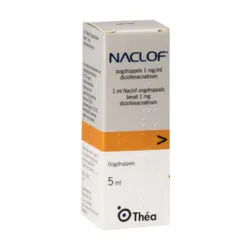
Table of Contents
Package leaflet: information for the user
Naclof, 1 mg/ml, eye drops, solution
Diclofenacum natricum
Please read carefully the entire leaflet before using this medicine, as it contains
important information for the patient.
- Keep this leaflet, as you may need to read it again.
- If you have any questions, please consult your doctor or pharmacist.
- This medicine has been prescribed for a specific individual. Do not share it with others. This medicine may harm other people, even if their symptoms are the same.
- If the patient experiences any adverse reactions, including any not listed in this leaflet, they should inform their doctor or pharmacist. See section 4.
Table of contents of the leaflet
- What Naclof is and what it is used for
- Important information before using Naclof
- How to use Naclof
- Possible side effects
- How to store Naclof
- Contents of the pack and other information
1. What Naclof is and what it is used for
Naclof contains diclofenac sodium, a non-steroidal anti-inflammatory drug which also exhibits analgesic properties.
Indications for use
- Postoperative inflammatory conditions following cataract surgery and other ocular surgical procedures.
- Prophylaxis of cystoid macular edema after cataract surgery with intraocular lens implantation.
- Post-traumatic inflammatory conditions in cases of ocular injury without perforation of the eyeball.
- Inhibition of intraoperative miosis during cataract surgery.
- Relief of pain and photophobia symptoms.
2. Important information before using Naclof
When not to use Naclof:
- if the patient is allergic to the active substance or to any of the other ingredients of this medicine (listed in section 6);
- if the patient has asthma, urticaria, or rhinitis after taking acetylsalicylic acid. In patients with hypersensitivity to acetylsalicylic acid, cross-reactivity may occur with phenylacetic acid derivatives and other nonsteroidal anti-inflammatory drugs (cross-sensitivity).
Warnings and precautions
Ophthalmic nonsteroidal anti-inflammatory drugs may mask the onset and/or progression of infections due to their pharmacological action. If an infection occurs or there is a risk of infection, appropriate antibacterial treatment should be initiated concurrently with Naclof.
Although such cases have not been reported so far, there is a possibility that in patients taking medications which prolong bleeding time or in patients with a history of coagulation disorders, administration of diclofenac may exacerbate coagulation abnormalities.
Caution should be exercised when using nonsteroidal anti-inflammatory drugs such as diclofenac together with locally acting corticosteroids (see section Naclof and other medicines).
Naclof is intended for external use only – applied locally into the conjunctival sac. It must not be administered by subconjunctival injection or directly into the anterior chamber of the eye.
Naclof contains benzalkonium chloride
The product contains 0.0014 mg of benzalkonium chloride per drop, equivalent to 0.05 mg/mL.
Contact of the medicine with soft contact lenses should be avoided.
Benzalkonium chloride may be absorbed by soft contact lenses and may alter their color. Contact lenses must be removed before instillation and at least 15 minutes should elapse before reinsertion.
Benzalkonium chloride may also cause eye irritation, particularly in patients with dry eye syndrome or corneal disorders (the transparent layer at the front of the eye). If abnormal sensations, stinging, or pain in the eye occur after using the medicine, medical advice should be sought.
Naclof and other medicines
Concomitant use of locally acting nonsteroidal anti-inflammatory drugs such as diclofenac and locally acting corticosteroids in patients with significant prior corneal infection may increase the risk of complications. Therefore, caution is advised.
Naclof has been safely used in clinical trials in combination with antibiotics and β-adrenergic receptor blocking agents.
Inform your doctor or pharmacist about all medicines the patient is currently taking or has recently taken, as well as any medicines the patient plans to use.
Pregnancy and breastfeeding
If the patient is pregnant or breastfeeding, suspects she may be pregnant, or is planning to have a child, she should consult a doctor or pharmacist before using this medicine.
Naclof should not be used during the first six months of pregnancy unless absolutely necessary and recommended by a physician. If use is required, the lowest effective dose for the shortest possible duration should be administered.
Naclof should not be used during the last three months of pregnancy due to the risk of premature closure of the fetal ductus arteriosus and potential inhibition of uterine contractions.
Oral formulations of diclofenac (e.g. tablets) have been associated with adverse effects in the unborn child. It is unknown whether the same risk applies to Naclof when administered to the eye.
After oral administration of 50 mg of diclofenac (an amount equivalent to 10 packages of eye drops), trace amounts of diclofenac have been detected in breast milk, which are unlikely to cause adverse effects in the infant. However, the use of diclofenac eye drops during breastfeeding is not recommended unless the expected benefits outweigh the potential risks.
Driving and operating machinery
Patients who experience blurred vision after using Naclof should refrain from driving or operating machinery during this period.
3. How to use Naclof
This medicine should always be used according to the instructions given by your doctor. If in doubt, consult your doctor or pharmacist.
The usual dosage is as follows:
Adults
- Ophthalmic surgery and its complications: Preoperatively – 1 drop 5 times within 3 hours before surgery. Postoperatively – 1 drop 3 times on the day of surgery, and in the following days 1 drop 3 to 5 times daily, as long as necessary.
- Management of pain and photophobia symptoms: 1 drop every 4 to 6 hours. If pain is related to a surgical procedure, apply 1 to 2 drops within the hour preceding surgery, 1 to 2 drops within 15 minutes after surgery, and 1 drop every 4 to 6 hours for 3 days after surgery.
Elderly patients
There is no need to adjust the dose in elderly patients.
Use in children and adolescents
Naclof is not recommended for use in children. Clinical data on strabismus surgery in children are limited.
The contents of the container remain sterile as long as the original closure is intact. Do not touch the dropper tip to the eye or surrounding areas, as this may contaminate the solution.
If another eye medication is used, wait at least 5 minutes between applications.
Instructions for use
- Wash your hands before instilling the drops.
- Unscrew the cap and hold the bottle with your index finger and thumb, taking care not to touch the dropper tip.
- Tilt your head backward and direct the dropper tip toward the lower conjunctival sac, without touching it.
- Gently squeeze the bottle to instill 1 drop.
- Gently press with your finger on the inner corner of the closed eyelid.
- Carefully replace the cap.
Pressing on the nasolacrimal duct or closing the eyes for 5 minutes after administration may reduce systemic absorption. This helps minimize the risk of adverse effects and enhances local action.
Use of a higher than recommended dose of Naclof
There have been no reported cases of diclofenac overdose following its use as eye drops.
The risk of overdose, even in the case of accidental oral ingestion, is practically nonexistent, as the entire 5 ml container contains 5 mg of diclofenac, which corresponds to 3% of the recommended daily dose for adults when administered orally.
4. Possible adverse reactions
Like all medicines, this medicine can cause adverse reactions, although not everyone experiences them.
The frequency of the possible adverse reactions listed below is defined as follows:
- very common: (occurs in more than 1 in 10 people);
- common: (occurs in 1 to 10 in 100 people);
- uncommon: (occurs in 1 to 10 in 1,000 people);
- rare: (occurs in 1 to 10 in 10,000 people);
- very rare: (occurs in less than 1 in 10,000 people);
- not known: (frequency cannot be estimated from the available data).
Immune system disorders:
Frequency not known: hypersensitivity.
Eye disorders:
Very common: eye pain.
Common: eye irritation.
Uncommon: eye itching, eye hyperemia, blurred vision, punctate keratitis.
Rare: corneal disorders, corneal ulcerative keratitis, corneal overgrowth, corneal thinning,
corneal epithelial defects, corneal edema, visual disturbances, conjunctival hyperemia, allergic
conjunctivitis, eyelid irritation, eye allergy, eyelid edema.
Frequency not known: eyelid itching.
Respiratory, thoracic and mediastinal disorders:
Rare: exacerbation of asthma symptoms, dyspnea.
Frequency not known: cough and rhinitis.
Skin and subcutaneous tissue disorders:
Frequency not known: urticaria, rash, exanthema, erythema, pruritus.
Reporting of adverse reactions
If any adverse reactions occur, including any adverse reactions not listed in this leaflet, inform your doctor or pharmacist. Adverse reactions can be reported directly to the Department of Monitoring Adverse Drug Reactions of the Office for Registration of Medicinal Products, Medical Devices and Biocidal Products
Al. Jerozolimskie 181C, 02-222 Warsaw
Tel.: +48 22 49 21 301
Fax: +48 22 49 21 309
Website: https://smz.ezdrowie.gov.pl
Adverse reactions can also be reported to the marketing authorization holder.
Reporting adverse reactions helps to provide more information on the safety of the medicine.
5. How to store Naclof
Keep the medicine out of sight and reach of children.
Do not store above 25°C.
After opening the packaging, do not use for longer than 1 month.
Do not use this medicine after the expiry date stated on the carton.
Do not use packages that are damaged or show signs of tampering.
Medicines must not be disposed of via wastewater or household waste. Ask your pharmacist how to dispose of medicines no longer required. This will help protect the environment.
6. Contents of the pack and other information
What Naclof contains
- The active substance is sodium diclofenac. 1 ml of solution contains 1 mg of sodium diclofenac.
- The other ingredients are: disodium edetate, hydroxypropyl-γ-cyclodextrin, hydrochloric acid 1 M, propylene glycol, trometamol, tyloxapol, water for injections, and benzalkonium chloride – 0.05 mg/ml.
What Naclof looks like and contents of the pack
Naclof is available as a solution in a 5 ml polyethylene bottle with a dropper,
packaged in a cardboard box.
Marketing Authorisation Holder and Manufacturer
Marketing Authorisation Holder
LABORATOIRES THÉA
12, rue Louis Blériot
63017 Clermont-Ferrand Cedex 2
France
Manufacturer
EXCELVISION
27, rue de la Lombardière
ZI la Lombardière
07100 Annonay
France
For further information, please contact the representative of the Marketing Authorisation Holder:
Thea Polska Sp. z o.o.
ul. Cicha 7
00-353 Warsaw
Tel. +48 22 642 87 77