Monoprost
Poland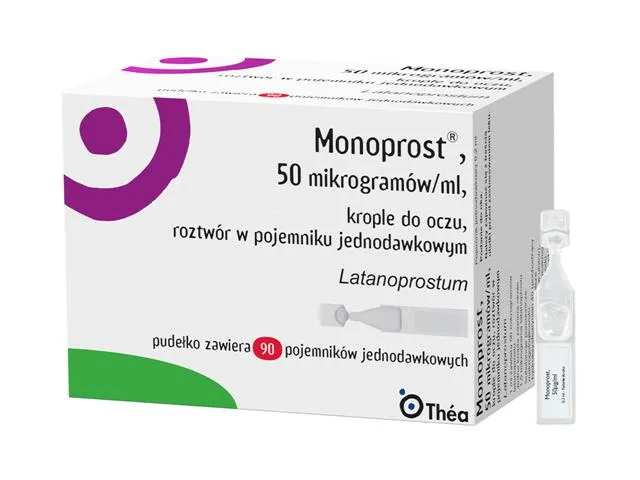
Table of Contents
Package leaflet: Information for the patient
MONOPROST, 50 micrograms/ml, eye drops, solution
Latanoprostum
Please read carefully the entire leaflet before using the medicine, as it contains
important information for the patient.
- Keep this leaflet, so that you can read it again if necessary.
- If you have any doubts, please consult your doctor, pharmacist, or nurse.
- This medicine has been prescribed for a specific individual. Do not pass it on to others. This medicine may harm another person, even if their symptoms are the same.
- If you experience any adverse reactions, including any not listed in this leaflet, inform your doctor, pharmacist, or nurse. See section 4.
Table of contents
- What Monoprost is and what it is used for
- Important information before using Monoprost
- How to use Monoprost
- Possible side effects
- How to store Monoprost
- Contents of the pack and other information
1. WHAT MONOPROST IS AND WHAT IT IS USED FOR
Monoprost belongs to a group of medicines known as prostaglandins. The medicine lowers intraocular pressure by increasing the natural outflow of aqueous humour from the eye into the bloodstream.
Monoprost is used in the treatment of a condition called open-angle glaucoma and a state known as ocular hypertension in adults. Both conditions are associated with elevated intraocular pressure and may affect vision quality.
Monoprost is a preservative-free eye drop solution.
2. IMPORTANT INFORMATION BEFORE USING MONOPROST
When not to use Monoprost
- If the patient is allergic (hypersensitive) to latanoprost or any of the other ingredients of this medicine (listed in section 6).
Warnings and precautions
Before starting to use Monoprost, consult a doctor, pharmacist, or nurse if any of the following apply to the patient:
- If the patient has undergone eye surgery (including cataract surgery) or if such surgery is planned.
- If the patient has eye problems (such as eye pain, eye inflammation, or eye irritation, blurred vision).
- If the patient has severe or uncontrolled asthma.
- If the patient wears contact lenses. Monoprost may still be used, but the instructions for contact lens wearers provided in section 3 must be followed.
- If the patient has had or currently has a viral eye infection caused by the Herpes simplex virus (HSV).
Children
This medicine should not be given to children and adolescents under 18 years of age, as studies on the use of Monoprost in this age group have not been conducted.
Monoprost and other medicines
Monoprost may interact with other medicines. Inform your doctor or pharmacist about all medicines the patient is currently using or has recently used, as well as any medicines the patient plans to use.
Pregnancy, breastfeeding, and fertility
Do not use Monoprost during pregnancy or breastfeeding.
If the patient is pregnant or breastfeeding, suspects she may be pregnant, or is planning to have a baby, she should consult a doctor or pharmacist before using this medicine.
Driving and operating machinery
Blurred vision may occur temporarily after using Monoprost. If such symptoms occur, do not drive or operate machinery until these symptoms have resolved.
Important information about certain ingredients of Monoprost
Monoprost contains macrogol glycerol hydroxystearate 40 (derived from castor oil), which may cause skin reactions.
3. HOW TO USE THE MEDICINAL PRODUCT MONOPROST
Recommended dose
- Monoprost should always be used exactly as directed by the physician. In case of doubt, consult a doctor or pharmacist.
- The usual recommended dose for adults (including elderly patients) is 1 drop into the affected eye(s) once daily. The best time to administer the drop is in the evening.
- Monoprost should not be used more frequently than once daily, as more frequent administration may reduce the effectiveness of treatment.
- Monoprost should always be used exactly as described in the patient information leaflet or as directed by the physician, for as long as the physician has not advised stopping treatment. In case of doubt, consult a doctor, pharmacist, or nurse.
- This medicinal product is an eye drop solution, preservative-free. Do not let the bottle tip (dropper) touch the eye or any surrounding area. This may lead to bacterial contamination, which could result in eye infection causing severe eye damage or even loss of vision. To avoid possible contamination of the dropper bottle, keep the tip of the bottle away from contact with any surface.
Contact lens wearers
If the patient wears contact lenses, they should be removed before using Monoprost. After using Monoprost, wait 15 minutes before reinserting contact lenses.
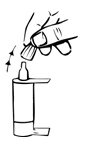
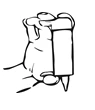
Instructions for use
It is important to follow these instructions when administering the medicine:
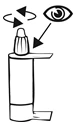 | Before using the medicine for the first time:
|
| |
 |
|
 |
|
If the drop does not fall, gently shake the bottle to remove any residual drop remaining at the tip. In such case, repeat step 3.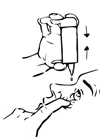 | |
| |
 |
|
Using Monoprost with other eye drops
If other eye drops are being used, they should be administered at least 5 minutes after applying Monoprost.
Using more than the recommended dose of Monoprost
If an excessive amount of eye drops is administered, the patient may experience mild eye irritation with redness and tearing. These symptoms should resolve on their own, but if the patient is concerned, they should contact their doctor for advice.
In case of accidental ingestion of Monoprost, medical advice should be sought immediately.
Missing a dose of Monoprost
The dose should be taken at the usual time. Do not use a double dose to make up for a missed dose. If in doubt, consult a doctor or pharmacist.
Stopping treatment with Monoprost
If you intend to discontinue using Monoprost, consult your doctor first.
If you have any further questions regarding the use of this medicine, consult your doctor, pharmacist, or nurse.
4. POSSIBLE ADVERSE REACTIONS
Like all medicines, this medicine can cause adverse reactions, although not everyone experiences them.
The following adverse reactions are known during treatment with Monoprost:
Very common: may affect more than 1 in 10 patients
- Gradual change in eye colour due to increased concentration of brown pigment in the coloured part of the eye called the iris.
- This effect is more frequently observed in patients with mixed-colour irises (blue-brown, grey-brown, yellow-brown or green-brown) than in patients with uniformly coloured eyes (blue, grey, green or brown).
- The change in eye colour may take years to develop, but is usually noticeable within 8 months of treatment.
- The change in eye colour may be permanent and may be more pronounced when Monoprost is administered to only one eye.
- No associated ocular symptoms have been reported with iris colour change.
- Iris pigmentation changes do not progress after discontinuation of Monoprost.
- Redness of the eye.
- Eye irritation (burning sensation, grittiness, itching, stinging or foreign body sensation in the eye).
- Gradual change in the appearance of eyelashes and vellus hair of the treated eye (especially in patients of Japanese origin). These changes include increased pigmentation (darkening), elongation, thickening and increased number of eyelashes.
Common: may affect up to 1 in 10 patients
- Eye irritation and ocular surface disorders, blepharitis, eye pain, light sensitivity (photophobia), conjunctivitis.
Uncommon: may affect up to 1 in 100 patients
- Eyelid swelling, dry eyes, inflammation or irritation of the ocular surface (cornea), blurred vision, inflammation of the coloured part of the eye (uveitis), retinal swelling (macular oedema).
- Skin rash.
- Chest pain (angina), palpitations (awareness of heartbeat).
- Asthma, shallow breathing (dyspnoea).
- Chest pain.
- Headache, dizziness.
- Muscle pain, joint pain.
- Nausea, vomiting.
Rare: may affect up to 1 in 1,000 patients
- Iritis, swelling symptoms or scratching sensation/damage to the ocular surface, periorbital oedema (swelling around the eyes), changes in the direction of eyelash growth or development of a double row of eyelashes, fluid accumulation within the coloured part of the eye (iris cyst).
- Skin reactions on the eyelids, darkening of the eyelid skin.
- Worsening of asthma.
- Severe skin itching.
- Development of viral eye infection caused by Herpes simplex virus (HSV).
Very rare: may affect up to 1 in 10,000 patients
- Worsening of angina pectoris in patients with a history of this condition.
- Appearance of sunken eyes (deepening of the eyelid sulcus).
Reporting of adverse reactions
If any adverse reactions occur, including any not listed in this leaflet, inform your doctor, pharmacist or nurse. Adverse reactions can be reported directly to the Department of Monitoring Adverse Drug Reactions at the Office for Registration of Medicinal Products, Medical Devices and Biocidal Products – Al. Jerozolimskie 181 C, 02-222 Warsaw
Tel.: +48 22 49 21 301
Fax: +48 22 49 21 309
Website: https://smz.ezdrowie.gov.pl
Adverse reactions can also be reported to the marketing authorisation holder.
Reporting adverse reactions helps provide more information on the safety of this medicine.
5. HOW TO STORE MONOPROST
Keep this medicine out of sight and reach of children.
Do not use this medicine after the expiry date stated on the carton and bottle. The expiry date refers to the last day of the specified month.
Before first opening the bottle: do not store above 25°C.
After first opening the bottle: Monoprost may be used for up to 1 month in the 2.5 ml bottle and up to 3 months in the 6 ml bottle, with no special storage requirements.
The date of first opening should be recorded on the carton.
Medicines must not be disposed of via wastewater or household waste. Ask your pharmacist how to dispose of medicines no longer required. Such measures help protect the environment.
6. CONTENTS OF THE PACKAGE AND OTHER INFORMATION
What Monoprost contains
The active substance is latanoprost.
1 ml of eye drops contains 50 micrograms of latanoprost.
The other components are: macrogol stearic acid alcohol ethoxylate 40, sorbitol, carbomer 974P, macrogol 4000, disodium edetate, sodium hydroxide (for pH adjustment), water for injections.
What Monoprost looks like and contents of the pack
Monoprost is a slightly yellow, opalescent solution, free from preservatives.
Monoprost is available in the following pack sizes:
- 2.5 ml bottle (containing at least 70 preservative-free drops), sufficient for 1 month of treatment, with a pump and HDPE cap with tamper-evident seal, placed in a dosing aid system (Easygrip), in a cardboard box.
- 6 ml bottle (containing at least 190 preservative-free drops), sufficient for 3 months of treatment, with a pump and HDPE cap with tamper-evident seal, placed in a dosing aid system (Easygrip), in a cardboard box.
Not all pack sizes may be marketed.
Marketing Authorisation Holder and Manufacturer
Marketing Authorisation Holder:
Laboratoires THEA
12, rue Louis Blériot
63017 Clermont-Ferrand Cedex 2
France
Manufacturer:
DELPHARM TOURS
Rue Paul Langevin
37170 Chambray Les Tours
France
Laboratoires THEA
12, rue Louis Blériot
63017 Clermont-Ferrand Cedex 2
France
For further information, contact the representative of the Marketing Authorisation Holder:
Thea Polska Sp. z o.o.
ul. Cicha 7
00-353 Warsaw
Poland
Tel. +48 22 642 87 77
This medicinal product is authorised in the member countries of the European Economic Area under the following trade names:
Belgium, Bulgaria, Cyprus, Denmark, Estonia, Finland, France, Greece, Spain, the Netherlands, Iceland, Luxembourg, Germany, Norway, Poland, Portugal, Sweden, Italy ................................ Monoprost
Austria, Czech Republic, Romania, Slovakia, Slovenia ....................................................................... Monopost
Detailed information on this medicinal product is available on the website of the Office for Registration of Medicinal Products, Medical Devices and Biocidal Products.