Milgamma n
Poland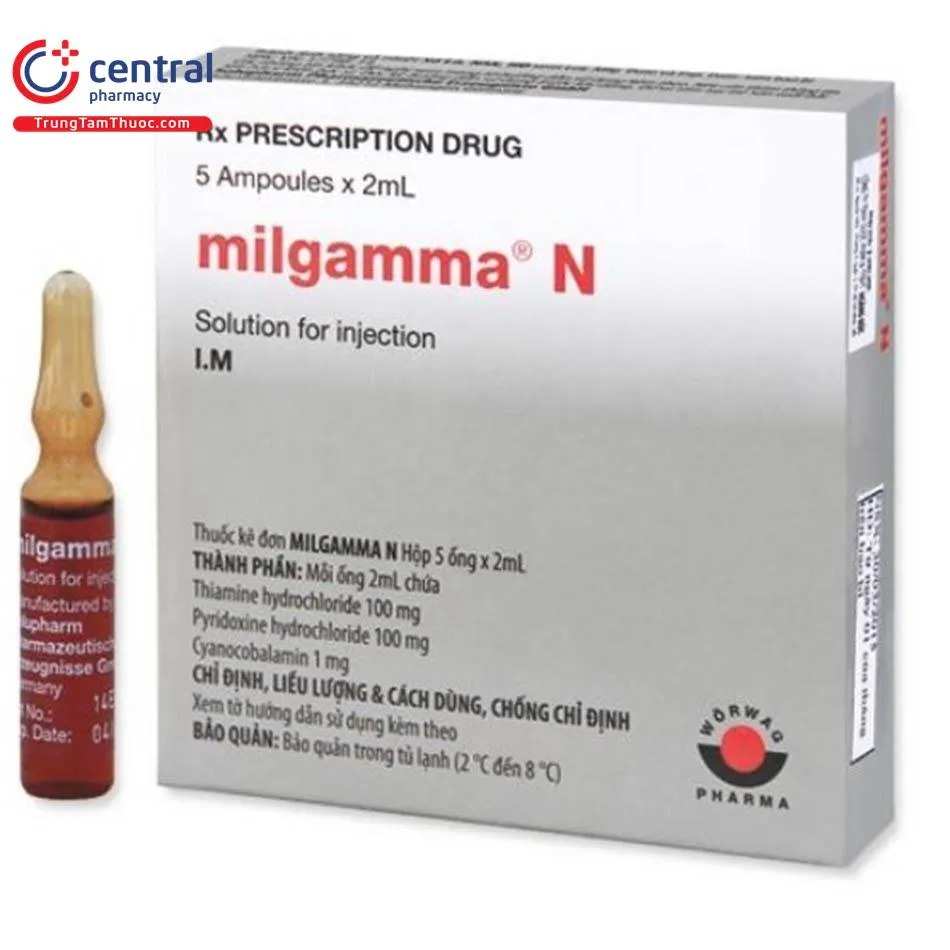
Table of Contents
Package leaflet: Information for the patient
Warning! Keep this leaflet! Information on the immediate packaging in a foreign language.
Milgamma N (Milgamma N Injekt)
(50 mg + 50 mg + 0.5 mg)/ml, solution for injection
Thiamini hydrochloridum + Pyridoxini hydrochloridum + Cyanocobalaminum
Milgamma N and Milgamma N Injekt are different brand names of the same medicinal product.
Please read this leaflet carefully before using the medicine, as it contains
important information for the patient.
- Keep this leaflet so that you can read it again if necessary.
- If you have any questions, please consult your doctor or pharmacist.
- This medicine has been prescribed for a specific individual. Do not share it with others. The medicine may harm another person, even if their symptoms are similar.
- If you experience any adverse reactions, including those not listed in this leaflet, inform your doctor, pharmacist, or nurse. See section 4.
Table of contents of the leaflet:
- What Milgamma N is and what it is used for
- Important information before using Milgamma N
- How to use Milgamma N
- Possible side effects
- How to store Milgamma N
- Contents of the pack and other information
1. What Milgamma N is and what it is used for
Milgamma N is a combination of B-group vitamins.
Milgamma N is used in adults in the following conditions:
- neurological disorders of various origins;
- nerve inflammation;
- neuralgia;
- polyneuropathies (e.g. diabetic, alcoholic, etc.);
- muscle pain (myalgia);
- radicular syndrome;
- cervical tension syndrome;
- shoulder pain;
- certain forms of optic neuritis (retrobulbar optic neuritis);
- herpes zoster;
- facial nerve paralysis;
- and as a tonic agent.
2. Important information before using Milgamma N
When not to use Milgamma N:
- if the patient is allergic to thiamine hydrochloride (vitamin B₁), pyridoxine hydrochloride (vitamin B₆), cyanocobalamin (vitamin B₁₂), or any of the other ingredients of this medicine (listed in section 6),
- if there are conduction disturbances and uncontrolled heart failure,
- during pregnancy and breastfeeding,
- in children and adolescents under 18 years of age.
Warnings and precautions
Before starting treatment with Milgamma N, discuss it with your doctor, pharmacist, or
nurse.
Milgamma N is intended exclusively for intramuscular injection (i.m.), not for
intravenous injection (i.v.). Any accidental intravenous injection must be monitored
by a physician or under hospital conditions, depending on the severity of symptoms resulting from it.
This medicine may cause neuropathies if used for longer than six months.
No special precautions are required for elderly patients.
Milgamma N and other medicines
Tell your doctor or pharmacist about all medicines you are currently taking, have recently taken, or plan to take.
This is particularly important for the following medicines:
- Solutions containing sulfites (vitamin B₁ degrades in solutions containing sulfites; other vitamins may be inactivated in the presence of vitamin B₁ degradation products),
- 5-fluorouracil – used in cancer treatment,
- INH (isoniazid) – used in the treatment of tuberculosis,
- D-penicillamine – used in the treatment of rheumatoid arthritis,
- Long-term use of oral contraceptives containing estrogens,
- Epinephrine – used in the treatment of severe allergic reactions (anaphylaxis),
- Norepinephrine – used in the treatment of depression and low blood pressure,
- Sulfonamides – antibiotics also used in the treatment of inflammatory bowel diseases,
- L-dopa – used in the treatment of Parkinson's disease.
Pregnancy and breastfeeding
If the patient is pregnant or breastfeeding, suspects she may be pregnant, or is planning to have a child, she should consult a doctor or pharmacist before using this medicine.
Pregnancy
During pregnancy, the recommended daily intake of vitamin B₁ ranges from 1.2 mg (second trimester) to 1.3 mg (third trimester). The recommended daily intake of vitamin B₆ during pregnancy is 1.9 mg, and vitamin B₁₂ – 2.6 μg. The safety of daily doses higher than recommended has not yet been sufficiently studied. Milgamma N should not be used during pregnancy.
Breastfeeding
During breastfeeding, the recommended daily intake is 1.3 mg of vitamin B₁, 1.9 mg of vitamin B₆, and 2.6 μg of vitamin B₁₂.
The safety of daily doses exceeding the recommended amounts has not yet been sufficiently studied.
Vitamins B₁, B₆, and B₁₂ pass into breast milk. High doses of vitamin B₆ may inhibit milk secretion.
Milgamma N should not be used during breastfeeding.
Driving and operating machinery
There are no special restrictions.
Milgamma N contains benzyl alcohol, sodium, and potassium
Benzyl alcohol
Milgamma N contains 40 mg of benzyl alcohol per 2 ml ampoule. Large volumes of benzyl alcohol should be administered with caution and only if necessary, especially in patients with impaired renal or hepatic function due to the risk of toxic accumulation (metabolic acidosis).
Sodium
Milgamma N contains less than 1 mmol (23 mg) of sodium per 2 ml ampoule, meaning the medicine is considered "sodium-free".
Potassium
Milgamma N contains less than 1 mmol (39 mg) of potassium per 2 ml ampoule, meaning the medicine is considered "potassium-free".
3. How to use Milgamma N
This medicine should always be used as directed by a doctor or pharmacist. If in doubt,
consult a doctor or pharmacist.
This medicine should be administered by intramuscular injection. Any accidental
intravenous injection must be monitored by a doctor or under hospital conditions, depending on the severity
of symptoms arising from it.
The doctor will determine the appropriate dose and frequency of administration for the patient.
Recommended dose:
For severe and acute pain conditions and to rapidly achieve high blood concentration:
initial dose is 1 injection (2 ml) per day. After the acute phase has subsided and in cases of mild
symptoms: 1 injection 2–3 times per week.
Dose adjustment is not necessary for elderly patients or patients with renal impairment.
There are insufficient studies on the use of Milgamma N in children and adolescents under
18 years of age. Therefore, Milgamma N should not be used in children and adolescents under
18 years of age. Safety and efficacy have not been established in patients with hepatic impairment.
Therefore, Milgamma N should not be used in patients with severe hepatic impairment.
Weekly monitoring of treatment by a doctor is recommended.
The treatment should be switched to oral administration as soon as possible.
Use of a higher than recommended dose of Milgamma N
This medicine is administered under medical supervision. It is unlikely that the dose would be too high
or too low; however, if the patient suspects this has occurred, they should inform their doctor or
nurse immediately.
4. Possible adverse reactions
Like all medicines, Milgamma N can cause adverse reactions, although not everyone experiences them.
The adverse reactions are listed below according to their frequency of occurrence:
Very common: may affect more than 1 in 10 people
Common: may affect up to 1 in 10 people
Uncommon: may affect up to 1 in 100 people
Rare: may affect up to 1 in 1,000 people
Very rare: may affect up to 1 in 10,000 people
Frequency not known: frequency cannot be estimated from the available data
Immediately inform your doctor if any of the following occur:
Rare:
- Allergic reactions (e.g. skin rash, shortness of breath, shock, swelling of the eyes, face, tongue, or throat)
If any of the following adverse reactions occur, consult your doctor as soon as possible:
Very rare:
- Palpitations (tachycardia);
- Excessive sweating, acne, skin reactions with itching and urticaria (hives);
Frequency not known:
- Dizziness, drowsiness;
- Slowing of the heart rate (bradycardia), heart rhythm disturbances;
- Vomiting;
- Seizures;
- Systemic reactions (reactions affecting the whole body) may occur after rapid injection (e.g. accidental intravenous administration, injection into tissues with high blood flow) or overdose.
Reporting of adverse reactions
If any adverse symptoms occur, including any not listed in this leaflet, inform your doctor, pharmacist, or nurse. Adverse reactions can also be reported directly to the Department of Monitoring Adverse Drug Reactions, Office for Registration of Medicinal Products, Medical Devices and Biocidal Products, Al. Jerozolimskie 181C, 02-222 Warsaw, Tel: +48 22 49 21 301, Fax: +48 22 49 21 309, Website: https://smz.ezdrowie.gov.pl.
Reporting adverse reactions helps provide more information on the safety of this medicine.
5. How to store Milgamma N
Keep this medicine out of sight and reach of children.
Store in a refrigerator (2°C–8°C) in the original packaging. Protect from light.
Do not use this medicine after the expiry date stated on the packaging. The expiry date refers to the last day of the stated month.
Medicines must not be disposed of via wastewater or household waste. Ask your pharmacist how to dispose of medicines no longer required. This will help protect the environment.
6. Contents of the package and other information
What Milgamma N contains
2 ml of solution for injection contain:
Active substances:
Thiamine hydrochloride (vitamin B ) 100 mg
Pyridoxine hydrochloride (vitamin B ) 100 mg
Cyanocobalamin (vitamin B ) 1 mg
Excipients:
Benzyl alcohol 40 mg, lidocaine hydrochloride 20 mg, sodium hydroxide, potassium
hexacyanoferrate(III), sodium polyphosphate, water for injections.
What Milgamma N looks like and contents of the pack:
Pack contains: 5 ampoules with 2 ml of solution for injection.
For further information, please contact the responsible party or the parallel importer.
Responsible party in Latvia, country of export:
Wörwag Pharma GmbH & Co.KG
Flugfeld-Allee 24
71034 Böblingen
Germany
Manufacturer:
Solupharm Pharmazeutische Erzeugnisse GmbH
Industriestrasse 3
D-34212 Melsungen
Germany
Parallel importer:
InPharm Sp. z o.o.
ul. Strumykowa 28/11
03-138 Warsaw
Repackaged in:
InPharm Sp. z o.o. Services sp. k.
ul. Chełmżyńska 249
04-458 Warsaw
Marketing authorization number in Latvia, country of export: 99-0934
Parallel import authorization number: 350/16